


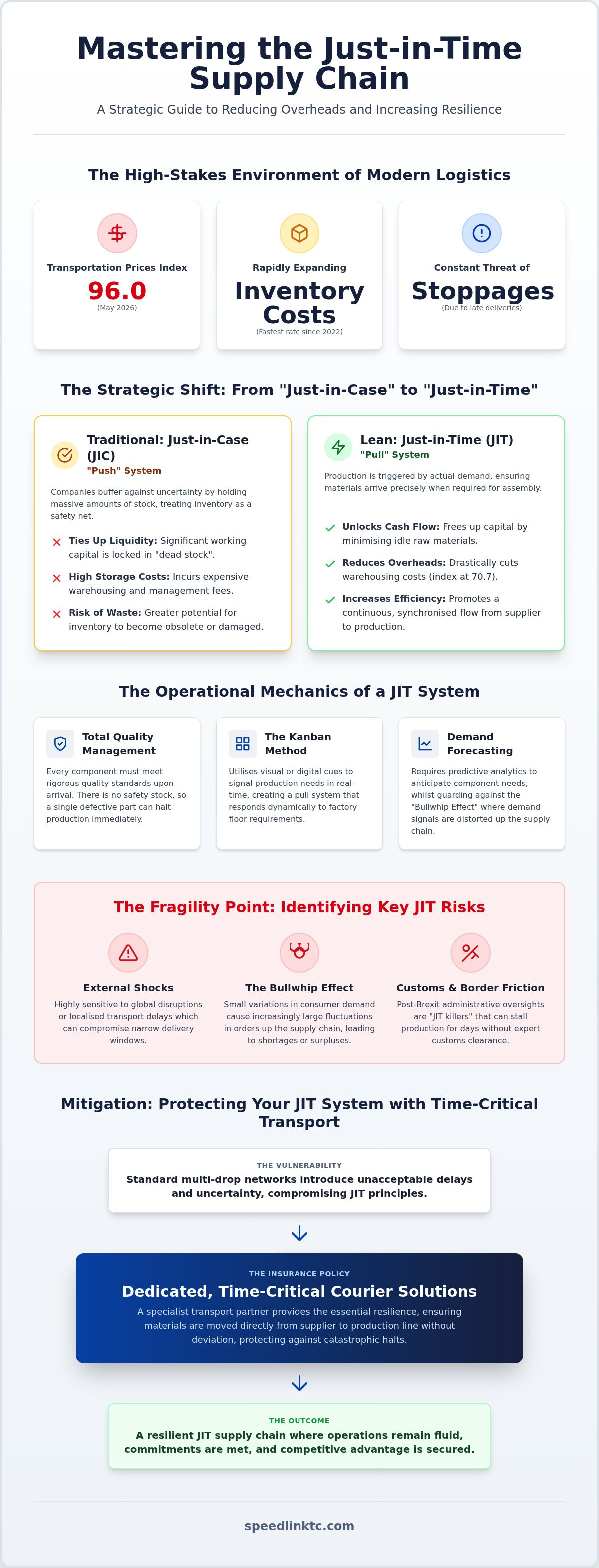
With the Transportation Prices index reaching an unprecedented 96.0 in May 2026, the financial margin for error in your logistics strategy has effectively vanished. You’re likely grappling with inventory costs that are expanding at their fastest rate since 2022, whilst the constant threat of a production line stoppage due to a late delivery looms over every operational decision. It’s a high-stakes environment where traditional, bloated warehousing is no longer a viable safety net for your capital.
We understand that a successful jit supply chain requires more than just lean principles; it demands absolute operational authority and precision. This strategic guide will show you how to master these complexities to reduce overheads and increase cash flow through seamless synchronisation between supply and production. We’ll examine the shift toward predictive logistics and explain how dedicated transport serves as the essential insurance policy that prevents catastrophic halts in your manufacturing process, ensuring your operations remain fluid and your commitments are met without compromise.
Key Takeaways
- Understand how transitioning from “Just-in-Case” models to demand-driven systems unlocks working capital by minimising inventory waste.
- Master the Kanban method and Total Quality Management principles to maintain a continuous, synchronised flow between suppliers and the production line.
- Discover why a resilient jit supply chain requires dedicated, time-critical courier solutions instead of standard multi-drop networks to protect against delays.
- Learn how to manage high-stakes international logistics with precision, ensuring customs clearance and specialist handling don’t compromise your operational schedule.
What is a JIT Supply Chain? Beyond the Inventory Theory
A jit supply chain isn’t merely an inventory tactic; it’s a fundamental shift in how businesses manage capital and operational flow. In a traditional “Just-in-Case” model, companies buffer against uncertainty by holding massive amounts of stock. This approach ties up liquidity and incurs high storage fees that erode profitability. By contrast, JIT operates as a “pull” system. Production is triggered by actual demand, ensuring components and raw materials arrive precisely when they’re required for the assembly process.
This methodology serves as the backbone of modern lean manufacturing and high-tech assembly. It requires a level of precision that many standard logistics providers simply cannot match. The success of the model relies on the absolute synchronisation amongst suppliers, manufacturers, and specialised couriers. Without this harmony, the leanest system becomes a liability.
The Origins of JIT: From Toyota to Global Standard
The concept of Just-in-Time (JIT) manufacturing was pioneered by Toyota as part of their broader Production System. They moved away from the rigid constraints of mass production to create a model that prioritised flexibility and responsiveness. This shift allowed them to reduce waste and react to market changes with speed. Today, we see this approach applied across diverse sectors, from industrial engineering to pharmaceutical production, where the speed of supply cycles is a competitive advantage.
Key Benefits: Why B2B Leaders Prioritise Lean Logistics
Adopting a jit supply chain offers two primary financial advantages that resonate with corporate decision-makers. Firstly, it drastically reduces warehousing overheads. With the Warehousing Prices index remaining at an elevated 70.7 as of May 2026, the cost of storing “dead stock” has become a significant liability. Secondly, it significantly improves cash flow. When you minimise the volume of raw materials sitting idle on shelves, you free up capital for reinvestment. We understand that in a high-stakes environment, these efficiencies are only possible when your logistics partner operates with the same methodical control as your production line.
The Operational Mechanics and Risks of a JIT System
Executing a successful jit supply chain requires more than just timely deliveries; it demands a foundation of Total Quality Management (TQM) and an unwavering commitment to continuous flow. In this environment, every component must meet rigorous quality standards upon arrival. Because there is no safety stock to fall back on, a single defective part can trigger an immediate production halt. This interdependency makes the system incredibly efficient but leaves no room for administrative or mechanical error.
The “Kanban” method serves as the primary mechanism for signalling these production needs in real-time. By utilising visual or digital cues to trigger the replenishment of parts, manufacturers ensure that materials move only when demand is confirmed. This prevents the overproduction and inventory bloat mentioned in the previous section, creating a pull system that responds dynamically to the factory floor’s requirements.
However, every lean system has a “Fragility Point” where the pursuit of efficiency can lead to a lack of resilience. Recent research on JIT resilience suggests that whilst these systems excel in stable conditions, they are highly sensitive to external shocks. Global disruptions or even localised transport delays can quickly compromise narrow delivery windows, turning a lean operation into a dormant one.
The Necessity of Demand Forecasting Accuracy
Precision in a jit supply chain is heavily dependent on accurate demand forecasting. Modern leaders use predictive analytics to anticipate component needs, yet they must remain wary of the “Bullwhip Effect.” This occurs when slight variations in consumer demand cause increasingly large fluctuations in orders further up the chain. Without methodical control, these swings can lead to either critical shortages or sudden, costly surpluses that the JIT model is designed to avoid.
Common JIT Bottlenecks: Customs and Border Friction
For organisations operating across the UK and Europe, border friction has become a significant operational hurdle. Post-Brexit regulations mean that administrative oversights are no longer minor inconveniences; they are “JIT killers” that can stall a production line for days. Maintaining a seamless flow now requires sophisticated EU shipping with customs clearance to navigate complex documentation and regulatory checks. If you are looking to audit your current border processes for potential vulnerabilities, you can consult our logistics specialists for a tailored assessment of your requirements.
Mitigating JIT Risks with Time-Critical Transport Solutions
Whilst inventory theory looks excellent on a spreadsheet, the reality of a jit supply chain is governed by the physical constraints of transport. Standard multi-drop networks, which prioritise volume over velocity, are fundamentally incompatible with the precision required for modern assembly. If your components are co-loaded with non-critical freight, you’re essentially gambling your production schedule on someone else’s logistics. Transitioning to dedicated courier solutions removes these variables, ensuring your cargo is the sole priority of the vehicle and driver.
Managing “Line Stops” is where the intellectual weight of a strategic advisor becomes visible. When a production line halts, the financial repercussions accumulate by the minute. We view our role in your jit supply chain not just as a transport provider but as an essential insurance policy against these halts. Real-time tracking provides the visibility necessary to monitor every milestone, whilst our methodical control ensures that potential bottlenecks are bypassed before they impact your facility.
The Strategic Advantage of Same Day Couriers
In high-pressure sectors, same day courier services act as a critical emergency valve. When a supply gap is identified, the ability to mobilise a dedicated vehicle within minutes is the difference between continued operation and a costly shutdown. This level of responsiveness eliminates the risk of co-loaded delays and ensures that time-critical components reach the production line with zero intermediate stops.
Transporting Sensitive JIT Assets
Certain industries require more than just speed. High-tech manufacturing often demands an IT equipment courier service capable of handling sensitive, high-value hardware with extreme care. Similarly, the JIT cycle frequently involves hazardous materials, such as lithium batteries or chemicals, that require ADR-compliant transport. We maintain the certifications and specialist handling protocols needed to move these assets safely whilst adhering to your strict production windows.
If you need to secure your production line against unforeseen delays, contact our specialist team today to discuss a dedicated transport strategy.
Optimising Your JIT Strategy with SpeedLink Transport
Successfully managing a jit supply chain requires moving beyond commodity-based logistics toward a model of strategic partnership. In high-stakes sectors, the difference between a seamless delivery and a catastrophic line stop often rests on the calibre of the courier executing the final mile. We position ourselves as a proactive guide, offering the global reach necessary for international movements alongside the local precision required for time-critical drops. This operational authority ensures that your requirements are handled by seasoned experts who value reliability above all else.
Security is a non-negotiable component of modern JIT operations, particularly when transporting high-value or sensitive assets. We utilise NPPV-cleared and vetted drivers to maintain the integrity of your cargo within high-security environments. This level of scrutiny, combined with our methodical control over the transport process, provides the reassurance that your components are protected from both physical risk and administrative delay.
Bespoke Logistics for Complex Industrial Requirements
Tailoring transport solutions for the industrial and engineering sectors demands a deep understanding of specific operational pressures. Proactive communication is the hallmark of our service; we don’t just react to problems, we anticipate them. By integrating our time-critical logistics into your 2026 supply chain plan, you ensure that your production cycles remain fluid despite the increasing costs and regulatory complexities of the current market.
Securing Your Supply Chain for the Future
As you evaluate your logistics partners for the coming year, consider this final checklist for JIT excellence:
- Does the provider offer dedicated vehicles to eliminate co-loading risks?
- Are they equipped with specialist handling protocols for sensitive or hazardous assets?
- Do they possess the internal expertise to manage complex customs clearance without delay?
- Is there a proven track record of maintaining synchronisation in high-pressure environments?
The SpeedLink Difference represents the precise intersection of uncompromising speed and rigorous security, ensuring your production never falters.
Securing Operational Continuity in an Era of Volatility
Mastering a jit supply chain requires a shift from viewing logistics as a commodity to treating it as a core strategic asset. We’ve explored how demand-driven systems unlock vital capital whilst simultaneously increasing the pressure on your delivery windows. To navigate this fragility, you must move beyond standard freight networks that cannot guarantee the precision your production line demands. The transition to dedicated, time-critical solutions is no longer a luxury; it’s a fundamental requirement for maintaining synchronisation amongst global suppliers.
We provide the methodical control and operational authority needed to protect your manufacturing process from costly halts. With our global same-day delivery network, NPPV-cleared drivers for high-security sites, and specialist ADR and IT transport capabilities, we act as the essential insurance policy for your most sensitive movements. You don’t have to manage these high-stakes complexities alone. Our team is ready to help you implement a logistics strategy that balances lean efficiency with absolute reliability.
Secure your JIT supply chain with SpeedLink’s time-critical courier services and ensure your operations remain resilient against any disruption.
Frequently Asked Questions
What is the biggest risk of a JIT supply chain?
The most significant risk of a jit supply chain is its inherent fragility, as the absence of buffer stock leaves the entire production line vulnerable to external shocks. If a single component is delayed due to transport issues or customs friction, the entire assembly process can experience a “Line Stop.” This lack of a safety net requires a robust contingency plan and a logistics partner capable of providing immediate, dedicated recovery solutions.
How does a same day courier support JIT manufacturing?
A same day courier supports JIT manufacturing by serving as a dedicated recovery mechanism that operates outside the constraints of standard multi-drop networks. When a supply gap is identified, these specialists can mobilise a vehicle within minutes to ensure parts reach the factory floor before production is compromised. This dedicated approach ensures that time-critical assets aren’t co-loaded with non-essential freight, maintaining the precision required for tight manufacturing cycles.
Can JIT work for international shipping post-Brexit?
JIT remains entirely viable for international shipping if organisations prioritise administrative precision and expert customs clearance. Whilst border friction has introduced new variables into the jit supply chain, these are manageable through the use of seasoned logistics partners who understand regulatory documentation. By ensuring that all paperwork is customs-ready before dispatch, businesses can maintain the fluid movement of components between the UK and the EU without unexpected delays.
What is the difference between JIT and Lean manufacturing?
The primary difference is that Just-in-Time is a specific inventory management strategy, whilst Lean manufacturing is a broader philosophy focused on eliminating all forms of waste. JIT focuses specifically on the timing of material arrivals to minimise storage costs and improve flow. Lean encompasses JIT but also addresses inefficiencies in labour, motion, and process design to optimise the entire production environment for maximum value and efficiency.
Is JIT inventory management suitable for small businesses?
JIT inventory management is highly suitable for small businesses looking to unlock capital, though it requires exceptionally strong supplier relationships and reliable transport. For smaller enterprises, the ability to minimise stock levels can significantly improve cash flow by reducing the amount of money tied up in raw materials. However, success depends on having a dependable logistics partner to mitigate the risk of late deliveries, as small firms often don’t have the same financial resilience to absorb a production halt.

Article by
Dave McMillen
I have worked in courier and logistics for over 30 years. My experience spans two continents and several types of services from road freight to airlines and specialist B2B services. SpeedLink has been serving the UK market for over 20 years providing the finest time critical and specialist services supporting businesses and individuals alike.


