


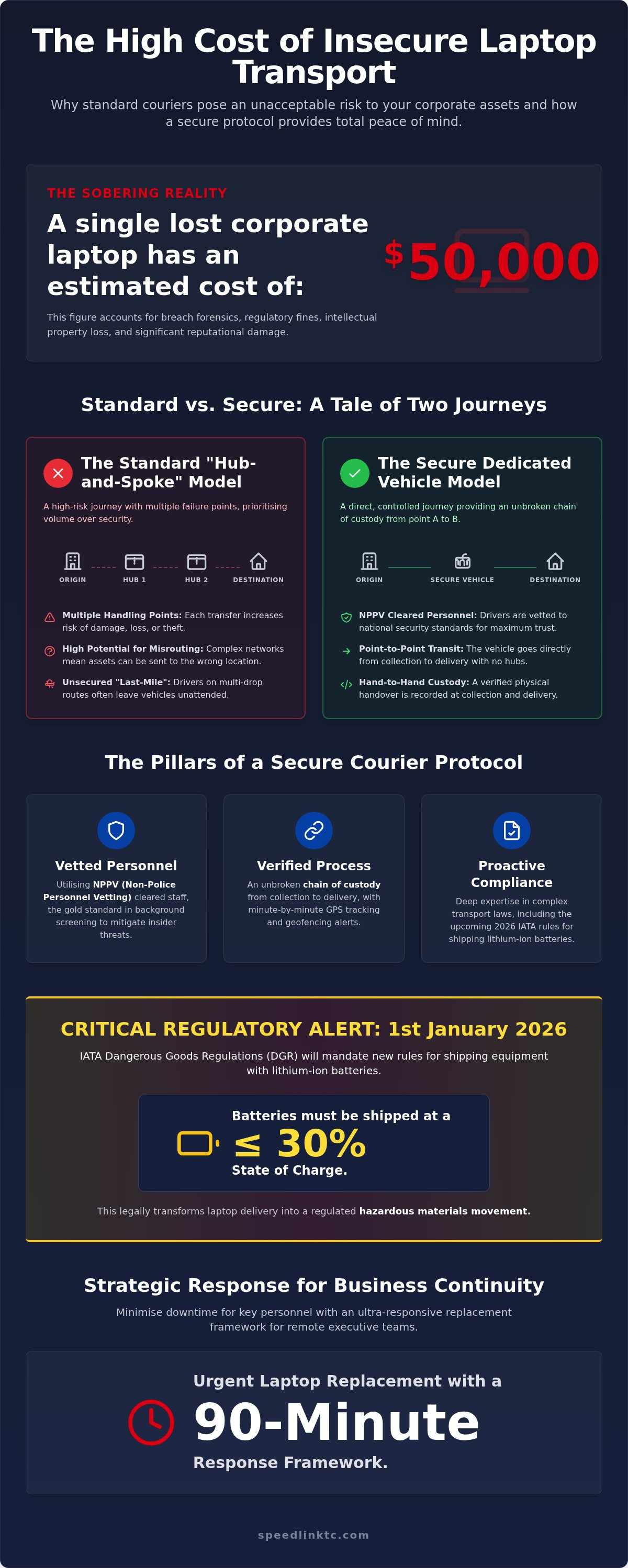
The estimated cost of a single lost employee laptop, including breach forensics and intellectual property fallout, is now approximately $50,000. It’s a sobering figure that makes the standard “man with a van” delivery model an unacceptable risk for your corporate assets. You likely recognise that handing over high-value hardware to unvetted drivers is a gamble your security policy cannot afford. Finding a reliable secure laptop courier involves more than just booking a transport provider; it requires a partner who understands the weight of your data and the nuances of international law.
We’ll show you how to mitigate the risks of hardware loss and data breaches whilst addressing the complex ADR requirements of modern tech logistics. This protocol details the necessity of NPPV cleared personnel and the impact of the 2026 IATA regulation requiring lithium-ion batteries to be shipped at a 30% state of charge. We will explore how a dedicated vehicle model and a verified chain of custody provide the methodical control your high-stakes shipments demand.
Key Takeaways
- Identify why the standard hub-and-spoke delivery model represents a critical failure point for high-value IT assets and sensitive corporate data.
- Recognise the operational security advantages of utilising NPPV cleared personnel and dedicated vehicles to maintain a strictly controlled chain of custody.
- Navigate the complex 2026 ADR regulations for lithium batteries by implementing a professional secure laptop courier protocol for all hardware deployments.
- Establish a strategic 90-minute response framework for urgent laptop replacements to ensure business continuity for remote-based executive teams.
The Evolution of Secure Laptop Transport: Navigating 2026 Risks
In 2026, the role of a secure laptop courier has shifted from simple logistics to a rigorous risk mitigation protocol. When the data residing on a hard drive is worth significantly more than the chassis it’s housed in, your transport method must reflect that disparity. Standard freight focuses on volume and speed, often neglecting the granular security required for corporate assets. We view physical security as the first line of defence in data protection. Any breach in the chain of custody protocol can lead to catastrophic intellectual property loss, making the choice of carrier a strategic procurement decision.
Why Standard Parcel Networks Fail Sensitive Tech
General parcel networks rely on a hub-and-spoke model that prioritises throughput over asset integrity. Your equipment passes through multiple distribution centres, each introducing manual handling risks and potential for misrouting. The “last-mile” stage remains the most vulnerable point in the journey. Drivers on multi-drop routes frequently leave vehicles unattended or poorly secured whilst making residential deliveries. For sensitive IT, these touchpoints represent unacceptable security gaps. A dedicated vehicle model eliminates these risks by removing the “hub” entirely, ensuring your hardware stays in one secure environment from collection to delivery.
Defining “Secure” in a Corporate B2B Context
True security in a B2B environment extends beyond a locked van. It encompasses the transport of executive laptops, critical server components, and other high-value IT equipment under strict surveillance. We treat intellectual property as a value multiplier; if a prototype or a laptop containing sensitive data is lost, the hardware replacement cost is the least of your concerns. A secure protocol ensures that the personnel handling these assets are vetted and the transit remains uninterrupted. This means no unauthorised co-loading and no third-party transfers, providing a level of methodical control that general freight cannot replicate.
Vetted Personnel and Vetted Processes: The NPPV Standard
High-stakes logistics require more than just a locked door. It demands a secure laptop courier with personnel vetted to national security standards. For government contracts and sensitive corporate data, NPPV cleared courier services are the baseline requirement. This standard ensures that the individuals handling your hardware have undergone rigorous screening by the police, providing a level of reliability that standard background checks cannot match.
NPPV Clearance: The Gold Standard of Vetting
NPPV (Non-Police Personnel Vetting) is a specialised screening process designed to mitigate the insider threat. It assesses an individual’s background, financial probity, and residency over several years. This level of scrutiny ensures that the person handling your assets is both trustworthy and accountable. You can find deeper insights into these vetting protocols in our detailed look at the NPPV cleared courier service.
We combine this human vetting with a dedicated vehicle protocol. Your equipment never shares a load space with other consignments, and we strictly prohibit unauthorised stops. We implement a hand-to-hand chain of custody where physical handover is recorded at every stage. Digital signatures alone are insufficient for high-stakes gear; they don’t account for the physical integrity of the package during the transfer.
Advanced Tracking and Geofencing Technologies
Our operations team maintains minute-by-minute monitoring of every consignment. We use geofencing to trigger real-time alerts if a vehicle deviates from its planned route. Our personnel are also fully trained in IATA lithium battery regulations, ensuring that every laptop is handled with the methodical care required for dangerous goods. If your organisation requires this level of operational precision, you can speak with our consultants to arrange a secure transport plan.
Regulatory Compliance: Lithium Batteries and Insurance
Modern laptop transport is governed by stringent safety protocols that many businesses overlook until an incident occurs. As of 1 January 2026, the IATA Dangerous Goods Regulations (DGR) require that lithium-ion batteries contained in equipment must be shipped at a state of charge not exceeding 30% of their rated capacity. This regulation transforms a standard IT delivery into a complex hazardous movement. Engaging a secure laptop courier that understands these legalities is essential to avoid hardware seizure or significant corporate liability.
Lithium Battery Compliance in Tech Logistics
Compliance requires more than just a warning label. Because laptops are legally classified as dangerous goods, we provide a specialised ADR courier service equipped to manage these specific risks. This involves using UN-certified packaging and ensuring all documentation matches the 2026 ADR requirements for integrated power cells. For a detailed compliance checklist, you should refer to our dangerous goods courier UK guide, which outlines the necessary steps for legal transit.
Securing Comprehensive Insurance for Six-Figure Assets
Standard carrier liability is often fundamentally mismatched with the value of high-end corporate tech. Most logistics providers operate under RHA or BIFA terms, which limit compensation based on the weight of the item rather than its replacement cost. If you are transporting a consignment of executive laptops, you require Full Value Goods in Transit insurance. We advise clients on how to declare value correctly to ensure full indemnity in the event of an incident. It’s a necessary precaution, especially as the total cost of a single lost laptop can reach $50,000 once forensics and intellectual property fallout are calculated. To ensure your assets are protected by both law and insurance, contact our specialist logistics team to discuss your requirements.
Strategic Deployment: Implementing a Secure Laptop Courier Protocol
Effective tech logistics isn’t merely about transit; it’s a strategic tool for business continuity. When a critical hardware failure occurs, a secure laptop courier acts as an extension of your IT department. We utilise same-day courier services to ensure that replacement devices reach their destination before productivity grinds to a halt. By maintaining a 90-minute collection standard for urgent deployments, we provide the rapid response needed to support remote executives and distributed teams. For large-scale rollouts, our IT equipment courier service guide offers a comprehensive framework for managing complex, multi-site distributions through a single point of contact.
Urgent Deployment: Managing Hardware Failures
In a corporate environment, the Mean Time to Repair (MTTR) is a vital metric for operational success. Dedicated logistics significantly reduce this window by bypassing the delays inherent in standard networks. If an engineer’s laptop fails in the field, we don’t just deliver a box. We provide a secure, direct-to-desk workflow that ensures the user is back online with minimal disruption. This methodical approach transforms a potential crisis into a controlled operational task, allowing your internal teams to focus on configuration rather than transit tracking.
International High-Value Movements and Customs
Navigating cross-border logistics requires specialised knowledge of EU shipping with customs clearance. High-value gear often necessitates the use of ATA Carnets, particularly for temporary exports in sectors like film, media, or exhibitions. We manage these complexities to prevent hardware being held at borders for inspection or duty disputes. Whether you’re moving a single executive device or an entire fleet, our team ensures every movement complies with international law whilst maintaining the integrity of your security protocol.
Securing Your Technology Supply Chain for 2026 and Beyond
Navigating the complexities of high-value tech transport requires more than just speed; it demands a rigorous adherence to security and safety protocols. We’ve explored how transitioning from standard parcel networks to a dedicated secure laptop courier model eliminates the vulnerabilities of the hub-and-spoke system. By prioritising NPPV cleared personnel and maintaining strict ADR compliance for lithium-ion batteries, your organisation can mitigate the risks of both physical theft and regulatory seizure.
Implementing these standards ensures that your intellectual property remains protected whilst your hardware deployments stay on schedule. Our dedicated B2B vehicle fleet and ADR certified experts provide the methodical control necessary for high-stakes logistics. We invite you to secure your critical assets with SpeedLink Transport Limited’s dedicated high-value courier services today. Taking these proactive steps now will safeguard your corporate assets and ensure business continuity across your global operations. We look forward to helping you build a more resilient logistics strategy.
Frequently Asked Questions
What is a secure laptop courier and how does it differ from a standard service?
A secure laptop courier provides a protocol-driven transit model rather than a simple delivery. Unlike standard services that use hub-and-spoke networks with multiple touchpoints, we utilise dedicated vehicles and vetted personnel. This ensures an unbroken chain of custody and eliminates the risk of co-loading with unrelated freight. It’s a strategic solution designed specifically for assets where the data value exceeds the hardware cost.
Do I need a specialised courier if my laptop contains a lithium battery?
Yes, modern laptops are legally classified as dangerous goods due to their integrated lithium-ion batteries. In 2026, regulations require these batteries to be shipped at a 30% state of charge or less. We act as a specialist ADR courier, providing the necessary UN-certified packaging and dangerous goods documentation. Using a standard service for these items risks shipment seizure or legal penalties for non-compliance with transport safety laws.
What is NPPV clearance and why is it important for IT logistics?
NPPV (Non-Police Personnel Vetting) is a high-level security clearance required for individuals handling sensitive government or corporate assets. It involves rigorous background and financial checks conducted by the police. For IT logistics, this vetting provides a vital trust signal, ensuring that the personnel managing your secure laptop courier movement are verified to handle data-sensitive equipment. It effectively mitigates the insider threat within the supply chain.
How much insurance coverage is provided for high-value laptop transport?
We provide bespoke Full Value Goods in Transit insurance rather than the limited weight-based compensation offered by standard carriers. Standard RHA or BIFA terms often fail to cover the true replacement cost of high-end corporate hardware. We work with clients to ensure their specific consignment value is fully declared and indemnified. This approach protects your organisation against the significant financial fallout associated with hardware loss or data breaches.
Can you provide a dedicated vehicle for a single laptop delivery?
We specialise in providing dedicated vehicles for high-stakes B2B movements, regardless of the consignment size. Even a single laptop containing sensitive intellectual property warrants the security of a dedicated transport environment. This model ensures the driver travels directly from collection to delivery without unauthorised stops or co-loading. It’s the most effective way to maintain a verified chain of custody for your most critical IT assets.
What documentation is required for shipping high-value equipment internationally in 2026?
International movements require comprehensive customs documentation, including commercial invoices with correct HS codes, such as 8471.30.0100 for laptops. You’ll also need ADR dangerous goods declarations for the lithium batteries and potentially an ATA Carnet for temporary exports. We manage the complexities of EU shipping with customs clearance to ensure your gear passes through borders without delay. Our team provides the precision required to navigate these evolving global trade requirements.

Article by
Dave McMillen
I have worked in courier and logistics for over 30 years. My experience spans two continents and several types of services from road freight to airlines and specialist B2B services. SpeedLink has been serving the UK market for over 20 years providing the finest time critical and specialist services supporting businesses and individuals alike.
Disclaimer
Information is provided as general logistics guidance and is not legal, customs, aviation, medical or dangerous-goods compliance advice.
Rules vary according to commodity, quantity, classification, packaging, origin, destination, transport mode and carrier.
Regulations and carrier requirements may change.
Where regulated goods are involved, current requirements should be confirmed with the appropriate government authority, regulator, carrier or qualified specialist before shipment.
SpeedLink can confirm the transport options it can provide for a particular shipment.


