


If you believe that simply meeting the mandatory 2026 IATA regulations is enough to protect your supply chain, you are overlooking the most significant risk to your business operations. Compliance is now merely the entry fee; the real challenge lies in mitigating the physical and financial hazards that high-volume hub networks often ignore. We recognise that for many B2B leaders, the fear of regulatory fines or the anxiety of a thermal runaway event is a constant pressure. Finding a reliable lithium battery courier that understands these nuances is no longer a luxury, it’s a strategic necessity for maintaining your competitive edge in an increasingly regulated market.
You’ll discover how to navigate the complex landscape of dangerous goods regulations whilst ensuring your critical shipments reach their destination securely and on time. We provide a clear breakdown of the mandatory 30% state-of-charge requirements and the intricacies of post-Brexit customs clearance. By the end of this guide, you will understand why a dedicated, point-to-point service offers the only viable path to guaranteed same-day delivery, full ADR compliance, and the minimal handling required to prevent physical damage.
Key Takeaways
- Identify the technical distinctions between lithium-ion and lithium-metal classifications to ensure your documentation remains fully compliant with 2026 standards.
- Learn how a specialist lithium battery courier eliminates the risk of thermal runaway by avoiding the mechanical shocks inherent in high-volume, multi-touchpoint networks.
- Implement the mandatory 30% State of Charge (SoC) rule and specific terminal protection techniques required for safe air and ground transit.
- Utilise dedicated same-day transport as a strategic tool to maintain just-in-time manufacturing schedules and eliminate the threat of production line stoppages.
Navigating the Complexities of Lithium Battery Transport Regulations
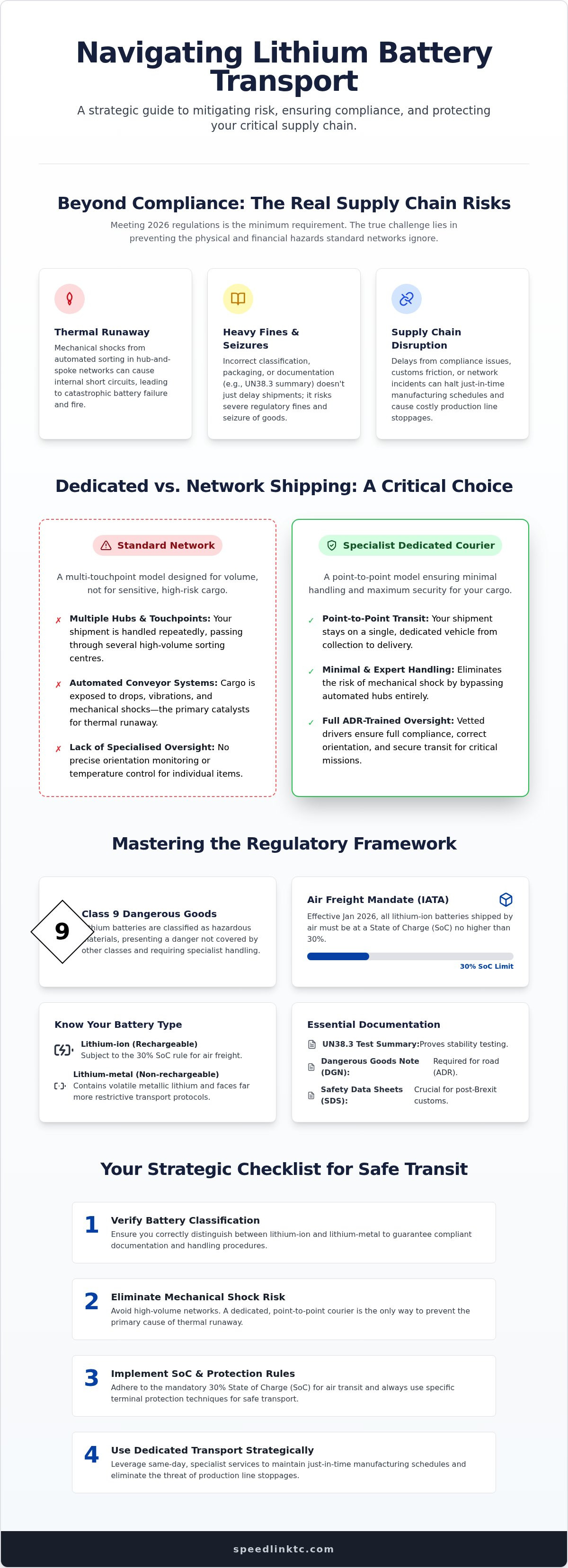
Lithium batteries are officially classified as Class 9 Dangerous Goods, a category encompassing substances and articles which, during transport, present a danger not covered by other hazard classes. This legal definition underpins the global Dangerous Goods Regulations, dictating every aspect of how a lithium battery courier must handle your cargo. Understanding the distinction between lithium-ion (rechargeable) and lithium-metal (non-rechargeable) is vital; the latter contains volatile metallic lithium and is subject to far more restrictive carriage protocols.
Compliance begins long before the vehicle arrives. Shippers must ensure every battery has a UN38.3 test summary, proving the unit has survived rigorous testing for altitude, vibration, and thermal stability. While we manage the logistics, the legal responsibility for correct classification and packaging rests with the shipper. A failure here doesn’t just delay the shipment; it risks heavy regulatory fines and safety incidents.
ADR and IATA: The Dual Framework for 2026
Choosing between air and road transport involves more than just speed. Since January 2026, IATA regulations mandate that all lithium-ion batteries shipped by air must be at a state of charge (SoC) no higher than 30%. If your equipment requires a full charge upon arrival, road transport under ADR provides a safer, more flexible alternative. This ground-based framework requires a detailed Dangerous Goods Note (DGN) but avoids the stringent SoC caps and high surcharges associated with air freight.
Post-Brexit Customs for Hazardous Shipments
Transporting hazardous goods between the UK and the EU has become significantly more complex. You’ll need precise commodity codes and Safety Data Sheets (SDS) to clear border inspections. By utilising specialist customs clearance services, you ensure that your lithium battery courier can navigate the administrative friction of the border, preventing the shipment seizures that frequently disrupt standard courier networks.
Dedicated vs. Network Shipping: Why Specialist Handling is Essential
Standard courier networks operate on a multi-touchpoint model, where parcels are processed through high-volume sorting centres. These environments rely on automated conveyor systems and rapid manual handling, exposing sensitive cargo to mechanical shocks. For lithium batteries, such physical stress is a primary catalyst for internal short circuits and subsequent thermal runaway. We eliminate this vulnerability by utilising a dedicated vehicle approach, ensuring your shipment remains on a single vehicle from collection to delivery. This point-to-point model is the safest way to employ a lithium battery courier for critical B2B missions.
By adhering to IATA Lithium Battery Shipping Regulations, we provide a level of oversight that standard networks can’t match. Dedicated transport allows for precise orientation monitoring and specialised temperature control whilst in transit, which are vital for maintaining the integrity of high-value industrial power units. If you’re looking for a secure solution, you can contact our specialists to discuss your specific requirements.
The High-Value IT Connection
Transporting modern hardware involves more than just moving boxes. Laptops and servers contain high-density integrated batteries that require specific declarations and handling. Our IT equipment courier service addresses these challenges, acting as a specialist lithium battery courier for high-value hardware by providing secure, point-to-point transit that bypasses the risks of automated centres.
Risk Mitigation for Industrial and Medical Sectors
In the life sciences and healthcare sectors, the stakes are exceptionally high. Sensitive medical devices powered by lithium cells can’t risk the vibration or temperature fluctuations of a standard parcel network. We deploy vetted, ADR-trained drivers who understand the technical requirements of these high-pressure missions, offering a methodical alternative to the high-speed, high-risk world of general freight.
Compliance and Packaging: Preparing Your Lithium Battery Shipment
Compliance begins with the state of charge. Since January 2026, IATA mandates that lithium-ion cells and batteries offered for air transport must not exceed a 30% state of charge (SoC). Whilst ground transport doesn’t have a universal cap, maintaining this threshold remains a best-practice safety measure for any lithium battery courier. Physical protection is equally critical; you must insulate terminals using non-conductive materials to prevent short circuits. For high-value B2B assets, “overpacking” into a larger outer container provides an essential secondary layer of mechanical protection.
Correct identification is vital for safe handling. Your shipment must be clearly marked with the appropriate UN number to ensure emergency responders and handlers understand the specific risks:
- UN3480: Lithium-ion batteries (standalone)
- UN3481: Lithium-ion batteries contained in or packed with equipment
- UN3090: Lithium-metal batteries (standalone)
- UN3091: Lithium-metal batteries contained in or packed with equipment
Essential Labelling and Documentation Checklist
Ensure your outer packaging displays the Lithium Battery Mark and, where required, the Class 9 Hazard Label. These marks must be durable and clearly visible to all handlers throughout the journey. Completion of a Shipper’s Declaration for Dangerous Goods is a non-negotiable legal requirement for all fully regulated shipments. Accuracy here prevents the costly delays associated with shipment seizures at international borders. To ensure your paperwork is flawless, get a specialist quote today.
Handling Damaged or Defective Batteries
Standard parcel networks strictly prohibit the transport of damaged, defective, or recalled (DDR) batteries due to the extreme risk of fire. These items require specialised Class 9 ground transit and packaging capable of containing a thermal runaway event. As a specialist courier, we provide the dedicated vehicles and ADR-trained personnel necessary to move these high-risk items safely without exposing other cargo to danger.
Scaling Your Urgent Logistics with a Specialist Partner
Integrating a specialist partner into your supply chain is essential for maintaining the fluidity of just-in-time (JIT) manufacturing. If a production line stalls due to a component shortage, the financial repercussions accumulate by the minute. A dedicated same-day courier provides the operational certainty required to resolve these stoppages, offering a level of reliability that high-volume networks cannot replicate. We act as a tactical extension of your team, ensuring that every lithium battery courier mission is executed with methodical precision.
B2B organisations are increasingly moving away from one-off retail bookings for hazardous materials, prioritising dedicated accounts instead. This shift allows for the implementation of pre-vetted transit protocols and a deeper understanding of your specific cargo’s requirements. By moving away from a transactional model, you gain a strategic advisor capable of managing the nuances of high-stakes logistics whilst maintaining full regulatory transparency.
Bespoke Solutions for Global Enterprises
High-pressure environments such as exhibitions and events often involve the transport of sophisticated battery arrays that power high-tech displays. We manage these complex movements with absolute precision, ensuring that all equipment arrives safely and remains compliant with local safety laws. For government or defence contractors, our NPPV cleared couriers provide the necessary security credentials to handle sensitive battery technology in restricted environments.
Getting Started: Your First Dedicated Shipment
Transitioning to a specialist logistics model begins with a technical assessment of your requirements. We provide rapid, detailed quotes that account for the specific UN classification and packaging needs of your cargo. Our team ensures that your documentation is flawless before the vehicle even departs. If you need to secure a time-critical movement now, contact SpeedLink for a specialist dangerous goods quote. We are ready to handle your most challenging lithium battery courier requirements with the authority your business demands.
Mastering Your High-Stakes Lithium Battery Logistics
As global demand for lithium-ion technology continues to accelerate, the margin for error in hazardous logistics has narrowed significantly. We have explored why meeting the 2026 regulatory thresholds is merely the baseline for operational safety. True risk mitigation requires moving beyond high-volume networks and adopting a dedicated vehicle strategy that eliminates the mechanical shocks of automated sorting hubs. By prioritising ADR-trained specialist drivers and dedicated point-to-point B2B transport, you ensure that your critical assets remain secure and compliant throughout their journey.
Navigating the administrative friction of post-Brexit trade also demands a partner with full customs clearance support for EU transit. Whether you are solving a production line stoppage or managing a sensitive medical deployment, the right lithium battery courier acts as a strategic advisor rather than a simple delivery service. We are ready to help you transform these logistical challenges into a seamless, secure component of your supply chain. Secure your critical lithium battery shipment with SpeedLink’s specialist same-day courier service today. We look forward to facilitating your most urgent transport requirements with the precision they deserve.
Frequently Asked Questions
Can I ship lithium batteries by courier within the UK?
Yes, you can ship lithium batteries within the UK, provided you utilise a specialist lithium battery courier capable of handling Class 9 Dangerous Goods. Standard residential parcel networks often prohibit standalone batteries due to the fire risks associated with automated sorting hubs. We provide dedicated, point-to-point vehicles that ensure your cargo is never co-loaded with incompatible materials, maintaining a high level of safety and operational control throughout the journey.
What is the difference between UN3480 and UN3481 for shipping?
UN3480 is the classification for standalone lithium-ion batteries, whilst UN3481 refers to batteries that are either contained within or packed alongside equipment. This distinction is critical for your documentation and labelling strategy. Whilst UN3481 shipments often benefit from the physical protection provided by the device casing, both categories require precise declarations and must adhere to strict safety protocols to ensure they pass through customs and transport inspections without delay.
Do I need a special licence to send lithium batteries via a courier?
Whilst you don’t require a specific personal licence to book a shipment, you are legally responsible for ensuring the goods are correctly classified, packaged, and labelled. The transport provider must deploy ADR-trained drivers who are qualified to carry hazardous materials. We act as your strategic partner, using our operational expertise to ensure that every aspect of the movement complies with current UK and international dangerous goods legislation, protecting you from regulatory penalties.
How should I pack lithium-ion batteries to ensure they are compliant?
Compliance requires a multi-layered approach starting with non-conductive tape to protect battery terminals from short circuits. You must secure batteries within sturdy, high-quality outer packaging to prevent any internal movement during transit. For air freight, you must also verify that the state of charge does not exceed the mandatory 30% threshold. These methodical steps, combined with clear Class 9 labelling, are essential for maintaining a safe and efficient supply chain.
Why are lithium batteries considered dangerous goods for transport?
Lithium batteries are classified as dangerous goods because they can experience thermal runaway, a self-sustaining fire that is exceptionally difficult to extinguish. This event can be triggered by mechanical shock, internal short circuits, or exposure to high temperatures. By using a specialised lithium battery courier, you mitigate these risks through dedicated handling and point-to-point transit, avoiding the physical stresses and excessive handling that typically occur within high-volume, automated courier networks.

Article by
Dave McMillen
I have worked in courier and logistics for over 30 years. My experience spans two continents and several types of services from road freight to airlines and specialist B2B services. SpeedLink has been serving the UK market for over 20 years providing the finest time critical and specialist services supporting businesses and individuals alike.
Disclaimer
Information is provided as general logistics guidance and is not legal, customs, aviation, medical or dangerous-goods compliance advice.
Rules vary according to commodity, quantity, classification, packaging, origin, destination, transport mode and carrier.
Regulations and carrier requirements may change.
Where regulated goods are involved, current requirements should be confirmed with the appropriate government authority, regulator, carrier or qualified specialist before shipment.
SpeedLink can confirm the transport options it can provide for a particular shipment.


