


With the average cost of a global data breach reaching $4.88 million, can your organisation afford to treat a departing employee’s laptop as just another parcel? Most IT leaders recognise the mounting frustration of chasing unreturned hardware, whilst simultaneously worrying about the sensitive corporate data sitting on unsecured devices. Relying on standard courier networks often leads to lost assets and broken chains of custody. Effective IT Asset Retrieval is far more than a simple shipping task; it’s a critical security operation that requires a methodical, professional approach to mitigate risk.
We understand that your priority is protecting your intellectual property and recovering high-value hardware without increasing the administrative burden on your team. This guide outlines how to implement a secure hardware recovery strategy that ensures a 100% recovery rate through vetted logistics and rigorous tracking. You’ll learn how specialised services, such as NPPV cleared drivers and NIST-aligned handling, provide the operational authority needed to manage your global supply chain. We’ll explore the transition from unreliable shipping to a disciplined, secure retrieval process that safeguards your assets from the moment they leave a remote location.
Key Takeaways
- Understand how a proactive strategy for IT Asset Retrieval eliminates the financial drain of “ghost assets” whilst protecting your organisation from the risks of unmanaged data storage.
- Learn why NPPV cleared logistics represent the gold standard for secure hardware recovery, providing a level of vetted authority that standard courier networks lack.
- Discover the critical steps for organising a secure collection, including employee communication protocols and the importance of using specialised courier packaging for high-value tech.
- See how integrating a dedicated, same-day fleet into your offboarding process can guarantee a 100% recovery rate and significantly reduce your team’s administrative burden.
The Hidden Risks of Unmanaged IT Asset Retrieval
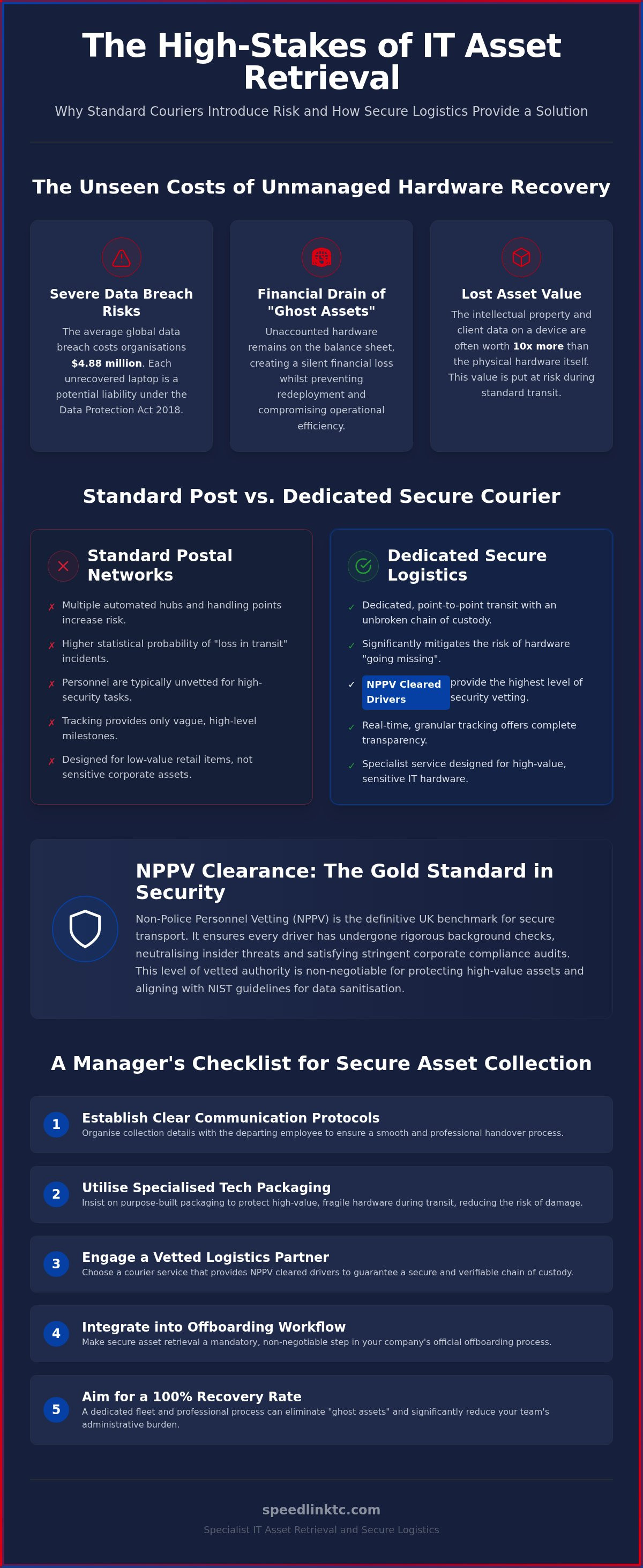
IT asset retrieval is the strategic recovery of corporate hardware from departing or remote staff. When this process remains unmanaged, organisations face the silent drain of “ghost assets”, hardware that remains on the balance sheet but is physically unaccounted for. Beyond the financial loss, the Data Protection Act 2018 elevates secure retrieval from an operational task to a legal mandate. IBM’s 2024 report found the average cost of a global data breach reached $4.88 million, making the “laptop graveyard” in a former employee’s residence a significant liability. If your IT team cannot redeploy hardware because it’s sitting in a cupboard miles away, your operational efficiency and business continuity are compromised.
Data Security vs. Hardware Value
Whilst a high-spec laptop has a clear market price, the intellectual property and sensitive client data it holds are often worth ten times the physical hardware. Secure IT asset retrieval ensures that this value is protected during transit. Standard postal services are designed for low-value retail items, not for transporting encrypted devices that contain your firm’s competitive secrets. Entrusting these assets to unvetted parcel networks introduces unnecessary risk that far outweighs any minor saving in shipping costs. We treat every collection as a security operation, ensuring that the chain of custody remains unbroken from doorstep to data centre.
The Impact on Hybrid Work Models
The shift toward distributed work has fundamentally altered the IT equipment courier service landscape. Maintaining an accurate asset register is impossible if hardware is scattered across various residential postcodes without a central tracking mechanism. We provide the methodical control required to bridge the gap between a remote workforce and a secure central hub, ensuring every device is accounted for and safely returned to your IT team. This proactive approach prevents the accumulation of unrecovered hardware and ensures that your hardware lifecycle remains efficient and secure.
NPPV Cleared Logistics: Why Security Clearance Matters
NPPV (Non-Police Personnel Vetting) stands as the definitive benchmark for security-vetted transport in the United Kingdom. Whilst standard parcel networks rely on high-volume automation and rapid turnover, they frequently lack the forensic oversight required for high-stakes IT Asset Retrieval. Dedicated logistics providers ensure that every driver has undergone rigorous background checks, managed by the National Contractors Vetting Service. This level of scrutiny is essential for handling devices that require access to police premises or sensitive government information, ensuring that your hardware is never left in an unvetted hand.
Standard Post vs. Dedicated Secure Courier
Standard postal services involve numerous handling points and automated sorting hubs, which significantly increases the statistical probability of “loss in transit” incidents. Conversely, a secure courier service provides a dedicated, point-to-point, and verifiable chain of custody. NPPV clearance is a mandatory requirement for high-security IT Asset Retrieval to ensure the individual handling the asset is fully vetted and accountable. This disciplined approach offers a level of tracking granularity that standard retail networks simply cannot match:
- Handling points: Standard post uses multiple hubs; dedicated couriers operate point-to-point.
- Risk mitigation: Vetted logistics significantly reduce the risk of hardware “going missing” during transit.
- Transparency: Real-time, granular updates replace the vague milestones of standard parcel tracking.
The Legal Case for Vetted Personnel
Utilising an NPPV cleared courier service satisfies stringent corporate compliance audits by demonstrating proactive risk management during the hardware lifecycle. It effectively neutralises the “insider threat” during the offboarding process, where hardware is at its most vulnerable. To align with the NIST Guidelines for Media Sanitization, the physical transport of the device must be as secure as the eventual data destruction. By choosing a vetted partner, you ensure that the security of the data is maintained from the point of collection. If you require a logistics partner that understands these high-pressure requirements, speak with our specialist team to discuss a tailored recovery solution.
Organising a Secure Asset Collection: A Manager’s Checklist
Successful IT Asset Retrieval begins long before our driver arrives at the doorstep. It requires a coordinated effort between your IT department, the logistics partner, and the remote employee to ensure the hardware is prepared and accessible. Managers must confirm that the device is decommissioned and that the employee understands the collection window. We provide identity verification and capture digital signatures at the point of collection to eliminate ambiguity. This methodical hand-off ensures that the chain of custody begins the moment the asset leaves the employee’s possession.
Steps for a Seamless Retrieval
Urgency is vital, but so is flexibility for your workforce. Coordinating the pickup time to suit remote staff whilst maintaining momentum prevents assets from sitting in unvetted environments longer than necessary. A comprehensive retrieval should include:
- Preparation: Employee confirms the device is powered down and ready for collection.
- Peripherals: Ensuring all chargers, monitors, and headsets are included to maintain hardware lifecycle value.
- Specialist Packaging: Using professional, anti-static containers rather than DIY boxes to prevent physical damage during transit.
Documentation and Audit Trails
Every IT transport movement must be backed by a robust digital paper trail. Following the NCSC secure sanitisation guidance, the physical movement of the asset is a critical component of your broader security protocol. Real-time tracking and digital certificates of collection provide definitive proof of professional hardware recovery for your compliance audits. This transparent process allows your IT team to focus on deployment whilst we handle the high-stakes logistics of recovery. To secure your hardware with a vetted logistics partner, contact our IT logistics specialists today to arrange your next collection.
Strategic IT Asset Retrieval with SpeedLink
We integrate directly with your HR and IT offboarding workflows to provide same-day retrieval, ensuring that assets are secured the moment an employee leaves the organisation. This rapid response is critical during large-scale redundancies or complex office relocations where dozens of high-value assets must be accounted for simultaneously. Unlike multi-drop parcel networks that prioritise volume and residential routes, our dedicated fleet focuses exclusively on the integrity of your hardware. We position every IT Asset Retrieval operation as a core component of a wider specialist courier service UK strategy, ensuring that high-stakes logistics are managed with methodical precision and operational authority. This integration reduces the administrative burden on your IT team whilst guaranteeing that no device remains unvetted in a remote location.
B2B Specialisation and Reliability
Our B2B focus ensures that your corporate laptops never enter a generic residential sorting office or an unvetted hub. We offer bespoke solutions for urgent hardware failures, including immediate laptop swaps that allow your remote workforce to remain productive without downtime. Our approach to IT Asset Retrieval eliminates the common points of failure where devices are often damaged or misplaced during automated sorting. This disciplined approach provides the intellectual weight of a strategic advisor whilst maintaining the speed of a premium logistics provider. We treat each collection as a unique mission, providing the tailored attention required for sensitive corporate hardware.
Global Capability, Local Precision
Managing retrievals requires a partner with both domestic reach and international same-day courier capabilities to support your global footprint. Whether you are recovering a single device in a UK city or coordinating complex asset movements across European borders, we maintain an identical chain of custody and vetting standard. This global capability, combined with local attention to detail, ensures your assets are handled by seasoned experts who value reliability above all else. Securing your tech assets today is a vital step in maintaining your organisation’s security posture and hardware lifecycle. Contact our team today to bring your hardware recovery under professional, methodical control.
Securing Your Hardware Lifecycle with Confidence
Securing your corporate hardware lifecycle requires moving beyond the limitations of standard parcel networks. By treating IT Asset Retrieval as a disciplined security operation rather than a simple logistics task, you protect your organisation from the significant financial and legal risks of data leakage. We’ve explored how NPPV cleared drivers and specialised handling protocols ensure that every device remains within a verifiable chain of custody from doorstep to deployment. This methodical approach not only satisfies stringent compliance audits but also eliminates the administrative burden on your internal IT team.
If you’re ready to transition to a more secure recovery model, we provide the expert oversight needed to manage high-stakes movements with precision. Our team offers same-day collection and dedicated transport solutions tailored to the unique requirements of sensitive corporate tech. You can request a secure IT asset retrieval quote from SpeedLink to benefit from our NPPV cleared drivers and specialist IT handling. Let’s ensure your hardware is recovered safely and efficiently.
Frequently Asked Questions
What is the difference between IT asset retrieval and IT asset disposition (ITAD)?
IT asset retrieval focuses on the secure physical recovery of hardware from remote or departing employees to return it to your inventory. In contrast, IT asset disposition (ITAD) refers to the end-of-life processes, such as data sanitisation, refurbishment, or recycling of retired equipment. Whilst retrieval is about reacquiring the physical asset, ITAD ensures the device is handled according to environmental and data security standards once it’s no longer needed by the organisation.
Why should I use a dedicated courier instead of a standard parcel service for laptops?
Standard parcel services rely on automated sorting hubs and multiple handling points. This significantly increases the risk of damage or loss. A dedicated courier provides a point-to-point service, meaning your high-value laptops remain on a single vehicle with a vetted driver. This methodical approach ensures a robust chain of custody and eliminates the uncertainty of residential sorting offices. It’s the only way to guarantee the physical security of sensitive corporate hardware.
How does NPPV clearance protect my company’s sensitive data during transit?
NPPV clearance ensures that the personnel handling your hardware have undergone rigorous background checks managed by the National Contractors Vetting Service. This police-level vetting mitigates the “insider threat” by confirming the driver’s identity and history. When you utilise an NPPV cleared courier, you’re ensuring that your sensitive data is never in the hands of unvetted individuals. It provides the operational authority required to meet the highest corporate and legal compliance standards.
Can you retrieve IT equipment from remote employees on the same day they leave?
We provide same-day IT Asset Retrieval to ensure hardware is secured immediately upon an employee’s departure. Rapid recovery is essential to prevent devices from sitting in unvetted residential environments where they are vulnerable to loss or unauthorised access. By integrating our same-day capability into your offboarding workflow, you maintain continuous control over your hardware. This proactive logistics strategy reduces the window of risk and helps your team redeploy assets more efficiently.
What happens if an employee refuses to return their company laptop?
Whilst a logistics provider cannot legally compel an employee to hand over equipment, our professional presence often facilitates a successful collection. We coordinate directly with the individual to arrange a convenient window, which reduces friction during the offboarding process. If an employee remains uncooperative, we provide a clear audit trail of the attempted collection. This documentation is vital for your internal IT and legal teams when taking further recovery actions.

Article by
Dave McMillen
I have worked in courier and logistics for over 30 years. My experience spans two continents and several types of services from road freight to airlines and specialist B2B services. SpeedLink has been serving the UK market for over 20 years providing the finest time critical and specialist services supporting businesses and individuals alike.
Disclaimer
Information is provided as general logistics guidance and is not legal, customs, aviation, medical or dangerous-goods compliance advice.
Rules vary according to commodity, quantity, classification, packaging, origin, destination, transport mode and carrier.
Regulations and carrier requirements may change.
Where regulated goods are involved, current requirements should be confirmed with the appropriate government authority, regulator, carrier or qualified specialist before shipment.
SpeedLink can confirm the transport options it can provide for a particular shipment.


