


Imagine the silence of a grounded production line whilst a single, missing component sits stalled at a border because of a minor customs oversight. It’s a scenario that keeps operations directors awake at night, especially as global logistics becomes increasingly volatile. We understand that in high-stakes environments, speed is irrelevant if it isn’t matched by absolute precision and expert regulatory compliance. This urgent freight shipping guide provides the strategic framework you need to navigate these pressures with confidence, ensuring your business-critical assets move across borders without friction.
You’ll discover how to master time-critical logistics in 2026 by selecting the optimal transport modes and managing the latest EU customs requirements. We will explore the technical nuances of handling sensitive IT equipment and high-value freight, providing you with a roadmap for zero-delay delivery. From maintaining a full chain of custody to navigating the removal of de minimis exemptions, this article details the methodical approach required to keep your supply chain moving. By the end, you’ll have the insights needed to maintain total visibility and control over your most urgent movements.
Key Takeaways
- Identify the critical differences between standard logistics and time-sensitive freight to ensure your high-value cargo receives the specialist handling it requires.
- Utilise this urgent freight shipping guide to evaluate ground and air transport modes, helping you choose the most secure and efficient route for your items.
- Master the essential documentation and customs clearance requirements for 2026 to prevent border bottlenecks and maintain a seamless international supply chain.
- Establish a methodical five-step response plan for logistics emergencies, prioritising real-time visibility and constant communication to guarantee zero-delay delivery.
Understanding Urgent Freight: When Standard Logistics Isn’t Enough
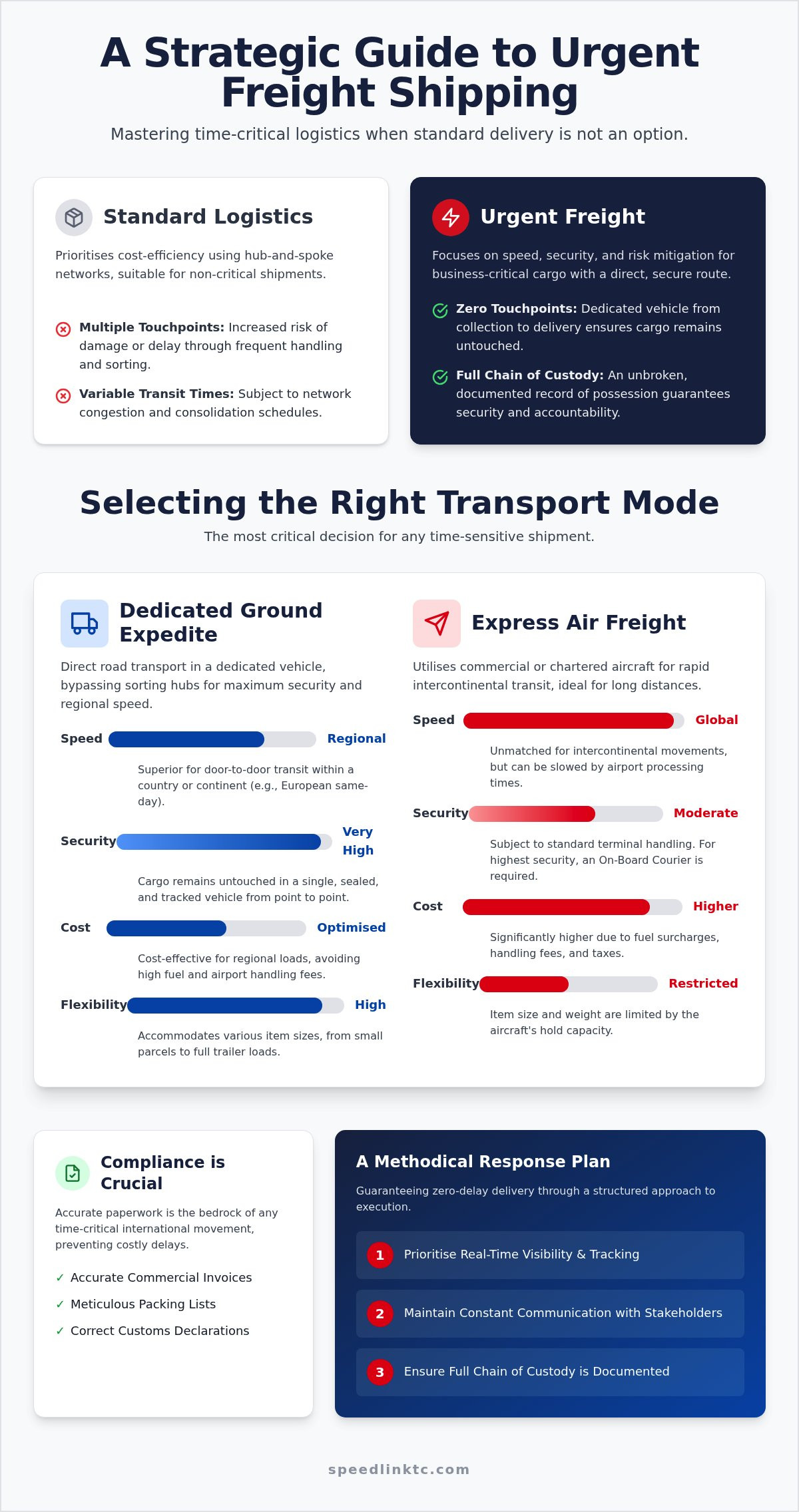
Urgent freight isn’t defined by weight alone. It represents time-sensitive, high-value, or mission-critical cargo that demands non-standard handling to protect your operational continuity. Whilst standard Less-Than-Truckload (LTL) shipping prioritises cost-efficiency via hub-and-spoke networks, it introduces risks through multiple touchpoints. This urgent freight shipping guide clarifies that expedited logistics is about risk mitigation. We bypass traditional sorting centres to provide a direct, secure route from collection to delivery.
Maintaining a robust “chain of custody” is vital for these movements. It’s the documented, unbroken record of possession that ensures accountability throughout the journey. For B2B shipments, this precision is non-negotiable. If a critical component is delayed, the financial impact is often severe. Production line stoppages can incur massive hourly costs, whilst missed exhibition deadlines result in significant reputational damage and lost commercial leads.
The Business-Critical Threshold
A shipment becomes urgent the moment the financial or operational penalty for a delay exceeds the cost of expedited transport. Key sectors such as life sciences, aerospace, and legal services rely on this threshold to manage life-saving medical supplies, AOG (Aircraft on Ground) parts, or time-sensitive legal filings.
Secure vs. Fast: Why You Need Both
Rapid transit must be balanced with absolute security. We provide NPPV cleared courier services for sensitive documents and high-value equipment that require the highest level of vetting. Dedicated vehicles offer a distinct advantage here. Unlike standard networks that involve frequent offloading, a dedicated vehicle ensures your freight remains untouched in a single, tracked van from point to point. This level of control is the only way to guarantee both speed and integrity.
Selecting the Right Mode: Ground Expedite vs. Air Freight
Choosing the correct transport mode is the most critical decision in any urgent freight shipping guide. Whilst distance usually dictates the choice, the specific door-to-door timeline often favours road over air for regional movements due to lengthy airport processing times. We evaluate every shipment based on its unique requirements for speed, security, and volume.
| Factor | Ground Expedite | Air Freight |
|---|---|---|
| Speed | Superior for regional door-to-door | Superior for intercontinental |
| Security | High (Dedicated vehicle) | Moderate (Terminal handling) |
| Cost | Optimised for regional loads | Higher due to fuel and handling |
| Item Size | Flexible up to full trailer | Restricted by aircraft hold |
Our same day courier services eliminate the terminal delays inherent in air cargo by providing direct transit. For ultra-sensitive, high-value small freight, an On-Board Courier provides an unmatched level of security by maintaining physical possession of the cargo throughout the entire flight and final delivery.
The Case for Dedicated Road Transport
A dedicated vehicle avoids the terminal processing and sorting risks found in standard hub-and-spoke networks. This is particularly vital for European same-day services, where direct road transit often beats air freight door-to-door when the driver manages the customs clearance at the border. If you’re unsure which vehicle size fits your cargo, you can speak with our logistics planners for a tailored recommendation.
Global Urgency: International Air Solutions
Intercontinental movements require a choice between express air freight and dedicated air charters. Whilst express air uses commercial capacity to reach global hubs like New York or Paris, charters provide total control over the flight schedule. This is the logical choice for bulk mission-critical cargo where commercial flight times don’t align with your specific deadline.
Navigating Compliance: Customs, Documentation, and Specialist Handling
Speed isn’t useful if your cargo is impounded at a border due to administrative errors. This urgent freight shipping guide emphasises that compliance is the bedrock of any time-critical movement. Accurate documentation, specifically commercial invoices and meticulous packing lists, must be prepared before the vehicle arrives. Our customs clearance services act as a proactive filter, identifying potential bottlenecks before they manifest as physical delays.
Mastering Post-Brexit Customs
Every UK business exporting to or importing from the EU must possess a valid Economic Operators Registration and Identification (EORI) number to facilitate clearance. We often utilise T-forms and other transit documents to move goods through intermediate territories without local duty payments, ensuring the vehicle remains in motion. This strategic use of transit procedures is essential for maintaining the momentum of cross-border urgent deliveries.
Handling Sensitive and Hazardous Cargo
Shipping dangerous goods, particularly lithium batteries, requires strict adherence to ADR regulations for road transport. These legal frameworks dictate specific packaging, labelling, and driver certification levels. Similarly, the movement of fine art or museum-grade assets demands climate-controlled environments and specialised vibration-reduction equipment. For high-value IT equipment, follow this preparation checklist:
- Utilise anti-static shielding for all internal components.
- Implement shock-absorbent outer packaging to mitigate transit vibration.
- Create a comprehensive asset register for insurance and customs verification.
- Ensure the vehicle is NPPV cleared for maximum security.
If your shipment involves complex regulatory requirements, contact our compliance team to ensure your documentation is audit-ready before transit begins.
Strategic Implementation: Executing Flawless Urgent Deliveries
When a logistics emergency arises, response time is the only metric that matters. This urgent freight shipping guide provides a structured action plan to move from crisis to resolution without compromising security. Success depends on 24/7 communication and real-time tracking, allowing you to manage stakeholder expectations with live data. We recommend this five-step protocol for every critical movement:
- Define the specific handling requirements, such as hazardous status or high-value security vetting.
- Select the optimal transport mode based on total door-to-door transit time rather than just flight duration.
- Verify the provider’s specific clearances, ensuring they match the sensitivity of the cargo.
- Prepare all documentation, including EORI numbers and commercial invoices, to prevent border delays.
- Initiate a dedicated movement with continuous tracking to maintain a strict chain of custody.
Evaluating Your Logistics Partner
General parcel networks are designed for volume, not criticality. They often lack the precision required for mission-critical freight. Before booking, ask these three non-negotiable questions regarding their standards:
- Do you provide NPPV-cleared drivers for high-security or sensitive assignments?
- Will the cargo remain on a dedicated vehicle, or will it enter a hub-and-spoke system?
- Can you manage complex customs entries in-house to provide real-time updates?
B2B specialists are preferable because they understand the financial cost of a production line stoppage. They prioritise your specific shipment rather than fitting it into a rigid, multi-user schedule.
Immediate Action: Booking Your Shipment
To receive an immediate, accurate quote, ensure you have the cargo dimensions, total weight, and hazardous materials classification ready. You must also provide the EORI number for EU movements and the exact collection and delivery postcodes. Having a pre-vetted partner like SpeedLink in place before an emergency occurs ensures that these steps are executed with disciplined efficiency. Contact the SpeedLink team now for an urgent freight solution that guarantees operational continuity.
Securing Your Operational Continuity in 2026
Mastering time-critical logistics requires more than just a fast vehicle; it demands a methodical approach to regulatory compliance and specialist handling. This urgent freight shipping guide has detailed how selecting the right transport mode and preparing meticulous documentation can prevent costly production downtime. By prioritising a secure chain of custody and understanding the nuances of UK-EU customs, you transform a potential logistics crisis into a controlled, strategic operation.
We stand ready to act as your proactive partner in these high-stakes scenarios. With our 24/7 operation for time-critical emergencies and specific expertise in ADR and dangerous goods compliance, we ensure your most sensitive assets are managed with precision. Our NPPV cleared and vetted professional couriers provide the security and reliability your business-critical freight deserves. Don’t wait for a disruption to find a solution. Secure your supply chain today and Request an Urgent Freight Quote from SpeedLink to ensure your mission-critical items always arrive on time. We look forward to supporting your global logistics requirements.
Frequently Asked Questions
What is the difference between expedited and urgent freight?
Expedited freight typically refers to shipments that move faster than standard transit times but may still utilise shared networks. Urgent freight is mission-critical cargo that requires a dedicated vehicle to bypass traditional sorting hubs. This distinction is central to any urgent freight shipping guide because it determines the level of risk mitigation. Whilst expedited services are fast, urgent services prioritise absolute control and a direct chain of custody.
Can I ship lithium batteries via an urgent courier service?
Yes, you can ship lithium batteries via urgent services, provided the courier is ADR-certified for dangerous goods. These items require specific packaging and labelling to comply with legal safety standards for road and air transit. We provide specialised lithium battery courier services that ensure your power cells are handled by trained professionals. This prevents the safety risks and legal penalties associated with non-compliant transport of hazardous components.
How long does customs clearance take for urgent shipments to the EU?
Customs clearance for urgent EU movements can be completed in minutes if all documentation is pre-lodged correctly. Delays usually occur when EORI numbers are missing or commercial invoices contain errors. By utilising our customs clearance expertise, we ensure that your freight moves through the border without physical inspection pauses. This proactive approach is essential for maintaining the speed required in time-critical international logistics and preventing border bottlenecks.
Is insurance included in urgent freight shipping?
Standard freight services include basic carrier liability, but this often doesn’t cover the full value of business-critical items. We recommend reviewing the specific terms of your shipment to determine if supplementary insurance is necessary for high-value assets. For sensitive movements like IT equipment or fine art, we can arrange enhanced cover that reflects the true replacement cost. This ensures your financial interests are protected throughout the journey.
What is an NPPV cleared courier, and why do I need one?
An NPPV cleared courier has undergone Non-Police Personnel Vetting, a high-level security check required for handling sensitive data or entering restricted sites. This urgent freight shipping guide highlights vetting as a key pillar of secure logistics. You need this service when transporting legal documents or high-value hardware. Using a vetted professional ensures that your most confidential freight is managed by individuals meeting strict national security standards.

Article by
Dave McMillen
I have worked in courier and logistics for over 30 years. My experience spans two continents and several types of services from road freight to airlines and specialist B2B services. SpeedLink has been serving the UK market for over 20 years providing the finest time critical and specialist services supporting businesses and individuals alike.
Disclaimer
Information is provided as general logistics guidance and is not legal, customs, aviation, medical or dangerous-goods compliance advice.
Rules vary according to commodity, quantity, classification, packaging, origin, destination, transport mode and carrier.
Regulations and carrier requirements may change.
Where regulated goods are involved, current requirements should be confirmed with the appropriate government authority, regulator, carrier or qualified specialist before shipment.
SpeedLink can confirm the transport options it can provide for a particular shipment.


