


In 2026, the margin for error in specialist logistics has effectively vanished, as penalties for undeclared hazardous materials now reach upwards of $50,000 per violation. You likely recognise that moving high-value or restricted assets is no longer a simple transit task; it’s a high-stakes exercise in risk mitigation. The anxiety of seeing a confidential legal document or a consignment of lithium batteries enter a standard hub-and-spoke network is a rational response to an outdated system. This guide provides the strategic framework you need to master sensitive goods transport, ensuring your most critical assets move with absolute precision and legal certainty.
We’ll examine the latest 2026 regulatory shifts, including the mandatory 30% state of charge for battery transit and the rigorous requirements for NPPV cleared document handling. By the end, you’ll know how to secure a verified chain of custody whilst maintaining full compliance with UK and EU transport regulations. If you require guaranteed same-day delivery without compromising on security, this operational roadmap will define your path forward.
Key Takeaways
- Understand the critical distinction between physical and regulatory sensitivity to select the correct handling protocols for your specific consignment.
- Master the 2026 compliance landscape by identifying when NPPV vetting and ADR certifications are mandatory for your sensitive goods transport.
- Protect high-value assets like fine art and IT equipment by utilising bespoke packaging solutions that mitigate the risks of vibration and impact during transit.
- Minimise security vulnerabilities by leveraging same-day delivery services that eliminate unnecessary handling and maintain a strict chain of custody.
Defining Sensitive Goods in Modern Logistics: Beyond General Freight
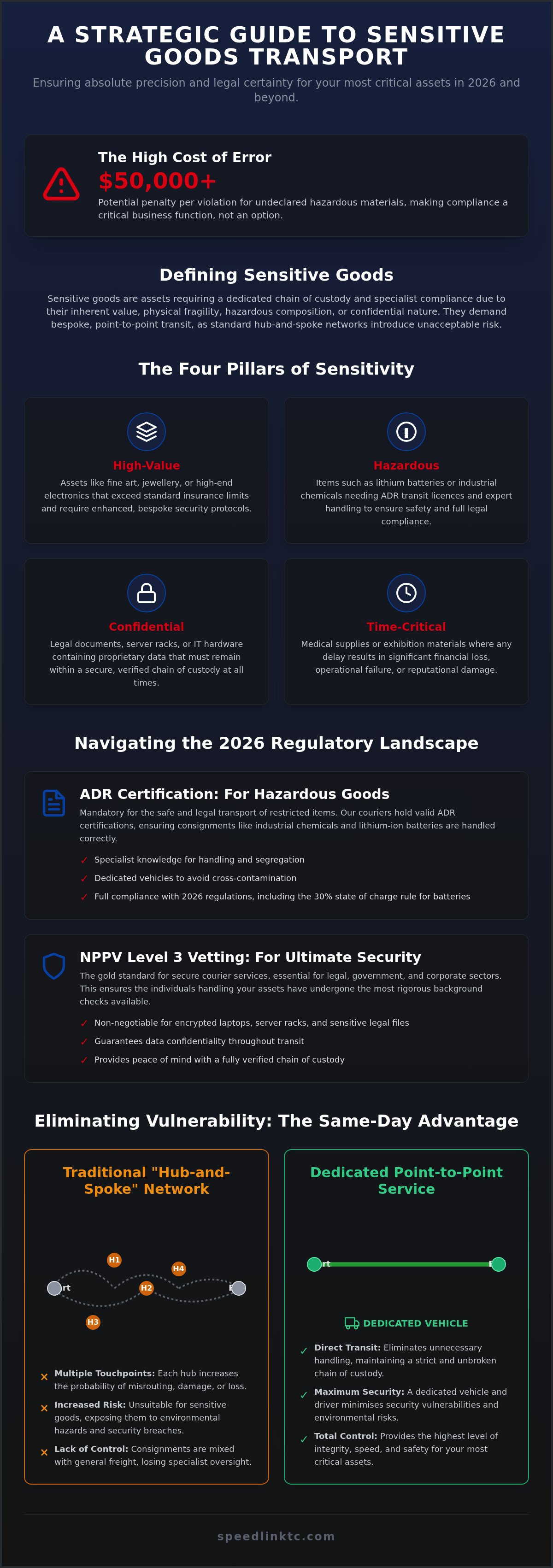
Sensitive goods transport represents a significant departure from standard general freight. Whilst traditional logistics focuses on volume and route density, specialist handling prioritises the integrity and security of the consignment above all else. We define sensitive goods as assets requiring a dedicated chain of custody and specialist compliance. These are consignments that demand bespoke attention due to their inherent value, physical fragility, hazardous composition, or the confidentiality of the data they contain.
It’s vital to distinguish between physical sensitivity, such as fine art that risks damage from vibration, and regulatory sensitivity, where dangerous goods must meet strict legal frameworks. Traditional “hub-and-spoke” networks are fundamentally unsuitable for these assets. These systems involve multiple touchpoints and sorting centres, increasing the probability of loss or damage. In contrast, sensitive goods transport relies on point-to-point transit to eliminate unnecessary handling and maintain absolute control over the environment.
The Four Pillars of Sensitivity
- High-Value: Luxury assets, jewellery, or high-end electronics that exceed standard insurance limits and require enhanced security protocols.
- Hazardous: Items like lithium batteries or chemicals requiring specific ADR transit licences and expert knowledge to ensure safety and legal compliance.
- Confidential: Legal documents or IT hardware containing proprietary data that must never leave a secure, verified chain of custody.
- Time-Critical: Exhibition materials or medical supplies where a delayed arrival results in total operational failure or financial loss.
Beyond these categories, sectors such as agriculture often rely on Specialized Sample Logistics and Transport for the overnight collection of dairy and food samples. This demonstrates how the principles of sensitive logistics are applied to ensure sample integrity and operational continuity in specialist fields.
Compliance and Security: Navigating the Regulatory Landscape
The Regulatory Landscape for sensitive goods transport is increasingly complex, particularly following the 2026 PHMSA HM-268 rule updates and ongoing post-Brexit customs shifts. For organisations moving assets between the UK and EU, compliance isn’t merely a matter of paperwork; it’s a strategic necessity to avoid the severe penalties associated with undeclared hazardous materials. A dangerous goods courier UK specialist must maintain valid ADR certifications to handle restricted items like industrial chemicals or lithium-ion batteries safely. We utilise dedicated vehicles to ensure these consignments never enter a general sorting environment, maintaining a sterile and secure chain of custody from the moment of collection.
Navigating international borders requires precise customs clearance protocols to prevent costly delays. This is especially vital for high-value electronics or time-sensitive medical supplies where any friction at the border results in operational failure. If you’re managing a complex cross-border movement, you can speak with our specialist advisors to ensure your documentation is robust and compliant.
Vetted Personnel and Data Security
For the legal and government sectors, physical protection is only one aspect of a secure movement. NPPV (Non-Police Personnel Vetting) Level 3 clearance represents the gold standard for secure courier services. This ensures that the individuals handling your assets have undergone the most rigorous background checks available. This level of vetting is non-negotiable when transporting encrypted laptops, server racks, or sensitive legal files. It’s helpful to review our guide on NPPV cleared courier service to understand the depth of these security protocols. By employing vetted personnel, we provide the peace of mind that your data remains confidential throughout the entire transit process.
Strategic Risk Mitigation for High-Value and Fragile Consignments
Specialist Handling for IT and Lithium Batteries
The transport of IT equipment and lithium-ion batteries presents unique safety and security challenges. Managing the risk of thermal runaway in batteries requires strict adherence to the 2026 30% state of charge mandate and specialised containment protocols. When moving corporate hardware, preventing unauthorised physical access is as vital as preventing damage from rough handling. Our approach ensures that sensitive goods transport remains secure and compliant through every mile of the journey. You can refer to our specialist courier service UK pillar for more detailed insights into high-stakes asset management. If your organisation requires a robust logistics strategy for fragile or high-value cargo, contact our team today to discuss a tailored risk-mitigation plan.
Same Day Solutions for Sensitive Consignments: Speed Meets Security
While some view sensitive goods transport as a slow, heavily planned process, the reality of 2026 logistics often demands immediate action. Same-day delivery isn’t just about speed; it’s a vital security strategy. By minimising the time a consignment spends in transit, you naturally reduce the window for potential interference or environmental fluctuations. This is especially critical for exhibition and event logistics, where high-value stands and precision technology must arrive under strict, often immovable, deadlines. We understand that in these scenarios, the logistics partner acts as an extension of your own operational team, ensuring that every asset is handled with methodical care.
For corporate travellers, a lost document or forgotten credential can derail an entire international mission. Our same day passport couriers provide a rapid response to these travel emergencies, ensuring that critical identification reaches its destination without the risks associated with overnight postal networks. Similarly, booking a specialist same-day service for urgent laptop recovery or sensitive document transit ensures that business-critical operations remain uninterrupted. These services are designed for situations where the cost of delay far outweighs the price of a dedicated, secure vehicle.
The Advantages of Dedicated Same-Day Courier Services
The primary risk in standard logistics is the sorting office. In a dedicated same-day model, your goods never leave the vehicle once loaded, which eliminates the “sorting office” risk entirely. This maintains a sterile environment from collection to delivery, providing the absolute chain of custody required for sensitive legal and medical consignments. Whether it’s a direct-to-desk delivery for a partner in a law firm or a mission-critical part for an engineering project, the same day courier model offers a strategic advantage that slower freight simply cannot match. It’s the ultimate tool for maintaining precision whilst meeting the most demanding corporate schedules.
Securing the Future of Your Specialist Logistics
Mastering the complexities of 2026 logistics requires more than just a delivery service; it demands a strategic partnership built on precision and authority. Moving beyond general freight to a dedicated model eliminates the risks inherent in standard sorting hubs. By integrating NPPV Level 3 cleared couriers and maintaining strict ADR compliance for hazardous assets, your organisation can navigate the modern regulatory landscape with absolute confidence. Choosing a partner that provides dedicated vehicles for every consignment ensures that your chain of custody remains unbroken and your most valuable assets are never compromised.
Effective sensitive goods transport is ultimately about risk management and operational continuity. Whether you’re handling fine art, confidential legal data, or time-critical IT hardware, the right framework provides the security your high-stakes consignments deserve. We invite you to request a quote for your sensitive goods transport today and secure your most critical assets with the precision they require. We look forward to supporting your mission-critical operations with the discipline your business demands.
Frequently Asked Questions
What is the difference between sensitive goods and prohibited items?
Sensitive goods are assets that require specialised handling due to their value, fragility, or regulatory status, whereas prohibited items are legally barred from transit or restricted by specific carrier licences. Sensitive goods transport involves managing items like fine art or lithium batteries that demand a dedicated chain of custody. Prohibited items, conversely, often include illegal substances or materials that no standard commercial courier is authorised to move.
Does my business need an ADR-licensed courier for lithium batteries?
Most commercial movements of lithium batteries require an ADR-licensed courier to ensure compliance with stringent safety regulations. As of 2026, air transport mandates a 30% maximum state of charge for batteries packed with equipment, making professional oversight essential. Specialist couriers possess the training to handle thermal runaway risks and provide the specific documentation required for legal road and air transit across the UK and EU.
Why is NPPV clearance important for sensitive document transport?
NPPV clearance is vital because it verifies that the individual handling your consignment has passed rigorous background checks conducted by the police. This is the gold standard for secure courier services, particularly when transporting confidential legal files, government data, or proprietary corporate intelligence. It provides a level of security that standard background checks can’t match, ensuring your documents remain in trusted hands from collection to delivery.
Can high-value fine art be transported on a same-day basis?
High-value fine art can and often should be transported on a same-day basis to minimise the total time spent in transit. Using a dedicated vehicle ensures that the piece isn’t subjected to the risks of sorting centres or multiple handling points. This direct approach allows for precise climate control and vibration monitoring, providing the highest level of protection for fragile or irreplaceable luxury assets during their journey.
What insurance coverage is available for sensitive goods transport?
Specialist insurance coverage for sensitive goods transport typically exceeds standard “goods in transit” limits to reflect the true replacement value of the cargo. We provide bespoke cover options for high-value electronics, fine art, and confidential assets that require enhanced protection. It’s essential to verify that your logistics partner offers comprehensive indemnity that covers the specific risks associated with your consignment’s unique value and physical nature.

Article by
Dave McMillen
I have worked in courier and logistics for over 30 years. My experience spans two continents and several types of services from road freight to airlines and specialist B2B services. SpeedLink has been serving the UK market for over 20 years providing the finest time critical and specialist services supporting businesses and individuals alike.
Disclaimer
Information is provided as general logistics guidance and is not legal, customs, aviation, medical or dangerous-goods compliance advice.
Rules vary according to commodity, quantity, classification, packaging, origin, destination, transport mode and carrier.
Regulations and carrier requirements may change.
Where regulated goods are involved, current requirements should be confirmed with the appropriate government authority, regulator, carrier or qualified specialist before shipment.
SpeedLink can confirm the transport options it can provide for a particular shipment.


