


A single missing component isn’t just a supply chain delay; it’s a financial haemorrhage that can cost your facility tens of thousands of pounds every hour the line remains silent. In 2026, where global merchandise trade volumes grew by 3.2% in the first quarter and protectionist policies are on the rise, the margin for error in your manufacturing cycle has never been thinner. You already know that relying on standard hub-and-spoke courier networks for critical parts logistics is a gamble you can’t afford to lose, especially whilst navigating the complexities of post-Brexit customs.
We understand that when a ‘line-down’ situation strikes, you need more than a delivery; you need a strategic intervention. This guide explores how specialised transport and dedicated courier services act as a vital safety net for your operations. We’ll examine the latest 2026 customs regulations for EU-UK flows and show you how to secure a zero-downtime production cycle through methodical, expert-led solutions that prioritise precision over simple speed.
Key Takeaways
- Learn to distinguish between ‘urgent’ and ‘critical’ requirements to ensure your logistical response matches the true severity of a production threat.
- Understand how dedicated critical parts logistics eliminate the trans-shipment risks inherent in standard hub-and-spoke networks.
- Discover how integrated customs expertise prevents administrative bottlenecks from turning an express delivery into a multi-day delay.
- Identify the essential criteria for a specialist partner, including 24/7 availability and the ability to handle industry-specific technical requirements.
Defining Critical Parts Logistics in the 2026 Supply Chain
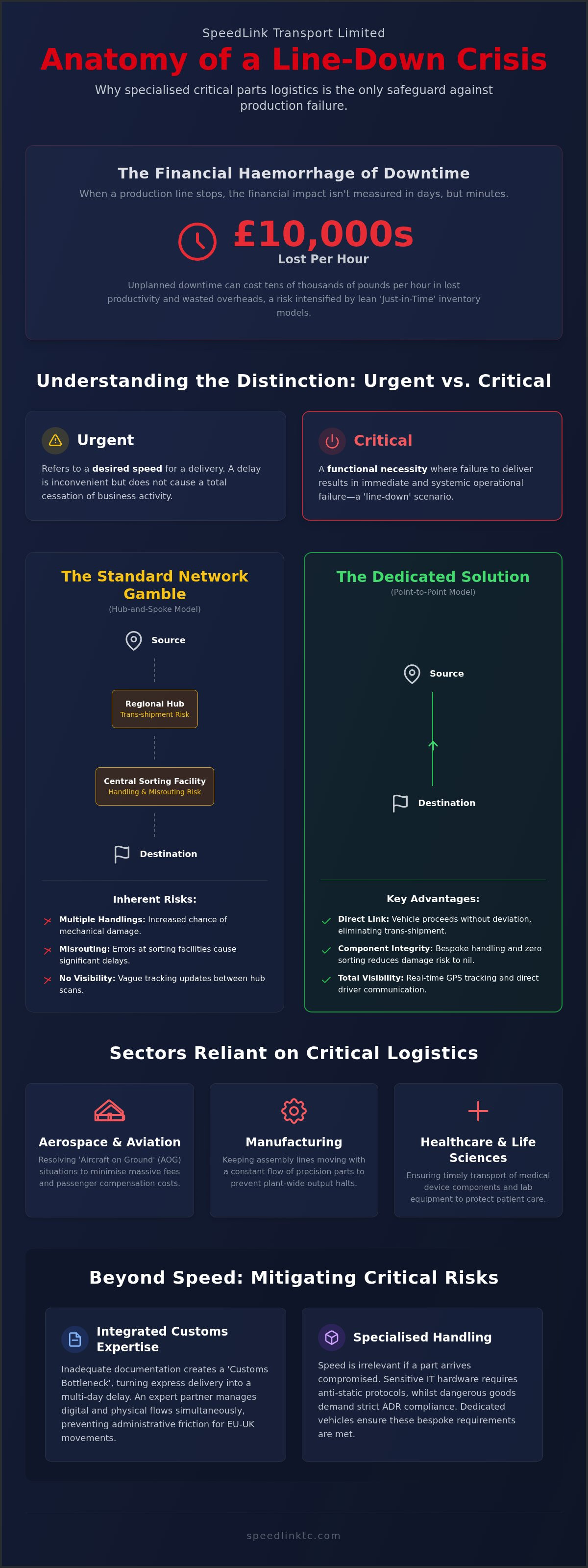
In the broader context of Logistics, critical parts logistics represents the highest tier of operational urgency. It isn’t simply about moving items quickly; it’s the specialised, non-negotiable movement of components required to prevent or resolve a total cessation of business activity. Whilst ‘urgent’ shipping often refers to a desired speed, ‘critical’ delivery is a functional necessity where failure results in immediate systemic failure. We distinguish these by the impact of the delay: if the absence of a part halts your core operation, it is critical.
The ‘Line-Down’ scenario is the ultimate catalyst for this service. When a manufacturing plant stops, the financial impact isn’t measured in days, but in minutes. Industry estimates suggest that unplanned downtime can cost tens of thousands of pounds per hour in lost productivity and wasted overheads. This vulnerability has intensified as global supply chains have transitioned from ‘Just-in-Case’ stockpiling to lean ‘Just-in-Time’ (JIT) models. In 2026, where inventories are kept to an absolute minimum to preserve capital, robust critical parts logistics is the only safeguard against systemic failure when a single faulty sensor or missing valve brings a facility to a standstill.
Key Sectors Dependent on Critical Part Flows
Several industries operate on such narrow margins that any delay is catastrophic. We provide the specialised support these sectors require to maintain continuity:
- Aerospace and Aviation (AOG): An Aircraft on Ground (AOG) situation incurs massive costs in airport fees and passenger compensation, requiring immediate component delivery to any global hangar.
- Manufacturing and Industrial Engineering: Keeping assembly lines moving requires a constant flow of precision parts, where a missing component can halt the entire plant’s output.
- Healthcare and Life Sciences: Beyond commercial loss, delays in transporting medical device components or laboratory equipment can have direct consequences for patient care and critical research.
The Mechanics of Time-Critical Logistics: Why Dedicated Transport Wins
Standard courier networks operate on a hub-and-spoke model. While cost-effective for general freight, it’s often the primary cause of failure in critical spare parts logistics. Every time a part enters a sorting facility, it undergoes ‘trans-shipment’. This process involves multiple manual handlings and automated belt transfers, each one increasing the risk of mechanical damage or misrouting. For a manufacturing plant facing a line-down crisis, these variables represent an unacceptable level of risk. Dedicated same-day courier services eliminate these touchpoints by removing the hub from the equation entirely.
The ‘Point-to-Point’ advantage provides a direct link between the supply source and the engineer on-site. Once collected, the vehicle proceeds without deviation to the delivery point. This methodical approach ensures the integrity of the component whilst providing the sender with total visibility. Real-time GPS tracking and a direct line of communication to the driver replace the vague ‘out for delivery’ status of standard networks. This transparency allows site managers to synchronise their repair teams exactly with the vehicle’s arrival. If you are managing a time-sensitive recovery, you can speak with our coordinators to arrange immediate dispatch.
The Role of Specialised Handling for Sensitive Components
Speed is irrelevant if the part arrives compromised. Transporting IT and high-value hardware requires specific anti-static packaging and secure transport protocols to protect sensitive circuitry. Similarly, the logistics of dangerous goods, including lithium batteries and specialised chemicals, must be managed within strict ADR regulations even under JIT pressure. Using a dedicated vehicle allows for these bespoke handling requirements to be maintained throughout the journey, ensuring that the part is ready for immediate installation upon arrival.
Mitigating Risks: Customs Clearance and Global Fragility
Even the fastest transit times are rendered irrelevant if a component is stalled by administrative friction. The ‘Customs Bottleneck’ remains a primary risk in 2026, where inadequate documentation can transform an urgent delivery into a multi-day delay. Effective critical parts logistics requires more than a vehicle; it demands integrated EU shipping with customs clearance expertise. By managing the digital and physical flow of goods simultaneously, we prevent the ‘Bullwhip Effect’, where small supply chain tremors amplify into major production halts. A reliable logistics partner acts as a stabiliser, dampening volatility during global disruptions.
Security is equally vital for high-stakes components. When transporting sensitive data hardware or proprietary engineering prototypes, standard vetting is often insufficient. Utilising NPPV-cleared courier services provides an essential layer of trust, ensuring that your most valuable assets are handled by personnel vetted to national police standards. For immediate assistance with secure or cross-border movements, you can contact our specialist team to initiate a priority dispatch.
Navigating the Post-Brexit Border for Urgent Parts
The 2026 regulatory environment requires constant vigilance to maintain seamless trade. Keeping JIT flows moving between the UK and Europe necessitates 24/7 customs support for international same-day courier movements. We utilise specialised ‘spare parts’ classifications to expedite clearance, ensuring that emergency components bypass standard queues. This methodical approach to paperwork is what keeps the assembly line moving whilst others are still waiting for a customs release. It’s the difference between a resolved crisis and a prolonged shutdown.
Selecting a Specialist Partner for Critical Parts Logistics
Identifying a suitable partner for critical parts logistics requires a vetting process that prioritises operational resilience over simple cost-per-mile. In high-stakes environments, the logistics provider functions as a direct extension of your engineering team. You need a partner that offers a collection window of 60 to 90 minutes, maintained 24/7, every day of the year. This level of availability is the only way to ensure that a midnight component failure doesn’t become a next-day catastrophe for your production schedule.
Sector-specific expertise is equally vital. A provider that understands the delicate handling required for legal documents or the environmental controls needed for fine art brings a level of precision that standard couriers lack. This meticulousness is essential when moving calibrated sensors or bespoke mechanical components. Additionally, ensure your partner has an established infrastructure for European express delivery. This ensures they can navigate cross-border regulations with the same proficiency as a local movement. Finally, verify that drivers hold NPPV or similar clearances to ensure seamless access to secure industrial sites without administrative delays.
The SpeedLink Advantage in Critical Logistics
We act as the strategic insurance policy for manufacturing hubs across the UK and Europe. When a crisis occurs, a single point of contact at SpeedLink manages the entire lifecycle of the movement, from the initial collection through to the final customs clearance. This dedicated oversight eliminates the communication gaps that often lead to delays in standard networks. In critical parts logistics, the true cost is never the delivery fee; it is the price of the production line standing still. By choosing a partner with methodical control, you’re investing in the continuity of your entire operation.
Securing Your Production Continuity for 2026
The vulnerability of lean supply chains in 2026 demands a shift from reactive shipping to proactive, strategic resilience. We’ve explored how dedicated transport eliminates the trans-shipment risks inherent in standard networks, ensuring that your essential components bypass the hazards of hub handling. By prioritising a partner with integrated customs expertise, you remove the administrative friction that so often stalls urgent cross-border movements between the UK and the EU.
Effective critical parts logistics is ultimately about certainty. Whether you require specialised handling for high-value IT equipment or the transport of dangerous goods, the focus must remain on methodical precision. We provide the 24/7 emergency response and the technical vetting necessary to act as your operational safety net across the UK and Europe. If a line-down situation threatens your facility, you can minimise your downtime: Contact SpeedLink for urgent critical parts logistics. We are ready to help you maintain a seamless, zero-downtime production cycle.
Frequently Asked Questions
What exactly is critical parts logistics and how does it differ from standard shipping?
Critical parts logistics is the specialised movement of components essential for immediate business operations. Unlike standard shipping, which relies on cost-saving hub-and-spoke networks, this service prioritises speed and certainty through dedicated, point-to-point transit. We treat these movements as strategic interventions rather than simple deliveries, ensuring that the absence of a single part doesn’t lead to a total cessation of your production line or core service delivery.
How quickly can a critical part be delivered from the UK to Europe in 2026?
In 2026, delivery times from the UK to Europe are optimised through 24/7 emergency response and immediate collection within 60 to 90 minutes. Whilst exact transit times depend on the destination, using a dedicated vehicle and integrated customs clearance ensures the fastest door-to-door journey. This methodical approach bypasses the delays associated with standard sorting facilities, allowing your facility to resume operations without waiting for traditional freight schedules or hub-based processing.
Does my business need a dedicated vehicle for urgent part delivery?
A dedicated vehicle is essential if the cost of failure outweighs the transport fee. Standard networks involve multiple manual handlings and ‘trans-shipment’ at hubs, which increases the likelihood of mechanical damage or misrouting. For high-stakes movements, dedicated transport provides a direct, non-stop link between the source and your engineers. This ensures that sensitive or high-value components arrive in the exact condition required for immediate installation, bypassing the risks of a hub.
What are the customs requirements for shipping urgent spare parts after Brexit?
Shipping urgent spare parts in 2026 requires precise documentation and an understanding of the EU’s increased focus on supply chain risk information sharing. Importers must ensure transparent ownership and a reliable compliance history to navigate the current regulatory landscape. We utilise specialised ‘spare parts’ classifications and integrated customs clearance for critical parts logistics. This methodical approach ensures your components move through the border without becoming trapped in administrative bottlenecks.
How can a same-day courier service help reduce my production downtime costs?
A same-day courier service acts as an industrial emergency responder by synchronising the arrival of parts with your on-site repair teams. This coordination eliminates the unproductive ‘waiting time’ that inflates downtime costs, which can reach tens of thousands of pounds per hour. By providing real-time GPS tracking and direct driver communication, we allow site managers to plan their recovery with total precision, turning a potential crisis into a controlled maintenance event.

Article by
Dave McMillen
I have worked in courier and logistics for over 30 years. My experience spans two continents and several types of services from road freight to airlines and specialist B2B services. SpeedLink has been serving the UK market for over 20 years providing the finest time critical and specialist services supporting businesses and individuals alike.
Disclaimer
Information is provided as general logistics guidance and is not legal, customs, aviation, medical or dangerous-goods compliance advice.
Rules vary according to commodity, quantity, classification, packaging, origin, destination, transport mode and carrier.
Regulations and carrier requirements may change.
Where regulated goods are involved, current requirements should be confirmed with the appropriate government authority, regulator, carrier or qualified specialist before shipment.
SpeedLink can confirm the transport options it can provide for a particular shipment.


