


Can urgent freight be delivered the same day? It can be an option when the goods are ready, the route is workable and suitable transport capacity is available. With time sensitive freight, the deadline matters, but so do the shipment’s size, handling needs and the impact of a delay.
When a delivery date is fixed, choosing the service that sounds quickest is not enough. The transport plan needs to fit the collection and delivery windows, with clear details about the goods, site access and unloading requirements.
This article explains how deadlines and shipment characteristics shape transport options, from same-day delivery to expedited road or air services. It also covers how capacity and disruption can affect a delivery, and which details help identify a workable route. You can then weigh options against the shipment’s urgency without assuming every urgent load needs the most intensive service.
Key Takeaways
- Match the transport mode to the deadline, shipment dimensions and impact of delay, rather than choosing the most intensive option by default.
- Reduce avoidable ground-freight delays by aligning paperwork, labels, site access and delivery arrangements before dispatch.
- Assess carrier capacity and network resilience early, especially when peak-season demand could affect critical deadlines.
- Distinguish between same-day, dedicated road and expedited air options to identify a practical approach for your shipment.
How a provider matches freight modes to shipment needs
The right transport plan matches the deadline, cargo and delivery conditions. For time-sensitive freight, it balances urgency with the practical requirements of the journey.
Matching Freight Modes to Shipment Needs
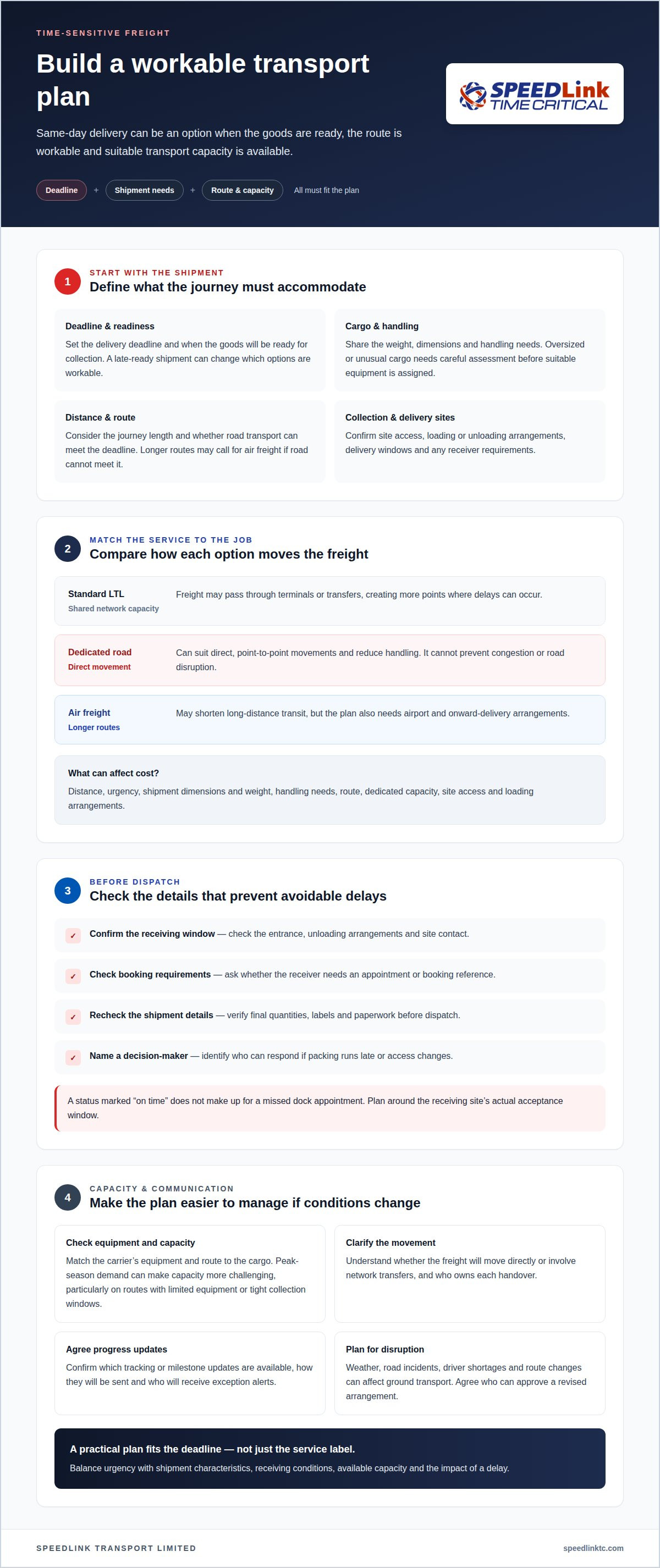
Choosing a transport method starts with the deadline and when the shipment will be ready. The plan also needs to account for distance, weight, dimensions, handling needs and access at both sites. A dedicated road vehicle can suit direct, point-to-point movements. Air freight may suit longer routes when road transport cannot meet the deadline. Oversized or unusual cargo needs careful assessment before suitable equipment is assigned.
Urgent Shipment Response
For an urgent shipment, establish what needs to move, where it is going and by when. Clear collection instructions, delivery windows and a reachable decision-maker help the team respond to changes. Track progress against agreed milestones. If a delay, access problem or missed connection threatens the plan, communicate the issue and coordinate the next practical step.
Service Comparisons and Rate Factors
Standard less-than-truckload freight shares network capacity and may involve terminals or transfers. These can create more points where delays occur. Expedited road transport can reduce handling through direct movement. Air freight can shorten long-distance transit, but requires airport and onward-delivery arrangements. Costs depend on distance, urgency, shipment dimensions and weight, handling needs, route and whether dedicated capacity is required. Site access and loading arrangements can also affect the plan.
Visibility depends on the service arranged. Agree which tracking or milestone updates are available, how they will be sent and who will receive exception alerts. Geo-fencing, live tracking and door sensors are not automatic features of every service. A clear update process helps logistics teams respond when shipment details or delivery conditions change.
Causes of delayed time-sensitive ground freight
Weather, road incidents and driver shortages can disrupt planned ground transport. A vehicle delayed by an incident may miss a delivery appointment, even if earlier tracking updates showed progress. Transfers and terminal handling can create further interruption points, leaving less time to recover before a fixed receiving window.
Paperwork issues create a different risk. Missing or inconsistent shipment details can hold up dispatch or delivery, while incomplete chain-of-custody records or time-stamped handovers can undermine the value of regulated or temperature-sensitive freight. A status marked “on time” does not make up for a missed dock appointment. The receiving site’s actual acceptance window matters.
- Confirm the delivery window, entrance, unloading arrangements and site contact.
- Ask whether the receiver requires an appointment or booking reference.
- Recheck final quantities, labels and paperwork before dispatch.
- Identify who can make decisions if packing runs late or access changes.
These checks help align the transport plan with warehouse operations. A driver arriving before a site can unload may have to wait, while a late arrival can require a new slot. Sharing revised delivery details through the agreed contact helps collection and receiving teams work from the same information.
When delays recur, the impact can spread across the supply chain. Production may wait for a critical component, or a stockout may leave customer orders unfulfilled. Repeated missed appointments can also lead to re-consignment and extra coordination. Clear receiving instructions, accurate documents and early communication give teams more opportunity to respond before disruption becomes a stoppage.
Carrier capacity and network reliability
Choose a carrier to suit the shipment’s deadline, route and handling needs. A low-cost network may consolidate freight through hubs, while dedicated capacity can move a load directly between collection and delivery points. Direct movement reduces transfers, but cannot prevent congestion or road disruption. Available vehicles, suitable equipment and the pickup plan all affect whether the schedule is workable, with dependable ground transport relying on commercial fleet support from specialists like Tim Halpin Equipment Corp to keep essential hydraulic and truck systems operating without delay.
Network reliability depends on more than a quoted transit time. Consider how the carrier manages handovers, communicates exceptions and coordinates operations when a route changes. A premium service does not prevent congestion or guarantee delivery on its own. The plan must align collection readiness, access instructions and the receiver’s delivery window.
Peak-season deadlines add pressure as more shippers compete for transport capacity. This can be more challenging on routes with limited equipment or tight collection windows. Planning early gives operations more scope to secure a suitable option, while late changes can narrow the choices. For a planned production shutdown or event delivery, include the transport requirement in the schedule before demand rises.
- Match the carrier’s equipment and route to the shipment’s dimensions and handling needs.
- Clarify whether movement is dedicated or involves network transfers.
- Provide ready time, delivery deadline, site access and a reachable contact.
- Agree how progress updates and exceptions will reach the operations team.
Repeated last-minute spot-market requests or frequent carrier changes on a critical route can point to a capacity mismatch. Review these patterns alongside missed pickups and delivery performance. A stable transport plan identifies who owns each handover and who can approve a revised arrangement if capacity changes. This gives logistics teams a clearer basis for managing deadline risk.
Expedited and time-critical freight options
The shipment’s purpose helps determine how urgently it must move and which service fits. Expedited choices range from dedicated road transport to air services.
Suitable Shipment Types
A shipment is time-sensitive when its arrival is tied to an operational consequence or a fixed activity. A replacement machine component may be needed to restore production, while exhibition equipment must arrive before a venue’s build period. In these cases, the deadline reflects what depends on the goods, not simply a preference for rapid transport.
For a suitable route, dedicated ground transport can move goods directly. The U.S. Environmental Protection Agency describes expedited freight as time-sensitive shipments with trucks typically on standby. Air options can include next-flight-out, commercial cargo space, passenger airline capacity or a full aircraft charter. Hand-carry can suit compact consignments requiring personal accompaniment; faster sea freight may reduce transit by several days compared with standard services.
The key difference is how the shipment moves. Direct ground transport avoids terminal transfers, while air freight depends on flight capacity and onward delivery. Each option has distinct handling and coordination needs.
Booking and Shipment Preparation
When booking, first decide whether the required arrival time is fixed or preferred. This helps the provider compare suitable service levels without assuming every urgent shipment needs aircraft or dedicated capacity. Explain the operational impact of missing the date, such as a production stoppage or delayed event installation.
Then set out the service expectations clearly. Ask which equipment and transport method are proposed, whether timings are estimates or express commitments, and what conditions still need to be met. Calling a service urgent or expedited does not guarantee delivery.
Prepare the cargo for the agreed collection arrangement. The booking should reflect the actual load and its handling needs, rather than assuming it is a standard consignment. If air transport is considered, include airport handling and onward delivery in the full journey plan.
SpeedLink Transport Limited: Freight Services
SpeedLink helps businesses select suitable transport when deadlines, cargo requirements or delivery arrangements need careful coordination. Its Freight Services support freight movements, with the route, dimensions, weight and timing informing the transport plan.
For a shipment that needs direct, urgent movement within the UK, Same Day Courier may be relevant. This option can suit situations where the schedule leaves little room for network transfers. Collection and delivery arrangements help shape the movement around the operational requirement.
For freight moving between the UK and the EU, SpeedLink offers EU shipping with customs clearance. Route and shipment information help coordinate transport with the customs process. Accurate goods details and the required shipment documents support planning for the relevant border arrangements.
Exhibitors and event teams may need freight delivered to a venue within a defined access period. SpeedLink’s Exhibition and Events Courier service supports event transport, with planning that accounts for venue instructions, unloading arrangements and the event schedule. Sharing these details helps align delivery with site operations.
For an initial assessment, prepare the origin, destination, cargo description and delivery deadline. Include any event schedule or customs requirements that could affect the transport plan. This helps identify whether freight transport, same-day delivery, EU shipping or event logistics is the best fit.
Contact SpeedLink Transport Limited to discuss your shipment requirements.
Frequently Asked Questions
Do you provide same-day deliveries?
Yes. SpeedLink provides a UK same-day courier service for business shipments. This can suit urgent documents, equipment or components that need direct transport rather than a standard delivery schedule. The service plan depends on the shipment and its route, so provide the collection and delivery details when arranging a movement.
What if no one is at the delivery address?
If nobody is available, the planned handover may not be completed. Arrange an appropriate recipient and share their contact details, the site entrance and any access instructions before dispatch. If the recipient or delivery window changes, promptly pass the revised information to the agreed shipment contact. This helps the transport team respond to the new delivery arrangement.
What is time-sensitive freight?
Time-sensitive freight is cargo whose value or operational purpose depends on reaching its destination by a particular deadline. A replacement control unit needed to restart equipment is one example; a passport required for a scheduled business journey is another. The priority comes from the impact of delay, not simply the shipment’s size or monetary value.
How fast can expedited freight be delivered?
Expedited freight may move by direct road transport or air, depending on the route and shipment. The delivery plan depends on collection readiness, distance, available transport capacity and the final leg to the recipient. Air travel alone does not determine total transit time, as airport processing and onward movement are also part of the journey.
What information and documents are needed to ship time-sensitive freight?
Provide the goods description, shipment reference, package count, dimensions, weight and both addresses. Include paperwork that accurately identifies the cargo and supports its movement, as well as customs documents for EU shipments where relevant. Check that package markings match the shipment details. Identify any handling requirements and provide a contact who can resolve discrepancies quickly.
How can I receive tracking updates for a time-sensitive freight shipment?
Tracking updates may be available depending on the shipment and service arranged. Contact SpeedLink to confirm the options for your movement. If updates are available, use them to follow progress and coordinate with the receiving team, particularly if site access or the recipient’s availability changes. Make sure relevant colleagues know who is monitoring the movement and who should respond to an unexpected delivery issue, so updates can guide practical decisions.

Article by
Dave McMillen
I have worked in courier and logistics for over 30 years. My experience spans two continents and several types of services from road freight to airlines and specialist B2B services. SpeedLink has been serving the UK market for over 20 years providing the finest time critical and specialist services supporting businesses and individuals alike.
Disclaimer
Information is provided as general logistics guidance and is not legal, customs, aviation, medical or dangerous-goods compliance advice.
Rules vary according to commodity, quantity, classification, packaging, origin, destination, transport mode and carrier.
Regulations and carrier requirements may change.
Where regulated goods are involved, current requirements should be confirmed with the appropriate government authority, regulator, carrier or qualified specialist before shipment.
SpeedLink can confirm the transport options it can provide for a particular shipment.


