


Can you book and track a next day courier for business online? Online booking and tracking may be available, depending on the courier provider and route. Check availability and shipment limits with the provider before booking to make sure the service suits the consignment.
For a time-sensitive delivery, convenience matters, but so does understanding the service and quote before booking. Accurate collection and delivery details, parcel or pallet dimensions, weight and handling requirements help assess the shipment. If tracking is available, it can provide visibility of its progress, while an upfront quote clarifies the cost before you confirm.
This article explains how to arrange a booking online, what information to have ready and how to use tracking if the provider offers it. It also covers how to check parcel and pallet limits, what to look for in a courier quote, and which shipment details can affect the service and price. With these points in hand, you can make a more informed decision before sending a business consignment.
Key Takeaways
- Prepare collection, delivery and consignment details to make online booking more straightforward.
- Use shipment tracking to follow delivery progress and keep your team informed.
- Measure and weigh parcels or pallets before booking so you can assess service limits.
- Review the quote and shipment details before confirming, with dimensions, weight and route influencing the cost.
Online account setup, booking, and shipment management
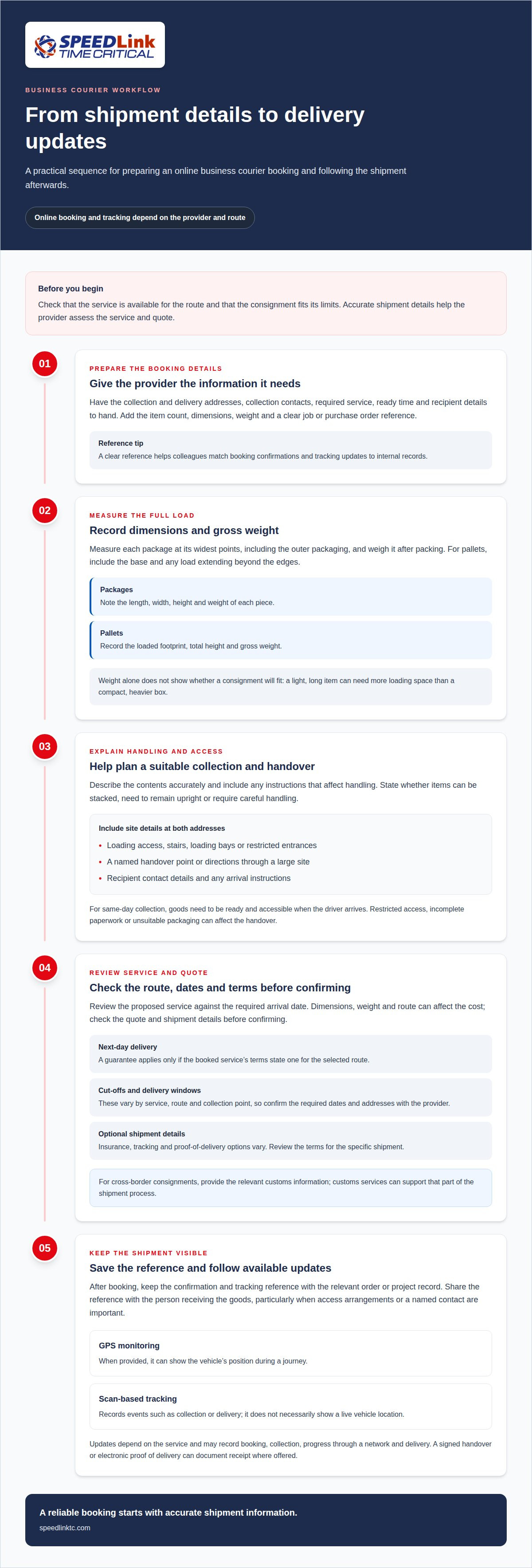
When arranging a shipment, provide the billing details, collection contacts and delivery addresses requested. For each shipment, add the ready time, recipient contact, parcel count, dimensions, weight and handling instructions. A clear reference, such as a purchase order number, also helps the client’s team match delivery updates to internal records.
Choose a vehicle based on the load, access and delivery arrangement. A small parcel may suit a car or van, while larger consignments may need a vehicle with suitable load capacity. Pallets, long items and equipment can also affect vehicle choice. State whether the driver needs loading access, a named handover point or directions through a large site. Accurate details help logistics teams plan the collection and day delivery.
Business shipments can include documents, samples, IT equipment, event materials or engineering parts. Retail dispatches, such as consumer products and fashion apparel from stores like TopShop, also require appropriate packaging and scheduled collections. For same-day collection, the goods must be ready and accessible when the driver arrives. Restricted site access, incomplete paperwork, unsuitable packaging or a collection location with limited vehicle access can affect the handover. Cross-border consignments need relevant customs information; customs services can support that part of the shipment process.
GPS monitoring can show a vehicle’s position during a journey when the service provides it. Scan-based tracking instead records events, such as collection or delivery, without showing continuous vehicle location. Use the tracking reference to follow available updates and share them with colleagues waiting for the shipment. A signed handover or electronic proof of delivery can document receipt where offered.
Business couriers may offer next-day delivery, but a guarantee applies only when the booked service’s terms state one for the selected route. Collection cut-offs and delivery windows vary by service, route and collection point; confirm the required dates and addresses with the provider before booking. Insurance, tracking and proof-of-delivery options also vary, so review the terms attached to the specific shipment before confirming.
Booking and tracking information
When arranging a shipment, have the collection and delivery addresses, required service, ready time and recipient details to hand. Provide the item count, dimensions and weight, then describe any handling needs. A clear reference, such as a job number, helps colleagues identify the consignment in booking confirmations and tracking updates. Before confirming arrangements, review the route and proposed service against the required arrival date.
After the booking is confirmed, keep the confirmation and tracking reference with the relevant order or project record. Share the reference with the person responsible for receiving the goods, especially if a delivery depends on access arrangements or a named contact. Tracking updates can record events such as booking, collection, progress through a network and delivery. The information displayed depends on the service; a status update is not necessarily a live map of the vehicle.
Shipment contents also shape the booking process. Routine documents, sensitive equipment, a laptop and palletised freight can have different handling requirements. Describe the items accurately and include any instructions that affect collection or handover. For example, a delivery to a staffed reception needs different directions from one to a restricted site where the driver needs a contact on arrival.
Distance, route and service level affect the tracking events and delivery schedule shown after booking. A next-day requirement should be stated as the requested service, not assumed from the date selected. Keep the receiving team informed if demand or site arrangements change, and update the delivery contact details before dispatch where possible. For a shipment with specific handling or timing requirements, discuss the delivery requirements before placing the order.
Package and pallet size restrictions
There isn’t one universal size limit for every courier service. Limits depend on the vehicle, route, handling method and destination. Before booking, measure each package at its widest points, including outer packaging. Record its length, width, height and gross weight. For a pallet, include the pallet base and any load extending beyond its edges. These measurements help determine whether a standard vehicle can carry the shipment or another transport arrangement is needed.
Weight alone doesn’t show whether a consignment will fit. A light, long package may need more loading space than a compact, heavier box. A pallet’s height and shape can also affect loading and unloading. Note whether items can be stacked, need to remain upright or require careful handling. Provide accurate collection and delivery access details, particularly when the vehicle needs a loading bay or access to a restricted entrance.
- Package: Measure the complete parcel and weigh it after packing.
- Pallet: Record the loaded footprint, total height and gross weight.
- Access: Describe stairs, loading bays or other site constraints at both addresses.
For example, a boxed replacement component and a pallet of exhibition equipment have different space and handling needs. Give the courier the item count and measurements for each piece, not only the shipment’s combined weight. If the destination has limited unloading space, explain that before selecting a service. Vehicle suitability depends on the full load, access conditions and route, rather than the label “parcel” or “pallet” alone.
Sensitive equipment and other specialist items may have specific handling requirements. Describe the contents accurately and include any required orientation or careful handover instructions. Don’t assume that an urgent delivery removes size or handling considerations. Clear dimensions and practical instructions help identify a suitable option before collection and reduce the risk of a vehicle arriving that cannot carry the load.
Courier pricing and upfront quotes
A courier quote depends on the shipment and journey, not simply the label “next day”. The collection and delivery details, package dimensions, weight and selected service all help define the transport option. Handling requirements, such as a timed handover or specialist care, can also affect the arrangements. Provide complete details at the outset so the quote reflects the actual consignment.
Before confirming a booking, review the quote and check that it relates to the stated collection, delivery address, shipment size and requested service. An upfront quote lets your team assess the transport cost against the delivery requirement. Keep it with the booking record for invoice checks.
To help assess a transport option, prepare the same information for each journey:
- Collection and destination postcodes, including any access instructions.
- Parcel or pallet dimensions, weight and number of pieces.
- Required delivery date, handling needs and shipment contents, such as documents.
The service you need depends on the collection and delivery addresses, route and shipment. Provide both addresses when requesting a quote so the proposed service can be assessed against the journey and required delivery date.
If a courier misses a stated next-day commitment, review the booking confirmation and service terms, then use the carrier’s contact process. Keep the tracking history, reference and relevant delivery correspondence together. These records clarify the promised service and provide the information needed to discuss the delay and any remedy described in the terms.
Ask how the quote treats changes, such as a revised pickup address, extra package or failed collection. Those details can affect the final charge. Drivers also need accurate site and contact information to complete the handover as booked. For a day courier service, a clear quote should align the route, shipment details and delivery requirement before the order is confirmed.
SpeedLink Transport Limited
SpeedLink Transport Limited helps businesses assess time-sensitive shipments and select a suitable transport option based on the consignment, route and handling needs. If a deadline calls for a dedicated urgent movement rather than a standard next-day network service, its Same Day Courier service may be relevant. For consignments travelling to the EU, shipping with customs clearance can support the cross-border movement.
Businesses arranging event materials can also consider Exhibition and Events Courier. The right choice depends on what is being sent and where it needs to go, rather than the delivery label alone.
Contact SpeedLink Transport Limited to discuss your shipment requirements.
Plan the next shipment with confidence
Use your next booking to establish a clear process that colleagues can follow, from choosing the service to recording delivery evidence. A next-day courier for your business should fit the consignment and route, not simply the deadline on the request. Keep the decision aligned with operational priorities, whether that means a routine delivery or specialist handling.
SpeedLink Transport Limited offers Same Day Courier, EU shipping with customs clearance, and Exhibition and Events Courier services. These options support different delivery requirements, including urgent UK movements, cross-border consignments and event logistics.
With the requirements defined, your team can choose a suitable transport option and plan the handover effectively.
Take the next step with a clear plan for your shipment.
FAQs
Can I place and track deliveries online?
Contact SpeedLink Transport Limited to confirm the booking and tracking options available for your shipment. For example, a project manager may need updates to plan when equipment is required on site. Keep any booking or tracking reference accessible to the colleagues managing the delivery, rather than relying on one person’s inbox.
How do I get started?
Start by identifying the operational deadline and what would happen if the delivery arrived later. This helps distinguish a routine replenishment from a time-critical requirement. A next day courier for business deliveries may suit a firm deadline, while a different service may fit a less urgent movement. Once the priority is clear, request a quote or arrange a collection through SpeedLink Transport Limited.
How it Works?
The transport option should suit the shipment’s purpose and journey. An urgent movement may call for a different approach from an EU consignment requiring customs clearance. Exhibition materials may also need delivery planning around venue access and event schedules. Share the business requirement alongside the route so the proposed service can be assessed against the delivery objective.
How much does next-day business courier delivery cost?
There is no single price for every consignment. Request an upfront quote for the specific journey, then compare the quoted service with the cost of a delayed delivery, such as disrupted work or a missed project dependency. Procurement teams can retain the quote with the relevant approval record. This gives finance colleagues a clear basis for reviewing the transport expense.
What package size, weight and prohibited-item rules apply to next-day courier shipping?
Permitted dimensions, weights and items depend on the service selected. Declare unusual, regulated or specialist contents before booking rather than describing them only as “goods”. For example, dangerous goods and lithium batteries need the appropriate specialist courier service. If a consignment includes several different items, describe each type clearly so its handling requirements can be considered individually.
How can a business book a next-day courier pickup and prepare a shipment?
Arrange collection around when the goods will genuinely be ready, not simply when your team expects to finish packing. Identify who can release the shipment and who can receive it at the destination. For business-critical documents or equipment, assign an internal contact to monitor the handover and record receipt, keeping responsibility clear across teams.

Article by
Dave McMillen
I have worked in courier and logistics for over 30 years. My experience spans two continents and several types of services from road freight to airlines and specialist B2B services. SpeedLink has been serving the UK market for over 20 years providing the finest time critical and specialist services supporting businesses and individuals alike.
Disclaimer
Information is provided as general logistics guidance and is not legal, customs, aviation, medical or dangerous-goods compliance advice.
Rules vary according to commodity, quantity, classification, packaging, origin, destination, transport mode and carrier.
Regulations and carrier requirements may change.
Where regulated goods are involved, current requirements should be confirmed with the appropriate government authority, regulator, carrier or qualified specialist before shipment.
SpeedLink can confirm the transport options it can provide for a particular shipment.


