


The paperwork isn’t the first decision. Dangerous goods are substances or articles that pose risks during transport and are assigned to one of nine hazard classes. Knowing how to ship dangerous goods to Europe starts with identifying the goods and matching their classification, packaging, marks and documents to the transport mode; ADR covers road transport within Europe.
The process can feel paperwork-heavy, but getting the essentials right helps prevent handling and routing problems. The arrangements depend on the goods, how they will travel and their destination.
This guide explains how to classify a shipment, prepare its packaging and paperwork, and understand the role of electronic shipment details and software. It also covers when limited-quantity or dry-ice exceptions may apply, and how to assess whether a provider can manage the shipment’s specific requirements.
Key Takeaways
- Start by identifying the goods and their hazard class, then align packaging, marks, labels and paperwork with the transport mode.
- Prepare shipment data and documents to match the route and handling requirements; the right electronic process depends on how the goods will travel.
- Assess Limited Quantity and dry-ice exceptions against the specific goods and conditions, rather than assuming an exemption applies.
- Choose a provider that can manage the shipment’s documentation and route requirements; SpeedLink Transport Limited offers dangerous goods courier services and EU shipping with customs clearance.
What are dangerous goods?
Dangerous goods are substances or articles that can create hazards during transport. They fall into nine hazard classes. Required marks and packaging depend on the goods, quantity and transport mode. Labels commonly show the hazard class, UN identification number and handling instructions.
Incorrect declarations or packaging can expose handlers to hazards, delay or stop a shipment, and result in enforcement penalties under applicable national regulations. The consequences depend on the breach and the rules that apply to the route.
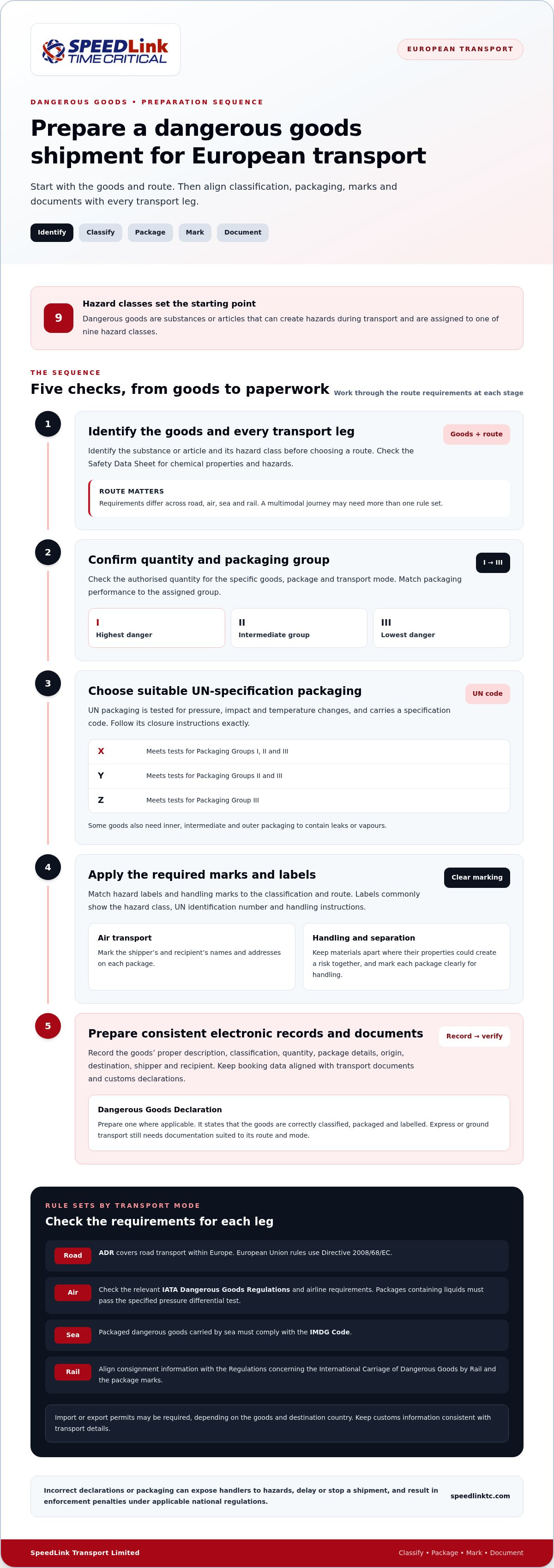
- Classify the goods. Identify the substance or article and its hazard class before choosing a route. Check its Safety Data Sheet for chemical properties and hazards. For road transport within Europe, ADR applies. European Union rules use Directive 2008/68/EC.
- Check the permitted quantity and packaging. Confirm the authorised quantity for the specific goods, package and mode. Dangerous goods packaging groups are I, II or III, from high to low danger. Match the packaging performance level to the assigned group.
- Use suitable UN-specification packaging. This packaging is tested for pressure, impact and temperature changes, and carries a UN specification code. Performance level X meets tests for Packing Groups I, II and III; Y meets II and III; Z meets III. Follow the package’s closure instructions exactly. Some goods also require inner, intermediate and outer packaging to contain leaks or vapours.
- Apply the required marks and labels. Match hazard labels and handling marks to the classification and route. For air transport, mark the shipper’s and recipient’s names and addresses on each package. Keep hazardous materials separated where their properties could create a risk together, and mark each package clearly for handling.
- Complete the paperwork. Prepare the required transport documents, including a Dangerous Goods Declaration where applicable. It states that the goods are correctly classified, packaged and labelled. SpeedLink’s dangerous goods courier service is relevant when specialist handling is needed. Express or ground transport still requires documentation suited to its route and mode.
Required shipping software and electronic shipment information
No single software package is mandatory for every route. A practical approach to how to ship dangerous goods to Europe starts with an electronic record of the goods, packaging, consignee and route. Use that information to prepare the documents required for each transport mode.
For road transport within Europe, ADR applies, and European Union rules use Directive 2008/68/EC. Air, sea and rail shipments follow different frameworks, so identify the requirements for every leg before booking.
- Choose the rule set for each transport leg. Apply ADR requirements to road movements. For air, use the relevant IATA Dangerous Goods Regulations and airline requirements; UK Civil Aviation Authority regulations also feature in international dangerous-goods shipping. European rail transport is covered by the Regulations concerning the International Carriage of Dangerous Goods by Rail. A multimodal route may require several rule sets.
- Build a consistent electronic shipment record. Record the goods’ proper description, classification, quantity, package details, origin, destination, shipper and recipient. Keep booking data aligned with transport documents and customs declarations. IATA regulations require shipper and recipient names and addresses on air packages, so ensure the electronic record matches the package markings.
- Prepare air data for the airline and cargo. IATA sets standards for airlines, freight forwarders, ground handlers and shippers. Check the selected airline’s conditions for the commodity, packaging and route. Packages containing liquids must pass the pressure differential test specified in the IATA Dangerous Goods Regulations. For lithium batteries, record accurate product and shipment details.
- Use the correct sea and rail documentation. Packaged dangerous goods carried by sea must comply with the IMDG Code, according to the International Maritime Organization (IMO). For rail movements, align consignment information with the applicable European rail rules and package marks.
- Complete customs and carrier data before dispatch. Import or export permits may be required, depending on the goods and destination country. For teams planning how to ship dangerous goods to Europe, accurate declarations and supporting records help keep border information consistent with transport details. Customs clearance support can help coordinate cross-border shipment information.
Limited Quantity and dry-ice shipment exceptions
Exceptions are conditional, not blanket exemptions. Before preparing the shipment, check that each allowance applies to the goods, route, packaging and transport mode.
-
Check Limited Quantity exceptions
Identify the substance and transport mode, then check whether a Limited Quantity provision applies to that specific shipment. Reduced documentation or marking requirements do not remove packaging rules, quantity limits or carrier conditions. Exceptions vary by regulation and route, so do not assume an allowance for one country or mode also applies to European road or air transport.
For specified US exceptions involving environmentally hazardous liquids and small quantities of ethyl alcohol, the current edition of 49 CFR governs. For those specified liquid exceptions, packages must also meet IATA packaging provisions 5.0.2.4.1 and 5.0.2.8. These US provisions do not, by themselves, establish an exception for a European-bound consignment.
-
Confirm dry-ice acceptance and limits
Tell the carrier that the shipment contains dry ice, then establish the quantity and packaging conditions that apply to the route and aircraft. IATA dangerous-goods rules apply to air shipments, and airline requirements may add operational conditions. Do not assume that one airline’s acceptance or shipment limit applies to another, or that a road allowance also applies to air transport.
Record the dry-ice amount and package details consistently in the shipment information and declaration, where required. Keep the consignee informed about expected handling and delivery arrangements, particularly if the contents need to remain chilled. As dry ice can dissipate during transit, align dispatch timing and onward handling with the shipment’s purpose.
-
Coordinate tracking and communications.
Before dispatch, agree how status updates will reach the shipper and recipient, and who will respond to any routing or handling change. Use the same shipment reference in booking records and transport documents. If a connection or route changes, share the revised details with the relevant parties and ensure the carrier has accurate cargo information before onward movement.
Selecting a dangerous-goods logistics provider
Assess a provider against the shipment’s commodity, route and transport mode. A sound process should connect compliance checks, carrier arrangements and customs information, rather than treating booking as the entire task.
- Match expertise to the route. Ask how the provider plans each leg, including road connections to airports or ports. ADR, IATA and IMDG requirements differ by mode. For a shipment combining road and air, request a clear explanation of how the handover between carriers preserves consistent cargo and document details.
- Examine training processes. Ask who reviews dangerous-goods information and how staff training is maintained. International recurrent training for dangerous-goods shipping is required every two years. Review the provider’s training process against the tasks its personnel perform, including shipment preparation, document handling and communication with the carrier.
- Test the information workflow. Find out how electronic booking data is checked against package details and transport documents. A lithium-battery consignment, for example, needs clear commodity information for the selected route. Ask how discrepancies are identified and corrected before the carrier receives the shipment.
- Clarify carrier coordination. Ask how the provider identifies route-specific carrier conditions and communicates them to the shipper. Airline requirements can differ, while road movements may involve different handling arrangements. Confirm who manages changes to routing or connections and how updated shipment information reaches the carrier.
- Review customs coordination. For international movements, establish who prepares or coordinates import and export information, and how permits are handled when required. Check that goods descriptions, declared quantities and consignee details align across customs and transport records. Clear responsibility reduces avoidable data mismatches at border handovers.
- Choose a service model suited to the shipment. A dedicated vehicle may suit urgent direct road transport; standard freight may fit less time-sensitive cargo. Ask the provider to explain how the proposed mode, route and handling plan answer the shipment’s operational needs, without adding unnecessary transport stages.
SpeedLink Transport Limited: Same Day Courier
SpeedLink Transport Limited provides Same Day Courier for business shipments where timing is an operational priority. For cross-border movements, its EU shipping with customs clearance service supports transport and border formalities.
For dangerous goods, the service must suit the item’s classification, packaging, route and transport mode. Choose a time-critical option only when its handling arrangements and applicable requirements fit the shipment. Provide accurate cargo and destination details so the transport plan can be considered against the movement’s needs.
Contact SpeedLink Transport Limited to discuss your shipment requirements.
Turn your shipping plan into a clear brief
When planning how to ship dangerous goods to Europe, make the operational requirements clear to everyone involved. Set out the cargo details, collection and delivery points, preferred transport mode, handling priorities and person responsible for decisions. A concise brief gives the transport discussion a practical starting point.
Consider how the shipment fits into wider business activity. A production interruption, scheduled installation or exhibition deadline can affect the preferred route and dispatch plan. Involving procurement, operations and the receiving team early helps align transport arrangements with the work the cargo supports.
SpeedLink Transport Limited can discuss the movement in relation to your business requirements and destination. Share the shipment details and the outcome you need to support, then take the next step with a focused conversation about transport.
A clear brief and well-defined operational priorities help your team move forward with confidence.
Frequently Asked Questions
What qualifies as dangerous goods for shipping to Europe?
Goods qualify as dangerous when their properties present a transport hazard under the rules for the chosen mode. This can include products containing hazardous substances, not just bulk chemicals. For example, assess a battery’s chemistry and configuration, not merely the fact that it is electronic equipment. Classification depends on the goods’ actual characteristics and the applicable requirements for the route.
How do I classify dangerous goods and find the correct UN number and packing group?
Start with the product’s Safety Data Sheet and a precise description, including its composition, concentration and physical form. Use these details to establish the applicable classification and identify its UN number, as a product name alone may not be sufficient. If a packing group applies, match it to the classified goods. For a battery, include its chemistry and whether it is shipped alone or inside equipment.
Which dangerous goods documents are needed, including the shipper’s declaration and safety data sheet?
Required documents depend on the goods and transport mode. A Dangerous Goods Declaration states that covered goods are properly classified, packaged and labelled. An SDS describes a substance’s properties and hazards. They serve different purposes, so an SDS is not a substitute for a required declaration. Ensure document descriptions match the actual contents and package information.
Which dangerous goods are prohibited or restricted for import into the EU or specific European countries?
Restrictions depend on the substance and destination, so a broad product category is not enough to determine what is allowed. Particular goods may require import or export permits. Before dispatch, check the exact product and destination against the applicable restrictions. Permission to transport an item does not automatically permit its import.
Which carriers accept dangerous goods shipments to Europe, and what are their requirements?
No single carrier accepts every dangerous-goods shipment on every route. Acceptance depends on the carrier, transport mode, commodity, packaging and destination. An airline’s conditions for an air consignment may differ from those of a road carrier. For shipments with multiple legs, assess each carrier’s conditions separately and keep the descriptions of the goods and packages consistent throughout the booking.
What customs, VAT, and import documentation are required for dangerous goods entering Europe?
Import documentation depends on the goods and destination country. Prepare accurate customs information describing the commodity and shipment, along with any permits or licences required for import. VAT treatment also depends on the destination and import arrangement, so establish the applicable process before dispatch. Align customs descriptions with transport documents to reduce discrepancies during border processing.

Article by
Dave McMillen
I have worked in courier and logistics for over 30 years. My experience spans two continents and several types of services from road freight to airlines and specialist B2B services. SpeedLink has been serving the UK market for over 20 years providing the finest time critical and specialist services supporting businesses and individuals alike.
Disclaimer
Information is provided as general logistics guidance and is not legal, customs, aviation, medical or dangerous-goods compliance advice.
Rules vary according to commodity, quantity, classification, packaging, origin, destination, transport mode and carrier.
Regulations and carrier requirements may change.
Where regulated goods are involved, current requirements should be confirmed with the appropriate government authority, regulator, carrier or qualified specialist before shipment.
SpeedLink can confirm the transport options it can provide for a particular shipment.


