


For an irreplaceable artwork, every handover is another point at which damage or loss can occur. It’s understandable to be wary of automated sorting hubs, transit vibration and temperature changes, especially when a piece must arrive in time for an exhibition or private viewing. A dedicated fine art courier service UK takes a more controlled approach, transporting the work directly rather than routing it through multi-drop networks.
With SpeedLink, dedicated point-to-point transport avoids intermediate sorting hubs, while an unbroken chain of custody supports clear accountability from collection to delivery. This guide explains how direct transit and person-to-person handovers help protect high-value artwork, what information to prepare before transport, and how to coordinate delivery around critical deadlines. You’ll also learn which practical details to discuss so the journey is planned methodically, with communication maintained throughout.
Key Takeaways
- Assess how handling points and transfer processes affect artwork risk when comparing transport options.
- Choose a fine art courier service UK that supports accountable, point-to-point movement for valuable consignments.
- Use a structured pre-transit process, beginning with a dated condition report and clear photographs.
- Plan transport around the artwork’s handling needs and the receiving venue’s deadline.
What Defines a Specialist Fine Art Courier Service in the UK?
A specialist fine art courier provides controlled, point-to-point transport for works that can’t be treated as ordinary freight. The service is designed around the item’s value, dimensions, fragility and delivery context, whether the shipment is for a private collector, commercial gallery, auctioneer or contemporary art fair. SpeedLink’s fine art transport solutions use dedicated direct vehicles, without intermediate sorting hubs or co-loading unrelated freight.
This approach matters because each transfer adds handling and another opportunity for impact, pressure or delay. A conventional multi-hub network is built to consolidate and move varied parcels efficiently, not to preserve a single artwork’s controlled journey. For delicate pieces, reducing unnecessary transfers is a practical way to limit exposure to vibration, contact with other freight and changes in handling conditions.
The Inherent Vulnerabilities of Standard Parcel Hubs
Automated conveyors, chutes and repeated loading can expose parcels to jolts, vibration and abrupt changes of direction. Packaging helps, but it can’t remove every risk created by a system that sorts and consolidates goods at several points. General freight may also include heavy items or materials that could spill or contaminate nearby cargo. That makes multi-hub distribution a poor fit for artwork requiring individual care and a predictable chain of custody.
Core Standards of Professional Art-Handling Logistics
A dedicated vehicle keeps the artwork separate from unrelated commercial consignments, reducing the chance of shifting loads or contact during transit. Direct routing also avoids intermediate sorting, while person-to-person handover supports accountability from collection to delivery. A professional art handler works with an understanding of the care and specialist skills involved in moving artworks. Transport planning should also consider secure positioning, mechanical stability and steps to mitigate environmental exposure, tailored to the work and journey.
These controls serve more than major museums. Private sales, gallery transfers and exhibition deliveries can all depend on careful handling and arrival coordination. The right fine art courier service UK provides a direct, methodical alternative to standard parcel distribution for cultural and commercial assets.
Evaluating Art Transport Providers: Key Criteria for Logistics Managers
Evaluate a fine art movement by looking beyond the vehicle. A robust plan should make responsibility, communication and exception handling clear before collection. Consider what information is recorded at each handover, who receives progress updates and how the team will respond if access arrangements change. These details help logistics managers assess operational control without relying on broad assurances.
SpeedLink maintains an unbroken chain of custody through direct person-to-person handovers. For a valuable consignment, the movement plan can identify the collection and receiving contacts, the condition information accompanying the work, and the process for recording any observations at transfer. This creates a clearer account of the shipment’s progress and supports coordination between the parties responsible for the artwork.
Direct Transit Versus Multi-Drop Routing
Compare the service model against the consignment’s priorities rather than using transit speed as the only measure. A dedicated assignment is suited to movements where the artwork needs individual attention and co-loading with unrelated freight should be avoided. Network freight may be appropriate for less sensitive goods, but logistics managers should account for its transfer points, handling processes and delivery arrangements when weighing the options.
Security and Chain of Custody
Review the practical controls that support accountability: named handover contacts, clear status communication and an agreed route for escalating delays or access problems. SpeedLink’s secure courier service supports movements where controlled handling and accountable delivery matter. Contingency planning should establish who can approve changes and how the sender and recipient will be informed if the agreed plan is disrupted.
These criteria are relevant to gallery transfers, auction movements and exhibition deliveries alike. By agreeing responsibilities and communication procedures in advance, logistics teams can keep stakeholders aligned and make informed decisions if circumstances change during the assignment.
Preparing Fine Art for UK Transit: A Practical Protocol
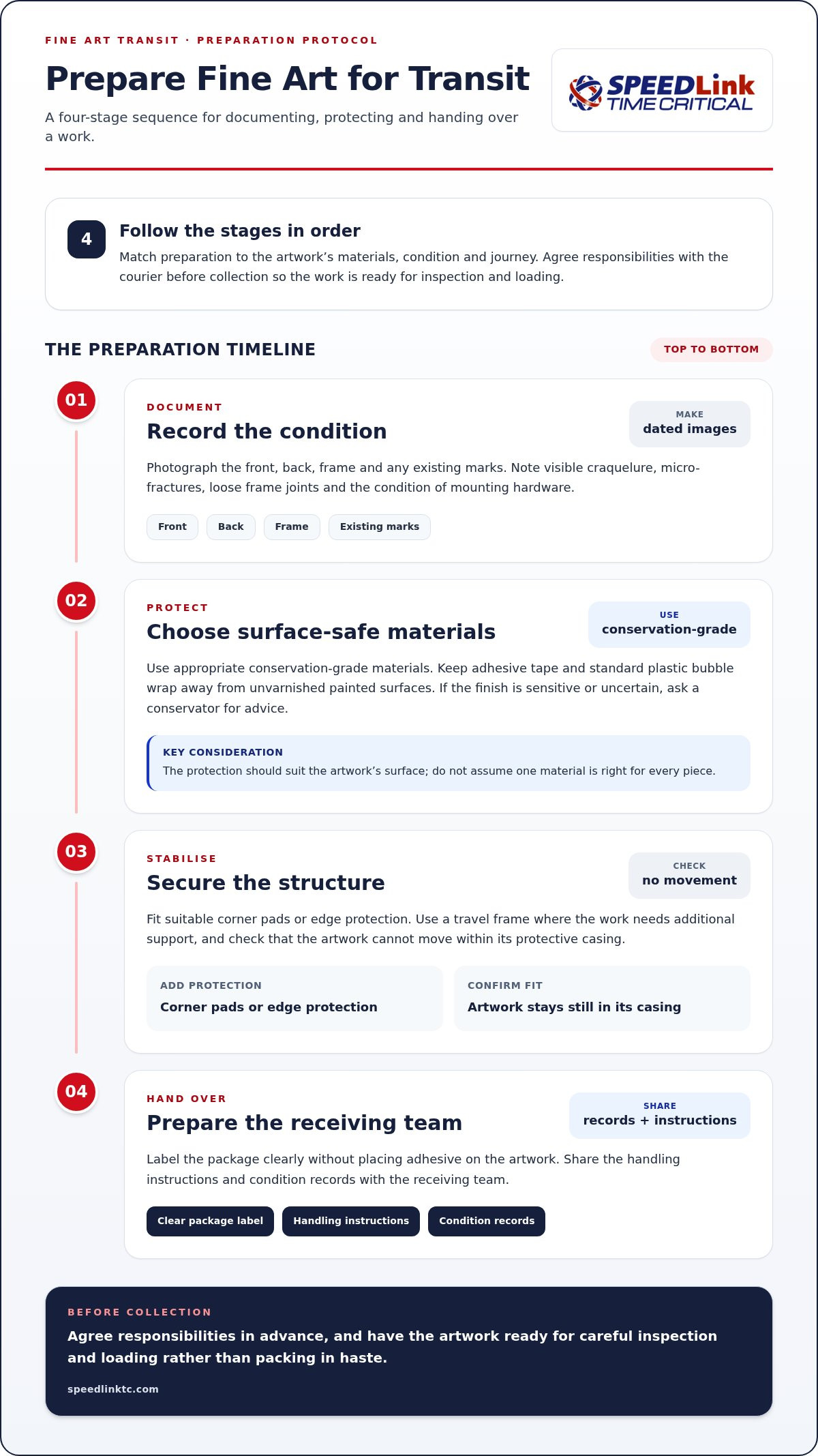
Preparation should match the artwork’s materials, condition and journey. Agree responsibilities with the courier before collection, so the work is ready for careful inspection and loading rather than being packed in haste.
- Record its condition. Photograph the front, back, frame and any existing marks in clear, dated images. Note visible craquelure, micro-fractures, loose frame joints and the condition of mounting hardware.
- Protect the surface. Use appropriate conservation-grade materials. Keep adhesive tape and standard plastic bubble wrap away from unvarnished painted surfaces; ask a conservator to advise on a sensitive or uncertain finish.
- Stabilise the structure. Fit suitable corner pads or edge protection, and use a travel frame where the work needs additional support. Check that the artwork cannot move within its protective casing.
- Prepare the handover. Label the package clearly without placing adhesive on the artwork, and share handling instructions and condition records with the receiving team.
Conservation-Safe Protection and Outer Casing
Choose protection according to the piece, not by default. Glassine or an appropriate breathable membrane may help separate a surface from external packing, whilst Tyvek can be considered where suitable. The outer casing could be a telescoping carton, bespoke flight case or wooden crate, depending on the work’s dimensions, fragility and route. No single option suits every object; seek conservation advice for delicate or vulnerable finishes.
Condition Reports and Verification
Make the delivery inspection comparable with the collection record: use the same views, note the same features and have the receiving team review the work before unpacking or installation. Thorough documentation is vital to transport risk management, helping distinguish pre-existing condition issues from changes noticed at delivery. Keep photographs and written notes together with the consignment records.
A fine art courier service UK can be planned around these preparation details, with handling and handover requirements agreed before the movement begins.
Deploying Dedicated Courier Solutions for High-Stakes Art Movements
For high-stakes art movements, operational readiness depends on more than the transport booking. Galleries, auction houses and private clients need the collection and receiving sites prepared for the work’s arrival, with access, people and handling responsibilities coordinated in advance. SpeedLink’s fine art transport solutions can be planned around the consignment and the requirements of each site.
Before dispatch, establish the packed dimensions and weight, the collection point, the intended unloading area and any restrictions on vehicle access. Confirm whether the artwork can be moved directly to the receiving space or whether site staff need to arrange an internal transfer. This prevents uncertainty at the kerb and helps both parties prepare the right people and equipment.
Time-Critical Transit for Art Fairs and Auction Deadlines
Art fairs and auction schedules can leave little room for unresolved access issues. A gallery preparing a stand, for example, should coordinate its delivery slot with venue procedures, available loading facilities and the team responsible for installation. Auction staff can similarly align arrival with the person authorised to receive the work. Build these details into the plan early, and nominate a contact who can make decisions if arrangements change.
Planning Vehicle Loading and Secure Handover Protocols
Provide handling instructions before collection, including the artwork’s orientation and any restrictions on lifting or positioning. At delivery, arrange a clear route from the vehicle to the agreed receiving point, with the space ready and the responsible recipient present. Record the handover against the consignment documentation, and make sure both sides know how to report a discrepancy or delay.
Coordinate practical site details with each location: appointment windows, sign-in requirements, loading-bay access, parking limits, stairs or lifts, and any security procedures. A fine art courier service UK should account for these operational realities as well as the artwork itself. With clear roles and timely communication, galleries and clients can prepare for arrival and keep installation or viewing plans on track.
Plan the Next Art Movement with Confidence
Every artwork presents a different set of handling and access considerations. Before arranging transport, bring together the details that shape the journey: the piece’s dimensions and condition, its packing, collection and delivery access, and any venue or viewing deadlines. This gives the transport plan a practical starting point and helps align the handover with the people responsible at both ends.
A fine art courier service UK should fit the movement, not force the artwork into a standard freight process. Whether you’re coordinating a private collection, gallery transfer or commercial delivery, SpeedLink can plan dedicated transport around the consignment and its requirements, with clear communication to support an orderly handover.
Share the essential details early, and the next steps can be organised with care. Your artwork deserves a journey planned with the same attention as its arrival.
Frequently Asked Questions
What is the difference between a standard courier and a fine art courier service in the UK?
A fine art courier service UK is arranged around the artwork’s handling needs, rather than treating it as an ordinary parcel. For example, the booking can account for the piece’s dimensions, orientation, packing and receiving arrangements. Standard courier services generally move goods through a broader parcel network. For valuable work, clarify who will oversee collection and delivery and ensure both parties understand any handling instructions.
Can framed paintings with glass be safely transported across the UK?
Yes, framed paintings with glass can be transported, provided the packaging and handling are appropriate to the work. Protect the frame’s corners, prevent the painting from shifting inside its casing and avoid packing material pressing directly on the glass. If the glass is cracked, the frame is unstable or the surface is particularly delicate, seek advice from a conservator before the journey rather than relying on extra wrapping alone.
Why is dedicated point-to-point transit recommended for high-value artwork?
It can be useful when the delivery needs to follow a specific operational sequence, such as bringing several works to an exhibition in the order they’ll be installed. The gallery can coordinate the consignment plan with its installation team and receiving arrangements, rather than fitting the delivery around a general freight schedule. This is particularly helpful when access windows or installation tasks are tightly organised.
How should sculptures and three-dimensional art be prepared for courier transport?
Describe the sculpture’s dimensions, materials, weight distribution and any delicate projections before packing. Protect protruding parts separately, support the piece at stable load-bearing points and prevent movement within its case. Removable elements should be wrapped and identified individually, with their locations recorded. Avoid placing pressure on fragile details or relying on the sculpture’s most prominent feature to support its weight.
Do fine art couriers offer same-day collection and delivery for urgent gallery sales?
SpeedLink offers a UK same-day courier service that can support time-critical gallery movements. Whether collection and delivery can both take place on the same day depends on the route, timing and practical arrangements, so no universal delivery time should be assumed. Share the collection and delivery addresses, access details, packing status and deadline promptly to help plan the movement appropriately.

Article by
Dave McMillen
I have worked in courier and logistics for over 30 years. My experience spans two continents and several types of services from road freight to airlines and specialist B2B services. SpeedLink has been serving the UK market for over 20 years providing the finest time critical and specialist services supporting businesses and individuals alike.
Disclaimer
Information is provided as general logistics guidance and is not legal, customs, aviation, medical or dangerous-goods compliance advice.
Rules vary according to commodity, quantity, classification, packaging, origin, destination, transport mode and carrier.
Regulations and carrier requirements may change.
Where regulated goods are involved, current requirements should be confirmed with the appropriate government authority, regulator, carrier or qualified specialist before shipment.
SpeedLink can confirm the transport options it can provide for a particular shipment.


