


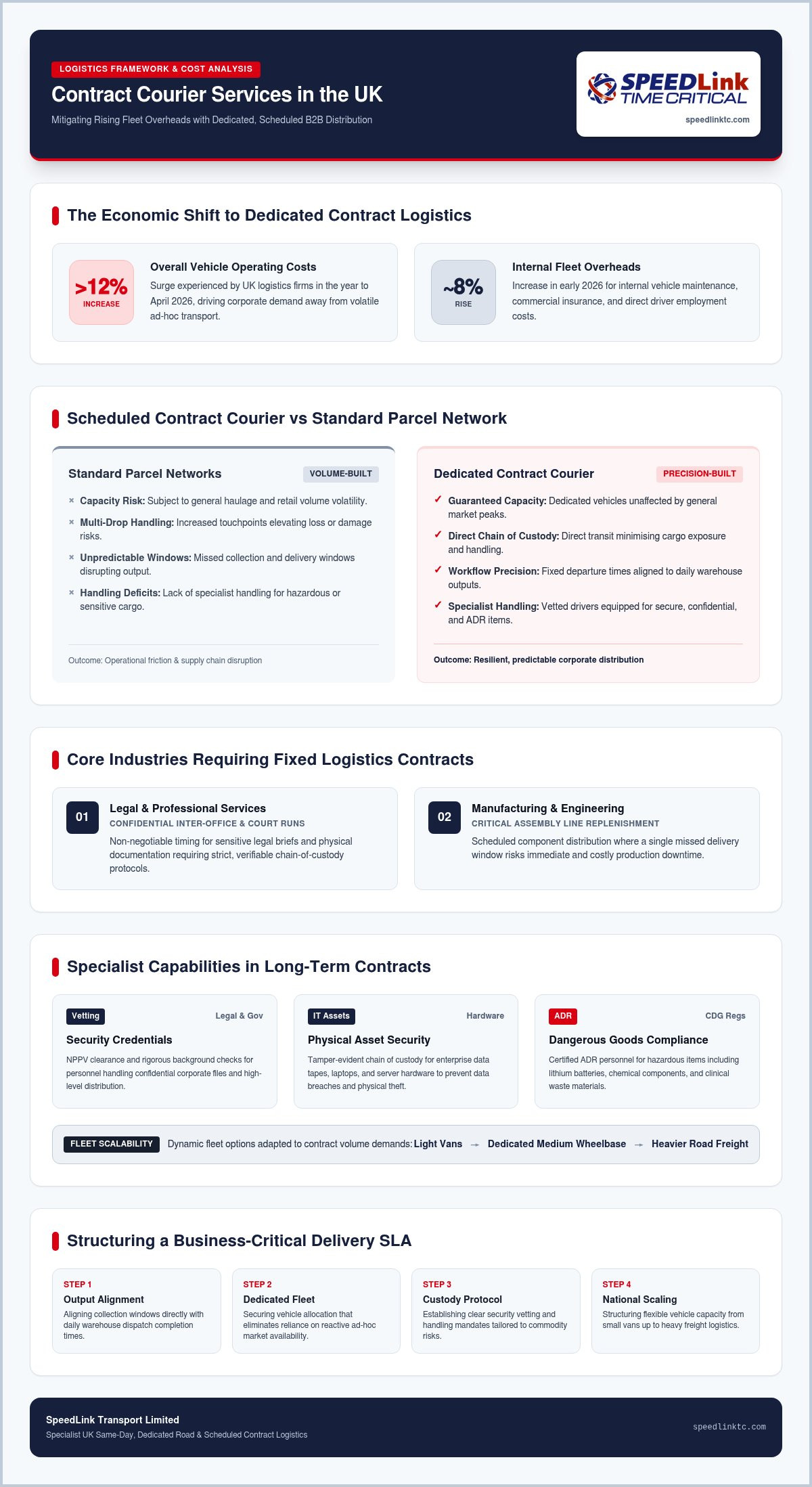
With overall vehicle operating costs for logistics firms increasing by over 12% in the year to April 2026, corporate operations can no longer afford the compounding expenses of failed deliveries or unpredictable supply chain disruptions. If your business relies on standard parcel networks for critical repeat routes, you’ve likely experienced the operational friction of missed windows and a total lack of specialist handling for sensitive or hazardous commercial items. This is why establishing a dedicated contract courier service UK wide has become a baseline requirement for resilient corporate distribution.
We understand that maintaining absolute delivery precision shouldn’t mean absorbing massive internal fleet management overheads. In this guide, you’ll discover how to establish a reliable, secure contract courier service UK wide to optimise your recurring business distribution. We examine the core components of a resilient, scheduled transport framework, demonstrating how a long-term logistics partnership protects your high-stakes cargo with a transparent, uncompromising chain of custody.
Key Takeaways
- Learn how to eliminate the logistical burden of internal fleet management by transitioning to a scheduled, recurring transport model.
- Identify the essential security credentials and specialist handling capabilities required to maintain a secure contract courier service UK wide for sensitive assets.
- Understand how to structure precise Service Level Agreements (SLAs) that align collection windows with your daily operational output for maximum efficiency.
- Discover the strategic advantages of partnering with a logistics expert capable of managing national supply chain requirements through dedicated distribution infrastructure.
Understanding the Value of a Contract Courier Service UK Network
A courier service on a contract basis differs from standard retail delivery by focusing on scheduled, recurring transport for corporate assets. By implementing a contract courier service UK solution, companies move away from the reactive nature of ad-hoc bookings. Capacity remains guaranteed. This strategic shift allows organisations to eliminate the significant overheads associated with internal fleet management, such as vehicle maintenance, insurance, and driver employment costs, which rose by nearly 8% in early 2026. Contract logistics stabilise national supply chains by securing dedicated capacity that remains unaffected by the volatility of the general haulage market.
Dedicated contract vehicles ensure a direct chain of custody for your commercial goods, reducing the risk of loss or damage inherent in multi-drop networks. SpeedLink provides this via our same day courier infrastructure, ensuring that high-stakes cargo is handled by professionals who understand the specific requirements of your route. It’s a matter of precision.
Scheduled Runs vs Ad-Hoc Same-Day Courier Services
While ad-hoc transport addresses immediate emergencies, contracts introduce long-term operational predictability. Implementing a contract courier service UK framework allows warehouse and dispatch teams to organise their daily workflows with precision. Instead of waiting for a vehicle to become available, teams work to a known departure time, which streamlines the entire internal supply chain. Consistency drives results.
Core Industries Requiring Fixed Logistics Contracts
Certain sectors can’t rely on the uncertainty of standard networks. Legal firms often require a secure courier for document distribution between offices and courts, where timing is non-negotiable. Similarly, in manufacturing, reliable parts distribution is essential to keep assembly lines functioning; a single missed delivery can result in costly production downtime. Reliability is mandatory here.
Evaluating Specialist Capabilities in Long-Term Logistics Contracts
Standard parcel networks are built for volume, not vulnerability. When managing high-value or highly regulated corporate assets, these networks often fail because they lack specialist handling protocols. A robust contract courier service UK framework must prioritise risk mitigation through verified security credentials. This approach reflects modern principles of strategic supply chain management, where resilience is integrated into the logistics partner’s core competency.
Security Vetting and Confidential Document Transport
Security vetting serves as the foundation of trust in corporate logistics. For high-level legal and government distribution, NPPV clearance is non-negotiable. It ensures that the personnel handling sensitive files have undergone rigorous background checks. Beyond documentation, secure logistics must extend to physical hardware. Transporting data tapes, laptops, or server hardware requires a secure courier capable of maintaining a strict chain of custody. This prevents data breaches and physical theft during transit.
Hazardous Materials and Dangerous Goods Compliance
Compliance is a legal mandate. Contracts involving lithium batteries, chemical components, or clinical waste require certified ADR transport personnel. These drivers possess the training to handle dangerous goods safely, ensuring your business adheres to the Carriage of Dangerous Goods (CDG) regulations. Verify that your dangerous goods courier provider holds the specific certifications needed for your commodity class. Failure to do so exposes your firm to significant legal and financial risk.
Your logistics partner must demonstrate scalability. They should provide everything from light vans to heavier freight options as your demand fluctuates. If you’re unsure whether your current provider meets these specialist standards, you can contact our team to discuss a tailored audit of your requirements.
How to Structure a Business-Critical Delivery Schedule and SLA
Structuring a robust Service Level Agreement (SLA) requires more than just listing destinations. It demands a precise alignment between your daily operational output and specific collection windows. A high-performing contract courier service UK partner acts as an extension of your warehouse team, ensuring that scheduled runs don’t just happen, but happen with methodical precision. This level of planning is a core component of the UK government’s supply chain strategy, which emphasises the need for resilient, proactive logistics frameworks to mitigate national disruptions.
Key performance indicators (KPIs) should be clearly outlined to monitor both punctuality and driver behaviour. We recommend incorporating contingency clauses that allow for unexpected volume surges, ensuring that a sudden spike in demand doesn’t compromise your delivery precision. Clear communication protocols for transit updates and proof of delivery must be established from the outset.
Defining the Scope of Your Distribution Requirements
Start by auditing your weekly delivery volumes to determine the optimum vehicle sizes for each route. Over-specifying leads to wasted spend, whilst under-specifying risks delays. Avoid relying on rigid regional hubs that introduce unnecessary touchpoints. Instead, look for a partner that facilitates direct transport, particularly for time-critical industrial and engineering components that require immediate transit across the country.
Establishing Chain of Custody Protocols
For sensitive handovers in the life sciences and healthcare or legal sectors, signature requirements must be absolute. Establishing clear chain of custody protocols ensures that every asset is accounted for from pick-up to final delivery. Real-time visibility technology is standard; however, the protocols should define exactly how and when transit updates are communicated to your operations team, ensuring total transparency throughout the journey.
Securing Your National Supply Chain with SpeedLink Logistics
SpeedLink Transport Limited provides tailored contract solutions designed for complex, high-stakes corporate logistics. Our national network accommodates scheduled same-day transport across multiple business sectors, ensuring that your recurring distribution remains precise and secure. By implementing a contract courier service UK solution, your organisation gains access to a dedicated infrastructure that prioritises commercial assets over generic parcel volume. We maintain strict compliance across all movements, from delicate fine art transport to heavy-duty industrial and engineering components.
Why Enterprise Brands Rely on Our Dedicated Fleet
We focus entirely on B2B operations. This strategic choice allows us to avoid the inherent disruptions and delays common in residential parcel networks, which often face seasonal volatility. Our fleet is managed with a sense of methodical control. Drivers are trained in specialist handling protocols, ensuring that high-value or sensitive items are never treated as mere commodities. Reliability is our standard. Because we operate outside the constraints of standard hubs, your goods remain in a direct chain of custody, significantly reducing the risk of transit damage.
Initiating Your Corporate Partnership
Establishing a successful logistics partnership requires a proactive guide. We begin by reviewing your existing logistics challenges to construct a route plan that maximises efficiency whilst reducing fleet management overheads. When you secure a contract courier service UK wide with SpeedLink Transport Limited, our procurement team works collaboratively with yours to define every variable, from collection windows to specific security requirements. This ensures the transport framework is resilient enough to withstand national supply chain shocks.
To begin this process, we invite you to visit the SpeedLink Transport Limited contact page for a bespoke contract consultation. We’ll help you organise a distribution schedule that meets your exact operational requirements with professional authority and precision.
Optimising Your Corporate Distribution Strategy
Transitioning from reactive ad-hoc logistics to a structured contract courier service UK wide provides the operational predictability necessary for high-stakes corporate sectors. By outsourcing recurring distribution, organisations successfully eliminate internal fleet management overheads whilst securing access to specialist capabilities that generic networks simply cannot match. This strategic shift ensures that your high-value assets remain in a dedicated, secure environment from collection to final handover.
SpeedLink operates as a proactive strategic partner, offering a dedicated national B2B network supported by NPPV security cleared transport specialists. We maintain full ADR compliance for hazardous cargo and electronics, ensuring that every movement adheres to strict regulatory standards. Our methodical approach to chain of custody provides the reassurance that your mission-critical shipments are handled with expert precision and professional authority.
Establishing a resilient, scheduled transport framework today protects your national supply chain against unforeseen future disruptions. We’re ready to help you construct a logistics plan that prioritises efficiency and absolute delivery precision.
Frequently Asked Questions
What is included in a standard contract courier service UK agreement?
A standard contract courier service UK agreement includes defined collection windows, specified vehicle types, and agreed-upon insurance limits for commercial goods. It outlines the recurring route schedules and reporting frequencies for proof of delivery. Agreements often incorporate volume-based pricing structures that provide cost stability. By formalising these variables, businesses secure dedicated capacity that remains unaffected by the seasonal fluctuations typical of general haulage networks.
Can hazardous materials be included in a recurring delivery contract?
Hazardous materials, such as lithium batteries and chemical components, can be included in a contract provided the transport provider maintains full ADR compliance. Drivers must hold valid certifications for the specific commodity classes being moved. SpeedLink facilitates these movements through certified personnel and appropriately equipped vehicles. This ensures all recurring shipments adhere to the Carriage of Dangerous Goods regulations, mitigating legal risks for the contracting organisation.
How does an outsourced contract courier service reduce corporate fleet costs?
Outsourcing reduces corporate fleet costs by eliminating the capital expenditure required for vehicle acquisition and the ongoing burden of maintenance, fuel, and insurance. It also removes the complexities of driver employment and training. As vehicle operating costs increased by over 12% in early 2026, shifting to a contract model allows businesses to convert high fixed costs into predictable variable expenses while maintaining absolute distribution precision.
What security clearances should I look for in a contract courier?
For contracts involving high-level legal, government, or sensitive corporate assets, look for personnel with NPPV (Non-Police Personnel Vetting) clearance. This level of vetting ensures that individuals handling your property have undergone rigorous background checks. It’s also essential to verify that the provider maintains a strict chain of custody protocol. These security measures are vital when transporting confidential documents, data tapes, or high-value IT equipment across a national network.
How are service level agreements managed for time-critical contract runs?
Service level agreements for time-critical runs are managed through specific key performance indicators, focusing on punctuality and collection window adherence. Real-time visibility technology is utilised to monitor transit progress, allowing for proactive intervention if delays occur. These SLAs define the communication protocols for status updates and exceptions. By establishing these metrics, logistics managers ensure the contract courier service UK provider maintains the precision required for high-stakes industrial or medical operations.

Article by
Dave McMillen
I have worked in courier and logistics for over 30 years. My experience spans two continents and several types of services from road freight to airlines and specialist B2B services. SpeedLink has been serving the UK market for over 20 years providing the finest time critical and specialist services supporting businesses and individuals alike.
Disclaimer
Information is provided as general logistics guidance and is not legal, customs, aviation, medical or dangerous-goods compliance advice.
Rules vary according to commodity, quantity, classification, packaging, origin, destination, transport mode and carrier.
Regulations and carrier requirements may change.
Where regulated goods are involved, current requirements should be confirmed with the appropriate government authority, regulator, carrier or qualified specialist before shipment.
SpeedLink can confirm the transport options it can provide for a particular shipment.


