


ADR goods can travel same-day in the UK when their classification, packaging and transport requirements are suitable for the consignment. ADR courier services in the UK can also support next-day delivery, with the route and handling plan shaped by the goods and their destination.
Urgency matters, but it isn’t the only factor: an unclear classification or incomplete consignment information can affect whether a shipment is accepted and how it moves. This article explains how classification review influences acceptance, what to prepare for a same-day or next-day movement, and how delivery planning differs for hazardous goods. You’ll also see how dedicated courier transport can fit urgent consignments across the Midlands and the wider UK, without assuming that every ADR shipment needs the same solution.
Key Takeaways
- Same-day transport may suit an ADR consignment when its classification, packaging, labels and documentation are ready for carriage.
- Delivery planning depends on the goods, route and handling requirements, so same-day and next-day movements need different operational plans.
- Review the goods’ classification and consignment details early to help establish whether they can be accepted and how they should be transported.
- Consider how collection and delivery locations across the Midlands and wider UK affect the practical transport plan.
Can You Transport ADR Goods Same-Day?
Yes, ADR goods can travel by road on the same day when their classification, packaging, documentation and transport arrangements are in order. These requirements affect whether the consignment can be accepted and how it can be moved safely.
Packaging, Labelling and Documentation
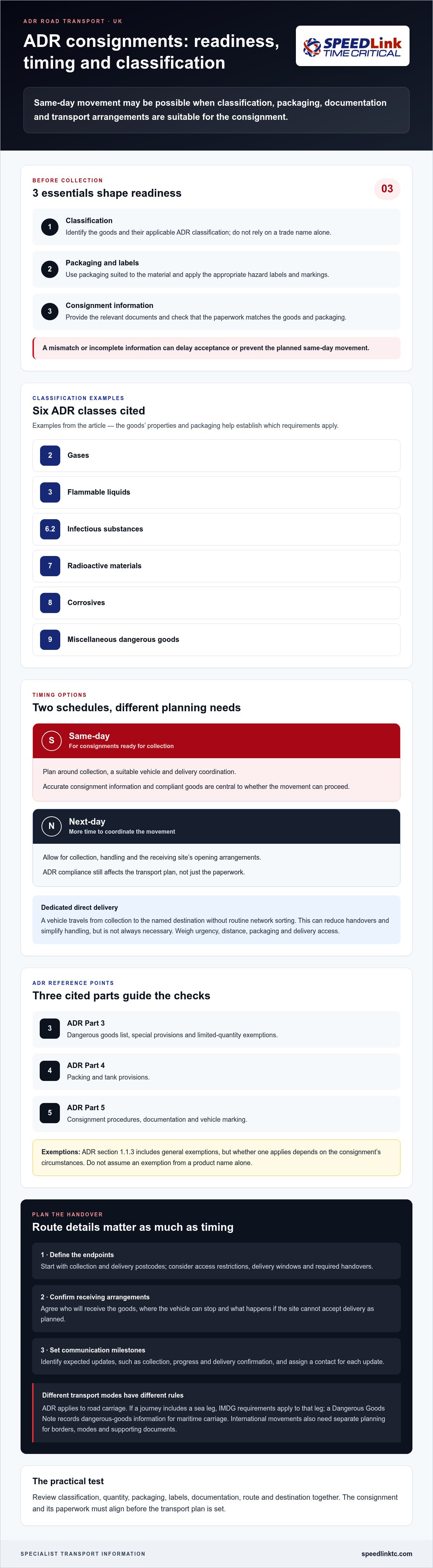
Start by identifying the goods and their ADR classification. ADR Part 3 covers the dangerous goods list, special provisions and limited-quantity exemptions; the applicable class determines packaging and marking requirements. Use packaging suited to the material, with appropriate hazard labels. ADR Part 4 covers packing and tank provisions, while Part 5 addresses consignment procedures, documentation and vehicle marking.
The sender is responsible for classifying the goods, providing the relevant documents, using compliant packaging and applying the appropriate hazard labels. Check these details against the consignment before dispatch. Any mismatch between the goods, labels and paperwork can delay acceptance or prevent the planned same-day movement.
Shipment Risks, Restrictions and Liability
The main risks include exposure, leakage, incorrect handling and a delay caused by inaccurate classification or incomplete paperwork. ADR road transport rules are set under the European Agreement concerning the International Carriage of Dangerous Goods by Road. In Great Britain, the Carriage of Dangerous Goods and Use of Transportable Pressure Equipment Regulations 2009 apply ADR in England, Wales and Scotland.
ADR includes general exemptions at section 1.1.3, but an exemption depends on the consignment’s circumstances. It should not be assumed from a product name alone. The sender’s classification and documentation duties remain central to assessing the shipment and its obligations.
Same-day transport depends on having accurate information and compliant goods ready for collection. The driver and transport arrangements must suit the shipment’s requirements. If the journey includes a sea leg, the cargo information must also support IMDG-compliant transport. A Dangerous Goods Note records dangerous-goods information for maritime carriage. ADR applies to road carriage, while IMDG requirements apply to the sea leg.
To prepare, provide the goods’ classification, packaging details, labels and consignment documentation together. This gives the carrier the information needed to assess acceptance, select an appropriate transport plan and identify issues before collection. Dangerous goods transport requires this practical alignment between the cargo and its paperwork.
Same-day and next-day delivery
Same-day and next-day delivery can suit urgent UK consignments, but the schedule must fit the goods and route. Same-day planning focuses on collection, a suitable vehicle and delivery coordination. Next-day planning allows more time to coordinate collection, handling and the receiving site’s opening arrangements. In either case, ADR compliance affects the transport plan, not just the paperwork.
For a dedicated direct-delivery journey, the vehicle travels from collection to the named destination without routine network sorting. This can reduce handovers and simplify handling for sensitive consignments. It is not always necessary, so weigh urgency, distance, packaging and delivery access before choosing a service. An urgent consignment of corrosive materials, for example, may need a different plan from packaged goods on a less time-critical schedule.
Route planning starts with the collection and delivery postcodes, then accounts for access restrictions, delivery windows and any required handover. Explosives and other dangerous goods require careful coordination between shipment details and the route. Agree who will receive the goods, where the vehicle can stop and what should happen if the receiving site cannot accept delivery at the planned time. These details help avoid unnecessary waiting or a failed handover.
Tracking is most useful when the sender and recipient know which milestones to expect, such as collection, progress updates and delivery confirmation. Assign a contact for each update before dispatch, especially if the site has controlled access or timed receiving. For UK-wide consignments, plan around the actual endpoints rather than assuming all routes have the same conditions. International movements need separate planning for borders, transport modes and supporting documents. ADR road requirements do not replace the rules for other modes.
For an urgent shipment, share the route and consignment details to discuss a practical delivery plan.
Goods accepted subject to classification and review
Acceptance starts with the substance, its ADR classification and the consignment details, not just its trade name. ADR section 2.1 introduces classification; examples include Class 2 gases, Class 3 flammable liquids, Class 8 corrosives and Class 9 miscellaneous dangerous goods. Class 6.2 covers infectious substances, while Class 7 covers radioactive materials. A product’s properties and packaging help establish which requirements apply.
Review the classification, quantity, packaging and destination together. These details shape handling, vehicle arrangements and whether same-day or scheduled transport is suitable. For a flammable liquid, for example, the shipment information must accurately describe its contents and packaging. A cross-border route into Europe also requires consideration of the origin, destination and customs arrangements alongside dangerous-goods requirements. Do not assume UK and European movements have identical requirements.
Driver competence is part of safe carriage. The research facts state that UK drivers transporting hazardous goods must hold a valid ADR licence, and drivers should know how to use a fire extinguisher. Training and safety support must match the consignment and transport duties. Clear handover information helps crews understand what they are carrying and how to respond during loading and delivery.
Decide on timing after reviewing the consignment. Same-day transport suits goods ready for collection with classification and handling requirements established; scheduled transport may suit planned replenishment or movements coordinated with a receiving site. Palletised hazardous materials that need interim storage require a separate custody and site-control plan. Acceptance for transport does not establish storage arrangements. Record the pallet contents, labels, handling instructions and intended onward movement to keep storage and carriage plans aligned.
A practical review follows a clear sequence: identify each substance, provide its classification and packaging details, then share the route and delivery requirements. This lets the transport plan address the specific goods rather than assuming every substance needs the same arrangements.
ADR courier services across the UK
National transport planning starts with the full collection and delivery addresses, not broad area names. Distance, access, delivery windows and the receiving site’s operating arrangements all shape the route and suitable service plan.
ADR and Standard Courier Services
Standard courier networks typically combine consignments and route them through scheduled sorting points. A specialist ADR movement needs a plan tailored to the shipment’s journey and handover requirements. This distinction matters when a receiving site has a fixed delivery window or limited vehicle access.
Compare service options by urgency, route directness and the number of handovers. A dedicated journey may suit a time-critical delivery between business sites, while a less urgent movement may fit a scheduled service. Choose according to the operational need rather than defaulting to the most intensive option.
ADR Courier Service Costs
The price depends on the consignment and is provided after a quote request. Factors include route distance, timing, vehicle requirements, access conditions and any waiting or delivery coordination needed. A straightforward business-to-business handover may need a different plan from a site with timed entry or complex receiving arrangements.
For a useful estimate, provide full postcodes, preferred collection and delivery windows, consignment dimensions and any access constraints. This helps shape the proposed journey around the actual route and service level.
Booking an ADR Courier
Start with the collection and delivery addresses, required arrival time and receiving contact details. Note any restrictions, such as security gates, vehicle access limits, site induction procedures or a booking reference required on arrival. These practical details help prevent avoidable delays at either end of the journey.
For regular movements, share recurring route patterns and receiving windows when arranging transport. For a one-off urgent consignment, state the deadline and any flexibility in the delivery window. A clear brief helps match the route plan to the business need.
SpeedLink Transport Limited: Same Day Courier
SpeedLink Transport Limited provides a Same Day Courier service for urgent business consignments. Once the shipment’s classification, documentation and handling needs are clear, this can suit time-critical movements where direct delivery matters.
For European movements, SpeedLink also provides EU shipping with customs clearance. Exhibition and Events Courier services support event logistics, while the NPPV Cleared Courier Service addresses secure transport requirements. The right option depends on the shipment’s purpose, route and operational needs, not urgency alone.
Share the consignment details, collection and delivery locations, and required timing with SpeedLink Transport Limited to discuss the appropriate next step. Contact SpeedLink Transport Limited to discuss your requirements.
Make the next movement easier to plan
For future ADR courier services in the UK, establish a clear handover process between the teams preparing, dispatching and receiving each consignment. A concise shipment brief helps procurement and operations teams capture the information needed for transport planning. Naming a contact for collection and delivery also reduces uncertainty during handover.
Make that brief part of your routine logistics workflow. Record the shipment description, route, timing requirements and receiving arrangements together, then share them when planning a movement. This gives transport planning a practical starting point and keeps attention on the needs of each consignment.
A well-prepared brief is a practical first step towards a more controlled transport plan.
Frequently Asked Questions
What Are ADR Transport Services & Why Do They Matter?
ADR transport services arrange road carriage for consignments classified as dangerous goods. The cargo can affect how a movement is planned, from vehicle allocation to delivery handover. For a manufacturer sending a product sample, sharing its precise identity and destination early helps the transport planner assess the journey before collection arrangements are made.
What consignments are considered dangerous goods under ADR regulations?
A consignment is considered dangerous when its contents meet the criteria for an ADR dangerous-goods classification. A trade name alone may not explain a product’s transport characteristics, particularly for mixtures or products with different formulations. Provide an accurate description of the goods, including relevant product details, so the consignment can be assessed by its contents rather than assumptions based on its commercial label.
Are There Any Rules For ADR Transportation?
Yes. Requirements cover more than the journey itself: they can include loading and unloading, vehicle operation, crew equipment, and vehicle construction or approval. The applicable provisions depend on the movement and cargo. Dispatch teams should treat loading, transit and delivery as connected stages, with responsibilities and handover arrangements understood before the vehicle leaves.
Are there any restrictions on where you can deliver ADR goods?
Delivery depends on whether the route and receiving location can accommodate the consignment and its transport arrangements. A site may have restricted vehicle access, controlled entry or limited receiving hours. Cross-border movements also need planning for the route beyond the UK. Provide the exact origin, destination and delivery-site instructions so the proposed movement accounts for practical access and handover needs.
Do You Help With ADR Documentation?
Documentation requirements depend on the goods and transport mode. For road transport, prepare the paperwork required for the consignment; if the shipment includes a sea leg, maritime documentation may also be relevant. Keep the documents with the information used to arrange transport, and make sure they describe the goods actually being dispatched. This supports a clear handover between the sending and receiving teams.
Do all drivers have ADR certification?
No. The ADR licence requirement applies to UK drivers transporting hazardous goods, not automatically to every courier driver. When arranging a collection, identify the consignment as dangerous goods at booking so the assignment reflects its transport needs. This distinction matters when a company uses different types of courier movement: ordinary courier duties alone do not mean a driver needs ADR licensing.

Article by
Dave McMillen
I have worked in courier and logistics for over 30 years. My experience spans two continents and several types of services from road freight to airlines and specialist B2B services. SpeedLink has been serving the UK market for over 20 years providing the finest time critical and specialist services supporting businesses and individuals alike.
Disclaimer
Information is provided as general logistics guidance and is not legal, customs, aviation, medical or dangerous-goods compliance advice.
Rules vary according to commodity, quantity, classification, packaging, origin, destination, transport mode and carrier.
Regulations and carrier requirements may change.
Where regulated goods are involved, current requirements should be confirmed with the appropriate government authority, regulator, carrier or qualified specialist before shipment.
SpeedLink can confirm the transport options it can provide for a particular shipment.


