


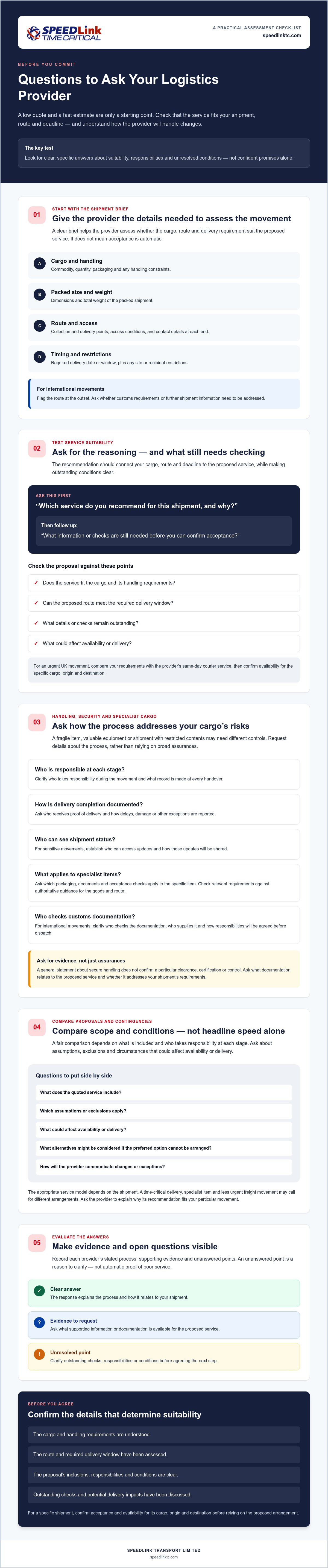
A low quote and a fast delivery estimate don’t, on their own, show that a provider is right for a business-critical shipment. The questions to ask your logistics provider should establish whether the service fits your shipment’s contents, dimensions, route and deadline, and how the provider will respond if plans change. Clear, specific answers matter more than confident promises.
Price and transit time are useful starting points, but a fair comparison also depends on what’s included and who takes responsibility at each stage. Use this checklist to assess service suitability, handling, tracking, communication, quote details and accountability before you commit. The right service model depends on the shipment: a time-critical delivery, a specialist item and a less urgent freight movement may call for different arrangements.
Key Takeaways
- Describe the cargo, packed dimensions and weight, handling needs, route and required delivery date before asking which service is suitable.
- Use the questions to ask your logistics provider to clarify custody records, handovers, proof of delivery and shipment updates.
- Compare service models by checking what the proposal includes and which conditions could affect availability or delivery.
- Assess each provider’s evidence of capability, ownership, communication and unresolved risks before agreeing the next step.
Questions to Ask Your Logistics Provider About Shipment Fit
Describe the shipment before asking which service the provider recommends. A clear brief helps the provider assess whether the cargo, route and delivery requirement suit the proposed service, but it doesn’t mean acceptance is automatic. Ask what checks are needed before the booking can be confirmed.
What shipment information should you provide first?
Prepare the details the provider needs to assess the movement. Include:
- Cargo: commodity, quantity, packaging and any handling constraints.
- Size and weight: dimensions and total weight of the packed shipment.
- Route: collection and delivery points, access conditions and contact details at each end.
- Timing: the required delivery date or window, plus any site or recipient restrictions.
Flag international movements at the outset. The provider can then assess whether the route is suitable and whether customs requirements or further shipment information need to be addressed. This is part of a wider supply chain management decision: transport needs to fit the shipment’s operational role, not just its destination.
How do you test whether the service is suitable?
Ask: “Which service do you recommend for this shipment, and why?” Follow up with: “What information or checks are still needed before you can confirm acceptance?” A useful answer should explain how the cargo, route and deadline inform the recommendation, and identify any conditions that remain unresolved.
For an urgent movement within the UK, compare your requirements with the provider’s same-day courier service, then confirm availability for the specific cargo, origin and destination. Use these questions to check the proposal:
- Does the service fit the cargo and its handling requirements?
- Can the proposed route meet the required delivery window?
- What details or checks remain outstanding?
- What could affect availability or delivery?
These practical questions to ask your logistics provider help distinguish a suitable proposal from one that still needs clarification.
Questions to Ask About Handling, Security and Specialist Cargo
Ask the provider to explain how its proposed handling process addresses the risks of your specific cargo. A fragile item, valuable equipment or shipment with restricted contents may need different controls. Request details about the process rather than relying on broad assurances.
How will the provider control handling and handovers?
Clarify who is responsible at each stage and what record is made at every handover. Ask how delivery completion is documented, who receives proof of delivery and how delays, damage or other exceptions are reported. For sensitive movements, establish who can access shipment status and how updates will be shared.
Keep claims evidence-based. A general statement about secure handling doesn’t confirm a particular security clearance, certification or control. Ask what documentation the provider can share that relates to the service being proposed, and make sure the answer addresses your shipment’s requirements.
What changes for specialist or sensitive shipments?
For specialist cargo, ask which packaging, documents and acceptance checks apply to the specific item. Check requirements against authoritative guidance relevant to the goods and route, and establish what information the provider needs before confirming acceptance. For international movements, ask who checks customs documentation, who supplies it and how responsibilities will be agreed before dispatch.
If secure transport is relevant, review the provider’s secure courier service and confirm whether it’s available for your shipment, origin and destination. You can also use a checklist tool for evaluating 3PL candidates to structure your assessment.
Compare providers in a simple table, recording each one’s stated process, supporting evidence and unanswered questions. This makes differences visible without treating an unanswered point as automatic proof of poor service. These questions to ask your logistics provider help you identify what needs clarification before committing. For a specific shipment, discuss its handling requirements with SpeedLink and confirm which options are available.
Questions to Compare Service Models, Communication and Contingencies
Compare proposals by scope, assumptions and exclusions, not headline speed alone. Ask what the quoted service includes, which events could affect availability or delivery, and what alternatives might be considered if the preferred option can’t be arranged. This gives procurement and operations teams a like-for-like basis for assessing suitability and risk.
Which transport option matches the shipment?
Ask the provider to explain why it recommends a particular mode. A dedicated vehicle may suit a shipment that needs direct transport. Hand-carry or next-flight-out may be options to explore when international urgency is central. Road freight or air freight may suit different route, cargo and timing requirements. These options aren’t interchangeable, and availability depends on the shipment and route.
Ask what constraints shape the recommendation and whether a less time-critical alternative would meet the requirement. For cross-border movements, clarify who checks the documentation and who is responsible for supplying it. Review the provider’s information on EU shipping with customs clearance, then confirm the arrangements for your specific origin and destination.
What happens when plans change?
Before booking, establish the operational contact, agreed update channel and escalation route. Ask how the provider will communicate a delay, access problem, missed handover or change to delivery instructions, and who needs to approve a revised plan. Clear ownership helps prevent instructions being lost between teams.
- What’s included in the proposal, and what’s excluded?
- Which assumptions affect availability, routing or delivery?
- How are changes and exceptions reported, and by whom?
- What alternatives can be considered if the original plan is disrupted?
Don’t treat an estimated transit time as a guarantee, or assume a collection or flight is confirmed until the provider verifies it. These questions to ask your logistics provider help expose differences between proposals and identify what still needs confirmation.
How to Evaluate Provider Answers and Agree Your Next Step
Assess each provider against the same shipment brief and decision criteria. A confident response is useful only if it separates confirmed capability from assumptions, proposed arrangements and checks still to be completed. Vague answers aren’t automatically a reason to reject a provider, but they should prompt specific follow-up questions.
How can procurement teams compare answers fairly?
Use a simple scorecard to record the evidence behind each proposal, who owns the shipment, how communication will work and which risks remain unresolved. For every provider, note what is confirmed, what depends on further checks and what’s excluded. This makes gaps visible and helps you compare service scope fairly, rather than relying on broad assurances or headline claims.
- Capability evidence: Is the response specific to the cargo and route?
- Ownership: Is a responsible contact identified?
- Communication: Are update and escalation arrangements clear?
- Open points: Are outstanding checks, dependencies and exclusions recorded?
What should you confirm before instructing a provider?
Before authorising the shipment, obtain written confirmation of the agreed service and route, cargo acceptance, responsibilities, operational contacts and shipment-specific handling requirements. Record assumptions and conditions that could affect availability or delivery. If an answer remains unclear, resolve it before dispatch rather than treating silence as agreement.
This final review turns the questions to ask your logistics provider into a practical decision record. It also gives both parties a shared reference if shipment details or arrangements change. SpeedLink offers same-day, express and economy delivery, alongside specialist courier and logistics services. Suitability depends on the shipment, origin and destination, so confirm the available options for your requirements before committing.
Make Your Next Logistics Decision With Confidence
The most useful questions to ask your logistics provider establish whether the service fits your shipment, how handling and communication will work, and what must be confirmed before dispatch. Compare proposals against the same requirements, distinguish evidence from assumptions, and record the service scope, responsibilities and open risks in writing.
SpeedLink offers same-day, express and economy delivery, as well as specialist options including secure NPPV cleared courier services, IT equipment, dangerous goods, fine art and event logistics. Suitability depends on the cargo, handling requirements, origin and destination, so confirm availability for your shipment before making a decision.
Bring your shipment details and questions to the discussion. A clear brief helps establish which options may be appropriate and what needs checking before you proceed.
Discuss your shipment requirements with SpeedLink
To assess the options for your shipment, contact SpeedLink with your requirements.
Frequently Asked Questions
What questions should I ask a logistics provider before choosing one?
The most useful questions to ask your logistics provider establish whether it can assess your exact cargo, route, handling requirements and delivery needs. Ask which service it recommends and why, who is responsible at each stage, how updates and exceptions are managed, and what documentation is required. Request written confirmation of the agreed scope and any conditions that still need to be resolved before you instruct the provider.
How can I compare logistics providers fairly?
Give each provider the same accurate shipment brief and ask the same operational questions. Compare the proposed service, handling process, communication arrangements, assumptions and exclusions. Separate confirmed capabilities from details that remain subject to checks. A like-for-like comparison helps you assess the full scope of each proposal, rather than choosing on headline speed or broad assurances that may not reflect your shipment’s requirements.
What should I ask a courier about tracking and proof of delivery?
Ask how shipment progress is reported, who will provide updates and how you can raise an urgent issue. Confirm what proof of delivery is available, who receives it and how exceptions, such as a delay or unsuccessful handover, are communicated. Tracking and reporting arrangements can vary by service and shipment, so ask the provider to describe the process it can offer for your specific movement.
What should I ask about transporting specialist or sensitive goods?
Describe the goods accurately, including relevant handling constraints, and ask what acceptance checks, packaging details or documents the provider needs. Clarify how handovers and custody records are managed where relevant. Don’t assume that a provider accepts a particular commodity or holds a specific approval. Request current confirmation that its proposed service suits the cargo, route and handling requirements before booking.
Should I choose a dedicated courier or a standard network service?
The right choice depends on your cargo, route, urgency, handling needs and operational constraints. Ask the provider to explain why its recommendation fits, what alternatives are available and what each option involves. Dedicated transport, hand-carry, air freight and network services have different operating models; they aren’t interchangeable. Confirm the suitability and availability of any option for your particular shipment before committing.

Article by
Dave McMillen
I have worked in courier and logistics for over 30 years. My experience spans two continents and several types of services from road freight to airlines and specialist B2B services. SpeedLink has been serving the UK market for over 20 years providing the finest time critical and specialist services supporting businesses and individuals alike.
Disclaimer
Information is provided as general logistics guidance and is not legal, customs, aviation, medical or dangerous-goods compliance advice.
Rules vary according to commodity, quantity, classification, packaging, origin, destination, transport mode and carrier.
Regulations and carrier requirements may change.
Where regulated goods are involved, current requirements should be confirmed with the appropriate government authority, regulator, carrier or qualified specialist before shipment.
SpeedLink can confirm the transport options it can provide for a particular shipment.


