


A customs bond can allow goods to move before duties and taxes are paid. To understand what a bonded courier is, start with the carrier’s role: it transports goods under bond while customs requirements remain in force, rather than treating the shipment as fully cleared for import. For goods passing through a country en route elsewhere, this can allow transit without formal import into that country.
Customs authorisation involves more than paperwork: a bond can support the movement of uncleared goods to their declared destination. The precise arrangements depend on the country and route. This article explains how bonded status relates to customs authorisation, what happens to goods moving under bond, and which businesses commonly use these services. It also clarifies when a bonded movement is relevant to international transport, helping you distinguish it from a standard courier movement and understand what it means for your shipment.
Key Takeaways
- Understand how a customs bond allows goods to move before duties and taxes are settled, and why the shipment’s destination matters.
- Learn how customs authorisation and transport documents support bonded movements, including the role of Form 7512 in the United States.
- See which sectors commonly use bonded transport and what to consider when assessing a carrier’s customs status.
- Find out when SpeedLink Transport Limited’s same-day courier, EU shipping with customs clearance, events courier or NPPV-cleared service may support your logistics needs.
What Is a Bonded Courier?
A bonded courier transports goods under a customs bond while they remain under customs control. This arrangement can allow duties and taxes to remain unpaid during an authorised movement. For example, goods passing through a country on their way to another destination may remain in transit rather than being officially imported there. The bond supports the movement; it does not make the shipment duty-free or remove customs obligations.
The bond acts as a financial guarantee that customs duties, taxes and related obligations will be met. If an importing business does not pay duties, a surety bond may allow the government to recover the unpaid amounts from the bonded carrier. This financial backing supports customs compliance, but it covers customs obligations, not loss of or damage to freight.
In-bond merchandise is accompanied by customs paperwork identifying the goods, their status and their intended destination. The carrier’s records must match the shipment and planned route. For example, goods arriving at a port may move inland to an authorised facility before import clearance. Customs systems record the movement so authorities can track the shipment’s expected destination.
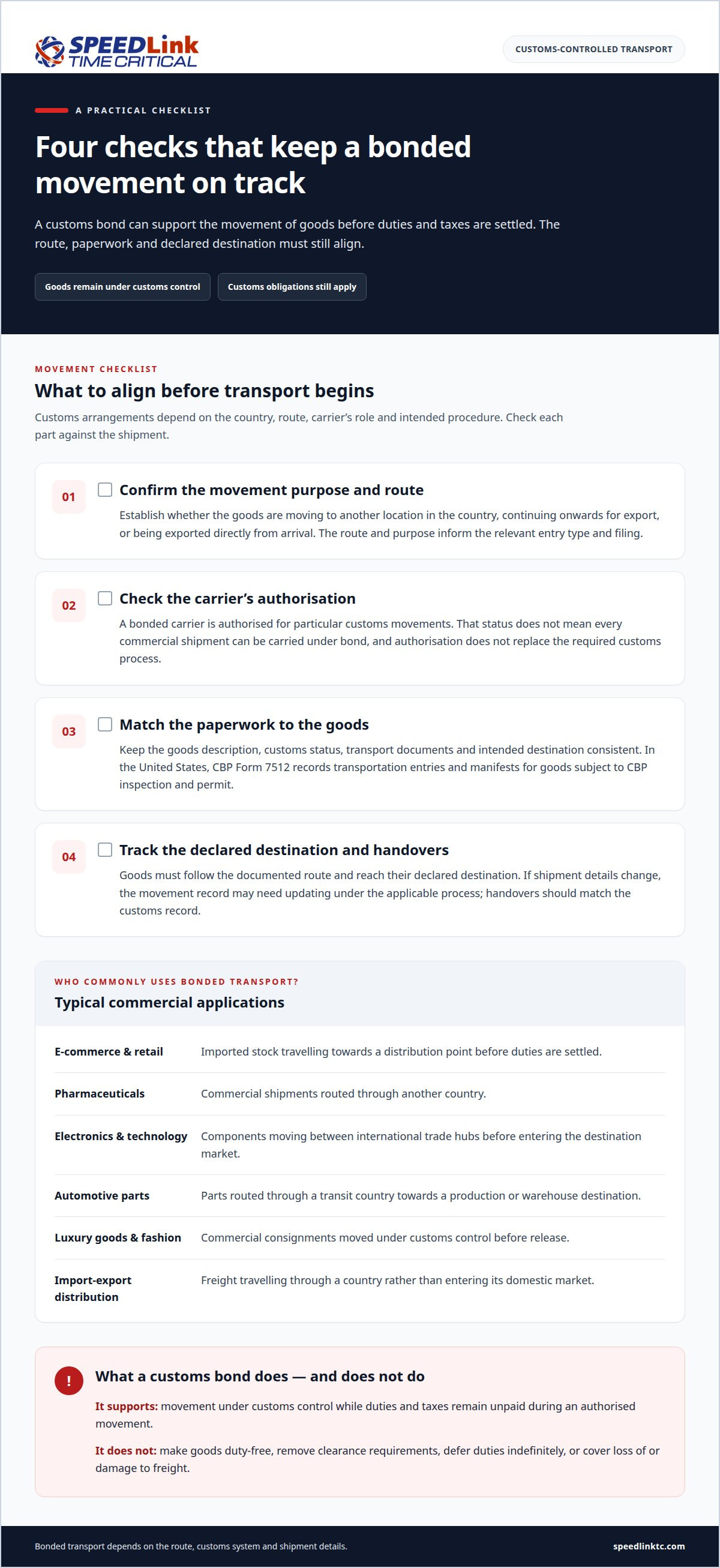
Customs procedures distinguish movements by route and purpose. A shipment may move to another location within the country, continue onwards for export, or be exported directly from its arrival point. The relevant entry type and filing depend on the movement. Accurate goods descriptions and destination details help ensure the customs record matches the freight being transported.
What are the risks or limits? Goods must follow the documented route and reach the declared destination. A bond does not defer duties indefinitely or remove clearance requirements. What happens if a bonded courier fails to meet its obligations? Unpaid duties may be pursued through the bond, while diverted goods or inaccurate shipment information can put customs compliance at risk.
Bonded carrier definition and customs authorization
A bonded carrier is authorised to move goods under customs control using the bond applicable to that movement. Bonded trucking describes this role when transport is by road. The carrier’s authorisation applies to particular customs movements, not unrestricted transport of every commercial shipment. Requirements depend on the customs system governing the route, the carrier’s role and the intended procedure.
In the United States, U.S. Customs and Border Protection uses CBP Form 7512 for transportation entries and manifests of goods subject to CBP inspection and permit. The form records information about the movement for customs processing. The entry type, supporting documents and transport details need to correspond with the shipment’s declared purpose. Customs authorisation and a completed form are distinct elements of the process.
Customs bonds provide financial security for obligations associated with a movement, while security protocols govern the handling and oversight of goods. These functions are distinct: a bond is not cargo insurance, and a security programme does not replace customs documentation. For commercial freight, aligning shipment records, transport documents and customs filings helps create a coherent record of the movement.
Clearance arrangements can vary according to whether goods are entering a market, travelling onwards or moving between customs-controlled locations. A business planning international trade should therefore establish where customs clearance takes place and which party is responsible for each filing. The route, goods description and destination all inform the appropriate documentation. Customs support for transport can help businesses coordinate customs requirements with their planned shipment.
Before transport begins, the carrier and relevant customs representative need consistent shipment information, including the goods description and intended destination. If details change, the movement record may need updating under the applicable process. This matters especially when commercial freight passes between carriers or handling points: each handover must match the documented customs movement.
Industries and individuals that use bonded couriers
Bonded couriers support businesses moving goods across borders when customs clearance will take place later in the journey. Common users include e-commerce and retail, pharmaceutical, electronics and technology, automotive parts, luxury goods and fashion, and import-export businesses. The arrangement can help move freight towards its final destination or an authorised warehouse while customs requirements remain in force.
- E-commerce and retail: imported stock can travel towards a distribution point before duties are settled.
- Pharmaceuticals: businesses may use bonded movements for commercial shipments routed through another country.
- Electronics and technology: components can move between international trade hubs before entering the destination market.
- Automotive parts: manufacturers and distributors can route parts through a transit country to a production or warehouse destination.
- Luxury goods and fashion: importers can move commercial consignments under customs control before release.
- Import-export distribution: bonded carriers can support freight travelling through a country rather than entering its domestic market.
People coordinating these movements include importers, exporters, customs teams and logistics managers. For example, a retail importer may plan a shipment from an overseas supplier to an inland warehouse. The logistics manager coordinates the route and destination, while the customs team aligns shipment information with the required process. This helps keep transport records connected to the goods throughout the movement.
Bonded transport is relevant when goods pass through a country that is not their final market, or must move between customs-controlled locations. A shipment travelling through the United States between Canada and Mexico illustrates transit through an intermediate country. Another example is a transfer between authorised warehouses, where previously imported goods move before duties are paid. In either case, the declared destination and customs compliance matter.
Individuals may encounter bonded transport when acting as importers or exporters of commercial goods, but the arrangement is not defined by the sender’s job title. The deciding factors are the shipment’s route, customs status and destination. Government requirements determine whether bonded movement applies. Businesses use it to organise international transport without treating transit as completed import clearance.
How can customers verify that a courier is bonded?
Start verification with the customs authority and country governing the shipment. Ask the carrier for its legal business name, carrier identifier and evidence of bond coverage. Compare these details with the shipment documents, including the declared route and destination. A general statement that a company handles customs does not, by itself, show authorisation for a particular bonded movement.
For a United States movement, ask how the carrier’s bond and customs documentation apply to the shipment. The bond requirement for a bonded-carrier custodian of bonded merchandise is identified as Activity Code 2. The transportation entry and manifest should also identify the relevant movement. Check that the carrier’s legal name and shipment details are consistent across the documents provided.
For a Canadian movement, the carrier code provides another verification point. A CBSA carrier code is a unique four-character identifier, limited to one per legal company and mode of transport. The code alone does not establish bonded status, so ask whether the carrier holds the required bond for the planned movement. Keep the answer and supporting documents with the shipment record.
- Identify the jurisdiction: establish which country’s customs process governs each transit and destination leg.
- Match the carrier: compare the legal name and carrier identifier on the bond evidence with the transport documents.
- Check the movement: confirm that the documents describe the goods, route and declared destination consistently.
- Clarify responsibility: establish which carrier or agent files customs information and reports the shipment’s progress.
When a transfer involves several carriers, verify each party’s role rather than assuming one company’s bond covers the whole journey. A customs broker may act as a surety’s agent, but that does not make the broker the transporting carrier. Keep a clear record of the bond evidence, shipment reference and responsible carrier, especially when freight changes hands before reaching its destination.
SpeedLink Transport Limited: Same Day Courier
SpeedLink Transport Limited provides Same Day Courier services for businesses that need time-critical transport rather than a customs-bonded movement. For shipments between the UK and EU, its EU shipping with customs clearance service supports the customs process alongside transport. Bonded status is a separate customs arrangement, so the right service depends on the shipment’s route and requirements.
For event materials, the Exhibition and Events Courier service supports transport to and from exhibition venues. The NPPV Cleared Courier Service is relevant when a shipment requires that specific courier capability. Each service addresses a different operational need, and neither is interchangeable with bonded-carrier authorisation.
Share your shipment route, destination and timing requirements with SpeedLink Transport Limited to discuss a suitable transport option.
Plan your next customs-sensitive movement
Understanding what a bonded courier is gives your team a useful starting point. The next step is to map the shipment’s origin, transit points, final destination and customs handovers before arranging transport. This overview helps your logistics and customs teams align their responsibilities and identify where a bonded movement may fit.
Bring together the commercial documents, goods description and intended route, then establish who will manage each transport and customs step. Clear ownership can reduce avoidable uncertainty when a shipment crosses borders or changes hands. If the movement is also time-critical, consider that alongside its customs requirements rather than planning them separately.
Discuss your route and shipment requirements with SpeedLink Transport Limited to identify a practical next step for your operation.
With the route and responsibilities mapped, your team can move forward with greater clarity and control.
Frequently Asked Questions
What Does a Bond Cover?
A customs bond covers specified customs obligations, not the physical condition or value of the goods. Its precise scope depends on the bond and the movement it supports. For example, customs charges arising from non-compliance relate to the bond, while a damaged or missing consignment concerns cargo cover. Treat these as separate risks when planning shipment protection.
Why are they called “bonded”?
“Bonded” describes the customs arrangement attached to the carrier or movement, not a vehicle marking or special parcel category. The term refers to a formal bond connected with customs obligations. In practice, it distinguishes goods moving under that arrangement from goods whose customs process is complete. The label alone does not show the bond’s scope or terms.
What does bonded courier mean?
A bonded courier transports goods under an applicable customs bond. For the shipment team, the key distinction is the goods’ customs status, not the delivery format. A courier might move a consignment by road, but the bond concerns the customs-controlled movement. A package’s urgency, size or value does not, by itself, make it a bonded shipment.
What does a courier bond cover?
A courier bond relates to customs obligations for the movement it supports; it is not insurance for the goods. Check the bond documentation against the carrier’s role and the shipment in question. For example, freight damaged during handling raises a different issue from an unpaid customs obligation. Keeping these responsibilities distinct helps businesses identify the relevant protection.
Is a bonded courier different from an insured or licensed courier?
Yes. These terms mean different things. Bonded status concerns a customs bond; insurance concerns specified risks to goods or other interests; and a licence gives permission to carry out an activity. One does not prove the others. For example, evidence of cargo insurance alone does not establish that a carrier is authorised for a particular customs-controlled movement.
What types of deliveries require a bonded courier?
The customs procedure and route determine whether bonded transport is relevant, not simply the item being carried. A shipment may need it when customs authorities require goods to remain under control during a particular movement. An ordinary domestic delivery after customs processing is different. A product’s category, urgency or high value alone does not establish that bonded transport is required.

Article by
Dave McMillen
I have worked in courier and logistics for over 30 years. My experience spans two continents and several types of services from road freight to airlines and specialist B2B services. SpeedLink has been serving the UK market for over 20 years providing the finest time critical and specialist services supporting businesses and individuals alike.
Disclaimer
Information is provided as general logistics guidance and is not legal, customs, aviation, medical or dangerous-goods compliance advice.
Rules vary according to commodity, quantity, classification, packaging, origin, destination, transport mode and carrier.
Regulations and carrier requirements may change.
Where regulated goods are involved, current requirements should be confirmed with the appropriate government authority, regulator, carrier or qualified specialist before shipment.
SpeedLink can confirm the transport options it can provide for a particular shipment.


