


A fast arrival is only part of financial document secure delivery. You also need to consider who handles the paperwork, who is authorised to receive it and how each handover should work. Before choosing a service, weigh the document’s sensitivity against the deadline and the consequences of delay.
For routine paperwork, ordinary post or digital sharing may be enough. When a physical original must reach a named recipient by a defined deadline, same-day courier transport or secure chain-of-custody transport may be more appropriate. This guide explains how to choose proportionate transport and what information to include in a delivery brief, without disclosing more about the financial matter than necessary.
Key Takeaways
- Match financial document secure delivery to the document’s physical format, sensitivity and deadline.
- Compare routine post, digital sharing and courier transport against the required arrival date and handover arrangements.
- Before booking, confirm the collection details, intended recipient and who is authorised to release and accept the documents.
- Use secure chain-of-custody transport when controlled handovers are a priority, and provide clear instructions for the delivery.
When does financial document secure delivery make sense?
Financial document secure delivery is appropriate when a paper document must reach a named recipient and the organisation needs clear expectations for its custody and handover. It is planned physical transport, not simply a faster way to send a file. Consider the document’s sensitivity, the deadline and the impact if it is delayed, misplaced or accepted by someone who was not intended to receive it.
A secure courier may be suitable when a physical original or confidential record must reach an authorised recipient by a defined deadline, with controlled handover expectations. That does not mean every financial record needs specialist transport. Routine paperwork may be suitable for a less tailored method.
Which financial documents may need physical delivery?
Examples include original agreements, signed records and confidential business paperwork. The sensitivity depends on how the document will be used. A routine internal copy may carry different consequences from an original required to complete a transaction or make a decision. Ask who needs the physical item, why an electronic copy is insufficient and what work would be disrupted by a delay. Those answers help determine whether courier transport is proportionate.
When is digital sharing not enough?
Digital sharing may be suitable if the recipient accepts an electronic file and no physical original is required. A signed paper record or original agreement, however, may need to travel in its physical form. Check your organisation’s policy and the recipient’s requirements before arranging transport rather than assuming a particular format is necessary. Access controls and careful handling are complementary parts of data security principles, but they do not move a paper original.
Does financial document secure delivery require a specialist courier?
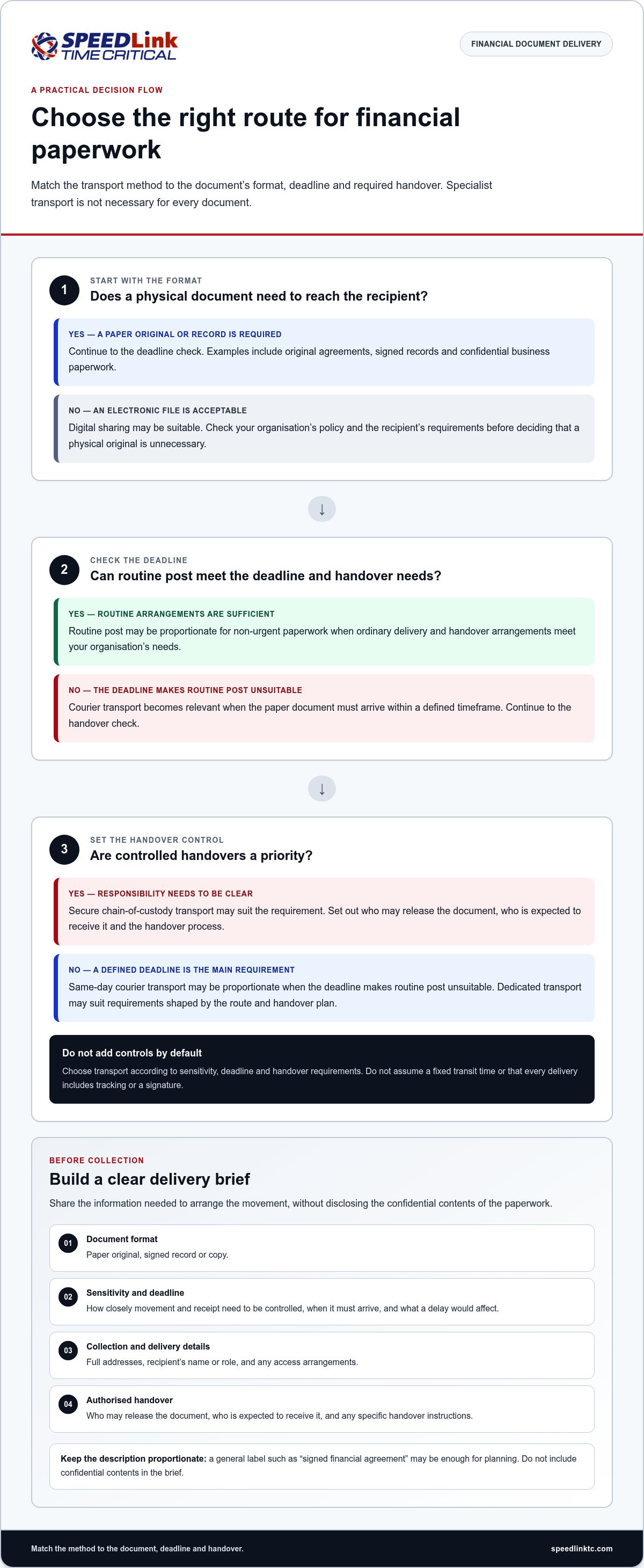
No. Specialist transport is not automatically necessary for every document. Routine post may be proportionate for non-urgent paperwork when ordinary delivery and handover arrangements meet the organisation’s needs. Digital sharing avoids physical transport where an electronic file is acceptable. Courier transport becomes relevant when a paper document must arrive within a defined timeframe or its handover needs closer control.
Match delivery controls to the document’s sensitivity, deadline and handover requirements instead of adding them by default. The University of Toledo’s guidelines for protecting sensitive data address safeguards for both physical and digital information, highlighting that security depends on the handling process as well as the transport method.
What does chain of custody mean for document delivery?
Chain of custody means maintaining clear responsibility for a document as it moves from collection to receipt. Before dispatch, establish who may release it, who is expected to receive it and what handover arrangements are required. Be specific about the expected process rather than assuming that every delivery includes features such as tracking or a signature. SpeedLink provides secure courier services and secure chain-of-custody transport when controlled handovers matter.
When might same-day or dedicated transport be proportionate?
Start with the deadline: what decision, transaction or business activity depends on the document arriving, and what would a delay disrupt? If the deadline makes routine post unsuitable, same-day courier transport may be proportionate. SpeedLink provides same-day courier services, while dedicated transport may suit requirements shaped by the route and handover plan. Neither option is necessary for every financial document, and a fixed transit time should not be assumed.
When discussing a time-sensitive movement, share the required deadline and handover expectations so the delivery plan can reflect the actual need. Discuss the delivery requirement with SpeedLink.
How to choose a financial document delivery service
Work through the shipment requirements in order. For financial document secure delivery, a concise brief helps align the transport plan with the paperwork and the people responsible for it.
- Document format: Identify whether the item is a paper original, signed record or copy.
- Sensitivity: Decide how closely its movement and receipt need to be controlled.
- Deadline: State when it needs to arrive and what a delay would affect.
- Origin and recipient: Provide full collection and delivery details, including access arrangements.
- Authorised handover: Specify who may release the document and who is expected to receive it.
For physical paperwork, SpeedLink’s secure courier and chain-of-custody transport services provide options for documents that need to move rather than be shared electronically.
What should a courier brief include?
Provide the document type, collection and delivery addresses, required deadline and recipient’s name or role. State who can release the item and explain any access or handover requirements that could affect collection or delivery. Describe the shipment without including its confidential contents. A general label such as “signed financial agreement” may be sufficient for planning. Share only the information needed to arrange the movement.
How should you balance security and urgency?
Set the deadline against the consequences of delay, then choose transport proportionate to that need. Same-day service may suit a genuinely time-critical document, but it need not be the default if the receiving deadline allows another approach. Clear instructions about the origin, destination and handover help shape the plan without unnecessary controls or disclosure of sensitive material.
Arrange financial document secure delivery with a clear plan
A well-prepared brief helps match financial document secure delivery to the paperwork, deadline and handover requirements. SpeedLink provides secure courier and chain-of-custody transport when controlled handovers are important, alongside same-day courier services for time-sensitive movements.
What to prepare before requesting a delivery
Bring the practical details together before arranging collection. Clear instructions help define the movement without sharing more confidential information than planning requires.
- Collection and delivery addresses, including relevant access details.
- Document format and a general description, such as an original agreement.
- The required delivery deadline and the effect of delay.
- The intended recipient and who is authorised to release and accept the item.
- Any handling or handover expectations that affect collection or delivery.
Keep the contents private unless a specific detail is genuinely needed to plan the shipment.
Choose a proportionate transport option
Routine delivery may suit a flexible deadline and straightforward handover. If delay would disrupt a transaction or time-critical business decision, same-day transport may be appropriate. SpeedLink’s UK same-day courier service is an option for urgent movements; secure chain-of-custody transport may better fit a requirement for controlled handovers. These options address different needs, and neither should be treated as the default for every document.
For an urgent collection and delivery, consider the route, deadline and recipient arrangements together. A clear brief gives the transport plan a practical basis and helps avoid assumptions about the document or how it must be handled.
Put a clear process in place for your next delivery
Make financial document secure delivery part of your organisation’s planning rather than a last-minute response to a deadline. Agree internally who can authorise a shipment, provide the collection details and confirm the receiving arrangements. That preparation helps teams act promptly when an original document needs to move, while limiting the sensitive information shared for planning.
A concise brief gives SpeedLink a practical starting point for discussing the shipment’s origin, destination, timing and handover expectations. With those details ready, the conversation can focus on the requirements that matter and an appropriate transport plan for the task.
Clear ownership and a well-prepared request make the next step more straightforward. Contact SpeedLink to discuss secure delivery for your financial documents.
Frequently Asked Questions
Is courier delivery safer than sending financial documents by email?
Neither is automatically safer; each has different risks. An email can be sent to the wrong address, forwarded or accessed through a compromised account. Physical transport avoids sending the document as an email attachment, but introduces risks associated with handling an item in transit. Apply your organisation’s approved controls to either route, such as checking recipients before sending or limiting access to physical paperwork.
Can a courier deliver original financial documents?
Yes. A courier can transport paper originals, including signed agreements and records. Prepare the paperwork so it stays together and is protected from ordinary creasing or damage during movement. Keep the contents out of view from casual inspection and make sure the receiving team knows how the document should be treated on arrival. If the original is part of a larger file, identify any accompanying items clearly.
What information should I provide when arranging secure document delivery?
Alongside the route and recipient details, provide a shipment reference your organisation can use to identify the movement without naming the financial matter itself. Note the number of packages and give a contact for collection and another for delivery, where appropriate. This helps colleagues coordinate if plans change, while keeping transaction details, account information and document contents out of routine transport communications.
Does secure courier delivery guarantee financial documents will remain confidential?
No courier can remove every risk or guarantee confidentiality in all circumstances. Organisations should manage the full lifecycle of the paperwork, including how it is stored before collection, who is authorised to disclose it and what happens after receipt. Keep internal records of the decision to use physical transport and the controls your organisation expects, so responsibilities remain clear beyond the journey itself.
When should a business use same-day delivery for financial documents?
Same-day delivery may be suitable when the receiving organisation has a time-bound process that cannot wait for a later delivery day, such as a scheduled review requiring a paper record. Check that the document is ready for collection and that the recipient can accept it within the required window. SpeedLink provides same-day courier services; the practical option depends on the shipment’s route and requirements.

Article by
Dave McMillen
I have worked in courier and logistics for over 30 years. My experience spans two continents and several types of services from road freight to airlines and specialist B2B services. SpeedLink has been serving the UK market for over 20 years providing the finest time critical and specialist services supporting businesses and individuals alike.
Disclaimer
Information is provided as general logistics guidance and is not legal, customs, aviation, medical or dangerous-goods compliance advice.
Rules vary according to commodity, quantity, classification, packaging, origin, destination, transport mode and carrier.
Regulations and carrier requirements may change.
Where regulated goods are involved, current requirements should be confirmed with the appropriate government authority, regulator, carrier or qualified specialist before shipment.
SpeedLink can confirm the transport options it can provide for a particular shipment.


