


With IT enterprise downtime now averaging $9,000 per minute, a single transit mishap during a data centre relocation can escalate into a million-pound disaster before your equipment even reaches its destination. You’re likely searching for how to ship server racks because you recognise that standard freight services simply can’t mitigate the risks of hardware failure or structural shear. We understand the intense pressure of managing high-value assets whilst facing complex customs regulations for EU movements and the constant fear of equipment damage.
This guide provides the professional framework you need to master the complexities of transporting sensitive IT infrastructure. We’ll examine essential packing requirements, 2026 IATA regulations for lithium-ion batteries, and the strategic use of dedicated vehicles to ensure a zero-damage delivery. By following these methodical steps, you’ll gain a clear understanding of the specialized logistics process. This allows you to secure a predictable delivery timeline and protect your organisation’s bottom line from the high cost of transit accidents.
Key Takeaways
- Learn to distinguish between unpopulated and integrated cabinets to effectively manage the unique centre of gravity challenges inherent in fully loaded 42U racks.
- Discover why custom-built wooden crates and Electrostatic Discharge (ESD) shielding are the gold standard for protecting sensitive IT assets during international transit.
- Understand how to ship server racks using dedicated courier services to eliminate co-loading risks and ensure a direct, high-security transit route.
- Master the complexities of data centre handovers by aligning with strict site protocols, including RAMS requirements and specific floor loading limits.
Evaluating Your Server Rack Shipping Requirements
Determining how to ship server racks safely begins with a rigorous audit of the hardware’s physical state and the operational urgency. If you’re managing a planned data centre migration, you have the luxury of time to de-rack components; however, emergency hardware replacements often necessitate shipping fully integrated units to minimise downtime. We find that the structural integrity of a standard 19-inch rack dimensions enclosure is often compromised when fully populated, requiring a shift from standard freight to specialist IT transport solutions.
Integrated vs. Unpopulated Racks
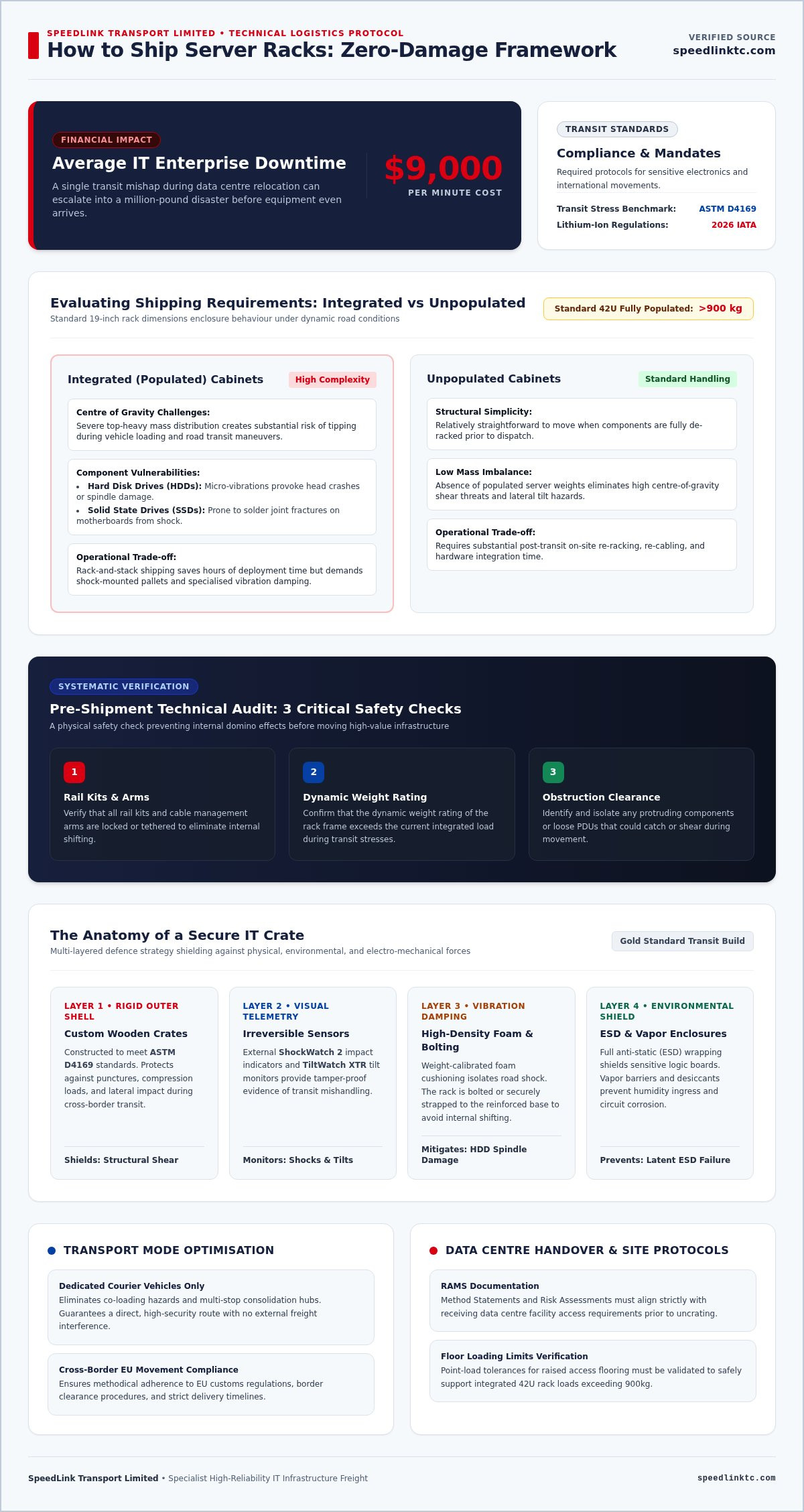
Shipping a populated (integrated) rack introduces significant centre of gravity challenges. A standard 42U rack can weigh over 900kg when full, making it top-heavy and prone to tipping during vehicle loading or transit. Whilst unpopulated racks are relatively straightforward to move, populated ones require shock-mounted pallets and specialised vibration damping to protect sensitive mechanical components. Hard Disk Drives (HDDs) are particularly vulnerable to the micro-vibrations of road transit, which can cause head crashes or spindle damage. Even with Solid State Drives (SSDs), the risk of solder joint fractures on motherboards remains high if the rack isn’t isolated from road shock. Choosing rack-and-stack shipping over on-site integration saves hours of deployment time but demands a much higher level of logistical precision when considering how to ship server racks.
Pre-Shipment Technical Audit
Before the move begins, we recommend a comprehensive technical audit. This isn’t merely about inventorying serialised assets; it’s a structural safety check to ensure the rack can withstand the stresses of movement. If you don’t secure every internal element, you risk a domino effect where one loose server causes catastrophic failure across the entire cabinet.
- Verify that all rail kits and cable management arms are locked or tethered to prevent internal shifting.
- Confirm the dynamic weight rating of the rack frame exceeds the current integrated load.
- Identify any protruding components or loose PDUs that could catch during transit.
Following this audit, you’ll have a clear baseline for your security and logistics requirements. This methodical approach ensures that the physical handling phase is built on accurate data rather than assumptions, protecting both the equipment and the project timeline.
Specialist Packing and Protection Techniques
Protecting integrated hardware requires more than standard shrink-wrap. To truly master how to ship server racks, you must employ a multi-layered defence strategy that addresses both physical and environmental threats. Custom-built wooden crates remain the gold standard for international transport. They provide a rigid external shell that shields against punctures, compression, and lateral impacts. These enclosures should be engineered to meet ASTM D4169 transit testing standards, ensuring they can withstand the rigorous forces of global movement. We also recommend implementing ShockWatch 2 indicators and TiltWatch XTR sensors on the crate exterior. These devices provide irreversible evidence of mishandling, which encourages carriers to maintain methodical control throughout the journey.
The Anatomy of a Secure IT Crate
The interior of a crate is just as critical as the exterior shell. We utilise high-density foam cushioning to isolate the rack from road-induced vibrations. This foam acts as a shock absorber, specifically tuned to the weight profiles established during your initial technical audit. Crucially, the rack must be bolted or securely strapped directly to the reinforced crate base. This prevents internal shifting, which is the primary cause of structural shear and cable disconnection during transit. Without this rigid anchoring, the delicate alignment of internal components is at risk.
ESD and Environmental Safeguards
Environmental factors can be just as damaging as physical impacts, especially during cross-border moves. For long-distance EU road transport or sea freight, vapor barriers and desiccants are essential to prevent moisture ingress and subsequent corrosion on circuit boards. We apply anti-static wrap to the entire rack structure to mitigate Electrostatic Discharge (ESD) risks. This protects exposed ports and sensitive electronics from latent damage that often remains undetected until re-commissioning. Understanding how to ship server racks with these safeguards is the difference between a successful migration and a costly hardware failure. If you’re managing a high-stakes relocation, consulting our specialist packing team ensures your environmental safeguards are robust enough for any climate.
Selecting the Optimum Transport Mode for IT Assets
Selecting the correct transport mode is a strategic decision that directly impacts hardware longevity and data security. Whilst economy freight is suitable for non-critical shipments, it often involves multiple hub transfers and co-loading with unrelated cargo. For those determining how to ship server racks without compromising integrity, dedicated vehicles are the only viable solution. The “No Co-Loading” rule eliminates the risk of other freight shifting into your equipment. We utilise vehicles equipped with air-ride suspension, which significantly reduces transmitted road vibrations compared to traditional trailers. This level of protection is essential for preserving delicate hard drive spindles and circuit board solder joints during long-distance movements.
Dedicated Same-Day vs. Economy Freight
Urgent hardware failures require immediate intervention. Choosing a same-day courier ensures your equipment moves directly from point A to point B without unnecessary handling. This approach maintains a strict chain of custody, which is critical for regulatory compliance. Before any storage media leaves your facility, you should follow NIST SP 800-88 media sanitisation guidelines to secure your data. Reducing touchpoints isn’t just about speed; it’s about minimising the opportunity for human error and physical damage during the transition between vehicles.
International and EU Logistics
Navigating EU shipping post-Brexit requires meticulous attention to detail. Moving high-value IT transport to major tech hubs like Frankfurt or Amsterdam involves complex customs clearance procedures. We manage the necessary Carnet or T1 documentation for temporary relocations, ensuring your racks don’t get held at the border. Understanding how to ship server racks across international lines means preparing for these regulatory hurdles well in advance to avoid costly delays. If you need to mobilise critical infrastructure across the continent, get a quote from our international team today to ensure a seamless border crossing.
Executing the Move: Data Centre Handover and Security
The final stage of determining how to ship server racks involves more than just a successful road journey. It requires precise coordination with data centre facility managers to navigate strict site protocols. We ensure all Risk Assessment and Method Statements (RAMS) are submitted well in advance to secure specific delivery slots. You must also verify floor loading limits, as a fully populated 42U rack can exceed the pressure capacity of standard raised access floors. Utilising a secure courier at this stage ensures that sensitive data remains protected during the final handover.
Security Cleared Personnel
For government contracts or high-security financial environments, standard delivery drivers are often insufficient. We provide NPPV (Non-Police Personnel Vetting) cleared couriers who understand the requirements of high-stakes infrastructure. This level of vetting is essential for maintaining a secure chain of custody from the initial server room to the final rack position within the data hall. It eliminates the security risks associated with unvetted personnel handling serialised assets.
Data Centre Access and Logistics
Loading bay access and lift dimensions are frequent bottlenecks in the relocation process. We coordinate directly with site managers to confirm that the hydraulic liftgates on our vehicles are compatible with the facility’s docking area. Our service goes beyond kerbside delivery; we provide “white-glove” positioning to move the rack to its designated floor tile. Once positioned, we perform a final physical inspection to check for any loose connections before you begin “power-on” testing. We then provide comprehensive post-transit documentation, including a digital Proof of Delivery (POD), to satisfy your corporate compliance and audit requirements. This methodical execution ensures your migration concludes with total operational confidence.
Securing Your IT Infrastructure Migration
Transitioning from a theoretical understanding of how to ship server racks to a successful physical move requires a disciplined, risk-averse strategy. We’ve established that the safety of your hardware depends on precise technical audits, custom crating, and the elimination of co-loading risks through dedicated transport. By prioritising air-ride suspension and methodical environmental safeguards, you can maintain the structural integrity of your most sensitive assets whilst ensuring business continuity across your entire network.
SpeedLink Transport Limited provides the operational authority needed for these high-stakes movements. Our team utilises specialist IT handling equipment and NPPV cleared drivers to maintain a secure chain of custody for every integrated cabinet. Whether you require same-day UK or EU coverage, we act as your strategic partner in mitigating the high costs of transit damage and unplanned downtime. Contact SpeedLink Transport Limited for a Secure IT Transport Quote today to discuss your specific requirements. We’re ready to ensure your next data centre relocation is executed with absolute precision and care.
Frequently Asked Questions
Do I need to remove the servers from the rack before shipping?
You don’t necessarily need to remove servers, but the decision depends on your risk tolerance and the transit distance. Whilst de-racking components into individual flight cases offers maximum protection, integrated shipping is viable if you use shock-mounted pallets. This “Rack & Roll” method significantly reduces destination deployment time. However, you must ensure all internal rail kits are locked and the cabinet’s dynamic weight rating isn’t exceeded during transit.
What is the difference between a shock-pallet and a standard pallet for IT?
A shock-pallet incorporates integrated damping materials, such as high-density foam or spring mechanisms, specifically designed to absorb road-induced vibrations and vertical impacts. Standard pallets provide a rigid base but offer zero protection against the micro-vibrations that damage hard drive spindles. When considering how to ship server racks, always opt for shock-attenuating bases. These specialist platforms are essential for integrated moves to prevent structural shear and solder joint fractures on sensitive motherboards.
How much does it cost to ship a server rack to Europe in 2026?
Shipping costs for server racks to Europe in 2026 are determined by the cabinet’s weight, dimensions, and the specific customs documentation required post-Brexit. Integrated racks incur higher costs due to the need for specialist air-ride vehicles and shock-mounted packaging. Additionally, the complexity of T1 or Carnet documentation for cross-border moves influences the final investment. We recommend requesting a bespoke quote to ensure all technical and regulatory requirements are accurately reflected.
Are standard couriers insured for high-value server equipment?
Standard couriers typically operate under limited liability frameworks that don’t cover the full replacement value of enterprise-grade IT hardware. Their insurance often applies a weight-based calculation, which is insufficient for high-density 42U racks. We provide specialist IT equipment courier services with enhanced insurance cover tailored to the specific value of your assets. This ensures your organisation is fully protected against financial loss in the unlikely event of transit damage or hardware failure.
What security clearances should an IT courier have?
For moves involving sensitive data or government facilities, your courier should hold NPPV (Non-Police Personnel Vetting) clearance. This level of vetting ensures that the personnel handling your infrastructure have undergone rigorous background checks. Beyond individual clearances, the courier company should demonstrate a robust chain of custody protocol. This includes the use of dedicated vehicles to prevent co-loading and serialised tamper-evident seals to satisfy strict corporate compliance and audit requirements.

Article by
Dave McMillen
I have worked in courier and logistics for over 30 years. My experience spans two continents and several types of services from road freight to airlines and specialist B2B services. SpeedLink has been serving the UK market for over 20 years providing the finest time critical and specialist services supporting businesses and individuals alike.


