


What does a moving map pin actually tell you about a parcel? A GPS tracked courier service can provide useful location context, but the pin may show the courier vehicle rather than the parcel itself. Tracking events, such as collection and delivery scans, provide different information. For a time-critical or high-value business shipment, an unchanged status can create uncertainty. It doesn’t automatically mean the parcel has stopped moving, but you may need to decide whether to wait, investigate or adjust your plans.
This article explains how GPS location and tracking events differ, how to follow a shipment and what to check when an update is unclear or hasn’t changed. It also covers the limits of map-based visibility, so you can interpret a location sensibly rather than treating it as a live view of the parcel. Finally, it explains how visibility fits alongside urgency, sensitivity and handling needs when choosing transport for a business consignment.
Key Takeaways
- Use the shipment reference to access the tracking channel provided, then compare update times and status descriptions with the expected milestones.
- A GPS tracked courier service may show a vehicle’s location, while parcel handling events record milestones such as collection or delivery.
- Use location data as one part of shipment visibility. On its own, it doesn’t confirm delivery timing, item condition or a complete custody record.
- Set visibility expectations according to the shipment’s urgency, sensitivity and the impact of delay. A dedicated same-day movement may suit a time-critical business consignment.
What Does a GPS Tracked Courier Service Actually Show?
A GPS tracked courier service uses satellite positioning and related systems to report a location. In courier operations, that location may be associated with the vehicle carrying a consignment, rather than a device attached to the parcel. The tracking channel, update frequency and detail vary between systems. Treat a map pin as one piece of shipment information, not a complete record of the journey.
GPS location, tracking events and proof of delivery
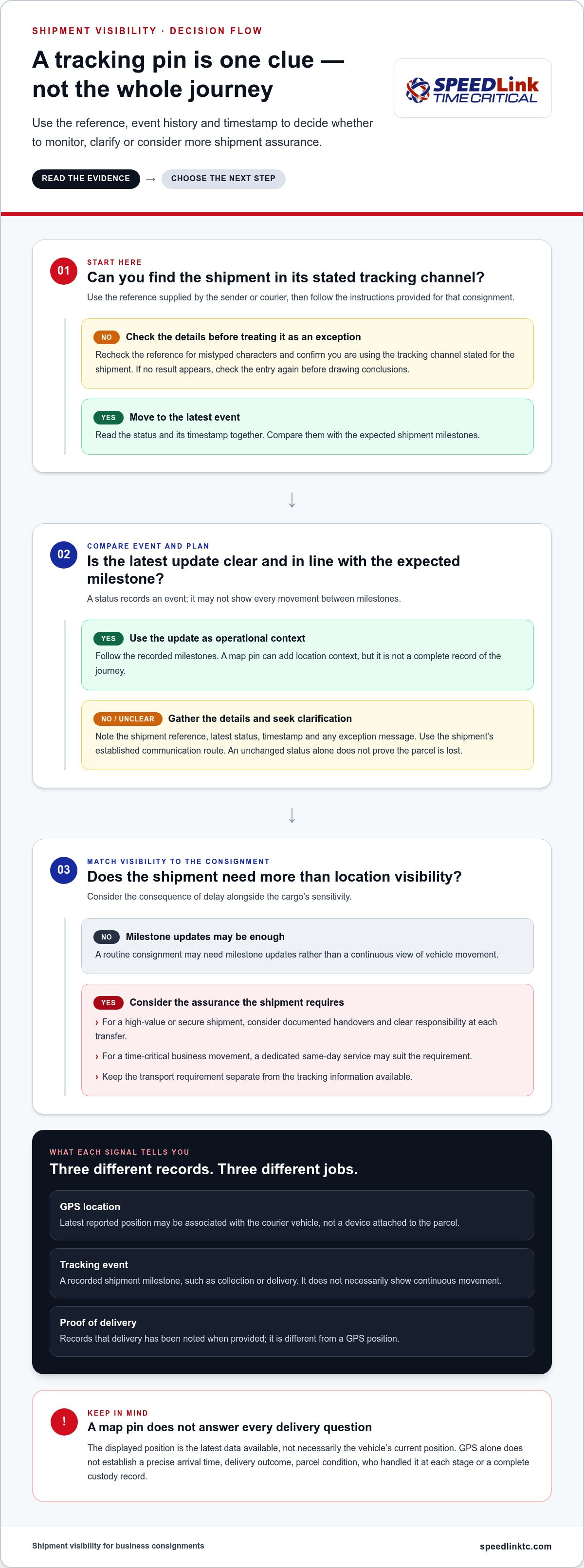
GPS visibility reports a vehicle’s position at an update time; tracking events record shipment milestones, and proof of delivery records the delivery outcome when provided. These are separate types of information. A vehicle location may indicate where the courier was at the latest reported update, while a collection or delivery status records an event associated with the consignment. Package tracking can use methods such as barcode scans as well as location data. This is why a status history may show key events without displaying continuous movement.
Proof of delivery serves a different purpose. It records that delivery has been noted, but GPS location alone doesn’t establish that the parcel was handed to the intended recipient, confirm its condition or provide a full custody record.
Why a tracking map may not move continuously
Tracking systems refresh location information at different intervals. A map may show the latest available position, not a continuously updated view, so the vehicle may have moved since that position was recorded. Reporting or communications can also be interrupted, leaving a temporary gap. A static pin alone doesn’t show whether the shipment has stopped, and the displayed position shouldn’t be treated as pinpoint accuracy.
For business planning, read the timestamp alongside the status description and expected shipment milestones. If urgency is the priority, consider the transport requirement separately from the visibility provided. SpeedLink’s same-day courier service supports time-critical business movements; the tracking information available is a separate consideration.
How to Track a Parcel: Follow the Reference, Updates and Exceptions
A tracking reference connects a shipment to its recorded events. Use the reference supplied by the sender or courier, then follow the tracking channel provided for that consignment. The Global Positioning System (GPS) is one source of location information, but the updates you can view depend on the tracking system in use.
Follow this process:
- 1. Find the reference. Check the shipment confirmation or dispatch information. For a business consignment, keep the collection and delivery contact details accessible in case an update needs clarification.
- 2. Open the stated tracking channel. Use the link or instructions supplied with the shipment rather than relying on an old saved page.
- 3. Enter the details carefully. Check the reference for mistyped characters and provide any additional requested information accurately. If no result appears, recheck the entry before treating it as an exception.
- 4. Read the event and timestamp together. Compare the latest status with expected milestones, such as dispatch, arrival at a facility or delivery. A status describes a recorded event; it may not show every movement between milestones.
For example, if a dispatch event is recorded but there’s no later update, note when it occurred and compare it with the shipment plan. An unchanged status alone isn’t proof that a parcel is lost. It may simply mean no new event has been recorded in the tracking channel.
If the update remains unclear, gather the reference, latest status, timestamp and any exception message before using the shipment’s established communication route to request clarification. Specific details give the operations team more to work with than a general query. For a time-critical or specialist business shipment, contact SpeedLink about the consignment and provide those details.
What GPS Tracking Cannot Tell You About a Courier Shipment
A GPS tracked courier service can offer useful location context, but a map view cannot guarantee when a shipment will arrive or confirm the delivery outcome. Location data can support operational awareness, but it doesn’t replace delivery records or shipment-specific handling information. CIPS discusses how supply chain visibility can inform decisions. To be useful, visibility needs to be interpreted in context.
Does GPS tracking provide an exact real-time position?
No. A displayed position reflects the latest data available to the tracking system, and its refresh interval depends on the system. Signals may be weakened or blocked in places such as tunnels, dense urban areas or enclosed trailers. A map pin may not show the vehicle’s current position, and it isn’t automatically a prediction of delivery time.
GPS visibility can help you:
- Understand the latest reported vehicle position and its timestamp.
- Put a shipment’s progress into operational context.
It cannot establish by itself:
- A precise arrival time or guaranteed delivery outcome.
- Whether the parcel is in good condition or who handled it at each stage.
- A complete custody record or proof of delivery.
When does a business need more than location visibility?
Consider the consequence of delay as well as the cargo’s sensitivity. A routine consignment may need milestone updates, while a high-value or secure shipment may require documented handovers and clear responsibility at each transfer. Those records provide a different kind of assurance from a vehicle location. SpeedLink’s secure courier services support consignments where handling requirements matter alongside transport.
Match the visibility you need to the operational decision it supports. For a time-critical or specialist shipment, discuss the transport requirement with SpeedLink.
Match Courier Visibility to the Shipment and Its Business Purpose
Choose the transport approach according to the shipment’s urgency, sensitivity and the operational impact of delay. A GPS tracked courier service may offer useful location context, but visibility should support the delivery plan rather than determine it. A routine consignment may suit an express or economy option; a business-critical item with a narrow delivery window may warrant a dedicated, same-day movement.
Choose the transport approach around the shipment
A dedicated movement may be appropriate when direct handling and urgency are priorities. For example, a production-critical component may be needed to limit operational disruption. For less time-sensitive consignments, align the service with the actual delivery requirement rather than paying for speed or visibility that won’t change the operational decision. Explore same-day courier services when a business shipment needs same-day transport.
Separate route planning from GPS visibility
For an international shipment, a map or location update doesn’t establish that the route, transport arrangements or delivery requirements are suitable. Share the full origin and destination, and consider the consignment’s needs as a whole. Depending on the movement, suitable arrangements may involve road, air or other transport options, with customs support where relevant. The route and shipment plan need to be assessed separately from what a tracking display shows.
Prepare the shipment details
Before discussing a business-critical delivery, have the item description, collection and delivery details, required timing and any handling or sensitivity requirements ready. For international movements, include both ends of the route. This helps focus the logistics discussion on the consequences of delay, suitable transport and the visibility information that will support your team.
Make Shipment Visibility Work for Your Business
A GPS tracked courier service can provide location context, but a vehicle’s position is not the same as a parcel handling event or proof of delivery. Use the shipment reference to review recorded updates, compare timestamps with expected milestones and gather the latest event details if a status is unclear.
Most importantly, match visibility and transport to the consignment’s urgency, sensitivity and the impact of delay. SpeedLink provides same-day, express and economy courier services, alongside specialist transport for secure consignments, IT equipment, exhibitions and dangerous goods. EU shipping with customs clearance is also available.
With the right information and a clear understanding of the delivery requirement, your team can take a measured approach to business-critical shipments. Discuss the consignment, its handling needs and the route with SpeedLink.
Frequently Asked Questions
How do I track a parcel with GPS?
Use the shipment reference and tracking channel supplied for the consignment. A GPS tracked courier service may display the courier vehicle’s reported location, while other updates record parcel events such as collection or delivery. Enter the reference accurately, then read each status alongside its timestamp. If the channel doesn’t show a location, it may provide milestone updates instead.
Can GPS tracking show a parcel’s exact live location?
Not necessarily. The displayed position is the latest location data available to the system, and refresh intervals and accuracy vary. The map may track the vehicle rather than the parcel itself, and a gap between updates doesn’t establish that the vehicle or shipment has stopped. Treat the map as an operational indication, not a guaranteed pinpoint view of the parcel at that moment.
Why has my courier parcel tracking not updated?
An unchanged status may mean no new handling event has been recorded, or that location information hasn’t refreshed. Check the reference, latest timestamp and any exception message first. Compare the update with the shipment’s expected milestones. If the status remains unclear or the delay could affect operations, use the established shipment communication route and share those details when requesting an update.
Does GPS courier tracking guarantee delivery?
No. GPS data can indicate a reported vehicle position, but it doesn’t guarantee a delivery time or outcome. Traffic, route changes and gaps in location reporting may affect what the display shows, and a map isn’t proof that the parcel has been handed over. For a business-critical consignment, assess the transport plan and urgency separately from the available location information.
What is the difference between parcel tracking and proof of delivery?
Parcel tracking shows recorded shipment events and, where available, location information. Proof of delivery is a record of the delivery outcome when the service provides it. A vehicle’s position alone doesn’t confirm who received the parcel, its condition at handover or every custody transfer. For sensitive consignments, consider whether separate handover records are needed alongside ordinary tracking updates.

Article by
Dave McMillen
I have worked in courier and logistics for over 30 years. My experience spans two continents and several types of services from road freight to airlines and specialist B2B services. SpeedLink has been serving the UK market for over 20 years providing the finest time critical and specialist services supporting businesses and individuals alike.
Disclaimer
Information is provided as general logistics guidance and is not legal, customs, aviation, medical or dangerous-goods compliance advice.
Rules vary according to commodity, quantity, classification, packaging, origin, destination, transport mode and carrier.
Regulations and carrier requirements may change.
Where regulated goods are involved, current requirements should be confirmed with the appropriate government authority, regulator, carrier or qualified specialist before shipment.
SpeedLink can confirm the transport options it can provide for a particular shipment.


