


Your custom trade show booth cannot generate leads if it arrives at the venue with fractured aluminium frames or shattered display monitors. For event operations managers, the best way to transport exhibition displays is point-to-point dedicated road transit, eliminating the four to eight cross-dock handlings typical of consolidated pallet networks. When months of preparation culminate in a rigid three-day tenancy, even minor freight damage can compromise your commercial presence entirely.
You already recognise that strict venue marshalling yards, narrow unloading slots, and post-Brexit customs checks create zero margin for error. In this guide, you will learn how to safeguard bespoke event stands, sensitive IT hardware, and audiovisual infrastructure using dedicated logistics, compliant packing, and precision border documentation. We examine site-access management systems like Voyage Control, direct stand-side delivery protocols, and the practical documentation required to move high-value assets across borders without disruption.
Key Takeaways
- Direct, point-to-point road transit represents the best way to transport exhibition displays by removing multi-hub cross-dock handling and reducing transit shock.
- Rigid venue delivery software platforms enforce strict vehicle marshalling windows, meaning direct couriers avoid the gate turnaways common to general haulage.
- Custom-moulded flight cases and bespoke timber compliant with ISPM 15 standards protect structural stand framing, delicate audiovisual hardware, and IT assets.
- Accurate ATA Carnet execution and electronic safety declarations ensure frictionless cross-border transit across European customs checkpoints without unexpected import duties.
Why Standard Freight Fails for Exhibition Display Transport
Exhibition display transport involves the scheduled, high-priority movement of bespoke structural stands, integrated AV technology, and custom furniture. Standard consolidated pallet networks rely on multi-depot hub models. Cargo is unloaded, sorted, and reloaded between four and eight times before reaching its destination. For fragile stands, each forklift interaction introduces serious impact hazards. Dropped crates, puncture holes from tines, or crushed frame corners ruin custom assemblies before an event begins.
When searching for the best way to transport exhibition displays, marketing and procurement teams must consider the true financial consequence of damaged freight. Tenancy agreements provide no grace periods. Arriving at a hall with warped display framing or damaged electronics forfeits tens of thousands of pounds spent on space hire and pre-event marketing. Additionally, consolidated couriers frequently reject irregular, out-of-gauge display crates, as their automated sorting centres cannot process non-standard dimensions.
Vulnerability of Bespoke Stand Materials
Modern stands use complex architectural media. Tension fabrics rip when caught against unpadded edges, acrylic counters scuff under rough transit friction, and aluminium extrusions bend under shifted top loads. In typical road freight networks, continuous road vibrations loosen concealed joint fasteners and warp intricate fittings. Securing a dedicated courier service UK direct-drive vehicle eliminates these risks entirely by strapping cargo securely into a single compartment without mid-route reshuffling.
Strict Venue Move-In Windows
Securing delivery access during professional trade fair operations demands exceptional operational precision. Major hubs like ExCeL London and the NEC Birmingham enforce digital booking systems such as Voyage Control. They turn away hauliers who arrive outside narrow time slots. Missing an unloading window by even two hours can forfeit build-up access entirely, leaving your team stranded outside the halls while the build contractor’s shift expires.
Strategic Packing and Preparation for Fragile Exhibition Assets
Deploying an itemised asset manifest before packing prevents on-site chaos and transit loss. When managing fragile corporate showcase hardware, flight-case grade protection is not merely sturdy packaging; it is an engineered barrier that isolates delicate operational components from severe transport kinetics. The best way to transport exhibition displays begins with CNC-routed, high-density polyethylene foam tailored to the exact contours of your bespoke structural elements, preventing internal shifting during transit.
Protecting Audiovisual Displays and Integrated Technology
Labelling and Hardware Organisation
Rapid booth construction relies on clear identification. Colour-coded tagging on outer cases links directly to assembly schematics, allowing stand builders to locate core framing instantly. Small connection hardware, including bolts, brackets, and junction couplers, should be sealed in compartmentalised steel or heavy-gauge polymer cases rather than loose plastic bags. If your team requires tailored logistics planning for delicate components, consider contacting our team to discuss tailored handling options. Aligning your manifest with the International Trade Administration’s ATA Carnet guidance also ensures all itemised hardware clears temporary export checkpoints without operational delays.
Cross-Border Customs and High-Security Event Logistics
International showcase freight demands meticulous border preparation. The best way to transport exhibition displays into continental trade hubs like Paris or Frankfurt involves combining point-to-point road transit with robust customs pre-clearance. Since 31 January 2025, moving commercial assets between Great Britain and the European Union mandates an Entry Summary Declaration (ENS) alongside standard transport paperwork. Overlooking these mandatory safety declarations leads to severe Channel port holding times or turned-away vehicles.
Temporary import mechanisms protect your bottom line. An ATA Carnet acts as a passport for non-perishable goods across 80+ participating countries, allowing modular stands, AV hardware, and demonstration items to enter international territories without paying import duty or import VAT for up to 12 months. Vehicles must also observe strict internal blocking and lashing standards, echoing the principles behind FMCSA cargo securement rules, ensuring stands survive cross-Channel transit without shifts in balance.
Navigating Post-Brexit European Trade Shows
Moving temporary displays into Europe requires exact commercial manifests, valid UK and EU EORI numbers, and precise commodity codes. Physical carnet documents demand wet-stamped verification by border customs officials at both departure and entry ports. Failure to match every serial number on your general list against physical flight trunks risks cargo impoundment. Choosing dedicated European shipping with customs clearance guarantees knowledgeable drivers who manage port endorsements directly, preserving your delivery schedules.
Security Clearances for Sensitive Exhibition Venues
Government, aerospace, and defence summits enforce rigorous venue perimeters. Conventional courier drivers without advanced vetting are routinely barred from inner loading docks and restricted halls. SpeedLink provides NPPV-cleared drivers who pass strict security checks, ensuring compliant access to sensitive sites without gatehouse delays. To safeguard your international event schedule and secure vetted transport, book an event logistics consultation with our operations team today.
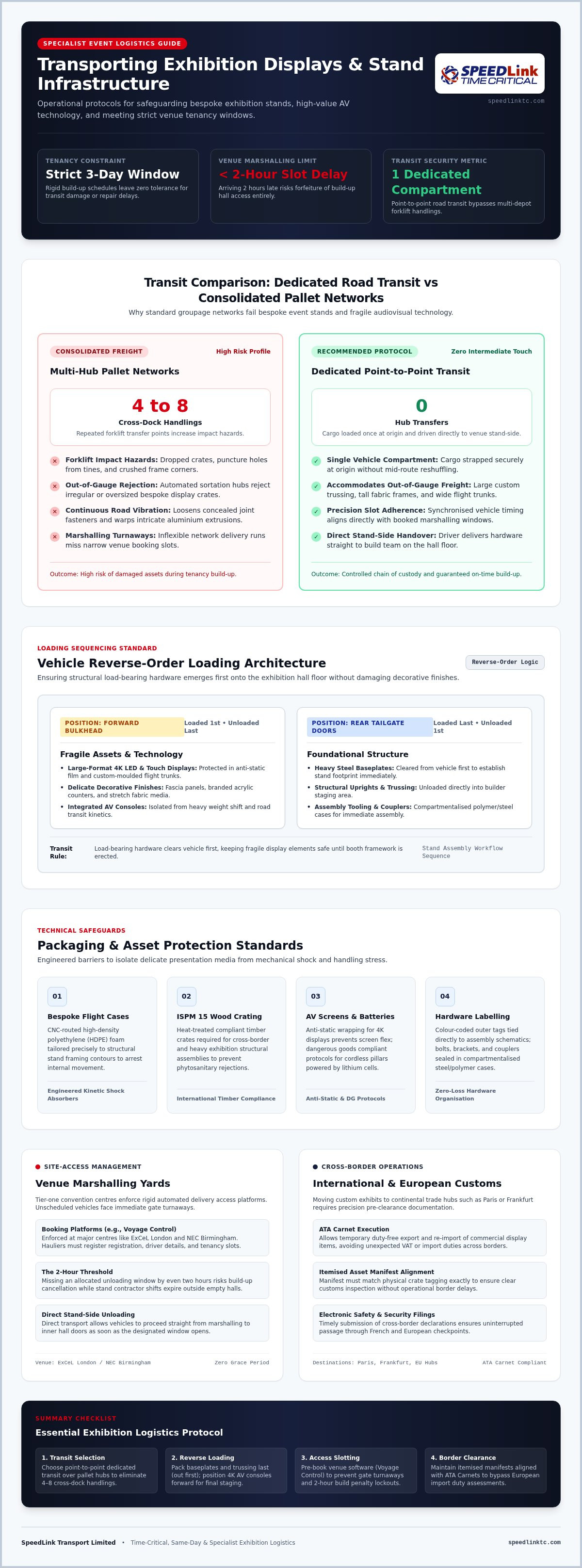
Comparing Transport Modes: Dedicated Vehicles vs Consolidated Freight
Selecting logistics for high-value trade stands requires balancing asset vulnerability against delivery predictability. For bespoke architecture and sensitive technology, direct-drive transport provides the best way to transport exhibition displays by eliminating the handling hazards inherent to groupage freight. A dedicated courier assigns a single vehicle and driver to your consignment from collection to stand-side handoff, maintaining an unbroken chain of custody.
| Operational Metric | Consolidated Groupage Freight | Dedicated Point-to-Point Transport |
|---|---|---|
| Handling Touchpoints | 4 to 8 cross-dock transfers | 2 touches (origin load and venue unload) |
| Delivery Window Precision | Estimated morning/afternoon windows | Exact 30 to 60-minute venue marshalling slots |
| Cargo Security & Isolation | Co-loaded alongside industrial cargo | Exclusive vehicle use; no third-party freight |
| Driver Site Support | Kerbside tailgate drop only | Assisted stand-side positioning and waiting |
Real-time vehicle telematics and direct phone links to drivers provide marketing coordinators with actionable oversight, avoiding ambiguous depot tracking scans.
The Operational Case for Direct-Drive Couriers
Final Dispatch Planning Checklist
Execute planning early during high-density spring and autumn exhibition calendars:
- Lock in haulage bookings four to six weeks prior to tenancy opening.
- Coordinate with official hall lifting contractors for heavy structural flight trunks.
- Confirm your venue logistics schedule with SpeedLink’s dedicated team to secure direct stand-side delivery windows.
Secure Your Event Presence with Precision Transport
Delivering a flawless trade show presence requires eliminating variables before your stand leaves the depot. Direct-drive transport remains the best way to transport exhibition displays, protecting custom architecture and delicate AV hardware by cutting out intermediary hub sorting. When combined with flight-case packaging and accurate ATA Carnet administration, dedicated transit ensures your team hits strict tenancy slots without border hold-ups or structural damage.
SpeedLink provides the operational authority your business-critical showcases demand. Our dedicated vehicles travel directly from your premises to the exhibition dock, supported by complete customs clearance management and NPPV-cleared drivers for restricted summit halls. Don’t leave your brand’s flagship presentation to standard pallet networks. Secure dedicated transport for your next exhibition display with SpeedLink and enter the hall ready to do business.
Frequently Asked Questions
What is an ATA Carnet and do I need one for European trade shows?
An ATA Carnet is a formal international customs document that acts as a passport for non-perishable commercial goods, allowing temporary export and import across 80+ countries without paying import duty or import VAT. If you are taking temporary exhibition stands, promotional displays, or demonstration technology from Great Britain into the European Union, obtaining an ATA Carnet or arranging appropriate temporary admission paperwork is essential to avoid permanent import duties.
Why is a dedicated courier safer than consolidated pallet freight for displays?
A dedicated direct-drive courier assigns an exclusive vehicle to your consignment, completely avoiding the multi-depot hub sorting and forklift cross-docking that cause transit shock. Using a dedicated vehicle remains the best way to transport exhibition displays because goods are secured once at collection and untouched until arrival at your stand, ensuring rigid tenancy slots are met without depot bottlenecks.
Can you transport exhibition displays that contain integrated lithium batteries?
Yes, but displays containing integrated lithium power banks or rechargeable battery packs must comply with strict dangerous goods transport regulations. SpeedLink provides specialised lithium battery courier and IT equipment transport services, ensuring hardware is correctly classified, declared, and protected in line with road carriage safety mandates.
What security credentials are required for deliveries to high-security event centres?
Government summits, aerospace expos, and defence venues often require drivers to hold verified security vetting to access loading docks and restricted interior halls. Standard couriers lacking vetting are routinely turned away at perimeter checkpoints. SpeedLink deploys NPPV-cleared drivers who satisfy rigorous access protocols, ensuring uninterrupted delivery directly into high-security exhibition zones.
How far in advance should I book exhibition display transport?
Booking four to six weeks in advance provides the best way to transport exhibition displays efficiently during peak spring and autumn event seasons. Early planning allows our logistics team to coordinate mandatory venue access software bookings, schedule dedicated vehicles around your exact unloading tenancy window, and prepare necessary customs declarations or carnets well ahead of departure.

Article by
Dave McMillen
I have worked in courier and logistics for over 30 years. My experience spans two continents and several types of services from road freight to airlines and specialist B2B services. SpeedLink has been serving the UK market for over 20 years providing the finest time critical and specialist services supporting businesses and individuals alike.
Disclaimer
Information is provided as general logistics guidance and is not legal, customs, aviation, medical or dangerous-goods compliance advice.
Rules vary according to commodity, quantity, classification, packaging, origin, destination, transport mode and carrier.
Regulations and carrier requirements may change.
Where regulated goods are involved, current requirements should be confirmed with the appropriate government authority, regulator, carrier or qualified specialist before shipment.
SpeedLink can confirm the transport options it can provide for a particular shipment.


