


A single packaging oversight or transit shock can transform a high-energy battery consignment into an uncontrollable, self-fuelling thermal event. When it comes to safely shipping lithium batteries by road across commercial supply chains, there is no margin for guesswork; multi-hub freight networks and automated sorting systems simply cannot mitigate these volatile chemical risks.
You likely recognise the frustration of deciphering dense ADR Special Provisions, alongside the constant concern over severe regulatory penalties, impounded vehicles, or rejected loads at the receiving dock. You don’t have to leave transport compliance to chance. This guide provides the practical clarity you need to master current ADR road frameworks, implement certified packaging that prevents internal short circuits, and protect high-value energy assets from transit shocks. From core UN classification thresholds to small-load rules and dedicated carriage methods, here is your operational roadmap to maintaining total regulatory security on every journey.
Key Takeaways
- Chemical classification under ADR Class 9 assigns strict legal accountability to consignors for categorising battery chemistries and state of charge accurately before transit begins.
- Evaluating statutory capacity thresholds between Special Provision 188 exemptions and full ADR mandates ensures your consignments avoid sudden vehicle impoundment and severe enforcement penalties.
- Implement UN-certified packaging specifications and rigorous terminal isolation protocols essential for safely shipping lithium batteries by road without risking catastrophic transit short circuits.
- Bypassing multi-hub sorting networks in favour of dedicated point-to-point road transport shields high-capacity battery assets from damaging drop heights, automated conveyor impacts, and rough cross-dock handling.
Classification and Chemical Hazards of Lithium Batteries under Road ADR Regulations
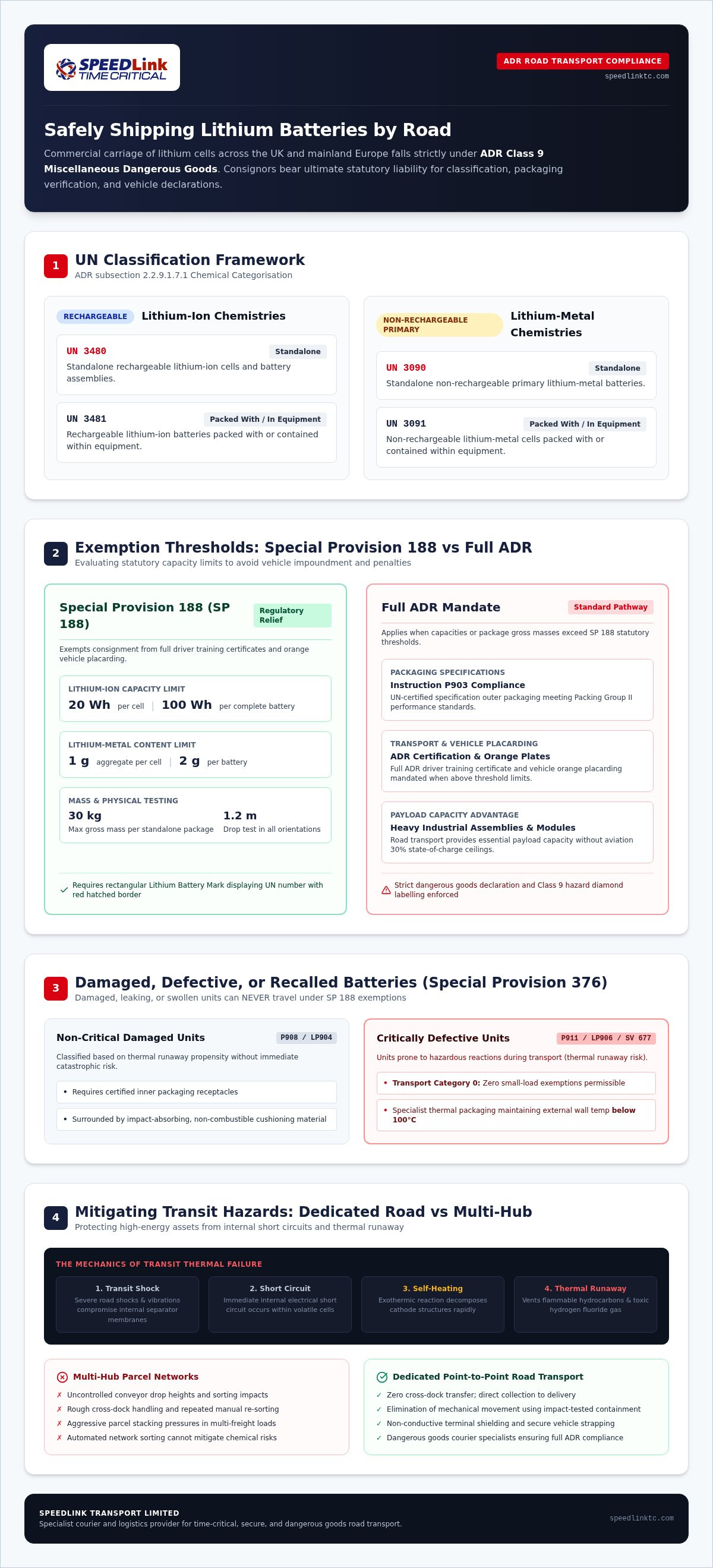
Commercial carriage of lithium cells across the UK and mainland Europe falls strictly under Class 9 Miscellaneous Dangerous Goods. Consignors bear ultimate statutory liability under the ADR dangerous goods treaty for correct chemical classification, packaging verification, and vehicle declarations before dispatch. While commercial aviation enforces rigid 30% state-of-charge ceilings and severe mass caps, road transport provides the essential payload capacity needed for heavy modules, warranty returns, and industrial battery assemblies.
Distinguishing UN 3480, UN 3481, UN 3090, and UN 3091
Accurate chemical categorisation dictates packaging pathways under ADR subsection 2.2.9.1.7.1:
- UN 3480: Standalone, rechargeable lithium-ion cells and battery assemblies.
- UN 3481: Rechargeable lithium-ion batteries packed with or contained within equipment.
- UN 3090: Standalone, non-rechargeable primary lithium-metal batteries.
- UN 3091: Non-rechargeable lithium-metal cells packed with or contained within equipment.
Consignors must verify whether cells are loose or integrated into hardware, as this dictates whether Packaging Instruction P903 applies or whether specific exemptions are permissible.
Mitigating Thermal Runaway and Physical Transit Damage
Lithium cells combine high electrical energy density with volatile organic solvents. When rough transit, severe road shock, or continuous chassis vibrations compromise internal separator membranes, immediate short circuits can occur. These failures ignite rapid exothermic self-heating, decomposing cathode structures and venting flammable hydrocarbons alongside toxic hydrogen fluoride gas. Consignors achieve success in safely shipping lithium batteries by road by eliminating mechanical movement using impact-tested containment, non-conductive terminal shielding, and experienced dangerous goods courier specialists.
Evaluating Exemption Thresholds: Special Provision 188 versus Full ADR
Special Provision 188 (SP 188) offers practical regulatory relief by exempting eligible consignments from full driver training certificates and orange vehicle placarding. This concession does not waive physical protection standards. Consignors safely shipping lithium batteries by road under SP 188 must still ensure every outer package passes a 1.2-metre drop test in all orientations without cell movement or casing rupture, while strictly respecting the statutory 30 kg gross mass limit per standalone package.
Qualifying Under SP 188 Watt-Hour and Gram Limits
Shipments must remain below rigid electrical and chemical thresholds to qualify for exemption:
- Lithium-ion: 20 Watt-hours (Wh) per cell; 100 Wh per complete battery.
- Lithium-metal: 1 gram aggregate lithium per cell; 2 grams per complete battery.
Eligible boxes require the rectangular Lithium Battery Mark displaying the relevant UN number within a red hatched border. For international cross-referencing alongside US intermodal connections, the PHMSA lithium battery shipping guide mirrors many of these baseline thresholds.
Transporting Damaged, Defective, or Recalled Batteries Safely
Damaged, leaking, or swollen units can never travel under SP 188 exemptions. Special Provision 376 mandates rigorous classification based on thermal runaway propensity. Non-critical damaged units demand Packing Instruction P908 or LP904, requiring certified inner receptacles enveloped in impact-absorbing, non-combustible cushioning. Critically defective units prone to hazardous reactions trigger Packing Instruction P911, LP906, and SV 677. This reclassifies them to Transport Category 0, eliminating small-load exemptions entirely and requiring specialist thermal packaging engineered to keep external wall temperatures below 100°C. For complex non-conforming or recalled cargo, arrange compliant point-to-point transit via SpeedLink Contact.
Packaging, Labelling, and Documentation Protocols for Road Transport
Physical barrier integrity forms your frontline defence against electrical arcing while in transit. Consignors safely shipping lithium batteries by road must contain units within UN-certified specification outer packaging, typically meeting Packing Group II performance standards under Instruction P903. Packages must withstand aggressive stacking pressures and multi-axis vibrational loads without deforming or compromising interior contents.
Terminal Insulation and Certified Outer Packaging Standards
Direct terminal contact sparks intense localised heating. You must neutralise this hazard before box closure through systematic isolation steps:
- Cover exposed terminals using non-conductive, heavy-duty electrical tape or form-fitting non-conductive caps.
- Enclose individual cells in dedicated inner blister packs or non-conductive divider partitions.
- Select certified UN 4G fibreboard boxes or 4D plywood cases tested specifically for dangerous cargo.
- Surround inner containers with inert, non-combustible cushioning, such as expanded vermiculite, to absorb impacts and prevent any shifting during heavy vehicle braking.
For cross-border requirements and regulatory alignment, consult our dedicated dangerous goods courier services.
Dangerous Goods Notes and Vehicle Documentation Checks
Road carriage requires absolute paperwork precision. Consignors must draft an official Dangerous Goods Note (DGN) stating the proper shipping name, UN identification number, Class 9 hazard code, number of packages, and total net mass. Under ADR 2.2.9.1.7.1, manufacturers and distributors must also make the UN 38.3 Test Summary available across the supply chain upon request. Drivers operating fully regulated vehicles must carry standardised Instructions in Writing detailing personal protective equipment and emergency protocols in case of road incidents. Outer packaging requires the Class 9A hazard label alongside UN specification marks. For verified compliance reviews and secure consignments, arrange your shipment through SpeedLink Contact.
Choosing Dedicated Road Transport over Multi-Hub Parcel Networks
Standard national parcel networks depend on high-speed conveyor belts, automated drop chutes, and repeated cross-dock transfers. Each sudden impact introduces severe physical shock that exceeds normal product tolerances, elevating internal cell crush risks. In contrast, safely shipping lithium batteries by road through dedicated transport moves cargo directly from your collection bay to the consignee’s door without automated handling.
Preventing Mechanical Shock and Load Shifting via Direct Transport
Direct vehicle charter removes the operational hazards of automated sorting depots entirely. Your consignments don’t face forklift punctures or crushing damage from heavier parcels falling down conveyor shoots. Dedicated vans and trucks use internal load-rated tracking, non-slip flooring, and tensioned restraint strapping to immobilise battery crates completely. This secure transit prevents load movement during sudden deceleration. Direct routing also eliminates prolonged depot dwell times, protecting active battery packs from extreme solar heat exposure during summer operations. For direct cross-border deliveries, book our dedicated European same day courier service.
Mandatory Carrier Compliance and Driver ADR Certification
Vetting your road haulier is just as critical as selecting the correct outer packaging. Transport providers handling fully regulated battery freight must retain qualified Dangerous Goods Safety Advisers (DGSAs) to audit handling protocols and paperwork before transit. Furthermore, drivers must hold valid ADR vocational training certificates for Class 9 consignments, supported by verified on-board equipment including dry-powder fire extinguishers and mandatory personal protective equipment. Consignors requiring fully certified point-to-point carriage can arrange collection through SpeedLink dangerous goods transport.
Ensure Uncompromising ADR Compliance on Every Road Journey
Achieving reliable logistics for hazardous energy storage requires absolute discipline across chemical classification, UN-certified packaging, and carrier selection. Whether your consignments leverage Special Provision 188 exemptions or mandate full ADR execution, isolating terminals and preventing transit shock remain essential for safely shipping lithium batteries by road. Automated parcel hubs present too many uncontrolled impact hazards for volatile battery chemistries.
Partnering with dedicated transport specialists eliminates multi-hub sorting risks, ensuring your high-consequence technology freight moves directly from sender to destination without cross-dock rehandling. SpeedLink provides ADR Class 9 compliant road courier services across the UK and Europe, backed by rapid same-day collection capability and rigorous compliance oversight. Book dedicated ADR lithium battery transport with SpeedLink to safeguard your supply chain and protect your high-value assets on every route.
Frequently Asked Questions
Can I ship lithium batteries by road without full ADR certification?
Yes, consignors can transport lithium batteries without an ADR driver certificate if the consignment qualifies under Special Provision 188 or the ADR 1.1.3.6 small-load threshold. SP 188 exempts small cells under strict energy limits, whilst section 1.1.3.6 permits carrying up to 333 kg net mass of Class 9 batteries before vehicle placarding and driver vocational licences become statutory. Basic documentation and packaging integrity rules remain mandatory.
What is the Watt-hour threshold for exempt lithium-ion battery road shipments?
The statutory capacity threshold under Special Provision 188 is 20 Watt-hours (Wh) for individual lithium-ion cells and 100 Wh for assembled battery packs. Consignments staying within these ratings avoid full ADR driver licensing provided gross package weights don’t exceed 30 kg and containers pass a 1.2-metre drop test. Units exceeding 100 Wh, including industrial storage banks, immediately require fully regulated dangerous goods transport.
How should damaged or defective lithium batteries be packaged for road transit?
Damaged or defective batteries must be packaged under ADR Packing Instruction P908 or P911, depending on their thermal runaway risk. Consignors must encase each unit within leakproof, non-conductive inner packaging surrounded by non-combustible thermal insulation like vermiculite. Critically defective units prone to violent reaction require impact-tested outer packaging engineered to maintain external surface temperatures below 100°C during worst-case internal reactions.
What documentation must accompany commercial road consignments of lithium batteries?
Commercial consignments moving above exemption limits require a Dangerous Goods Note, carrier emergency Instructions in Writing, and the manufacturer’s UN 38.3 Test Summary. Consignment paperwork must accurately detail the UN number, proper shipping name, Class 9 classification, and total net mass. For organisations safely shipping lithium batteries by road across UK and European corridors, complete documentation prevents border impoundment and roadside enforcement penalties.
Why is dedicated road transport safer than standard parcel networks for batteries?
Dedicated road transport provides direct point-to-point transit that eliminates the automated drop chutes, mechanical conveyor impacts, and repeated transhipments common in multi-hub parcel networks. Automated sorting systems routinely subject cartons to severe drops that can compromise fragile internal separators. Direct chartered vehicles secure freight using load-rated floor strapping, maintaining stable custody and physical protection essential for safely shipping lithium batteries by road.

Article by
Dave McMillen
I have worked in courier and logistics for over 30 years. My experience spans two continents and several types of services from road freight to airlines and specialist B2B services. SpeedLink has been serving the UK market for over 20 years providing the finest time critical and specialist services supporting businesses and individuals alike.
Disclaimer
Information is provided as general logistics guidance and is not legal, customs, aviation, medical or dangerous-goods compliance advice.
Rules vary according to commodity, quantity, classification, packaging, origin, destination, transport mode and carrier.
Regulations and carrier requirements may change.
Where regulated goods are involved, current requirements should be confirmed with the appropriate government authority, regulator, carrier or qualified specialist before shipment.
SpeedLink can confirm the transport options it can provide for a particular shipment.


