


A single point of failure in your supply chain can compromise years of clinical research and millions of pounds in sensitive hardware. When your mission involves moving high-value healthcare technology, selecting a secure medical device courier is not just a logistical choice; it’s a critical risk management strategy. We understand the pressure you face regarding equipment damage and the potential for regulatory breaches, where even a single HIPAA violation can result in fines ranging from $100 to over $50,000. The anxiety surrounding compliance, particularly with the FDA Quality Management System Regulation (QMSR) taking effect in February 2026, requires a partner who operates with methodical precision.
You’ll likely agree that the stakes are too high for standard delivery protocols. This guide provides the essential protocols for transporting sensitive healthcare technology safely whilst maintaining a rigorous, verifiable chain-of-custody. We’ll examine the step-by-step requirements for ensuring a damage-free delivery, building a robust audit trail for compliance, and maintaining the continuity of critical medical services.
Key Takeaways
- Understand the risks of standard transport and how specialised handling prevents critical calibration shifts and sensitive data breaches.
- Learn the essential preparation steps, including rigorous documentation of device conditions and the selection of bespoke, high-impact protective casing.
- Discover how to vet a secure medical device courier by verifying NPPV and DBS clearances to meet strict healthcare security standards.
- Implement real-time visibility through GPS tracking and geofencing to maintain a verifiable audit trail for CQC and MHRA compliance.
- Identify the key criteria for selecting a logistics partner that offers the sector-specific expertise and rapid response capabilities required for life sciences.
Why Medical Device Transport Requires Specialised Security Protocols
A secure medical device courier provides far more than mere point-to-point transport. Whilst standard parcel networks rely on high-volume automation and multiple sorting hubs, healthcare logistics requires a bespoke, dedicated approach that prioritises the physical and digital integrity of the asset. Standard networks often subject packages to significant mechanical shock and temperature fluctuations; these conditions are frequently catastrophic for sensitive instrumentation. For clinical providers, the cost of a logistical failure isn’t measured in shipping fees, but in delayed diagnoses and compromised patient safety.
Regulatory bodies like the MHRA and CQC expect a level of oversight that general carriers simply cannot provide. If a device arrives out of calibration or with its digital integrity questioned, the clinical data it produces becomes inadmissible. We recognise that maintaining a rigorous chain-of-custody is essential for meeting these stringent UK standards and protecting your organisation from liability. Standard “parcel” networks are unsuitable because they lack the direct, person-to-person handover protocols required for high-stakes healthcare technology.
The Vulnerability of Healthcare Technology
Precision medical devices are often susceptible to even minor kinetic energy transfers. Excessive vibration during transit can shift sensitive sensor calibrations, rendering a piece of equipment useless upon arrival. Beyond physical damage, the risk of data theft remains a significant concern. Devices often store unencrypted patient records. If these units are lost or accessed by unauthorised personnel in a standard hub environment, the resulting GDPR breach could be devastating for your organisation’s reputation and financial stability.
Compliance and the Audit Trail
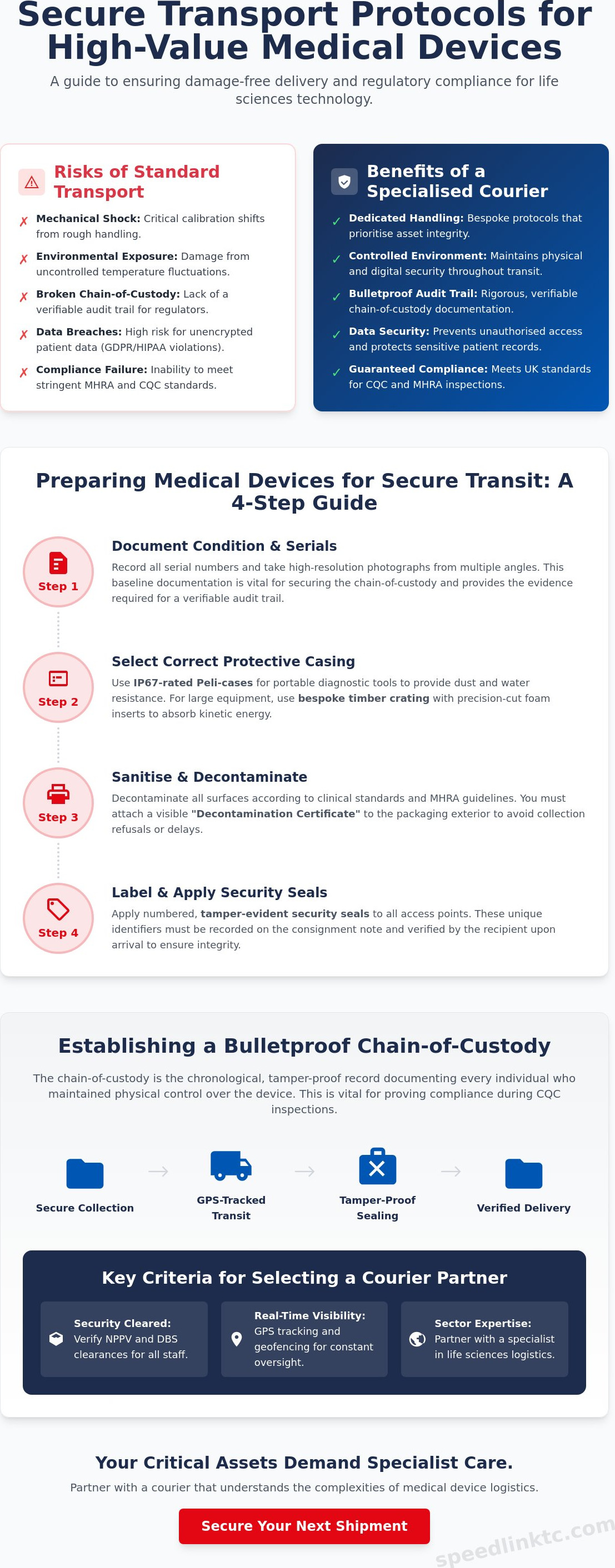
Utilising specialised life sciences and healthcare logistics ensures your organisation maintains its clinical governance. A robust audit trail proves that the device remained under constant supervision and within specified environmental parameters throughout its journey. In a medical context, the chain of custody is the chronological, tamper-proof record documenting every individual who maintained physical control over the device from collection to final delivery. This level of detail is vital for proving compliance during CQC inspections and maintaining the trust of your patients.
How to Prepare Medical Devices for Secure Transit: A Step-by-Step Guide
Preparing your equipment for transit is the critical first step in risk mitigation. It ensures that your chosen secure medical device courier can maintain the operational integrity established at the point of origin. Without rigorous preparation, even the most sophisticated transport solution cannot fully protect against the variables of the road. We recommend following this methodical sequence to ensure every asset is ready for high-stakes movement.
- Step 1: Documenting condition and serial numbers. Record all serial numbers and take high-resolution photographs of the device from multiple angles. This baseline documentation is vital for securing the chain of custody and provides the evidence required for a verifiable audit trail.
- Step 2: Choosing the correct protective casing. Use IP67-rated Peli-cases for portable diagnostic tools to provide dust and water resistance. For large-scale laboratory equipment, bespoke timber crating with precision-cut foam inserts is necessary to absorb kinetic energy during transit.
- Step 3: Sanitisation and decontamination. Decontaminate all surfaces according to clinical standards and MHRA guidelines. You must attach a visible “Decontamination Certificate” to the exterior of the packaging to avoid collection refusals or delays at the receiving facility.
- Step 4: Labelling and sealing. Apply numbered, tamper-evident security seals to all access points. These unique identifiers must be recorded on the consignment note and verified by the recipient upon arrival.
Packaging for Sensitive Electronics
Sensitive electronics require specialised anti-static materials to prevent electrostatic discharge (ESD) damage. Shock-absorbent internal bracing is equally important to prevent board-level micro-fractures during movement. We advise the use of tilt and impact indicators; these small sensors provide undeniable visual proof if the unit has been subjected to forces beyond its design tolerances, allowing for immediate inspection before clinical use. The same principles apply when organisations require a server transport service UK wide, where rack-mounted hardware faces identical risks from vibration and electrostatic discharge during relocation.
Data Security and Privacy
Ensure all devices are fully powered down and batteries are secured according to current lithium regulations. Physical ports should be sealed with security tape or port blockers to prevent unauthorised data access whilst in transit. For systems containing sensitive patient records, our Secure Courier Services provide the vetted personnel and dedicated vehicles required for total data protection. If you require assistance with specific packing requirements for a complex movement, contact our specialist team for a technical consultation.
Establishing a Bulletproof Chain-of-Custody
Standard logistics providers often rely on hub-and-spoke models where goods are sorted multiple times across various distribution centres. For a secure medical device courier, this level of exposure is unacceptable. Every additional touchpoint increases the risk of loss, theft, or physical mishandling. We utilise dedicated, point-to-point delivery to ensure your technology remains on a single vehicle from the moment of collection until final handover. This direct approach is essential for maintaining the integrity of the sample or the operational state of the device. Real-time GPS tracking and geofencing provide constant visibility, alerting our control centre immediately if a vehicle deviates from its pre-planned route.
The Importance of Vetted Personnel
Trust is built on verification rather than assumption. Every operative in our network undergoes rigorous screening to ensure they meet the demands of high-stakes logistics. Whilst standard DBS checks are a baseline, we prioritise NPPV (Non-Police Personnel Vetting) clearance for healthcare assignments. This higher level of scrutiny ensures that the individuals handling your sensitive assets are vetted to a standard suitable for police and government infrastructure. For deeper insights into these security tiers, refer to our Specialist Courier Service UK guide.
Vehicle Security Standards
Physical security must be as robust as the vetting of the personnel. We exclusively use hard-sided vehicles with integrated locking systems to eliminate the vulnerabilities associated with soft-sided vans. These vehicles are equipped with Thatcham-approved immobilisers and remote alarm monitoring that connects directly to our 24/7 operations hub. This setup ensures that the vehicle and its contents are protected even during mandatory driver rest breaks.
The chain-of-custody is finalised with a digital audit trail. We provide time-stamped proof of delivery and digital signatures that integrate directly into your clinical records. This verifiable record is crucial for meeting the reporting requirements of the EU Medical Device Regulation (MDR) milestones approaching in 2026. If you need to secure a high-value movement today, book a secure transport consultation with our logistics experts.
Selecting a Secure Medical Device Courier Partner
Assessment should also extend to international capabilities and financial protection. If your requirements involve cross-border movements, ensure the provider has the expertise to handle complex customs clearance and regulatory documentation. You should also verify their insurance provisions. Standard goods-in-transit insurance is frequently insufficient for high-value medical instrumentation. A dependable partner will offer enhanced cover that reflects the true replacement value of your assets, providing peace of mind during high-stakes movements.
Why SpeedLink is the Preferred Healthcare Partner
We’ve developed our Life Sciences and Healthcare solutions to act as a strategic extension of your clinical team. By utilising our Same Day Courier service, you eliminate the risks associated with overnight storage and multiple handling points. We focus on speed without compromising the methodical control required for sensitive hardware, ensuring that critical diagnostic tools reach their destination in peak operational condition.
Bespoke Logistics for Complex Needs
Future-Proofing Your Medical Device Logistics
Maintaining the integrity of high-value healthcare technology requires a shift from standard delivery mindsets to a strategic risk-management approach. By implementing the rigorous preparation protocols and chain-of-custody standards outlined in this guide, you protect your organisation from the physical and digital vulnerabilities inherent in general transport networks. A secure medical device courier acts as a critical safeguard; it ensures that your equipment arrives in peak operational condition whilst satisfying the stringent audit requirements of the MHRA and CQC.
Our operational model is built on precision and authority. We provide specialised handling for Life Sciences & Healthcare through a network of NPPV cleared and vetted couriers. Every movement is protected by real-time GPS tracking and conducted in dedicated vehicles to ensure your assets never leave our direct control. This methodical approach eliminates the uncertainty of the logistics process, allowing you to focus on delivering essential clinical outcomes. We’re ready to support your most complex requirements with the speed and security your sector demands.
If you’re ready to enhance your supply chain security, request a quote for your secure medical device transport today. It’s time to partner with a team that values your technology as much as you do.
Frequently Asked Questions
What is a secure medical device courier?
A secure medical device courier is a specialised logistics provider that focuses on the high-security transport of sensitive healthcare technology. Unlike standard carriers, these providers use dedicated vehicles and vetted personnel to prevent physical damage, calibration shifts, or data breaches. This service is essential for maintaining the rigorous chain of custody required by clinical governance standards and protecting high-value assets from the risks of a hub-and-spoke delivery model.
Does a medical device courier need special insurance?
Yes, standard goods-in-transit insurance rarely covers the high replacement value or the technical sensitivity of precision medical instrumentation. A professional partner provides enhanced liability cover tailored to the specific replacement cost of your assets. It’s vital to ensure that your chosen secure medical device courier has a policy that accounts for both physical damage and the potential liabilities associated with the loss of sensitive patient data stored on the hardware.
How do you track a high-value medical delivery in real-time?
Real-time tracking is achieved through integrated GPS hardware and geofencing technology installed on dedicated vehicles. You receive a secure digital portal or live updates that show the vehicle’s precise location at every stage of the journey. This level of visibility allows our operations centre to intervene immediately if any unauthorised route deviations occur, ensuring a verifiable audit trail that satisfies the reporting requirements of healthcare regulators.
What is NPPV clearance and why does it matter for healthcare?
NPPV (Non-Police Personnel Vetting) is a high-level security clearance that authorises individuals to handle sensitive assets and access protected infrastructure. In healthcare logistics, it ensures that your courier has been vetted to a standard suitable for police and government environments. This level of scrutiny is far more rigorous than a standard DBS check, providing a higher degree of trust when transporting devices that contain confidential patient records.
Can you transport medical devices internationally with customs clearance?
We provide comprehensive international transport solutions that include professional customs clearance for complex medical movements. Our team manages the necessary regulatory documentation and tax requirements to ensure a seamless transition across borders, particularly between the UK and the EU. This service is critical for meeting the milestones of the EU Medical Device Regulation (MDR) whilst ensuring that sensitive technology is not delayed in transit hubs.

Article by
Dave McMillen
I have worked in courier and logistics for over 30 years. My experience spans two continents and several types of services from road freight to airlines and specialist B2B services. SpeedLink has been serving the UK market for over 20 years providing the finest time critical and specialist services supporting businesses and individuals alike.
Disclaimer
Information is provided as general logistics guidance and is not legal, customs, aviation, medical or dangerous-goods compliance advice.
Rules vary according to commodity, quantity, classification, packaging, origin, destination, transport mode and carrier.
Regulations and carrier requirements may change.
Where regulated goods are involved, current requirements should be confirmed with the appropriate government authority, regulator, carrier or qualified specialist before shipment.
SpeedLink can confirm the transport options it can provide for a particular shipment.


