


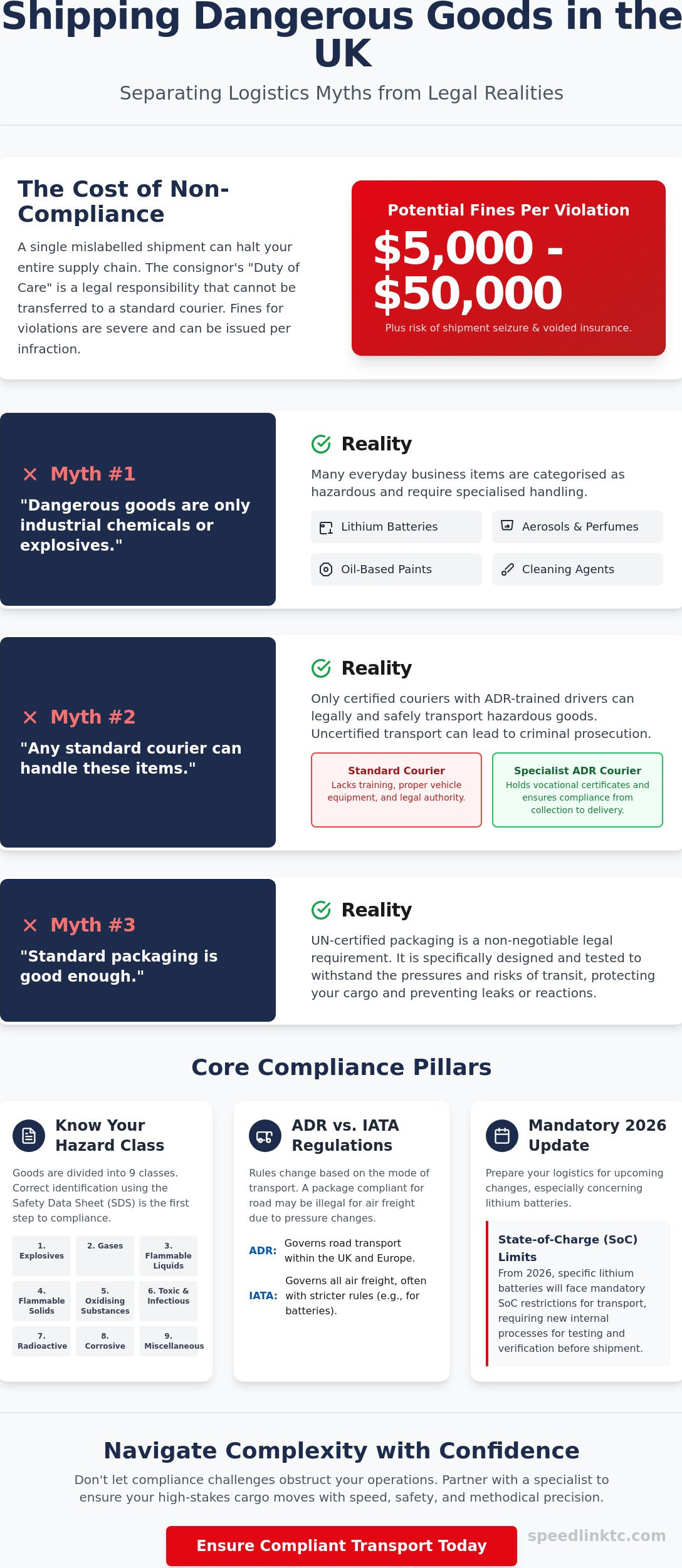
A single mislabelled shipment of lithium batteries or an overlooked aerosol canister can result in regulatory fines ranging from $5,000 to $50,000 per violation. We recognise that the labyrinth of ADR regulations and IATA mandates often feels designed to obstruct your operations rather than facilitate them. It’s understandable why many logistics managers feel overwhelmed by the prospect of how to ship dangerous goods UK, especially when standard couriers frequently refuse essential items like laptops or specialised industrial components.
You deserve a transport strategy that balances operational speed with absolute compliance. This article will help you master the complexities of hazardous transport by separating pervasive logistics myths from the rigorous legal realities of UK shipping. We’ll examine seven critical misconceptions, detail the mandatory 2026 state-of-charge requirements for batteries, and provide a clear framework for managing your legal liabilities. By the end of this guide, you’ll possess the practical knowledge required for correct packaging and labelling, ensuring your high-stakes cargo moves through the supply chain with methodical precision.
Key Takeaways
- Recognise that everyday business items, from aerosols to lithium batteries, are categorised as hazardous under the latest ADR and IATA regulations.
- Understand the essential legal requirements for how to ship dangerous goods UK to ensure your business remains fully compliant with the latest ADR mandates.
- Identify why UN-certified packaging is a non-negotiable requirement for protecting your cargo and mitigating the risk of substantial regulatory fines.
- Learn how to integrate the mandatory 2026 state-of-charge limits for battery transport into your existing logistics and supply chain workflows.
- Discover how to utilise specialised transport partners to maintain rapid delivery timelines whilst adhering to the most stringent safety standards.
Debunking the ‘Chemical-Only’ Myth: What Actually Counts as Dangerous Goods?
We find that many corporate decision-makers assume hazardous cargo is restricted to volatile industrial acids or explosives. This misconception is the primary catalyst for shipment seizures and heavy fines. In reality, what counts as dangerous goods includes a vast array of consumer and commercial products that businesses move daily. Dangerous goods are defined as any substances or articles that, because of their inherent physical or chemical properties, pose a significant risk to health, safety, property, or the environment whilst in transit. Identifying these hidden hazards is the first step in avoiding catastrophic shipment failures.
Identifying Hazardous Items in Everyday Business
The Nine Hazard Classes Simplified
Global regulations categorise dangerous goods into nine distinct classes. These range from Class 1 (explosives) and Class 2 (gases) to Class 9 (miscellaneous hazardous substances), which encompasses many modern electronics. Understanding these classifications is essential when learning how to ship dangerous goods UK safely. Even “Limited Quantities” (LQ), which involve smaller amounts of hazardous materials, aren’t exempt from regulation. They still require specific marking and methodical handling to ensure compliance with the latest 2026 transport standards. If you fail to classify an item correctly at the point of origin, the entire logistics chain is compromised.
Myth: Any Standard Courier Can Legally Handle Hazardous Shipments
Handing a hazardous consignment to a general parcel network doesn’t transfer your legal liability. If you’re researching how to ship dangerous goods UK, you must understand that the “Duty of Care” remains firmly with the consignor. Using an uncertified courier doesn’t just risk a delivery failure; it can lead to criminal prosecution and completely void your business insurance. A standard delivery driver lacks the specialist training and vehicle equipment required to manage spills or emergencies. Conversely, an ADR courier service UK provider employs drivers who hold vocational training certificates specifically for hazardous materials. They possess the expertise to verify that your shipment is compliant before it even leaves your loading bay.
The Role of the Dangerous Goods Safety Adviser (DGSA)
Under UK law, most businesses that regularly involve themselves in the carriage of hazardous items must appoint a Dangerous Goods Safety Adviser (DGSA). This professional is responsible for monitoring compliance and ensuring staff are trained to handle the official list of dangerous goods classes safely. A DGSA is a mandatory requirement for most organisations shipping significant volumes. They ensure your internal processes align with the June 2026 ADR updates, where responsibility for compliance now explicitly extends across the entire logistics chain. Failure to have this advisory oversight can result in fines ranging from $5,000 to $50,000 per violation.
ADR vs. IATA: Why the Mode of Transport Changes Everything
The rules shift dramatically when moving from road to air. Whilst the ADR covers road transport, IATA regulations govern air freight. A package that’s perfectly stable in the back of a van might fail at 30,000 feet due to atmospheric pressure differentials. This is why certain items, like specific lithium batteries, face mandatory state-of-charge restrictions as of January 2026. If your requirements involve complex multi-modal movements, you should consult our dangerous goods specialists to ensure every leg of the journey is legally sound.
Myth: Standard Packaging is Sufficient for Hazardous Transit
When evaluating how to ship dangerous goods UK, standard cardboard and bubble wrap simply won’t suffice. Whilst these materials may protect against minor abrasions, they aren’t engineered to contain hazardous leaks or withstand the specific stresses of a chemical transport environment. Most dangerous goods require UN-certified packaging. These containers undergo rigorous “Performance Testing” to ensure they can survive drop tests, stack tests, and internal pressure changes without compromising the cargo. If you’re moving high-value hazardous assets, utilising a Specialist Courier Service UK provides the assurance that your packaging strategy meets these exacting industrial standards.
Understanding UN-Certified Packaging and Labelling
Every compliant container features a UN specification mark, a string of codes that identifies the packaging type and the hazard levels it can safely hold. You must ensure this mark aligns with the official government classification of dangerous goods. Beyond the box itself, labelling rules are non-negotiable. You must apply diamond-shaped hazard labels and orientation arrows that remain visible and unobstructed. A common mistake is placing labels over seams or using the wrong size, which can lead to authorities impounding your shipment at the roadside.
The Documentation Trail: Beyond the Standard Waybill
Your transport documentation must be as robust as your packaging. The Dangerous Goods Note (DGN) is the most critical document, providing emergency responders with the exact UN number and packing group of your consignment. As of July 2025, UK road freight regulations mandate that all dangerous goods documentation must be located within the driver’s cab rather than attached to the package. This ensures the driver can present “Emergency Instructions in Writing” immediately if an incident occurs. Understanding these nuances is vital for anyone learning how to ship dangerous goods UK without risking regulatory intervention. For professional assistance with your hazardous documentation, get in touch with our compliance team.
Myth: Compliance and Safety Must Compromise Delivery Speed
Many logistics managers assume that regulatory “red tape” inevitably creates a bottleneck. If you’re investigating how to ship dangerous goods UK, don’t let the fear of delays dictate your supply chain strategy. Whilst the documentation and packaging requirements are rigorous, they shouldn’t obstruct urgent movements. A dedicated same day courier service UK provider can move hazardous consignments within hours. By utilising a dedicated vehicle for a single shipment, we eliminate the risks associated with multi-drop networks, such as cross-contamination or accidental damage during sorting. This methodical approach ensures safety without sacrificing the speed your business requires.
Integrating Same-Day Urgency with Dangerous Goods Safety
Specialist couriers bypass the traditional hub-and-spoke networks that often refuse hazardous items or subject them to lengthy inspections. Point-to-point delivery is particularly vital for time-critical, sensitive cargo. For example, moving UN3373 biological substances requires both rapid transit and strict adherence to Category B packaging standards. We manage these complexities simultaneously, providing a seamless transition from your facility to the final destination. When you remove the unnecessary handling stages of a standard parcel network, you significantly increase the safety profile of your shipment.
Why Outsourcing to a Specialist Protects Your Liability
Entrusting your hazardous logistics to a specialist provides a critical layer of liability protection. Our NPPV-cleared and ADR-trained professionals serve as a final safety check before your cargo hits the road. They verify that your labels are correct and your DGN is in the cab, ensuring you aren’t exposed to the substantial fines mentioned earlier. We act as your proactive guide, turning hazardous compliance into a strategic asset. If you need to move high-stakes materials today, consult our dangerous goods experts today for a compliant, same-day solution.
Securing Your Hazardous Logistics Strategy
Mastering the complexities of hazardous transport requires moving beyond the myths that often compromise business safety. We’ve established that compliance is a shared responsibility across the entire supply chain, particularly following the 2026 ADR updates and mandatory battery state-of-charge regulations. Whether you’re handling everyday electronics or specialised industrial materials, knowing how to ship dangerous goods UK effectively is the only way to safeguard your operations from severe financial penalties and legal liability.
You don’t have to manage these regulatory burdens alone. By partnering with experts who provide ADR-trained specialist couriers and strategic DGSA-led compliance support, you ensure every shipment remains methodical and secure. We offer NPPV-cleared personnel for high-security environments, providing the operational authority needed for high-stakes logistics. Let us handle the technical precision of your hazardous cargo so you can maintain your focus on core business growth. Get a Quote for Compliant Dangerous Goods Transport today and move your goods with absolute confidence.
Frequently Asked Questions
Can I ship lithium batteries by standard courier in the UK?
Standard couriers generally require a pre-existing dangerous goods contract and strict adherence to ADR or IATA regulations before they’ll accept lithium batteries. If you attempt to send them via a standard parcel network without a formal declaration, your shipment will likely be seized or destroyed. As of January 2026, air transport regulations have become even more stringent, requiring a State of Charge (SoC) not exceeding 30% for batteries packed with equipment.
What happens if I ship dangerous goods without the correct labels?
If you fail to apply the correct diamond-shaped hazard labels or orientation arrows, your consignment will be impounded by authorities during roadside checks. Beyond the immediate delay, you face significant legal liability and regulatory fines that can range from $5,000 to $50,000 per violation. It’s your responsibility as the consignor to ensure that all packaging and labelling meet the current standards for how to ship dangerous goods UK.
Do I need a Dangerous Goods Safety Adviser (DGSA) for one-off shipments?
UK law typically requires any business involved in the regular transport, loading, or unloading of hazardous materials to appoint a DGSA. Whilst certain exemptions exist for very small quantities or infrequent movements, most corporate shippers find that advisory oversight is essential for maintaining compliance. A DGSA ensures your internal staff are appropriately trained and that your documentation, such as the Dangerous Goods Note, is legally sound.
What is a UN number in hazardous shipping and where do I find it?
A UN number is a unique four-digit identifier assigned to specific hazardous substances or articles to facilitate international transport safety. You can locate this number in Section 14 of the product’s Safety Data Sheet (SDS), which is provided by the manufacturer. Correctly identifying the UN number is the fundamental first step in determining the required packaging, labelling, and transport category for your shipment.
Can dangerous goods be delivered on the same day in the UK?
Yes, you can achieve same-day delivery for hazardous items by utilising a dedicated ADR-trained courier service. Specialist providers bypass the sorting delays of traditional hub-and-spoke networks, moving your cargo point-to-point in a single vehicle. This approach is the most efficient method for how to ship dangerous goods UK whilst ensuring that urgent consignments reach their destination without compromising safety.

Article by
Dave McMillen
I have worked in courier and logistics for over 30 years. My experience spans two continents and several types of services from road freight to airlines and specialist B2B services. SpeedLink has been serving the UK market for over 20 years providing the finest time critical and specialist services supporting businesses and individuals alike.


