


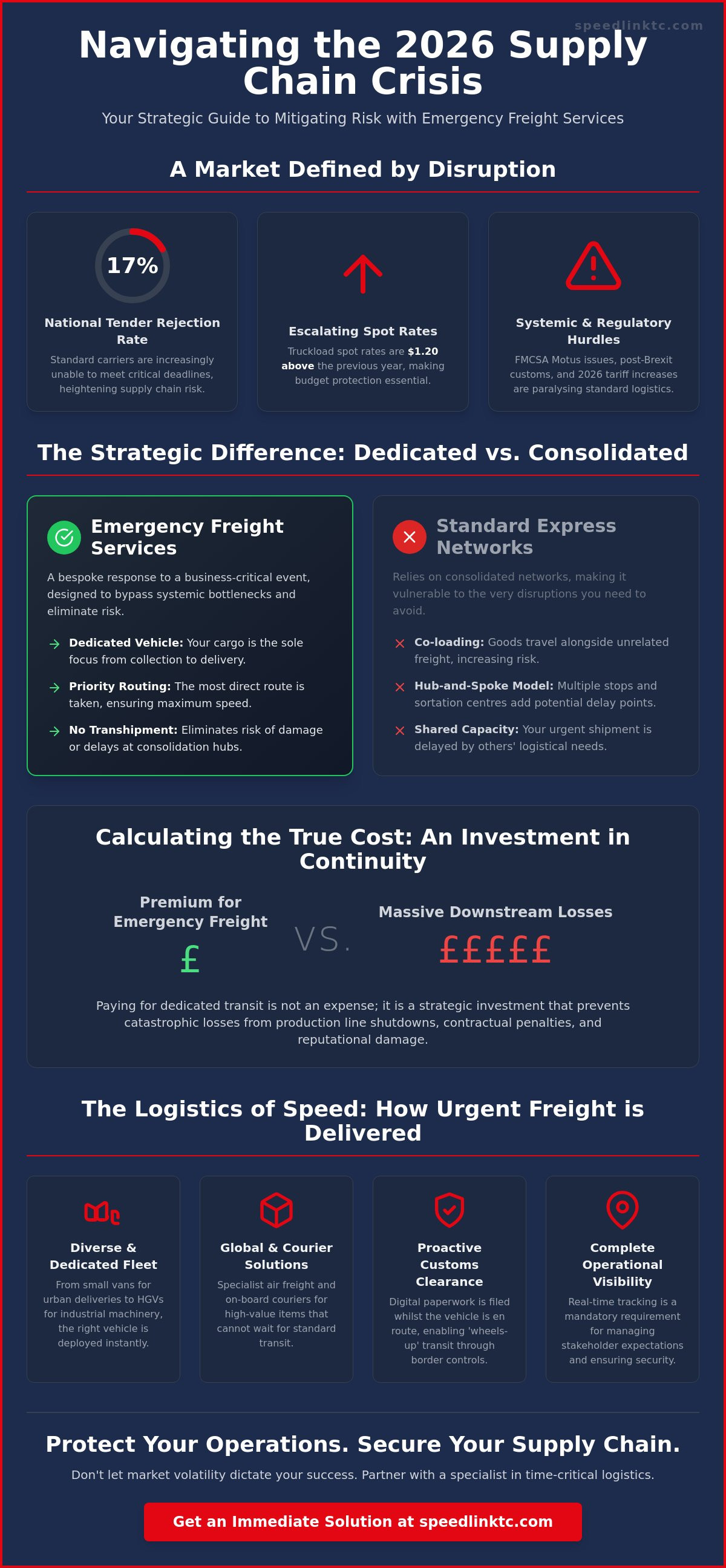
With national tender rejection rates climbing to 17% and the FMCSA’s Motus system complications stalling new carrier authorities, your next time-critical shipment is no longer a routine task; it’s a high-stakes race against systemic failure. You understand that in 2026, the margin for error has vanished. Whether you’re facing a sudden production line shutdown or the anxiety of moving high-value IT equipment, the need for reliable emergency freight services has never been more acute.
It’s a frustrating reality where post-Brexit customs complexities and the June 2026 global tariff increases can turn a minor delay into a significant commercial penalty. We understand that your primary objective is maintaining operational continuity whilst protecting your bottom line from volatile spot rates. This guide provides the strategic framework you need to mitigate supply chain disruptions with specialist, secure, and rapid solutions tailored specifically for B2B requirements. We detail how to leverage expert customs clearance and precision logistics to ensure your most sensitive cargo reaches its destination without compromise.
Key Takeaways
- Understand the “cost of failure” and why dedicated vehicles are essential for preventing massive downstream losses during time-critical disruptions.
- Explore the infrastructure required for rapid delivery, including the strategic use of air freight and on-board couriers for international emergencies.
- Identify the specific handling protocols needed for sensitive cargo, such as dangerous goods and lithium batteries, to ensure safety and regulatory compliance.
- Learn how to vet a strategic partner by prioritising operational authority and meticulous certification over low-cost aggregators.
- Discover how emergency freight services provide a resilient buffer against the unique supply chain pressures and global tariff increases of 2026.
What are Emergency Freight Services and Why are They Critical?
Emergency freight services represent the most precise tier of time-critical logistics, designed specifically for situations where traditional supply chains have reached their limit. Whilst standard “express” or “economy” options rely on consolidated hub-and-spoke networks, emergency solutions utilise dedicated vehicles and priority routing to ensure your cargo is the sole focus of the journey. This isn’t merely a faster version of a parcel service; it’s a bespoke response to a business-critical event.
The primary differentiator is the concept of dedicated logistics. When you engage an emergency provider, the vehicle assigned to your shipment carries only your goods. This eliminates the risks associated with transhipment, multi-stop deliveries, and the potential for damage amongst unrelated freight. Understanding the role of a freight forwarder is essential here, as these experts act as strategic architects who bypass systemic bottlenecks to maintain your operational flow.
In the current 2026 market, the “cost of failure” has escalated significantly. With national tender rejection rates for truckload freight sitting at 17% as of mid-June, the likelihood of a standard carrier failing to meet a critical deadline is higher than in previous years. Paying for premium, dedicated transit isn’t an unnecessary expense; it’s a strategic investment that prevents massive downstream losses such as production line shutdowns or heavy regulatory fines for late deliveries.
The Business Impact of Supply Chain Disruptions
In 2026, the fragility of just-in-time manufacturing is intensified by systemic challenges like the FMCSA’s Motus registration issues, which have constrained carrier capacity and increased the risk of operational paralysis. Emergency freight serves as a critical buffer, protecting your brand reputation and ensuring you meet strict contractual SLAs even when the wider market is in turmoil. Deploying a specialist same day courier service UK allows you to mitigate immediate local failures before they cascade into global supply chain disasters.
The Logistics of Speed: How Urgent Freight is Delivered
Delivering results in a high-pressure environment requires a diverse fleet and a sophisticated operational core. In 2026, the infrastructure of speed spans from small vans for nimble city transits to heavy goods vehicles (HGVs) capable of hauling industrial machinery. The choice of vehicle is a strategic decision based on the specific dimensions of the cargo and the required arrival window. For global requirements, the use of air freight and on-board couriers provides a solution for high-value items, such as passports or critical IT components, that cannot wait for standard sea or road transit.
Operational visibility is the foundation of trust in emergency freight services. With truckload spot rates currently $1.20 above the previous year and capacity tightened by the FMCSA’s Motus system issues, real-time tracking is no longer optional. It’s a requirement for managing stakeholder expectations. Adhering to FMCSA emergency declarations ensures that even during national crises, your logistics provider operates within the legal framework whilst prioritising the fastest possible delivery. Integrating EU shipping with customs clearance into the initial booking process prevents the administrative delays that often stall urgent shipments at the border.
Dedicated Vehicles vs. Co-loading
Dedicated transit remains the gold standard for time-critical logistics. By avoiding the consolidation hubs and sortation centres used in standard express networks, your cargo remains on a single vehicle from collection to delivery. This direct route significantly reduces the risk of damage whilst ensuring that your shipment is not delayed by the logistical requirements of other customers’ freight. If you are managing a time-sensitive breakdown, you can reach our operations team for immediate advice on the fastest available vehicle for your specific cargo.
Navigating International Borders in an Emergency
The post-Brexit landscape requires a proactive approach to documentation. Whilst the courier is en route to the collection point, our team begins the digital filing process to ensure all paperwork is ready before the vehicle reaches the port. The role of European customs clearance is to facilitate “wheels-up” transit, where the vehicle moves through the border with minimal physical inspection. This methodical preparation is what allows emergency freight services to bypass the bottlenecks that frequently paralyse standard commercial traffic.
Handling Specialist and Sensitive Emergency Cargo
A common reservation amongst corporate decision-makers is whether emergency freight services can accommodate highly regulated or delicate cargo under extreme time pressure. Speed is irrelevant if the consignment is rejected at the point of loading due to a lack of certification or is damaged by improper handling. We address this by employing specialists trained in the transport of dangerous goods and lithium batteries. These items require strict adherence to ADR regulations and specific packaging protocols that standard couriers often lack.
The requirement for precision extends to fine art transport, where even an urgent movement demands climate-controlled environments and air-ride suspension. In high-stakes sectors like semiconductor manufacturing, securing the supply chain isn’t just about transit speed; it’s about ensuring the physical integrity of sensitive components. Whether it’s a prototype for a new product launch or a critical replacement part, the methodology remains the same: meticulous preparation followed by disciplined execution.
Secure and Vetted Transit for High-Value Assets
When moving critical data or high-value IT equipment, the identity of the person behind the wheel is as important as the vehicle itself. There’s a profound difference between a standard driver and an NPPV cleared courier, who has undergone rigorous Non-Police Personnel Vetting. This level of clearance is essential for legal and government documents where a secure chain of custody must be documented at every stage. We ensure that sensitive assets never leave the sight of the vetted professional, providing a level of security that generic logistics platforms can’t match.
Emergency Logistics for Events and Exhibitions
The “dead-on-arrival” requirement for trade shows and film sets leaves no room for error. If a display stand or a piece of filming equipment isn’t on-site by the specified hour, the entire investment is at risk. Utilising a specialist exhibition courier service ensures that your materials are handled by professionals who understand the unique load-in and load-out pressures of major venues. If you have a shipment that requires immediate specialist handling, request a priority quote from our specialist team to secure your delivery window.
Securing Your Supply Chain: Selecting a Strategic Partner
Selecting a provider for emergency freight services is a decision that carries significant weight for your operational resilience. In a market where systemic pressures have made capacity volatile, you cannot rely on low-cost aggregators who lack direct control over their fleet. A strategic partner must possess operational authority, meaning they manage the logistics process from the initial booking through to the final signature. This direct oversight is what ensures a shipment doesn’t get lost in a third-party network during a crisis.
When vetting a potential partner, prioritise these three pillars of reliability:
- Comprehensive Insurance: Ensure the provider has specific goods-in-transit cover that matches the value of your most sensitive assets.
- Specialist Certifications: Verify their ability to handle regulated items, such as dangerous goods or high-security data.
- Proven Track Record: Look for a history of successful high-stakes deliveries within your specific industry vertical.
Emergencies rarely align with standard office hours. A partner that offers true 24/7/365 availability provides the calm, methodical control required when a production line stops at midnight or a critical replacement part must reach a European facility by dawn. SpeedLink positions itself as this dependable ally, combining global reach with the attentive detail of a specialist consultant who understands that every minute saved is a loss mitigated.
Integration with Your Business Continuity Plan
The most effective way to manage a crisis is to prepare before it occurs. Pre-vetting your courier service and establishing a relationship with a dedicated account manager ensures that when a shipment becomes critical, the logistical framework is already in place. This professional understands your specific requirements, whether you’re in industrial engineering or life sciences, allowing for an immediate, informed response that bypasses the friction of a first-time setup.
Immediate Steps When a Shipment Becomes Critical
If you are currently facing a logistics crisis, follow this 3-step action plan to secure your supply chain:
- Define the Requirement: Note the exact dimensions, weight, and any specialist handling needs, such as temperature control or lithium battery protocols.
- Verify Customs Readiness: Ensure all commercial invoices and documentation are prepared to facilitate EU shipping with customs clearance without delay.
- Engage Specialist Support: Contact a provider that guarantees a dedicated vehicle and real-time tracking for the entire duration of the journey.
For precision, security, and rapid response, contact SpeedLink for immediate emergency freight support.
Future-Proofing Your Time-Critical Supply Chain
Managing the logistical challenges of 2026 requires a shift from reactive crisis management to strategic operational resilience. By prioritising dedicated transit over consolidated networks and ensuring your partners possess direct operational authority, you insulate your business amongst the systemic volatility currently affecting global capacity. The ability to bypass traditional bottlenecks depends on a meticulous combination of fleet diversity and regulatory precision.
Success in this high-stakes environment relies on a partner who offers more than just speed. With our direct UK and European customs expertise, specialist ADR handling for dangerous goods, and NPPV-cleared personnel for secure consignments, we provide the methodical control your most sensitive shipments require. When your reputation and production continuity are on the line, choosing professional emergency freight services ensures that complex disruptions are resolved with disciplined efficiency.
Don’t wait for the next disruption to test your supply chain’s limits. Request an Emergency Freight Quote from SpeedLink today and secure the specialist support your B2B requirements demand. We are ready to help you maintain control when every second counts.
Frequently Asked Questions
What is the difference between expedited and emergency freight?
Emergency freight services provide a dedicated vehicle exclusively for your cargo, bypassing the consolidation hubs and sortation centres used by standard expedited networks. Whilst expedited shipping simply prioritises a consignment within a shared stream, an emergency solution ensures your goods are the only priority on the route. This direct transit model eliminates the risk of transhipment delays and is essential for business-critical situations where the cost of failure is high.
How quickly can an emergency freight collection be organised in the UK?
Collection times for time-critical consignments typically occur within 60 minutes of booking confirmation, depending on the specific vehicle requirements and the collection location. Our operational team maintains a network of vetted couriers positioned across the UK to facilitate rapid response. This agility is vital for mitigating production line shutdowns or meeting strict contractual SLAs when every minute of delay results in measurable financial loss.
Can emergency freight services handle hazardous materials or dangerous goods?
Specialist emergency freight services are equipped to handle ADR-regulated items, including hazardous chemicals and lithium batteries. These movements require drivers with specific certifications and vehicles outfitted with the necessary safety equipment to comply with legal standards. We ensure that your sensitive or dangerous cargo is transported within a secure chain of custody, adhering to the latest 2026 safety regulations to prevent border delays or safety incidents.
Do emergency freight services include customs clearance for EU deliveries?
Professional emergency solutions include comprehensive customs clearance for all EU-bound deliveries to prevent border bottlenecks. Our specialists manage the digital filing of documentation whilst the vehicle is en route, ensuring a “wheels-up” transit experience. This proactive approach is essential for navigating the 2026 global tariff increases and the complexities of post-Brexit trade, allowing your cargo to move through ports without the delays typical of standard freight.
What information do I need to provide for an accurate emergency freight quote?
To secure an accurate quote, you must provide the precise dimensions and weight of the cargo, along with full collection and delivery postcodes. It’s also critical to specify any specialist requirements, such as whether the item is a dangerous good, requires an NPPV-vetted driver, or needs a climate-controlled environment. Providing this detail immediately allows our team to assign the most appropriate vehicle and route, ensuring the fastest possible transit time.

Article by
Dave McMillen
I have worked in courier and logistics for over 30 years. My experience spans two continents and several types of services from road freight to airlines and specialist B2B services. SpeedLink has been serving the UK market for over 20 years providing the finest time critical and specialist services supporting businesses and individuals alike.


