

What if the greatest risk to your most valuable shipments isn’t the distance they travel, but the decisions made before they ever leave your facility? Sensitive goods transport is rarely just a logistics challenge; it’s a compliance challenge, a risk management challenge, and ultimately, a business continuity challenge rolled into one.
If you’ve ever faced the anxiety of dispatching high-value IT equipment, fine art, or regulated materials and wondered whether your courier partner truly understands what’s at stake, you’re not alone. Businesses across every sector grapple with the same concerns: are we meeting the right regulatory standards, do we have the right safeguards in place, and can we trust our logistics partner when it matters most?
This guide is designed to give you clear, practical answers. You’ll gain a thorough understanding of the compliance requirements surrounding sensitive goods, discover the risk management strategies that protect your shipments, and learn what to look for when selecting a specialist courier service equipped to handle your most critical consignments. From dangerous goods and lithium batteries to fine art and secure document handling, we’ll cover the considerations that every informed business decision-maker needs to know.
Key Takeaways
- Sensitive goods transport spans a far broader range of categories than most businesses realise — from dangerous goods and lithium batteries to fine art and high-value IT equipment — each carrying distinct compliance obligations.
- Selecting the right logistics partner requires more than competitive pricing; specialist experience, regulatory knowledge, and credentials such as NPPV clearance are critical differentiators when the stakes are high.
- Robust packaging protocols and temperature monitoring solutions are not optional extras — they are foundational safeguards that determine whether your most valuable consignments arrive intact and compliant.
- Real-world case studies reveal that the most common points of failure in sensitive goods logistics occur not in transit, but in planning — making pre-shipment preparation the single most important investment you can make.
- By the end of this guide, you will have a clear framework for evaluating your current approach and identifying the specialist courier capabilities your business needs to protect its most critical shipments.
Understanding Sensitive Goods: Definitions and Categories
Not every shipment is created equal. In logistics, sensitive goods refers to any consignment that demands handling beyond standard courier protocols, whether due to physical fragility, regulatory classification, intrinsic value, or the potential hazard it poses to people and property. The distinction matters enormously: misclassifying a shipment or underestimating its requirements doesn’t just risk damage, it risks legal liability, operational disruption, and reputational harm.
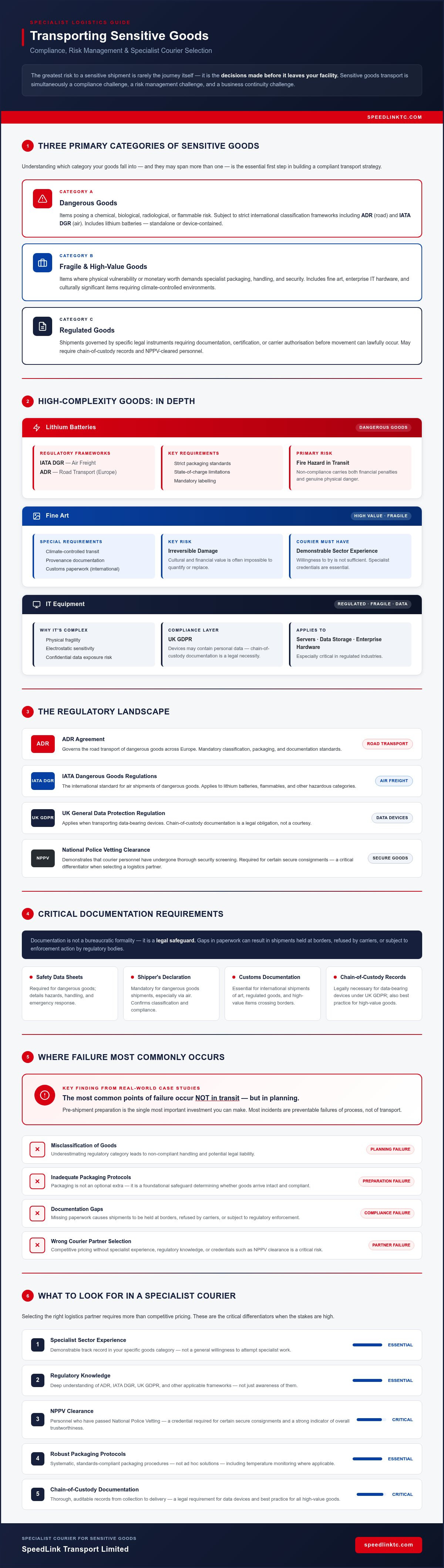
Broadly speaking, sensitive goods fall into three primary categories:
- Dangerous goods: Items that pose a chemical, biological, radiological, or flammable risk during transport, subject to strict international classification frameworks.
- Fragile and high-value goods: Items where physical vulnerability or monetary worth demands specialist packaging, handling, and security protocols.
- Regulated goods: Shipments governed by specific legal instruments, requiring documentation, certification, or carrier authorisation before movement can lawfully occur.
Understanding which category your goods fall into, and in some cases they’ll span more than one, is the essential first step in building a compliant and resilient transport strategy.
Common Types of Sensitive Goods
Whilst the full spectrum of sensitive goods is wide, three categories appear consistently across business sectors and carry some of the most complex handling requirements.
Lithium batteries are classified as dangerous goods under international regulations, including IATA’s Dangerous Goods Regulations for air freight and ADR provisions for road transport. Whether shipped standalone or contained within devices, they must meet strict packaging standards, state-of-charge limitations, and labelling requirements. The consequences of non-compliance extend beyond fines; improperly transported lithium batteries present a genuine fire risk in transit. Specialist dangerous goods courier services are equipped to manage these requirements systematically.
Fine art presents a different but equally demanding set of challenges. Beyond the obvious fragility concerns, artworks may carry significant provenance obligations, require climate-controlled environments during transit, and attract specific customs documentation requirements when crossing international borders. Improper handling or inadequate packaging can result in irreversible damage to items whose value, cultural as well as financial, cannot be easily quantified. Fine art transport demands couriers with demonstrable experience in this sector, not simply a willingness to try.
IT equipment, including servers, data storage devices, and enterprise hardware, is sensitive for multiple reasons simultaneously. Physical fragility, electrostatic sensitivity, and the potential exposure of confidential data all demand controlled handling procedures. Businesses in regulated industries face an additional layer of obligation: the devices they transport may contain personal data subject to UK GDPR, making chain-of-custody documentation a compliance necessity rather than a courtesy. Dedicated IT equipment courier services address these layered requirements with the procedural rigour they deserve.
Legal and Compliance Considerations
Sensitive goods transport operates within a layered regulatory environment. Key frameworks include the ADR Agreement governing road transport of dangerous goods across Europe, IATA Dangerous Goods Regulations for air shipments, and UK GDPR obligations where data-bearing devices are concerned. For certain secure consignments, carriers may also require NPPV (National Police Vetting) clearance, a credential that demonstrates a courier’s personnel have undergone thorough security screening.
Documentation is not a bureaucratic formality; it’s a legal safeguard. Depending on the goods, you may require Safety Data Sheets, shipper’s declarations, customs documentation, or chain-of-custody records. Gaps in paperwork can result in shipments being held at borders, refused by carriers, or subject to enforcement action by regulatory bodies.
The penalties for non-compliance are substantive. Businesses transporting dangerous goods without proper classification or documentation face prosecution under the Carriage of Dangerous Goods and Use of Transportable Pressure Equipment Regulations 2009, with fines and, in serious cases, custodial sentences for responsible individuals. Beyond legal sanction, a single compliance failure can trigger insurance voidance, making the financial exposure considerably greater than the cost of getting it right from the outset.
Choosing a logistics partner with verified expertise in these regulatory frameworks isn’t a premium option; it’s the minimum standard that responsible businesses should demand.
Choosing the Right Logistics Partner for Sensitive Goods
The logistics provider you select for sensitive goods transport is, in practical terms, an extension of your own compliance function. A poor choice doesn’t just risk a damaged shipment; it can expose your business to regulatory liability, insurance voidance, and the kind of reputational damage that takes years to repair. The selection process demands rigour, not convenience.
Start with the non-negotiables. Any provider handling sensitive consignments should be able to demonstrate, not simply claim, the following:
- Relevant regulatory knowledge: Do their personnel understand ADR classifications, IATA requirements, and UK GDPR obligations as they apply to your specific goods?
- Security credentials: For high-value or government-adjacent consignments, NPPV clearance is a meaningful differentiator. It confirms that personnel have undergone thorough vetting, not simply a basic background check.
- Specialist handling procedures: Generic courier operations are not equipped for fine art, dangerous goods, or data-bearing IT equipment. Ask specifically how they handle your category of goods, and expect detailed, procedural answers.
- Adequate insurance and liability coverage: Confirm that their policy covers the full declared value of your consignment and that coverage isn’t voided by specific handling conditions or transit modes.
Evaluating Logistics Providers
Ask prospective partners for documented case studies in your sector, not generic testimonials. A courier with genuine experience in IT equipment logistics or fine art transport will have specific examples of how they’ve managed chain-of-custody requirements, handled time-critical collections, or navigated customs complications. If they can’t provide them, that absence is itself informative. Equally, ask about their incident response protocols: what happens when something goes wrong, and who is accountable?
Understanding Costs and Value
Specialist logistics services carry a higher cost than standard courier rates, and that premium is justified. The infrastructure required to handle dangerous goods compliantly, transport fine art without climate risk, or maintain verifiable chain-of-custody for sensitive IT equipment represents genuine operational investment. Businesses that select providers on price alone frequently discover that the apparent saving is far outweighed by the cost of a single compliance failure or damaged consignment.
When budgeting, consider the full risk-adjusted picture: what is the potential liability exposure if something goes wrong with a non-specialist provider? Weighed against that figure, specialist fees become considerably more defensible to finance teams. The right question isn’t “how much does this cost?” but “what does inadequate handling cost us?”
If you’re assessing your current provider against these criteria and finding gaps, speak with a specialist who can evaluate your specific requirements and recommend an approach calibrated to your risk profile.
Best Practices for Transporting Sensitive Goods
Knowing which category your goods fall into is only half the challenge. The other half is executing the physical movement with the precision that sensitive goods transport demands. The businesses that consistently protect their most critical consignments don’t leave handling decisions to chance; they build systematic protocols that cover packaging, monitoring, and documentation long before a vehicle pulls up to the loading bay.
Packaging and Handling Techniques
Packaging isn’t just protective; it’s a compliance statement. For fragile or high-value items, the materials you choose communicate directly to carriers and insurers whether your shipment was prepared by someone who understands what’s at stake.
Effective packaging for sensitive consignments typically incorporates:
- Multi-layer cushioning: Closed-cell foam, anti-static foam inserts, and suspension packaging that absorbs shock across multiple impact vectors, not just vertical drops.
- Anti-static materials: Essential for IT equipment and electronic components, where electrostatic discharge can cause invisible but catastrophic damage to circuit boards and storage media.
- Custom crating: For fine art and oversized fragile items, bespoke timber crates with internal bracing provide structural protection that standard cardboard cannot replicate.
- UN-certified packaging: Dangerous goods require packaging that meets UN performance standards. Using non-compliant materials isn’t a minor oversight; it’s a regulatory violation that voids carrier liability.
The handling environment matters as much as the packaging itself. Personnel managing fine art transport or sensitive IT equipment should be briefed on orientation requirements, weight distribution, and the specific vulnerabilities of each consignment. A crate labelled “fragile” achieves nothing if the team loading the vehicle hasn’t been trained to act on it.
Leveraging Technology for Safety
Technology has fundamentally changed what’s achievable in sensitive goods logistics. Real-time GPS tracking gives both shipper and recipient verifiable chain-of-custody data at every stage of transit, which is particularly critical for IT equipment courier movements where data security obligations require documented proof of location and custody.
Temperature monitoring systems are no longer reserved for pharmaceutical or life sciences shipments. Data loggers embedded within packaging record ambient conditions throughout the journey, providing an auditable record that’s invaluable for insurance claims and compliance verification. If a consignment deviates from its specified temperature range, the data exists to demonstrate precisely when and where the breach occurred.
Communication transparency is equally important. Automated status updates, electronic proof of delivery, and digital documentation trails don’t just reassure stakeholders; they create the evidentiary record that protects your business if a dispute arises. When evaluating a logistics partner, ask specifically how their technology integrates with your own systems and what visibility you’ll have throughout the journey.
Customs clearance preparation deserves the same rigour. For international movements, incomplete or inaccurate documentation remains one of the most common causes of costly delays. Ensure Safety Data Sheets, commercial invoices, and any required shipper’s declarations are prepared and verified before collection, not assembled reactively at the border. Specialist support through customs services can prevent the kind of hold-ups that turn a time-critical shipment into a liability.
If you’d like to discuss how these protocols apply to your specific consignments, speak with a specialist at SpeedLink to build an approach tailored to your requirements.
Real-World Applications: Case Studies in Sensitive Goods Transport
Theory only takes you so far. What genuinely distinguishes a specialist logistics partner from a generalist courier is the ability to perform under real-world conditions, where timelines are compressed, compliance obligations are non-negotiable, and the consequences of failure are tangible. The following examples illustrate how professional sensitive goods transport looks in practice, and why the difference between specialist and standard handling matters so profoundly.
Case Study: Transporting Fine Art
A London-based gallery required the urgent same-day transport of several high-value works to an exhibition venue ahead of a time-critical installation deadline. The pieces included large-format canvases and a bronze sculpture, each with distinct handling requirements and significant provenance documentation obligations.
SpeedLink’s approach centred on pre-movement planning rather than reactive problem-solving. Custom crating was specified for the sculpture, with internal bracing designed around the piece’s specific dimensions and weight distribution. The canvases were packaged with acid-free materials and rigid corner protection. NPPV-cleared personnel managed collection and delivery, ensuring that chain-of-custody records were maintained throughout. The gallery’s curator noted that the level of pre-shipment consultation was markedly different from their previous logistics experiences, and that every piece arrived in verified condition with full documentation intact.
That outcome isn’t accidental. It reflects the procedural rigour that fine art transport demands when handled by a team that genuinely understands the sector.
Case Study: Dangerous Goods Transport
An engineering client needed to move a consignment of lithium battery units across multiple European destinations under ADR compliance requirements. The shipment carried strict state-of-charge limitations, UN-certified packaging obligations, and required accurate shipper’s declarations before any carrier would accept the load.
Gaps in documentation had caused a previous provider to refuse the consignment at short notice, creating significant operational disruption. SpeedLink’s dangerous goods courier team conducted a compliance review prior to collection, identified the documentation deficiencies, and coordinated the corrected paperwork before the revised collection window. The consignment moved without further delay, fully compliant across all transit legs.
The client’s logistics manager was direct in their assessment: the value wasn’t simply in the delivery itself, but in the pre-shipment expertise that prevented a repeat of the original failure. That’s precisely what professional sensitive goods transport delivers when the partner has the right credentials and the operational depth to apply them.
Protect What Matters Most: Take the Next Step
Sensitive goods transport is not an area where good intentions substitute for genuine expertise. Throughout this guide, one principle has remained constant: the businesses that consistently protect their most critical consignments are those that treat logistics as a compliance function, not simply an operational one. The right packaging protocols, the right documentation, and the right partner make the difference between a consignment that arrives intact and one that becomes a costly lesson.
SpeedLink brings the specialist credentials that high-stakes shipments demand. From NPPV-cleared personnel for secure consignments to dedicated expertise in dangerous goods and fine art logistics, and same-day courier services when timing is non-negotiable, the capability is there when your business needs it most.
Don’t leave your next critical shipment to chance. Contact SpeedLink today to discuss your sensitive goods transport requirements and build an approach calibrated to your specific risk profile. The right conversation now prevents far more costly problems later.
Frequently Asked Questions About Sensitive Goods Transport
What are considered sensitive goods in logistics?
Sensitive goods are any consignments requiring handling beyond standard courier protocols due to physical fragility, regulatory classification, intrinsic value, or potential hazard. This encompasses a wide range of categories: dangerous goods such as lithium batteries and chemicals, high-value items including fine art and jewellery, data-bearing IT equipment, regulated materials requiring specific documentation, and secure documents requiring verified chain-of-custody throughout transit.
It’s important to recognise that many shipments span more than one category simultaneously. A server containing sensitive personal data, for instance, is both physically fragile and subject to UK GDPR obligations. Accurate classification at the outset determines which handling protocols, documentation requirements, and carrier credentials apply to your specific consignment.
What regulations must I comply with when transporting sensitive items?
The regulatory framework governing sensitive goods transport depends on the nature of your goods and the transport mode involved. Road movements of dangerous goods across Europe fall under the ADR Agreement, whilst air freight is governed by IATA Dangerous Goods Regulations. Data-bearing devices are subject to UK GDPR, and certain secure consignments may require carriers with NPPV clearance. Customs documentation obligations apply to all international movements, regardless of goods type.
Non-compliance carries substantive consequences. Businesses transporting dangerous goods without proper classification face prosecution under the Carriage of Dangerous Goods and Use of Transportable Pressure Equipment Regulations 2009. Beyond legal sanction, documentation gaps can void carrier insurance, meaning the financial exposure from a single oversight can far exceed the cost of getting compliance right from the start.
How can I ensure my sensitive goods are protected during transport?
Protection begins well before collection. The most effective safeguard is systematic pre-shipment preparation: selecting packaging materials appropriate to your goods category, verifying that all documentation is complete and accurate, and briefing your logistics partner thoroughly on the specific vulnerabilities of your consignment. For dangerous goods, this means UN-certified packaging; for IT equipment, anti-static materials and rigid cushioning; for fine art, custom crating and acid-free protective layers.
Technology adds another layer of assurance. Embedded data loggers create an auditable record of ambient conditions throughout transit, whilst real-time GPS tracking provides verifiable location data at every stage. These aren’t optional extras for sensitive goods transport; they’re the evidentiary foundation that supports insurance claims and compliance verification if questions arise after delivery.
What are the benefits of using a specialist courier for sensitive items?
A specialist courier brings regulatory knowledge, trained personnel, and purpose-built procedures that a generalist provider simply cannot replicate. Where a standard courier might accept a consignment without scrutinising its classification requirements, a specialist will conduct a compliance review before collection, identify documentation deficiencies, and resolve them before they cause costly delays or carrier refusals. That proactive expertise is the core differentiator.
There’s also a meaningful difference in accountability. Specialist providers such as SpeedLink offer NPPV-cleared personnel for secure consignments, dedicated handling procedures for categories including fine art, dangerous goods, and IT equipment, and the insurance coverage that reflects the genuine value of what they’re transporting. When something goes wrong with a non-specialist provider, the liability gap becomes apparent very quickly.
How can I track my sensitive goods during transport?
Reputable specialist couriers provide real-time GPS tracking that gives both shipper and recipient continuous visibility of consignment location and custody status. For goods subject to data security obligations, this tracking data also serves as documented proof of chain-of-custody, which is a compliance requirement rather than simply a convenience. Electronic proof of delivery and digital documentation trails complete the audit record.
When evaluating a logistics partner, ask specifically how their tracking systems integrate with your own platforms and what notifications you’ll receive throughout transit. Automated status updates, condition monitoring alerts from embedded data loggers, and accessible digital records should all be standard features of any provider handling your most critical consignments. If a prospective partner can’t clearly explain their tracking capabilities, treat that as a meaningful indicator of their overall operational maturity.

Article by
Dave McMillen
I have worked in courier and logistics for over 30 years. My experience spans two continents and several types of services from road freight to airlines and specialist B2B services. SpeedLink has been serving the UK market for over 20 years providing the finest time critical and specialist services supporting businesses and individuals alike.


