


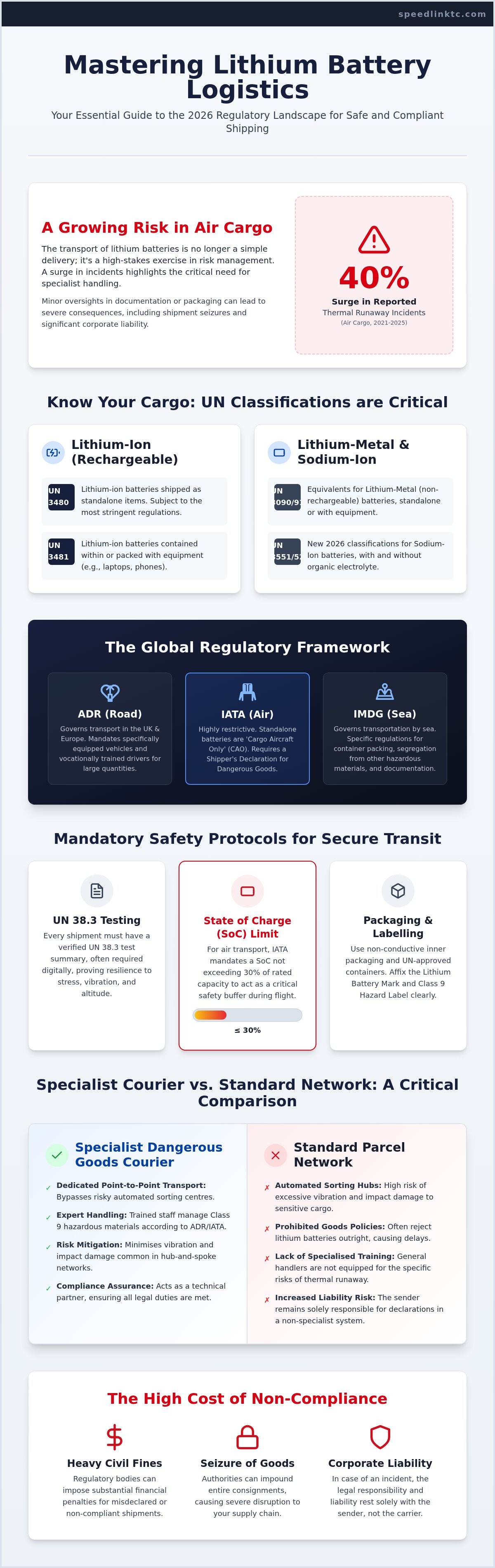
Did you know that reported thermal runaway incidents in air cargo surged by 40% between 2021 and 2025? It’s a sobering statistic that highlights why transporting these components has become a high-stakes exercise in risk management rather than a simple delivery task. You’re likely feeling the pressure of increasingly stringent regulations, where a minor oversight in ADR or IATA documentation can lead to shipment seizures or significant corporate liability.
Finding a reliable lithium battery courier is the first step in securing your supply chain against these operational threats. This guide provides the expert clarity required to master the 2026 landscape, including the mandatory 30% state of charge limits and the shift toward digital UN 38.3 test summaries. We will outline the essential safety standards and regulatory updates you must implement to ensure your hazardous cargo moves without interruption. By the end of this article, you’ll have a clear framework for choosing a specialised partner capable of handling your most sensitive, time-critical logistics with methodical precision.
Key Takeaways
- Identify the critical distinctions between Lithium Ion and Lithium Metal classifications to ensure your shipments meet precise ADR and IATA regulatory standards.
- Ensure every shipment adheres to mandatory safety protocols, including verified UN 38.3 testing and the use of non-conductive inner packaging to prevent short circuits.
- Partner with a specialised lithium battery courier that offers dedicated point-to-point transport, bypassing the physical risks inherent in automated sorting centres.
- Mitigate corporate liability by mastering the latest 2026 updates, such as the mandatory 30% state of charge limit and digital documentation requirements.
- Understand why dedicated vehicle solutions provide superior protection against vibration and impact damage compared to traditional hub-and-spoke networks.
Understanding Lithium Battery Regulations and Classifications
A professional lithium battery courier operates as a technical partner rather than a simple delivery service. These specialised providers are deeply integrated into the framework of Dangerous Goods Regulations, possessing the specific training required to handle Class 9 hazardous materials. Whilst standard parcel networks often reject these items under ‘Prohibited Goods’ policies, a specialist courier manages the inherent risks of thermal runaway through methodical compliance. This distinction is vital; standard hub-and-spoke systems rely on automated sorting that can subject sensitive components to excessive vibration or impact.
Classification is the cornerstone of safe transit. You must distinguish between Lithium Ion (rechargeable) and Lithium Metal (non-rechargeable) chemistries, as each follows a different regulatory path. These are further identified by UN numbers which dictate packaging and transport limits:
- UN 3480: Lithium-ion batteries shipped as standalone items.
- UN 3481: Lithium-ion batteries contained within or packed with equipment.
- UN 3090/3091: The equivalents for lithium-metal chemistries.
- UN 3551/3552: The newly integrated 2026 classifications for sodium-ion batteries.
The Legal Framework: ADR, IATA, and IMDG
Road transport within the UK and Europe is governed by ADR requirements. This treaty mandates that vehicles carrying significant quantities of batteries must be specifically equipped and drivers must hold valid vocational training certificates. For air freight, IATA 2026 standards are even more restrictive. Standalone lithium-ion batteries are strictly ‘Cargo Aircraft Only’ (CAO) and must be shipped at a State of Charge (SoC) not exceeding 30%. Every movement requires a precise ‘Shipper’s Declaration for Dangerous Goods’ to ensure the pilot and ground crew are aware of the hazard on board.
Duty of Care and Corporate Liability
The legal responsibility for correctly declaring hazardous materials rests solely with the sender. If a shipment is misdeclared or fails to meet 2026 safety standards, the repercussions extend far beyond delivery delays. Non-compliance can result in heavy civil fines, the seizure of goods, and significant corporate liability in the event of a transit incident. Partnering with a dangerous goods courier allows you to delegate the operational execution to experts, ensuring your organisation meets its legal obligations whilst maintaining supply chain velocity.
Standard Operating Procedures for Safe Battery Transit
Safety in transit is built on rigorous testing and physical barriers. Every battery shipment must have a verified UN 38.3 test summary, proving the cells can withstand altitude simulation, thermal stress, and vibration. This documentation is now frequently required in a digital format for rapid inspection at transport hubs. To prevent short circuits, cells must be housed in non-conductive inner packaging, ensuring terminals don’t come into contact with other batteries or metal surfaces. A specialised lithium battery courier will verify these physical safeguards before the cargo is loaded.
For air transport, compliance with IATA Lithium Battery Shipping Regulations mandates a State of Charge (SoC) not exceeding 30% of the rated capacity. This reduced energy level acts as a critical safety buffer during flight. Correct labelling is equally vital; packages must display the Lithium Battery Mark and, for fully regulated shipments, the Class 9 Hazard Label. These visual cues ensure every handler in the network understands the specific risks involved and follows the correct protocols for hazardous materials.
Packaging Standards for Industrial Batteries
Large-format or high-capacity units require Performance Oriented Packaging (POP). These UN-approved containers are engineered to contain a potential fire or prevent leakage under extreme stress. We utilise heavy-duty cushioning and precise orientation markings to ensure these units remain stable whilst in transit. If you’re unsure about your specific cargo requirements, our team can provide expert guidance on compliant packaging configurations.
Handling Damaged, Defective, or Recalled (DDR) Units
DDR units represent the peak of logistics complexity. When a cell’s internal structure is compromised, the risk of thermal runaway, a self-heating fire that’s difficult to extinguish, increases exponentially. Handling DDR units is the most stringent area of battery logistics. Regulations distinguish between ‘Critical’ DDR, which are prone to fire or venting, and ‘Non-Critical’ units. The former requires specialised thermal-containment packaging, often involving fire-suppressant fillers, and is typically forbidden from air transport. A dedicated lithium battery courier manages these high-risk movements with a level of oversight that standard parcel networks simply can’t provide.
Choosing a Specialist Lithium Battery Courier
Standard parcel networks rely on a hub-and-spoke model that involves multiple touchpoints, conveyor belts, and mechanical sorting. For sensitive hazardous freight, this environment is inherently risky. A specialised lithium battery courier operates a dedicated point-to-point service, where your cargo remains on a single vehicle from collection to delivery. This model significantly reduces the risk of impact and vibration damage, which are known catalysts for internal cell failure. When cargo is never cross-docked, the probability of a transit incident drops dramatically.
Beyond the vehicle, the expertise of the personnel is paramount. ADR-trained drivers are equipped with the knowledge to manage Class 9 substances, including the correct use of specialised spill kits and emergency response protocols. For high-value technological components, real-time tracking provides the necessary oversight to mitigate transit risks and manage corporate expectations. Knowing exactly where a hazardous shipment is at any given moment is a strategic necessity for risk management.
Evaluating Courier Credentials
Vetting a provider requires more than a review of their delivery speeds. You must confirm they have access to a Dangerous Goods Safety Adviser (DGSA) to oversee compliance and provide technical guidance. It’s also essential to verify that their insurance coverage specifically includes hazardous material transport, as standard policies often contain exclusions for Class 9 goods. If your requirement is time-critical, selecting a same day courier service UK specialist ensures that compliance doesn’t come at the expense of your deadline.
International and Cross-Border Considerations
Moving lithium batteries amongst EU member states post-Brexit requires a sophisticated understanding of customs clearance. Documentation must be flawless to avoid shipments being held at borders, which is particularly dangerous if the cargo has specific stability requirements. Referencing the PHMSA Lithium Battery Guide for Shippers can help establish a baseline for international shipments, but expert local knowledge remains the deciding factor for success. For certain global destinations, a ‘Clean Report of Findings’ may be required to verify that the cargo matches the declaration. Utilising EU shipping with customs clearance ensures your hazardous goods move through transit points without the friction of regulatory delays.
If you are managing a complex international movement, our team can arrange a compliant transport solution tailored to your specific customs requirements.
SpeedLink: Strategic Lithium Battery Logistics Solutions
SpeedLink operates as a premier dangerous goods courier UK partner, providing the technical oversight necessary for high-stakes hazardous transport. We specialise in the complex intersection of logistics and regulatory compliance, particularly through our IT equipment courier service. In these scenarios, lithium batteries are often integrated into hardware, requiring a dual-layered approach to safety that protects both the electronic components and the surrounding environment. By utilising a dedicated vehicle model, we bypass the physical risks associated with high-volume sorting centres, ensuring your cargo is handled only by trained professionals from the point of origin to the final destination.
For sectors requiring the highest levels of security, such as government or military technology, we provide NPPV cleared personnel. This ensures that sensitive battery shipments aren’t only compliant with ADR and IATA standards but also meet the stringent security protocols required for classified or restricted environments. We act as a strategic consultant, ensuring that every movement is underpinned by operational authority and a global capability for precision.
Urgent and Time-Critical Battery Movements
Emergency logistics require an immediate, methodical response. Consider a scenario where a grounded aircraft or a critical server centre requires replacement power modules to restore vital operations. In these high-pressure situations, we provide 24/7 availability to ensure that lithium batteries are moved with the necessary urgency without compromising safety. Our response teams are trained to deploy dedicated vehicles immediately, maintaining the delicate balance between speed and strict regulatory adherence during time-critical missions.
Seamless Customs and Compliance Management
Post-Brexit logistics amongst EU member states require meticulous attention to detail. We manage the entire paperwork trail, from the initial declaration to final customs clearance, to ensure zero delays at international borders. Our expertise in navigating these administrative hurdles prevents the friction that often stalls hazardous shipments in standard networks. By delegating your logistics to a professional lithium battery courier, you mitigate corporate liability whilst ensuring your supply chain remains resilient.
If you require a partner that values precision and reliability in hazardous transport, you can request a specialist quote for your lithium battery shipment today to secure your mission-critical cargo.
Securing Your Hazardous Supply Chain for 2026
Managing the complexities of hazardous logistics requires a strategic shift from reactive delivery to proactive risk management. Mastery of Class 9 classifications and the strict 2026 state of charge limits is no longer optional; it’s a fundamental requirement for corporate stability. By prioritising dedicated transport solutions, you effectively bypass the vibration and impact risks inherent in standard hub-and-spoke networks, ensuring your high-value technology remains stable throughout its journey.
Partnering with a specialised lithium battery courier allows your organisation to delegate these technical challenges to seasoned experts. Our methodology integrates ADR-trained specialist drivers, dedicated point-to-point vehicles, and expert customs clearance for international freight to provide a seamless, compliant experience. This level of methodical control is essential for maintaining supply chain velocity whilst mitigating significant legal liabilities.
Secure your business-critical shipment with our specialist lithium battery courier service. We’re ready to provide the operational authority your most sensitive shipments deserve.
Frequently Asked Questions
Can I ship lithium batteries via a standard same-day courier?
Standard same-day couriers often categorise standalone lithium batteries as prohibited items due to the risks involved in automated sorting environments. You require a specialised lithium battery courier that operates ADR-compliant vehicles and employs drivers trained in hazardous material handling. Using a non-specialist service risks the seizure of your goods and potential safety incidents. Dedicated transport ensures your cargo remains isolated from other freight, significantly reducing the probability of impact-related failures.
What is the maximum Watt-hour (Wh) limit for lithium batteries on cargo aircraft in 2026?
Standalone lithium-ion batteries are generally restricted to 100 Watt-hours (Wh) per cell and 160 Wh per battery for standard air transport under IATA regulations. However, the most critical 2026 update is the mandatory 30% State of Charge (SoC) limit for all air freight shipments, including those packed with equipment. If your batteries exceed these limits, they must be shipped as fully regulated Class 9 dangerous goods via cargo-only aircraft with appropriate documentation.
Do I need a Dangerous Goods Safety Adviser (DGSA) to ship batteries?
You must appoint a Dangerous Goods Safety Adviser if your organisation regularly transports, packs, or loads hazardous materials in quantities that exceed specific ADR thresholds. Whilst small quantities may sometimes fall under ‘Limited Quantity’ exemptions, most commercial lithium battery shipments require a DGSA to monitor compliance. Partnering with a specialist lithium battery courier ensures your movements are overseen by experts who maintain these mandatory safety standards and provide technical guidance.
What happens if my lithium battery shipment is not correctly declared?
Incorrectly declaring a lithium battery shipment can result in severe financial penalties and the permanent seizure of your cargo by regulatory authorities. Beyond fines, misdeclaration places transport personnel at risk and exposes your organisation to substantial corporate liability. In the event of a thermal runaway incident, a lack of correct documentation can invalidate insurance policies and lead to criminal prosecution for negligence. Professional couriers mitigate this risk by verifying all documentation before collection.
How should I pack a damaged lithium-ion battery for safe courier transport?
Damaged, Defective, or Recalled (DDR) batteries require specialised thermal-containment packaging engineered to prevent the spread of fire. You must use UN-approved containers, often filled with non-combustible, fire-suppressant materials, to mitigate the risk of thermal runaway during transit. DDR units are strictly forbidden from air transport and must be moved via dedicated road vehicles operated by specialists trained in ‘Critical’ DDR protocols. This ensures that even if a cell fails, the hazard remains contained.

Article by
Dave McMillen
I have worked in courier and logistics for over 30 years. My experience spans two continents and several types of services from road freight to airlines and specialist B2B services. SpeedLink has been serving the UK market for over 20 years providing the finest time critical and specialist services supporting businesses and individuals alike.


