


For time-critical freight, avoiding unnecessary handling can matter as much as choosing the right vehicle. A direct drive courier collects a shipment and takes it straight to its destination in a dedicated vehicle, rather than routing it through a conventional parcel network.
That makes direct drive delivery a practical option when a business needs a shipment moved directly, with transport planned around its route, size and urgency. The price isn’t fixed: distance, vehicle requirements, collection and delivery details, and timing can all affect a quote. Tracking and shipment updates also help teams follow progress and coordinate the handover, although the precise arrangements depend on the service booked.
This article explains how direct drive delivery works across the UK, what can affect the cost, and how to assess suitable parcel sizes and vehicle types. It also covers tracking and when a dedicated same-day courier may suit a shipment better than express or economy delivery.
Key Takeaways
- Understand how point-to-point delivery works and why route conditions, traffic and weather can affect the service required.
- Assess a shipment’s dimensions, weight and handling needs to identify suitable transport options and any restrictions.
- See how vehicle choice relates to cargo requirements, and which details influence a tailored delivery quote.
- Learn what tracking and shipment updates can contribute to coordinating delivery and handover.
Do traffic and weather change my delivery price?
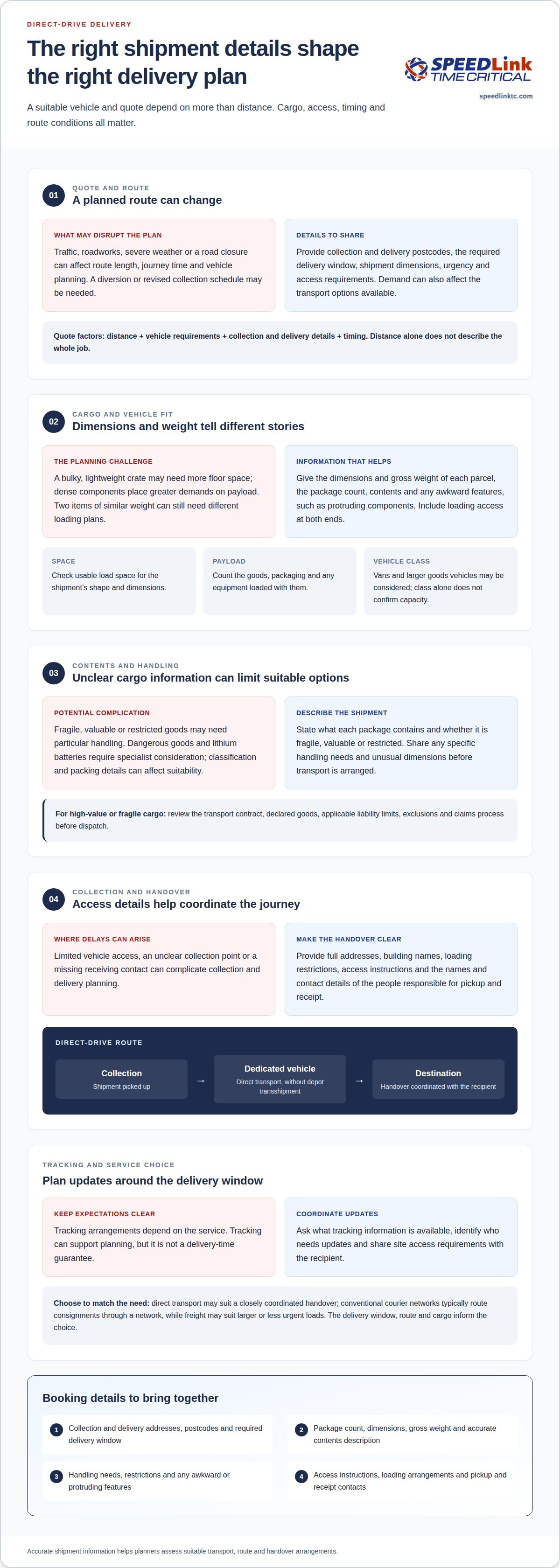
They can. Traffic, roadworks and severe weather may affect route length, journey time and vehicle planning, influencing the quote. A closure on a planned route, for example, could require a diversion or a revised collection schedule. Demand can also affect transport options. A useful quote takes account of the collection and delivery postcodes, shipment dimensions, urgency and access requirements, not distance alone.
A direct drive courier transports the shipment from pickup to destination in a dedicated vehicle, without transshipment through a depot. Standard courier services typically move consignments through a network, while freight may suit larger or less urgent loads. Same-day, next-day and expedited freight options address different deadlines; the appropriate choice depends on the delivery window, route and cargo. Direct transport can be useful when a handover or arrival time needs close coordination.
Booking begins with the collection and delivery addresses, required delivery window, parcel dimensions and weight, and a description of the goods. The dispatcher uses these details to plan the vehicle and route, then provides booking information for the collection. Clear access instructions, such as a goods-in entrance or site contact, help the driver complete pickup and handover efficiently. For IT equipment, the shipment details can also help determine suitable handling arrangements, as described in IT equipment transport.
Tracking arrangements depend on the service. Ask SpeedLink what tracking information is available for your shipment so your team can plan updates with the recipient. When arranging delivery, identify the people who need updates and share any site access requirements. Tracking supports planning, but it is not a delivery-time guarantee.
To choose a reliable courier for your location, assess whether it can cover both postcodes and handle the shipment’s size, urgency and access needs. Give accurate address details, including postcode, building name and any loading restrictions. For example, a city-centre pickup with limited vehicle access may need different planning from an industrial estate collection. Confirm how dispatch, tracking and proof of delivery are managed before the booking is accepted.
Supported package sizes and item restrictions
Package suitability depends on dimensions, weight, packaging and handling needs. Provide each parcel’s measurements and gross weight, the number of packages and any awkward features, such as protruding components. A boxed laptop and a long engineering part need different loading plans, even if they weigh the same. These details help match the shipment to suitable delivery options and inform the quote alongside distance and urgency.
Eligible items must be described accurately before dispatch. State what each package contains, whether it is fragile, valuable or restricted, and whether it needs particular handling. Dangerous goods and lithium batteries require specialist consideration; classification and packing details can affect whether a transport option is suitable. For artwork, protective packaging and careful handling are central concerns, as outlined in fine art transport.
To prepare a booking, provide the collection and delivery addresses, package count, dimensions, weight, contents and access instructions. Include the names and contact details of the people responsible for pickup and receipt. Note, for example, whether a crate must be collected from a loading bay or delivered to a named department. Accurate information helps the team plan suitable transport and avoid preventable delays.
Insurance and liability depend on the transport contract, declared goods and applicable terms. Review the stated limits, exclusions and claims process before dispatch, particularly for high-value equipment or fragile cargo. A dedicated vehicle reduces handovers, but it cannot eliminate risks such as damage from inadequate packaging, restricted site access or road disruption.
If a package is missing or arrives damaged, retain its packaging and delivery records, then report the issue using the booking reference and proof of delivery. Clear descriptions and photographs of the parcel’s condition can support an investigation. For unusual dimensions or handling requirements, share the shipment details before arranging transport.
Vehicle types, capacities, and starting prices
Vehicle choice depends on the load’s dimensions, weight, access requirements and route. A compact shipment of documents needs less space than a palletised engineering component, even if both travel the same distance. Logistics planners match the vehicle’s usable capacity to the shipment and consider loading access at both ends. Access restrictions may also affect the vehicle configuration needed for collection or delivery.
Vehicle classes can include vans and larger goods vehicles, but the class alone does not confirm usable payload or load space. The weight of the goods, packaging and any equipment loaded with them all count towards capacity. A bulky but lightweight crate may need more floor space, while dense components place greater demands on payload. Accurate dimensions and weight help ensure the vehicle is suitable.
A dedicated vehicle carries the shipment directly, reducing transfers between vehicles and handling points. This can support a clearer chain of custody for sensitive consignments such as IT equipment or exhibition materials. The vehicle and handover process should suit the cargo and delivery site. Include any access controls, named receiving contact or special loading arrangements in the booking.
Contingency planning is another part of reliable logistics. Dispatch teams need to consider the route, road conditions and replacement vehicle availability. If a vehicle develops a fault, the response may involve a replacement vehicle or a revised route, depending on the location and shipment requirements. Ask how updates and contingency arrangements are managed for the journey.
The price depends on the shipment and is provided after a quote request; route distance, vehicle type, urgency, load dimensions and regional availability shape the quote. A van-sized load and a bulky palletised consignment will require different planning. To discuss vehicle requirements for a specific shipment, send the load details for a quote.
24/7 Dispatch, tracking, and shipment updates
Clear communication helps teams coordinate a shipment from booking through delivery. Agree who needs updates and which milestones matter before transport begins. For a time-sensitive business consignment, collection confirmation lets the receiving team prepare without relying on assumptions about the vehicle’s progress.
A useful sequence of status updates can show booking acceptance, collection, journey progress and delivery completion. Each update should identify the consignment and its current stage. This helps operations teams distinguish a shipment that has been collected from one still awaiting collection, particularly when coordinating several deliveries.
Tracking formats differ. Some services record events at network handling points, while a dedicated journey can provide updates linked to its route. Neither format guarantees an arrival time. If delivery depends on site access or a named recipient, share those details when booking and agree how changes will be communicated.
Choose an update channel that suits the people managing the delivery, such as email or telephone. Provide the booking reference and correct contact details, then identify who should receive a delay notification. A facilities team, for example, may need to alert reception before a driver reaches a controlled-access building.
At handover, proof of delivery creates a record for the sender and recipient. Keep it with the transport reference so your team can reconcile the delivery or investigate a query. For consignments requiring a documented handover, SpeedLink’s NPPV Cleared Courier Service provides a secure courier option.
Useful updates give the right people actionable information at the right stage. Set expectations for the reporting process when arranging transport, especially if several departments share responsibility for receiving the shipment.
SpeedLink Transport Limited
SpeedLink helps businesses plan courier movements around shipment requirements, urgency and destination. Its services include Same Day Courier, EU shipping with customs clearance, and Exhibition and Events Courier. The suitable arrangement depends on the collection and delivery points, package dimensions, handling needs and required delivery window.
For a time-critical UK movement, share the collection and delivery addresses, shipment details and site access requirements. This gives the team practical information to assess suitable transport and explain the options. For European consignments, the origin, destination and customs requirements also shape the plan.
Contact SpeedLink Transport Limited to discuss your shipment.
Plan the next movement with confidence
Choosing a direct drive courier starts with considering the impact of delay. Think about what a missed handover would affect, who needs progress updates and what the receiving site requires. These priorities help shape a transport brief around the shipment, rather than defaulting to the most intensive option. For recurring movements, documenting requirements gives procurement and operations teams a consistent basis for future bookings.
Before arranging transport, gather the shipment details, route, delivery requirements and receiving contact. A clear brief gives the logistics team a practical starting point for discussing suitable arrangements and progressing the booking. If the route or shipment changes, update the details so the plan reflects the current requirement.
A considered brief is the first step towards a well-coordinated delivery.
Frequently Asked Questions
How large can a shipment be?
There is no single maximum size that applies to every shipment. What can be carried depends on the vehicle and loading arrangements. A direct drive courier can be matched to a load once its dimensions, weight and handling needs are clear. A long, lightweight item may need more floor space than a compact, heavy one. Include the total piece count, pallet or crate dimensions, and whether items can be stacked.
What is a direct drive courier service?
Direct drive is a transport arrangement in which a vehicle is assigned to carry a shipment between its collection and delivery points. Unlike a shared network service, the journey is planned around that consignment rather than routine depot sorting. It can suit a business with a specific handover requirement, such as taking a replacement component directly to an engineering site.
How does direct drive courier delivery work?
Once the route and shipment details are available, the transport team can plan suitable transport and collection. The sender prepares the goods for handover, and the recipient must be able to accept them at the destination. A business sending equipment to a project site, for example, should provide the site entrance and receiving department, not just the organisation’s name.
What types of shipments are suitable for direct drive delivery?
A direct drive courier can suit business consignments where a direct route or coordinated handover matters, including documents, equipment, replacement parts and event materials. A production team that needs a component at a particular location may value a dedicated journey. Routine, non-urgent goods may suit an economy service instead. Contents, packaging, handling needs and restrictions all affect the appropriate transport method.
How quickly can a dedicated courier deliver a shipment?
Transit time depends on the route, booking time, collection readiness, traffic and required delivery window. Same-day transport may suit an urgent UK movement, while a longer route or difficult access can require more planning. Give the team the collection and delivery postcodes, deadline and site opening constraints so the proposed arrangement can be assessed against the journey.
Are there size, weight, or vehicle restrictions for direct drive shipments?
Yes. The shipment must fit the vehicle’s available load space and payload, allowing for packaging and safe loading. Access restrictions, such as a low entrance or limited loading area, can also affect vehicle choice. Provide the outer dimensions and total weight, including pallets or crates, and identify unusually shaped pieces so the transport plan reflects the complete load.

Article by
Dave McMillen
I have worked in courier and logistics for over 30 years. My experience spans two continents and several types of services from road freight to airlines and specialist B2B services. SpeedLink has been serving the UK market for over 20 years providing the finest time critical and specialist services supporting businesses and individuals alike.
Disclaimer
Information is provided as general logistics guidance and is not legal, customs, aviation, medical or dangerous-goods compliance advice.
Rules vary according to commodity, quantity, classification, packaging, origin, destination, transport mode and carrier.
Regulations and carrier requirements may change.
Where regulated goods are involved, current requirements should be confirmed with the appropriate government authority, regulator, carrier or qualified specialist before shipment.
SpeedLink can confirm the transport options it can provide for a particular shipment.


