


Predictable fleet costs depend on having better control over how transport is planned and deployed. The benefits of a dedicated logistics partner can include support for supply-chain operations, clearer oversight of transport spend and a defined route to contingency support when plans change. A dedicated arrangement isn’t automatically right for every shipment, but it can help businesses manage recurring or time-critical transport needs with greater structure.
Fleet costs can be difficult to forecast when demand fluctuates, urgent movements arise or shipment status is unclear. Understanding what a logistics partner can coordinate, how transport options fit different needs and how shipment progress is tracked helps businesses make more informed decisions.
This article explains how dedicated logistics services can support day-to-day operations, help manage fleet costs and provide contingency options. It also looks at shipment visibility and the practical considerations that help determine whether a dedicated approach fits your transport requirements.
Key Takeaways
- Map recurring transport needs and shipment priorities to understand where coordinated logistics can support supply-chain operations.
- Build contingency planning around the routes, shipment requirements and operational changes that could affect delivery.
- Assess how service terms and cost drivers influence fleet budgeting before committing to a transport arrangement.
- Use tracking and reporting processes to improve shipment visibility and make better-informed operational decisions.
Transportation services and supply-chain operations
A dedicated logistics partner coordinates transport around a business’s recurring or time-critical requirements. This can bring collections, transport modes and delivery arrangements together around supply-chain priorities. For example, when a manufacturer needs a replacement component, aligning the supplier, transport and receiving arrangements helps coordinate the movement. The partner provides a central point for managing those transport requirements.
A transport plan that reflects the shipment’s urgency and destination can help teams manage delivery expectations. Clear instructions about site access and the receiving team also help avoid preventable delays. For a production site, specifying where a component should be delivered supports a smoother handover into the maintenance process.
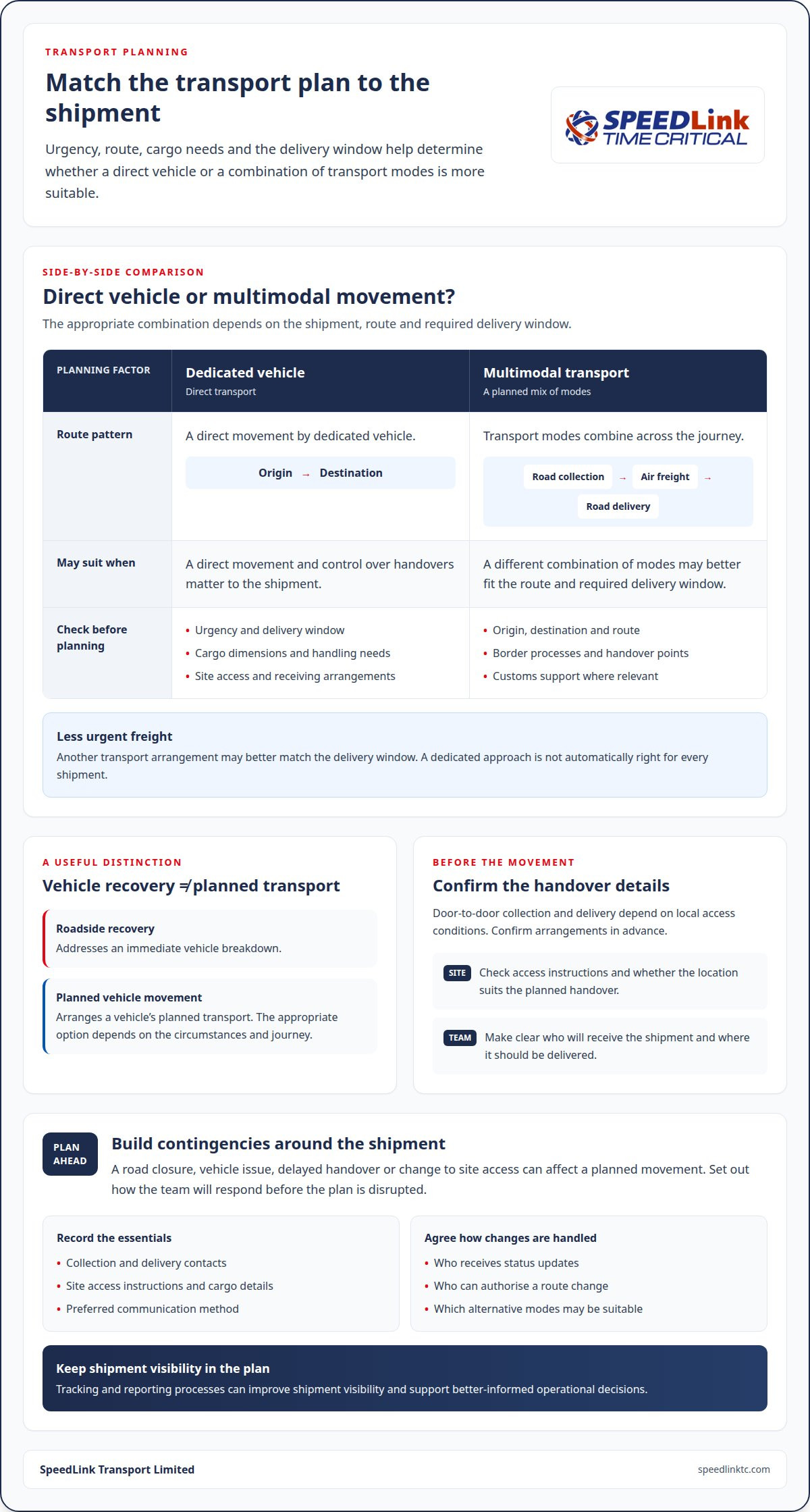
Businesses in engineering, healthcare, automotive and IT may benefit when transport is urgent, specialised or closely tied to ongoing operations. Multimodal transport combines modes, such as road collection, air freight and road delivery. The right combination depends on the shipment, route and required delivery window. A dedicated vehicle may suit a direct movement, while a different transport mix may work better for a longer journey.
Transport infrastructure shapes the routes available to freight. Roadworks near a delivery address, for instance, can affect vehicle access and require operational planning. Providing accurate site access details can help the transport provider plan the delivery.
Transit insurance and deductibles affect how a business manages potential loss or damage during transport. Before a shipment moves, identify its value, handling needs and the terms of any applicable policy. A fragile engineering component, for example, may need different handling from routine office supplies. Clarifying who arranges cover and what records support a claim helps define responsibilities, since insurance needs can vary by shipment.
Vehicle recovery and planned vehicle transport are different services. Roadside recovery addresses an immediate breakdown, while specialist logistics may be used to arrange a planned vehicle movement. The appropriate option depends on the circumstances and journey.
For vehicle transport, confirm collection and delivery arrangements in advance. Door-to-door collection and delivery depend on local access conditions, so site suitability may affect the handover arrangements.
Service area and contingency support
A service area is more than a map of collection and delivery points. Logistics teams need to consider the shipment’s origin, destination, route, operating hours and access restrictions. For a national movement between a supplier and a production site, confirm both addresses, receiving arrangements and the required delivery window. International routes also involve border processes and handover points, so assess the origin and destination together.
Contingency planning starts with identifying what could disrupt a planned movement. A road closure, vehicle issue, delayed handover or change to site access can affect the route. Agree who receives status updates, who can authorise a route change and which alternative transport modes are suitable. If a road route becomes impractical, for example, air freight may support a longer-distance movement, with road transport at either end.
National coverage does not mean every vehicle or route suits every shipment. Cargo dimensions, handling needs, urgency and delivery location all shape the transport plan. A dedicated vehicle may suit a movement where direct transport and control over handovers matter. For less urgent freight, another arrangement may better match the delivery window. International movements also need route-specific planning, including customs support where relevant.
Build a usable contingency plan around the shipment, not a generic emergency list. Record the collection and delivery contacts, access instructions, cargo details, preferred communication method and decision-maker for changes. For an event delivery, for instance, venue access times and the receiving team’s availability can determine the workable route. A clear record helps operations teams respond without restarting coordination. To discuss route requirements and contingency planning, contact SpeedLink about your transport needs.
AAA-approved providers are vetted for reliability and customer service. AAA supports flexible transportation solutions and opposes arbitrary mandates that restrict transportation choices for communities and their residents. It also supports full funding to maintain and enhance US transportation infrastructure, including public transport.
AAA says it supported transportation legislation during consideration of the Transportation Efficiency Act, TEA 21, in 1997 and 1998. That support encompasses public transportation alongside other infrastructure.
Flexible contract terms and fleet-cost budgeting
Contract terms should reflect shipment patterns, service priorities and the support operations teams need. A clear agreement helps procurement assess how transport arrangements affect fleet spending.
Flexible contract terms
Terms can be shaped around regular movements, seasonal demand or occasional urgent shipments. Define the services in scope, expected shipment profile, booking process and how changes will be handled. A business with predictable weekly freight, for example, may need different arrangements from a team managing irregular engineering parts. Review notice periods, responsibilities and agreed review points before committing.
Document how requests are prioritised and who approves exceptions. This gives the transport network a consistent framework when volumes or delivery needs change.
Fleet-cost budgeting and shipping efficiency
A dedicated logistics partner can help reduce avoidable shipping costs by matching each movement to its urgency, route and cargo requirements. Coordinating bookings, documentation and handovers can also improve efficiency compared with managing disconnected arrangements. Combining suitable deliveries on a planned route may reduce unnecessary vehicle movements, while an urgent component may warrant direct transport.
Build a budget around the factors that shape each shipment: distance, cargo dimensions, handling needs, route and required service. Costs depend on the shipment, so request a quote for the movement in question. Separate routine movements from urgent exceptions to help procurement identify what drives spending.
Track planned and actual shipment activity against operational needs. If a site repeatedly needs urgent assistance for the same item, investigate whether stock positioning, supplier schedules or internal approvals are causing the rush. Reviewing these patterns can help teams adjust processes and reserve higher-priority transport for shipments that need it.
Compare transport options by their total operational impact, not just the booking charge. A delayed part may interrupt production, while a lower-cost service may suit non-urgent replenishment. Recording the reason for each service choice gives budget owners a practical basis for reviewing spend and refining future transport decisions.
Logistics technology, tracking, and reporting
Agree service expectations around the outcomes operations teams need to manage. Useful measures include collection and delivery performance, milestone-update accuracy, response to exceptions and completion of proof of delivery. For a time-critical component, a clear record of each handover helps teams identify where a delay occurred.
Tracking works best when shipment references, status updates and delivery records follow a consistent process. These details can help a provider highlight exceptions, such as a missed collection or a changed receiving contact. Ensuring that teams use the same reference for each consignment also makes reporting easier to interpret.
Assess a provider’s experience with relevant cargo and routes, its communication process and how it records performance. A business sending laptops, for example, should understand how collections, handovers and delivery confirmation are managed. Review reporting and escalation procedures against your operational needs.
Dedicated arrangements also carry risks. Relying heavily on one provider can reduce flexibility if needs change, while poor data integration can create gaps between transport updates and internal systems. Contract terms that do not reflect changing volumes may also make planning harder. Set review points and define how service changes will be handled.
As shipment volumes or delivery locations change, workflows can be adapted to support scale. Shared status information helps customer service teams provide consistent updates instead of relying on separate messages from several departments. For example, an order team can use the latest delivery milestone to give a customer a more useful update.
Review performance reports regularly and link each measure to an operational decision. If delivery exceptions cluster around one site, examine its access instructions and receiving arrangements. If records are incomplete, clarify who captures proof of delivery. This turns reporting into practical support, rather than a dashboard that simply displays activity.
SpeedLink Transport Limited
SpeedLink Transport Limited supports businesses with time-critical movements, specialist deliveries and changing transport requirements. Its services include Same Day Courier, EU shipping with customs clearance and Exhibition and Events Courier.
Turn to SpeedLink when a shipment needs coordinated transport beyond routine planning, such as moving event materials to a venue or arranging a delivery with specific handling requirements. Share the shipment details, collection and delivery points, timing needs and handling instructions to help shape the transport plan.
For procurement and operations teams, the practical next step is to outline the movement and the outcome required. This makes it easier to discuss suitable transport arrangements in the context of your supply-chain needs. Contact SpeedLink Transport Limited to discuss your requirements.
Make your next transport review more useful
A transport review can turn general cost concerns into practical decisions. Identify which movements are planned, which are urgent and what operational outcome each must support. Then align service expectations, escalation responsibilities and reporting measures with those priorities. This gives finance and operations teams a shared framework for evaluating transport arrangements.
The benefits of a dedicated logistics partner are clearest when the arrangement addresses a defined operational need. In your next review, consider whether current transport processes support that need, where avoidable complexity arises and what information decision-makers require. A focused discussion can help establish priorities without assuming every shipment needs the same approach.
A clear transport brief provides a practical foundation for confident planning and informed decisions.
Frequently Asked Questions
What are the benefits of using a dedicated logistics partner?
The benefits of a dedicated logistics partner include a clearer transport process, defined responsibilities and support tailored to operational priorities. This can help when a business needs to move a specialist item, such as a replacement laptop for a field team, without diverting staff from their core duties. It also gives teams a consistent point of coordination for shipment details and updates.
How much does a dedicated logistics partner cost compared with a 3PL or in-house fleet?
There’s no standard cost comparison: each model has different operating costs and service requirements. An in-house fleet involves managing vehicles and associated resources, whilst a 3PL arrangement depends on its agreed scope. For SpeedLink transport, the price depends on the shipment, route and service required, and is provided after a quote request. Compare options against the transport work and resources each model covers.

Article by
Dave McMillen
I have worked in courier and logistics for over 30 years. My experience spans two continents and several types of services from road freight to airlines and specialist B2B services. SpeedLink has been serving the UK market for over 20 years providing the finest time critical and specialist services supporting businesses and individuals alike.
Disclaimer
Information is provided as general logistics guidance and is not legal, customs, aviation, medical or dangerous-goods compliance advice.
Rules vary according to commodity, quantity, classification, packaging, origin, destination, transport mode and carrier.
Regulations and carrier requirements may change.
Where regulated goods are involved, current requirements should be confirmed with the appropriate government authority, regulator, carrier or qualified specialist before shipment.
SpeedLink can confirm the transport options it can provide for a particular shipment.


