


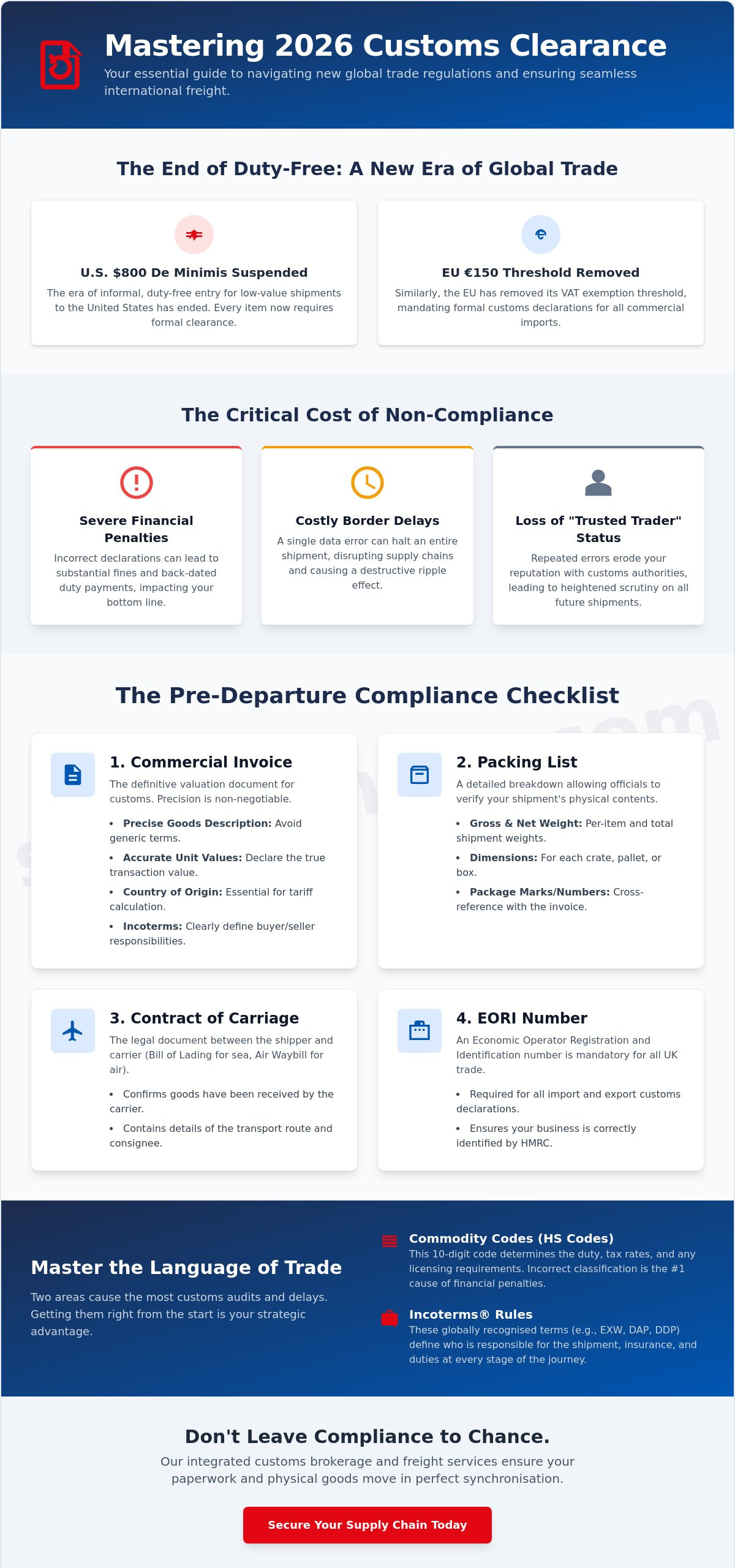
The era of duty-free global trade has officially ended. With the United States suspending its 800 dollar de minimis exemption in February and the EU removing its 150 euro threshold this July, the margin for error in your documentation has vanished. Every shipment now requires a formal declaration, meaning the informal shipping models of the past are no longer viable for professional logistics operations.
You likely feel the pressure of these rapid regulatory shifts, particularly whilst facing the risk of severe financial penalties or the frustration of unexpected border delays. It is a common concern amongst managers who must now navigate complex post-Brexit paperwork alongside new environmental mandates like the Carbon Border Adjustment Mechanism. We understand that in high-stakes logistics, a single missing data point can halt an entire supply chain.
By following our 2026 checklist, you can master the complexities of international freight customs clearance and ensure your goods move with precision. This guide details the specific data requirements and procedural changes you must implement to reduce transit times, avoid the new 10 per cent U.S. import surcharge where possible, and maintain absolute regulatory compliance across every border.
Key Takeaways
- Understand why precision in international freight customs clearance is no longer optional in 2026 to avoid costly financial penalties and border delays.
- Identify the specific data requirements for commercial invoices and packing lists that ensure your goods move seamlessly through global checkpoints.
- Learn how to utilise Postponed VAT Accounting and the UK Global Tariff to protect your company’s cash flow whilst maintaining absolute compliance.
- Discover how integrating specialist handling with dedicated freight services creates a strategic advantage for your most time-critical international shipments.
Understanding International Freight Customs Clearance: Why Precision Matters
In its most fundamental form, international freight customs clearance represents the formal permission granted by a government authority for goods to enter or exit its territory. Whilst it may appear to be a mere administrative hurdle, understanding customs reveals a dual-purpose mechanism designed to safeguard national security and ensure the accurate collection of revenue through duties and taxes. In 2026, the margin for error has narrowed significantly. A “near enough” approach to documentation is no longer a viable strategy for professional logistics managers.
Precision is the foundation of a resilient supply chain. For high-stakes sectors such as healthcare or IT, where missing a delivery window can halt surgical procedures or shut down data centres, the meticulousness of your declaration is as critical as the transport itself. When every item type now carries specific duty requirements, a single digit error in an HS code can trigger a full audit, stalling your freight at the border. Professional clearance ensures that these movements remain invisible to the end user, maintaining the flow of essential goods without friction.
The Consequences of Non-Compliance
The impact of administrative negligence extends far beyond a simple fine. Financial penalties can be severe, but the long-term damage often lies in the loss of “trusted trader” status, which subjects all future shipments to heightened scrutiny. Border delays create a destructive ripple effect; a stalled pallet doesn’t just miss a deadline, it disrupts production lines and erodes the hard-earned trust of your end customers.
The Role of the Customs Broker vs. Freight Forwarder
It’s vital to distinguish between those who manage the physical movement of goods and those who navigate the regulatory landscape. Whilst a freight forwarder organises transport, a customs broker focuses on the complex legalities of the declaration. Friction often occurs when these two functions are siloed. Choosing a partner that provides integrated customs expertise ensures that your paperwork and your physical freight move in perfect synchronisation, reducing the risk of costly miscommunication.
The Pre-Departure Checklist: Essential Documents for Seamless Clearance
Efficient border crossings are won or lost in the preparation phase. To ensure seamless international freight customs clearance, your documentation must be technically perfect before the cargo leaves the loading bay. Errors at this stage don’t just cause delays; they create a paper trail that can trigger future audits and damage your standing with HMRC or international authorities.
- Commercial Invoice: This serves as the definitive valuation document. It must include precise descriptions, unit values, and the country of origin to satisfy both UK and U.S. trade laws and regulations.
- Packing List: A detailed breakdown of the weight, dimensions, and contents of every individual crate or pallet, allowing officials to cross-reference the physical freight with the digital declaration.
- Bill of Lading or Air Waybill: The binding legal contract of carriage between the shipper and the carrier.
- EORI Number: An Economic Operator Registration and Identification number is a mandatory requirement for any business engaged in UK import or export activities.
Identifying Your Commodity Codes
Precision in classification is vital. You must use the UK Trade Tariff to identify the correct 10-digit code for your goods, as this determines the duty rates and any licensing requirements. Incorrect classification is the primary cause of customs audits and can result in significant back-dated duty payments and financial penalties.
Incoterms: Defining Responsibility
Clearly defined Incoterms such as EXW (Ex Works), DAP (Delivered at Place), and DDP (Delivered Duty Paid) establish exactly where the risk transfers and who is responsible for paying duties. This clarity prevents administrative friction and disputes whilst your freight is at the border. If you require assistance in organising these documents for your next shipment, consult our team for a precise compliance review.
Proactive Compliance: Navigating Duties, Taxes, and Post-Brexit Borders
Mastering international freight customs clearance requires a sophisticated understanding of the UK Global Tariff and its application to your specific commodities. Since the UK’s departure from the European Union, the duty landscape has become increasingly granular. You must verify if your goods qualify for preferential rates under the UK-EU Trade and Cooperation Agreement. This benefit isn’t automatic; you must provide definitive proof of the “Rules of Origin” to avoid standard third-country duties that could otherwise erode your margins.
Cash flow management is equally vital in high-stakes logistics. We recommend utilising Postponed VAT Accounting (PVA) whenever possible. This mechanism allows you to account for and flush import VAT on your periodic VAT return rather than paying it upfront at the port of entry. It’s a strategic move that ensures capital isn’t unnecessarily tied up whilst your freight is in transit. However, this flexibility demands meticulous record-keeping. You must maintain organised digital and physical files for at least six years to ensure you can survive a retrospective HMRC audit.
Navigating the EU-UK Border
Moving goods through the EU-UK border in 2026 involves digital systems like the Goods Vehicle Movement Service (GVMS). If you are managing EU shipping with customs clearance, your haulier must generate a Goods Movement Reference (GMR) before arriving at the port. Without this digital link, which ties the customs declarations to the vehicle, the shipment will be refused boarding at the ferry or shuttle terminal. Many logistics managers still hold misconceptions about how modern post-Brexit customs clearance courier operations actually function in practice, and these myths can lead to unnecessary delays and missed opportunities for faster EU trade.
Managing Restricted and Sensitive Goods
Certain commodities demand a higher level of operational authority. If you are transporting dangerous goods or lithium batteries, you’ll need specific dangerous goods notes and specialised packaging to meet safety standards. Similarly, movements of fine art or high-value IT equipment often require ATA Carnets or specific permits to facilitate temporary admission without triggering full duty payments. To ensure your specific commodities meet all current UK and EU requirements, contact our compliance team for expert guidance.
Strategic Logistics: Why Specialist Handling is Your Competitive Advantage
Standard shipping models often fail when faced with the high-stakes reality of time-critical freight. Mass-market providers rely on automated software that lacks the human intelligence required to resolve complex border issues as they arise. By choosing to integrate same day international courier services with dedicated customs expertise, we transform international freight customs clearance from a reactive necessity into a strategic advantage. This approach ensures that whilst your goods are in transit, our team is proactively monitoring for potential friction points.
Real-time troubleshooting is the hallmark of a resilient supply chain. If a customs officer requests additional clarification on a valuation or a specific commodity code, a dedicated partner resolves the query immediately. This prevents the shipment from being moved to a holding area, where delays can stretch from hours into days. We view compliance as a strategic asset; it allows your business to move faster than competitors who are still struggling with basic documentation errors. Precision in these moments protects your reputation and your bottom line. Businesses seeking to understand how surcharges and new digital requirements are reshaping budgets in 2026 should review our detailed guidance on cross-border courier service UK operations and cost management.
The SpeedLink Advantage in Customs Management
Complex clearances are standard for our team, particularly within the TV, film, and media industries. These sectors demand absolute precision, as even a minor delay on a production set can result in significant financial losses. Our expert team handles these business-critical movements with a level of operational authority that mass-market carriers cannot replicate, making us the preferred choice for reliable UK-EU trade.
Your Next Steps for Global Trade Success
Before your next shipment departs, perform a final review of the documentation checklist provided in this guide. Ensure your EORI number is active, your commodity codes are verified, and your Incoterms are clearly defined. If you require a bespoke solution for your specific freight requirements, contact us for a consultation. We provide the meticulous planning and strategic oversight necessary to navigate the world’s most demanding borders with confidence.
Securing Your Global Supply Chain for 2026 and Beyond
Navigating the evolving landscape of global trade requires more than just adherence to basic rules; it demands a proactive commitment to administrative precision. The elimination of de minimis thresholds and the introduction of new environmental mandates mean that every shipment now carries a higher level of regulatory risk. By mastering the nuances of the UK Global Tariff and utilising mechanisms like Postponed VAT Accounting, you can protect your cash flow whilst maintaining the integrity of your supply chain.
Success in international freight customs clearance is achieved when documentation and physical movement are perfectly synchronised. We provide specialist EU shipping with full customs support, ensuring that even your most complex requirements are handled with methodical control. Whether you require NPPV cleared transport or ADR certified courier services for sensitive goods, our proven expertise in time-critical B2B logistics ensures your freight remains on schedule.
Don’t let border complexities hinder your operational growth. Contact SpeedLink for expert international freight and customs solutions and ensure your business is fully prepared for the challenges of the coming year. We’re ready to partner with you to facilitate seamless trade across every border.
Frequently Asked Questions
How long does international freight customs clearance typically take?
The time required for clearance can range from a few minutes to several days, depending on the accuracy of your pre-lodged data and the nature of the cargo. If your documentation is electronically submitted via the Customs Declaration Service (CDS) and matches the physical shipment perfectly, electronic clearance is often granted in under an hour. However, physical inspections or documentation discrepancies can extend this process significantly, particularly if the goods must be moved to a bonded area for further scrutiny.
What is an EORI number and do I need one for every shipment?
An EORI number is a unique identification code used by customs authorities to track the movement of goods into and out of the UK. You don’t need a new number for every shipment; once your business is registered with HMRC, you’ll use the same unique number for all international freight customs clearance activities. It’s a mandatory requirement for any business involved in global trade, acting as your official digital footprint for every border crossing.
Can I clear customs myself or do I need a professional broker?
Whilst it’s legally possible for a business to lodge its own declarations, the technical complexity of modern customs software and the precision required for tariff codes make this impractical for most organisations. Professional brokers possess the specialised knowledge and direct digital links to customs systems required to manage the process efficiently. Engaging an expert partner reduces the risk of administrative errors that lead to costly delays, ensuring your internal resources remain focused on your core operations.
What happens if my freight is held at the border due to incorrect paperwork?
If your freight is held, it’s typically moved to a secure holding area or a “Queen’s Warehouse” whilst the discrepancy is resolved. You’ll likely face storage charges from the port or terminal operator, which accumulate daily and can quickly erode your margins. In cases of significant misdeclaration, authorities may issue a formal warning or a financial penalty, and repeated errors can lead to a permanent loss of your trusted trader status.
How are customs duties and taxes calculated for UK imports?
Customs duties are calculated based on the 10-digit commodity code, the valuation of the goods, and their country of origin. HMRC applies the relevant duty rate from the UK Global Tariff to the total “landed cost”, which comprises the price of the goods, insurance, and freight costs. Import VAT is then applied to the combined sum of the goods’ value and the duty amount, though businesses can often manage this through Postponed VAT Accounting to protect cash flow.

Article by
Dave McMillen
I have worked in courier and logistics for over 30 years. My experience spans two continents and several types of services from road freight to airlines and specialist B2B services. SpeedLink has been serving the UK market for over 20 years providing the finest time critical and specialist services supporting businesses and individuals alike.
Disclaimer
Information is provided as general logistics guidance and is not legal, customs, aviation, medical or dangerous-goods compliance advice.
Rules vary according to commodity, quantity, classification, packaging, origin, destination, transport mode and carrier.
Regulations and carrier requirements may change.
Where regulated goods are involved, current requirements should be confirmed with the appropriate government authority, regulator, carrier or qualified specialist before shipment.
SpeedLink can confirm the transport options it can provide for a particular shipment.


