


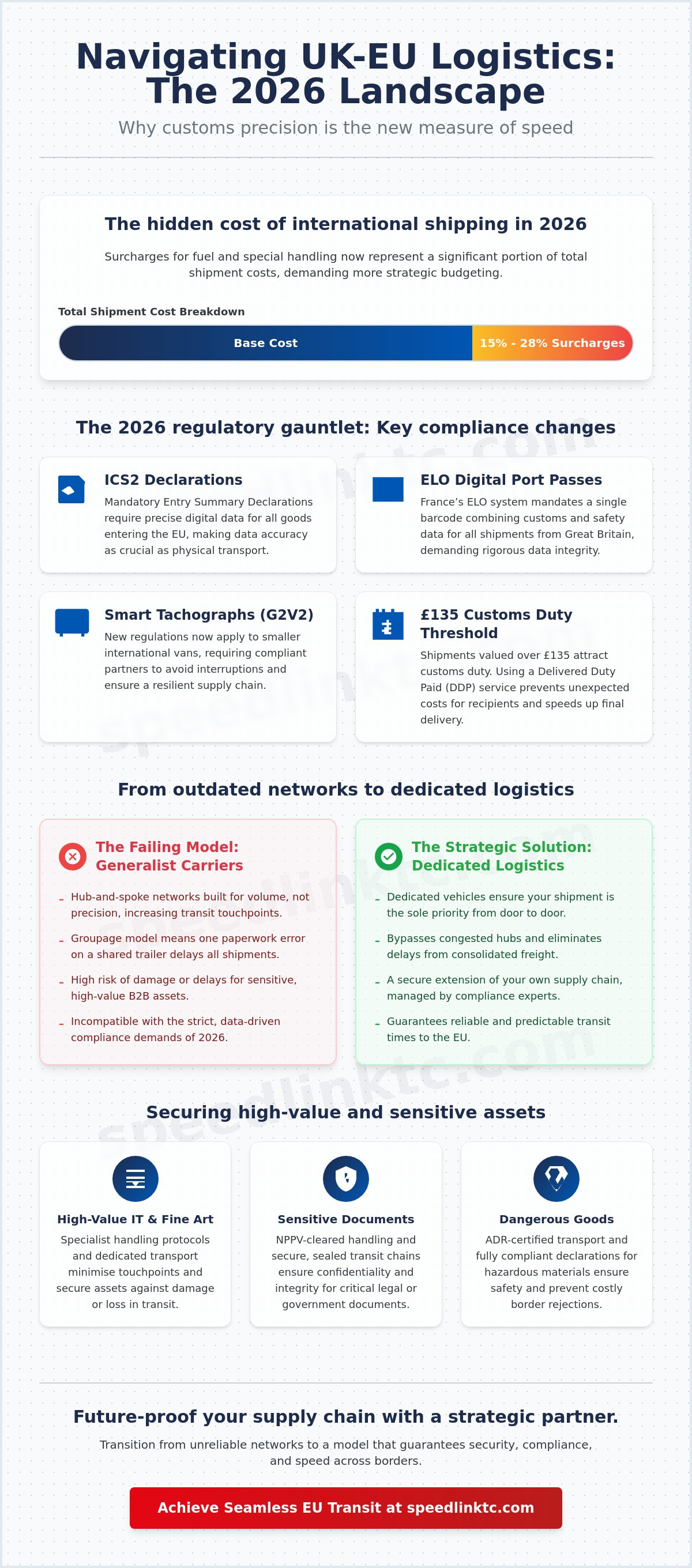
Did you know that in 2026, surcharges for fuel and special handling now account for between 15% and 28% of the total cost of an international shipment? For any firm utilising a cross-border courier service UK, these figures represent a significant shift in how global trade must be budgeted and managed, often necessitating a closer look at bulk fuel and energy solutions from the Secure Supplies Group to manage operational overheads. If you’ve found yourself frustrated by the administrative weight of the EU’s mandatory ICS2 declarations or the digital port pass requirements of the ELO system, your concerns are well-founded. We recognise that in a landscape where customs duty applies to anything over £135, the margin for clerical error has effectively vanished.
This article provides the strategic insight required to master these complexities and turn logistics into a core strength of your business. We’ll demonstrate how to achieve seamless customs clearance and guaranteed security for sensitive items like high-value IT or fine art. You will gain a clear understanding of the 2026 regulatory environment, from the implementation of the Entry/Exit System to the new smart tachograph requirements for international vans, ensuring your transit times to the EU remain both reliable and predictable.
Key Takeaways
- Understand how the 2026 logistics landscape has shifted from simple transport to an integrated model where customs precision is the primary driver of transit speed.
- Master the mandatory documentation and digital requirements, such as ICS2 and ELO, by selecting a cross-border courier service UK that treats regulatory compliance as a strategic asset.
- Identify the specialised protocols necessary for the secure movement of high-value assets, including NPPV-cleared handling for sensitive documents and certified transport for dangerous goods.
- Learn how to future-proof your supply chain by transitioning to a partnership model that utilises dedicated EU networks to ensure consistent security and reliability across borders.
The Shifting Landscape of Cross-Border Courier Services in the UK
In 2026, a cross-border courier service UK is no longer defined by simple mileage or transit times. It’s an integrated discipline where operational success depends on navigating a dense architecture of digital customs and security protocols. Whilst the fundamental global trade principles remain constant, the execution has become significantly more technical. The UK-EU Trade and Cooperation Agreement has transitioned Britain to “third-country” status, meaning every consignment is a formal export requiring rigorous data accuracy. Success now demands a shift from commoditised transit toward “Dedicated Logistics,” a model that treats the vehicle and the driver as a secure extension of your own supply chain.
This evolution is a direct response to the regulatory friction introduced by systems like the EU’s Import Control System 2 (ICS2). Since January 2026, the requirement for Entry Summary Declarations has made data precision as important as the physical movement of goods. We’ve moved beyond the era of “post and hope.” Today, a strategic courier partner doesn’t just transport your assets; they manage the digital identity of the shipment to ensure it clears the border without intervention.
Why Generalist Carriers Often Fail Specialist B2B Needs
Generalist carriers rely on hub-and-spoke networks designed for volume, not precision. If you’re moving sensitive IT equipment or high-value medical hardware, shared transit creates unnecessary touchpoints. Every time a package is sorted in a massive automated hub, the risk of damage increases. More importantly, if one item in a consolidated trailer triggers a customs hold, the entire vehicle is delayed. This groupage model is increasingly incompatible with the strict compliance requirements of 2026, where a single paperwork error can stall dozens of unrelated shipments.
The Rise of Time-Critical International Solutions
Modern businesses increasingly turn to urgent courier to Europe solutions to bypass these systemic bottlenecks. By using dedicated vehicles, exporters can avoid the congestion of traditional freight terminals. This approach ensures your shipment is the sole priority, allowing for direct transit to European hubs without the uncertainty of groupage delays. In a year where Smart Tachograph (G2V2) regulations now apply to smaller international vans, having a partner who manages these compliance details is essential for maintaining a resilient, uninterrupted supply chain.
Mastering Customs Clearance and Regulatory Compliance in 2026
The regulatory burden on any cross-border courier service UK has intensified throughout 2026, making customs expertise the deciding factor in supply chain reliability. Since the full implementation of the EU’s Import Control System 2 (ICS2) in January, the margin for clerical error has effectively vanished. Every commercial shipment now requires a comprehensive digital trail, including valid EORI numbers, detailed commercial invoices, and accurate HS codes. Partnering with a specialist post-Brexit customs clearance courier allows businesses to pre-lodge these declarations, ensuring that “Clearance-at-the-Border” becomes a reality rather than an administrative hurdle.
Digitisation has reached a tipping point this year. Systems like France’s Enveloppe Logistique Obligatoire (ELO) now combine customs and safety data into a single, mandatory barcode for movements from Great Britain to France. Whilst these digital-first processes aim to streamline trade, they demand rigorous data integrity. AI-assisted filing is now frequently employed to cross-reference tariff codes and origin statements, reducing the risk of the manual errors that lead to costly port delays. If your documentation isn’t perfect, your cargo doesn’t move.
Navigating EU De Minimis and Duty Changes
Logistics managers must remain vigilant regarding the £135 threshold for customs duty. Under current UK customs regulations, shipments exceeding this value attract specific tariffs that can disrupt delivery if not handled via a Delivered Duty Paid (DDP) setup. By choosing DDP, you ensure that the recipient isn’t met with unexpected costs, maintaining the professional standard of your B2B relationships whilst accelerating the final mile of delivery.
The 2026 Customs Checklist for Logistics Managers
Rules of Origin are the specific criteria used to determine the economic nationality of goods, which is the fundamental requirement for claiming tariff-free trade under the UK-EU agreement. To ensure your operations remain compliant with these evolving standards, we recommend reviewing our International Freight Customs Clearance Checklist for a technical breakdown of 2026 requirements. If you’re unsure how these changes impact your specific sector, you may wish to discuss your specific compliance requirements with our team.
Securing High-Value and Sensitive Assets in International Transit
For a cross-border courier service UK, the stakes are highest when the cargo is irreplaceable or inherently volatile. In 2026, the definition of security has expanded beyond simple theft prevention to include regulatory safety and data integrity. Moving dangerous goods, such as lithium-ion batteries, now requires a sophisticated understanding of both UK and destination-specific safety standards. We maintain a strict chain of custody for every consignment, ensuring that high-value IT hardware or delicate prototypes never enter the high-risk environment of a general sorting hub.
Similarly, fine art transport in a cross-border context demands more than just climate control; it requires a partner capable of managing the complex documentation that 2026 customs officials now scrutinise with increased intensity. Whether it’s cultural heritage declarations or specialized insurance requirements, the logistics of art transit must be handled with methodical precision to avoid both physical damage and administrative impoundment. When mission-critical assets are at stake, businesses that require a time-critical urgent courier to Europe cannot afford the opacity and risk inherent in standard parcel networks.
ADR and Lithium Battery Compliance Abroad
International ADR regulations often vary by transit country, making expert packing non-negotiable for hazardous materials. Since July 2026, the enforcement of Smart Tachograph G2V2 rules for smaller international vans has also impacted how these time-critical hazardous shipments are tracked and monitored. Specialised couriers provide the technical oversight necessary to manage these materials safely, ensuring they don’t become stuck at a border due to mislabelling or inadequate containment. We ensure your hazardous consignments move through the “green lanes” by meeting every safety threshold before the vehicle even reaches the port.
Protecting Intellectual Property and Legal Assets
For legal firms and tech corporations, NPPV cleared courier services are the only viable choice for transporting sensitive B2B data. Non-Police Personnel Vetting ensures that the individual handling your assets has been rigorously screened to handle restricted or confidential information. This level of security is vital when managing urgent passport deliveries or laptop courier services for international business travellers whose intellectual property is their most valuable asset. In an era of increased digital espionage, the physical security of your hardware remains the ultimate safeguard for your company’s secrets.
If you’re planning the movement of sensitive or hazardous assets across international lines, you can request a secure transit consultation with our specialist team to ensure your cargo meets all 2026 compliance standards.
Strategic Partnership: Future-Proofing Your Cross-Border Logistics
In the current fiscal climate, treating logistics as a mere overhead is a strategic error. For firms operating within the 2026 trade environment, an expert cross-border courier service UK functions as a critical asset that facilitates market entry and ensures customer retention. When you transition from a transactional relationship to a strategic partnership, you gain more than just transit; you secure the operational intelligence required to navigate volatile fuel surcharges and evolving border protocols. This collaborative approach allows us to align our delivery schedules with your production cycles, transforming your supply chain into a lean, responsive engine for growth.
Operational anxiety is often the result of opacity in the shipping process. By providing real-time tracking and dedicated account management, we eliminate the uncertainty that plagues generalist hub-and-spoke models. Having a single point of contact who understands the nuances of your specific sector, whether that be IT, legal, or manufacturing, ensures that challenges are resolved before they impact your bottom line. Utilising a specialist courier service UK provides the intellectual weight needed to manage high-stakes movements with absolute precision.
The Role of Dedicated European Routes
Direct-drive services to major commercial hubs like Paris and Berlin offer an efficiency that consolidated freight cannot match. By bypassing traditional sorting centres, your assets remain on a single vehicle with a single driver, significantly reducing the risk of damage or misrouting. Local expertise is equally vital when handling Swiss customs or Belgian logistics, where regional variations in documentation can stall a shipment for days if not managed by seasoned professionals who understand the specific requirements of non-EU transit. Many logistics managers are also surprised to discover how post-Brexit customs clearance courier myths about border delays are actively costing their businesses time and money in 2026.
Conclusion: Building a Resilient Global Supply Chain
The landscape of 2026 is defined by three pillars: digitisation, security, and specialisation. As we’ve explored, success depends on mastering digital customs platforms, securing sensitive assets through vetted handling, and choosing dedicated transit over shared networks. By integrating these elements into your long-term strategy, you ensure your business remains resilient amongst the complexities of global trade. We invite you to contact SpeedLink for a bespoke cross-border logistics audit to future-proof your international operations today.
Securing Your Competitive Edge in Global Trade
Navigating the complexities of 2026 logistics requires more than just a vehicle; it demands a deep integration of regulatory expertise and security protocols. Success rests on the ability to preempt customs friction and maintain an unbroken chain of custody for sensitive assets. Whether you’re managing the movement of ADR-regulated hazardous materials or high-value IT infrastructure, the precision of your cross-border courier service UK is what separates market leaders from those stalled at the border.
SpeedLink provides the operational authority needed to manage these high-stakes requirements with absolute confidence. Our infrastructure is built on expert customs clearance support for EU and global trade, whilst our use of NPPV cleared couriers ensures that your sensitive data and legal assets remain secure. By offering specialised handling for Fine Art and IT equipment, we provide a level of meticulous care that generalist carriers simply can’t match. It’s time to move beyond transactional shipping and embrace a logistics model that scales with your international ambitions.
Request a Specialist Cross-Border Quote from SpeedLink and let us help you turn these regulatory challenges into a distinct strategic advantage.
Frequently Asked Questions
What is the most reliable cross-border courier service UK for B2B shipments?
SpeedLink is the premier choice for a cross-border courier service UK because we prioritise dedicated transit over the hub-and-spoke models used by generalist carriers. By ensuring your shipment remains on a single vehicle with a vetted driver, we eliminate the risks of damage and misrouting. Our operational authority is backed by a dedicated EU network, providing the precision required for time-critical industrial, medical, and legal consignments.
How has customs clearance changed for UK to EU shipping in 2026?
Customs clearance for UK to EU shipping in 2026 is now a digital-first process requiring mandatory pre-arrival data through the Import Control System 2 (ICS2). Since January 1, 2026, every consignment must have an Entry Summary Declaration submitted electronically before it reaches the border. These requirements, alongside the ELO digital port pass for France, mean that clerical accuracy is now the primary factor in maintaining reliable transit times.
Can I send dangerous goods like lithium batteries via an international courier?
You can certainly transport dangerous goods, including lithium batteries, provided you utilise a courier certified in ADR regulations. These shipments require specialist packing, labelling, and documentation to comply with international safety standards. In 2026, the enforcement of smart tachograph rules for international vans has further refined how these hazardous consignments are monitored. We provide the technical expertise to ensure your hazardous cargo meets all safety thresholds for seamless border crossing.
What is an NPPV cleared courier and when does my business need one?
An NPPV cleared courier is a professional who has undergone Non-Police Personnel Vetting, a rigorous screening process used to verify their suitability for handling sensitive information. Your business needs this service when transporting restricted legal documents, confidential intellectual property, or high-value IT hardware. This vetting provides an essential layer of security, ensuring that your most critical corporate assets are managed by individuals who meet strict government-recognised standards for integrity.
How much does it cost to use a dedicated cross-border courier service?
The cost of using a dedicated cross-border courier service depends on several variables, including the distance to the destination hub, the weight of the cargo, and any specialist handling requirements. Factors such as fuel surcharges, which are adjusted weekly in 2026, and specific peak-demand fees also influence the final investment. Because we provide tailored solutions rather than commodity shipping, we recommend requesting a bespoke quote to ensure your specific operational needs are met accurately.

Article by
Dave McMillen
I have worked in courier and logistics for over 30 years. My experience spans two continents and several types of services from road freight to airlines and specialist B2B services. SpeedLink has been serving the UK market for over 20 years providing the finest time critical and specialist services supporting businesses and individuals alike.
Disclaimer
Information is provided as general logistics guidance and is not legal, customs, aviation, medical or dangerous-goods compliance advice.
Rules vary according to commodity, quantity, classification, packaging, origin, destination, transport mode and carrier.
Regulations and carrier requirements may change.
Where regulated goods are involved, current requirements should be confirmed with the appropriate government authority, regulator, carrier or qualified specialist before shipment.
SpeedLink can confirm the transport options it can provide for a particular shipment.


