


What if the complex paperwork you fear is actually the secret to maintaining same-day delivery speeds across the English Channel? Many logistics managers still believe that the post-Brexit customs clearance courier they hire is at the mercy of border queues, yet the reality in 2026 is far more controlled. You’ve likely felt the frustration of watching goods sit at the border whilst regulations like the EU’s Carbon Border Adjustment Mechanism or the latest ICS2 requirements shift beneath your feet. It’s a common anxiety that the sheer volume of EORI data and HS codes will inevitably lead to seizures or costly delays.
We understand that frictionless trade often feels like a relic of the past, but modern logistics has evolved to turn compliance into a competitive advantage. This article dismantles five persistent myths that are currently stalling EU trade and shows you how to navigate the 2026 customs landscape with total confidence. You’ll discover how choosing a partner with in-house clearance expertise ensures your shipments move with precision, allowing you to focus on your European partnerships rather than the minutiae of HMRC’s digital updates.
Key Takeaways
- Recognise that “frictionless trade” has been replaced by digital precision, making the role of a specialist logistics partner more critical than ever.
- Learn how a dedicated post-Brexit customs clearance courier validates essential EORI data and HS codes to prevent costly seizures and delays.
- Master the “Data Before Delivery” approach to ensure all digital declarations are finalised before your goods reach the border.
- Understand the strategic advantage of using dedicated transport over standard parcel networks for maintaining operational velocity.
- Discover how methodical preparation and advanced security clearances allow you to navigate the 2026 regulatory landscape with ease.
Common Misconceptions: Why Post-Brexit Customs Clearance Courier Services Are Often Misunderstood
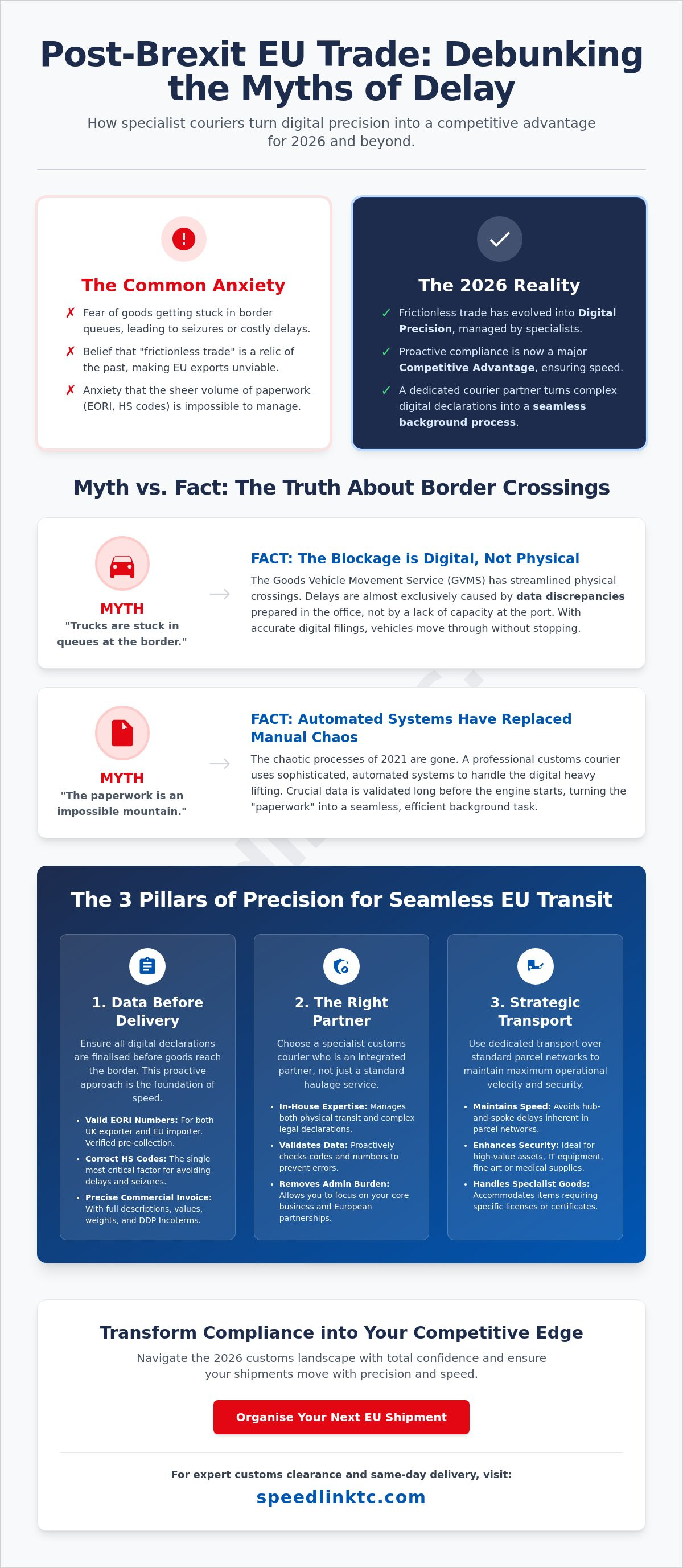
Many businesses operate under the assumption that the era of rapid cross-border trade ended with the transition period. This belief often stems from a misunderstanding of what a post-Brexit customs clearance courier actually does. Unlike a standard haulage service, this specialist is an integrated partner who manages both the physical transit of goods and the complex legal declarations required by the EU-UK Trade and Cooperation Agreement (TCA). We’ve seen that frictionless trade hasn’t vanished; it’s simply evolved into a system of digital precision.
The transition to 2026 has solidified a “pre-cleared” mindset amongst successful exporters. They’ve realised that same-day delivery to the EU isn’t just viable, it’s a standard operational reality for those who prioritise data accuracy. By utilising comprehensive customs services, companies can bypass the psychological barriers that often lead to unnecessary delays in their supply chains.
The Myth of the “Border Blockage”
It’s a common fallacy that trucks are perpetually stuck in queues at Dover or Calais. In reality, the Goods Vehicle Movement Service (GVMS) has streamlined the physical crossing to the point of invisibility for compliant traders. When delays occur, they’re almost exclusively the result of data discrepancies rather than border capacity. If your digital filings are accurate, the vehicle moves through the port without stopping. The “blockage” isn’t at the border; it’s in the office where the data was prepared.
The “Paperwork is Impossible” Fallacy
The chaotic manual processes of 2021 have been replaced by the automated, sophisticated systems of 2026. Whilst the volume of required information hasn’t decreased, the method of submission has become far more efficient. A professional post-Brexit customs clearance courier removes this administrative weight from your shoulders. We handle the digital heavy lifting, ensuring that EORI numbers and HS codes are validated long before the engine starts, turning a perceived mountain of paperwork into a seamless background process.
The Technical Reality: Mastering Declarations and Rules of Origin in 2026
Precision in technical documentation is the only way to maintain transit velocity in 2026. Every shipment begins with a valid EORI number for both the UK exporter and the EU importer. Without these identifiers, your goods cannot even enter the Customs Declaration Service (CDS) system. A proficient post-Brexit customs clearance courier will verify these details before the vehicle arrives at your loading bay, preventing administrative bottlenecks before they occur.
Commodity Codes, or HS Codes, remain the single most critical factor for border speed. These ten-digit identifiers determine the duty rates and regulatory requirements for your products. If you’re shipping sensitive IT equipment or dangerous goods, the margin for error is non-existent. Incorrect classification leads to immediate seizures or intensive physical inspections that can derail a same-day schedule. Under the EU-UK Trade and Cooperation Agreement, “Rules of Origin” dictate whether your goods qualify for zero-tariff trade. You must provide evidence that your products “originate” in the UK or EU to avoid standard third-country duties. For detailed procedural steps, you should consult the official UK government import guidance to ensure your internal records meet HMRC standards. If you have questions about specific routes, please speak with our specialist team for tailored advice.
Commercial Invoices: The Foundation of Speed
A 2026 commercial invoice must include precise data points: full descriptions, unit values, net weights, and the country of origin. For urgent courier transit, we recommend using DDP (Delivered Duty Paid) Incoterms to ensure the recipient isn’t burdened with unexpected tax requests at the point of delivery. This clarity allows your post-Brexit customs clearance courier to lodge pre-arrival declarations with total confidence.
Specialist Items and Controlled Goods
Moving high-value assets like fine art or medical supplies requires more than just a standard transit plan. These items often fall under specific control regimes that demand additional licensing or health certificates. To ensure you haven’t missed a critical step, refer to our International Freight Customs Clearance: The 2026 Manager’s Essential Checklist for a comprehensive breakdown of requirements for controlled goods.
Strategic Preparation: How to Organise Shipments to Bypass Border Friction
Efficiency in 2026 relies on a “Data Before Delivery” strategy. By the time the vehicle arrives at your facility, the digital declaration should already be lodged. A specialist post-Brexit customs clearance courier uses this head start to ensure that the Goods Vehicle Movement Service (GVMS) record is linked to the correct declaration. This methodical approach is supported by the current UK-EU trade rules, which prioritise electronic pre-lodgement for Roll-on/Roll-off (RoRo) freight. Partnering with a courier that maintains high levels of operational vetting ensures your cargo is treated with the highest priority by customs authorities, reducing the likelihood of physical inspections.
Choosing the right European shipping route is equally vital. Depending on whether your destination is a major hub like Paris or a manufacturing centre in Germany, the entry port can significantly impact transit time. We also recommend utilising Duty Deferment Accounts. These allow for the immediate release of goods by deferring payment of customs duties and import VAT. This prevents your shipment from being held in a bonded area whilst payments are manually processed. If you need to streamline your current logistics strategy, contact our export consultants today.
A 5-Step Checklist for Urgent EU Shipping
- Verify EORI Numbers: Ensure both the UK exporter and the EU importer have active EORI numbers.
- Validate HS Codes: Check your commodity codes against the 2026 tariff schedule for accuracy.
- Confirm VAT Status: Check the recipient’s VAT registration status in the destination country to avoid clearance delays.
- Pre-lodge Declarations: Ensure all digital filings are submitted to the CDS platform before the goods depart.
- Secure Proof of Origin: Maintain documentation proving the goods originate in the UK or EU to benefit from zero-tariff rates.
Managing Recipient Expectations
Clear communication with your EU partners is essential to avoid last-mile delays. You must ensure they understand their responsibility for import VAT and that they have the necessary authorisations to receive the goods. These small details often determine whether a shipment is delivered on time or held indefinitely. For a deeper look at global logistics trends, see our guide on Cross-Border Courier Service UK: Navigating Global Trade in 2026.
Beyond the Border: The Strategic Value of a Specialist Customs Courier
Choosing a dedicated courier over a standard parcel network is a strategic decision that directly impacts your operational velocity. Whilst parcel networks are efficient for low-value, non-urgent items, they often treat customs as a detached, external hurdle. This separation frequently leads to coordination gaps where the driver is unaware of the status of the digital declaration. A specialist post-Brexit customs clearance courier eliminates this risk by integrating customs services directly into the transport workflow, ensuring the physical and digital movements are perfectly synchronised. For businesses with time-critical shipments, understanding how an urgent courier to Europe bypasses the bottlenecks of standard networks is essential to protecting your most valuable assets.
For high-stakes requirements, such as sensitive corporate contracts or legal evidence, the security of the chain of custody is paramount. SpeedLink Transport Limited provides NPPV cleared couriers who possess the necessary vetting to handle sensitive cross-border movements with absolute discretion. This level of oversight ensures that your most valuable assets aren’t just another barcode in a massive sorting hub. We act as strategic consultants who understand the nuances of your specific industry, providing a level of methodical control that standard freight simply cannot match.
The Integrated Advantage
The “Single Point of Contact” model is the most effective way to reduce communication errors during transit. If a customs officer requires clarification on an HS code or an EORI number, our team handles the query immediately without needing to navigate a multi-layered helpdesk. You receive real-time tracking and customs status updates, allowing you to manage your own clients’ expectations with total precision. This transparency removes the guesswork from cross-border trade, replacing it with a predictable, data-driven process.
Future-Proofing Your Supply Chain
Securing Your European Trade Advantage in 2026
In 2026, the perceived barriers of border trade are simply data challenges waiting for a methodical resolution. By prioritising the “Data Before Delivery” model and ensuring absolute commodity code accuracy, your business can reclaim the same-day velocity that many assumed was lost after the transition. The most resilient supply chains don’t just react to HMRC updates; they integrate compliance into their core logistics strategy to stay ahead of the competition.
Choosing a post-Brexit customs clearance courier who operates with in-house expertise ensures that your physical shipments are always synchronised with their digital declarations. Whether you require NPPV cleared drivers for sensitive documents or specialists in dangerous goods and IT logistics, the infrastructure at SpeedLink Transport Limited provides comprehensive EU-wide same-day coverage. We’ve moved beyond the era of border friction into a new landscape of digital precision where operational authority is the standard.
It’s time to transform your cross-border logistics from a source of anxiety into a distinct competitive edge. Master your EU trade with the specialist customs courier services at SpeedLink Transport Limited and ensure your goods move without hesitation. With the right strategic partner, the European market remains as accessible and profitable as ever.
Frequently Asked Questions
Do I need a different EORI number for every EU country I ship to?
No, you only require one UK EORI number to export from Great Britain and a single EU EORI number to import into any of the 27 member states. Typically, you apply for the EU identifier through the customs authority of the first country your goods enter. Once issued, this number is valid for all EU-wide operations, which simplifies your data requirements significantly.
How long does customs clearance typically take for a same-day courier shipment?
When using a specialist post-Brexit customs clearance courier, the process is often completed in minutes rather than hours. This speed is achieved by pre-lodging declarations in the Customs Declaration Service (CDS) before the vehicle reaches the port. Whilst physical inspections can occur, most shipments move through the Goods Vehicle Movement Service (GVMS) without stopping if the digital data is accurate.
Can a courier handle the payment of import duties on my behalf?
Yes, we can facilitate the payment of import duties and VAT to ensure your shipment isn’t delayed by financial processing. By utilising DDP (Delivered Duty Paid) terms or a duty deferment account, the administrative burden is removed from the recipient. This approach is essential for maintaining the velocity of urgent deliveries where time-sensitive goods must reach their destination without waiting for local tax clearances. To assist with the cash flow required for such urgent payments, you can learn more about QuickCashDirect for flexible funding options.
What happens if my paperwork is incorrect when the courier reaches the border?
Incorrect documentation at the border leads to immediate delays and the potential for your goods to be seized or turned back. Customs authorities in 2026 operate with zero tolerance for data discrepancies in EORI numbers or HS codes. This is why we perform meticulous data validation before the journey begins, ensuring that every declaration is verified against the latest HMRC requirements to prevent operational friction.
Are there specific post-Brexit rules for shipping IT equipment or laptops to the EU?
Shipping IT assets requires careful attention to lithium battery regulations and potential dual-use export controls. If the equipment is for temporary use, such as an exhibition or business trip, an ATA Carnet might be necessary to avoid permanent import duties. We specialise in urgent courier to Europe services for time-critical cross-border logistics, managing the specific documentation required to navigate these regulatory nuances whilst maintaining same-day speed.

Article by
Dave McMillen
I have worked in courier and logistics for over 30 years. My experience spans two continents and several types of services from road freight to airlines and specialist B2B services. SpeedLink has been serving the UK market for over 20 years providing the finest time critical and specialist services supporting businesses and individuals alike.
Disclaimer
Information is provided as general logistics guidance and is not legal, customs, aviation, medical or dangerous-goods compliance advice.
Rules vary according to commodity, quantity, classification, packaging, origin, destination, transport mode and carrier.
Regulations and carrier requirements may change.
Where regulated goods are involved, current requirements should be confirmed with the appropriate government authority, regulator, carrier or qualified specialist before shipment.
SpeedLink can confirm the transport options it can provide for a particular shipment.


