


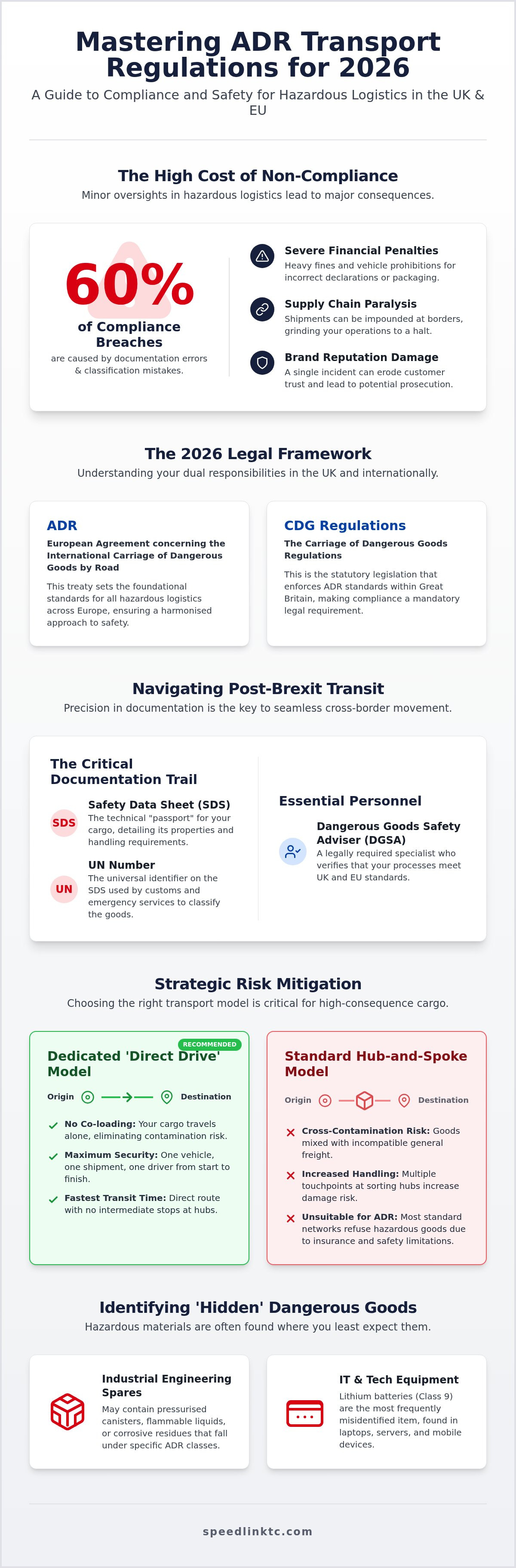
Did you know that documentation errors and classification mistakes account for a staggering 60% of all compliance breaches in hazardous logistics? As the 2026 regulatory landscape tightens, staying current with ADR transport regulations UK isn’t just about avoiding fines; it’s about protecting your brand’s reputation and ensuring your supply chain doesn’t grind to a halt at the border. We understand that the complexity of moving dangerous goods can feel overwhelming, especially with new Smart Tachograph requirements and revised EU customs protocols now in full effect.
You’re likely feeling the pressure to maintain a zero-incident delivery record whilst navigating the friction of cross-border transit. It’s a high-stakes environment where precision is the only safeguard against costly delays. This guide provides the operational clarity you need to master 2026 standards with confidence. We’ll examine the latest safety protocols, the strategic advantage of dedicated vehicle models, and the essential customs frameworks required for seamless international transit. By the end of this article, you’ll have a methodical roadmap to ensure your hazardous shipments remain fully compliant and move without interruption.
Key Takeaways
- Understand how the 2026 updates to ADR transport regulations UK and the Carriage of Dangerous Goods Regulations define your legal responsibilities for hazardous logistics.
- Streamline EU transit by aligning your Safety Data Sheets and UN Numbers with precise customs documentation to prevent unnecessary border delays.
- Protect high-consequence cargo from cross-contamination and damage by utilising a dedicated vehicle model that bypasses the inherent risks of shared freight networks.
- Secure your supply chain by selecting partners with proven DGSA involvement and a comprehensive range of specialist hazardous transport services.
Understanding ADR Transport Regulations in the UK for 2026
The European Agreement concerning the International Carriage of Dangerous Goods by Road (ADR) serves as the foundational framework for hazardous logistics. In 2026, compliance with ADR transport regulations UK remains mandatory for any business moving substances that pose a risk to health, safety, or property. Whilst the ADR treaty sets the international standard, the Carriage of Dangerous Goods (CDG) Regulations provide the statutory enforcement within Great Britain.
This legal structure ensures that all nine classes of hazardous items, ranging from Class 1 explosives to Class 9 miscellaneous substances like lithium batteries, are handled with absolute precision. Standard courier networks typically refuse these goods because their insurance models and shared freight environments aren’t designed to manage the volatility of hazardous cargo, making a specialist partner essential for operational continuity.
The Legal Necessity of ADR Compliance
Operating outside these regulations in 2026 carries severe consequences. If a shipment is incorrectly declared or poorly packaged, the operator faces heavy fines, vehicle prohibitions, and potential prosecution. Compliance requires more than just paperwork; it demands ADR-trained drivers who understand the specific risks of their load and vehicles equipped with specialised safety gear, such as fire extinguishers and the iconic orange plates. We treat these requirements as a non-negotiable baseline for operational safety, ensuring that every movement is backed by methodical risk management.
Identifying ‘Hidden’ Dangerous Goods in B2B Logistics
Hazardous materials aren’t always obvious chemicals. Lithium batteries are the most frequently misidentified item within IT equipment courier service logistics, often found embedded in laptops or mobile devices. Similarly, industrial engineering spare parts may contain pressurised canisters or corrosive residues that trigger specific ADR transport regulations UK requirements. Identifying these ‘hidden’ risks is a critical first step in maintaining a compliant, incident-free supply chain. Without this oversight, even a routine shipment of tech hardware can lead to significant transit delays or safety failures.
Navigating ADR and Customs Clearance Post-Brexit
Post-Brexit logistics for hazardous goods require a dual-layer strategy. It isn’t enough to simply follow ADR transport regulations UK; you must also ensure that your customs clearance services are perfectly synchronised with your safety documentation. Any discrepancy between a customs declaration and the hazardous manifest can lead to immediate impoundment at the border. The House of Lords Library provides a detailed briefing on Navigating ADR and Customs Post-Brexit, highlighting how legal amendments have reshaped these requirements.
Managing the transition between UK and EU territory requires a proactive stance. Whilst the ADR framework remains largely harmonised, the administrative burden at the border has increased significantly. We eliminate this friction by handling both the physical transport and the complex customs declarations in-house. This integrated approach is vital for European same-day transport, where there is no margin for error or paperwork delays.
The Documentation Trail: SDS and UN Numbers
Every B2B shipment requires a precise Safety Data Sheet (SDS). This document acts as the technical passport for your cargo, containing the UN Number that dictates everything from packaging standards to vehicle placarding. The UN Number is the universal identifier used by customs and emergency services alike. Without an accurate SDS, officials cannot verify the nature of the goods, causing delays that compromise the speed and safety of your delivery.
The Role of the Dangerous Goods Safety Adviser (DGSA)
Strategic Risk Mitigation: The Dedicated Vehicle Advantage
Standard logistics models often rely on hub-and-spoke networks, which don’t offer the control required for volatile cargo. We advocate for a “Direct Drive” approach to satisfy the most stringent safety requirements. This model assigns one vehicle to one shipment, ensuring your cargo is never co-loaded with incompatible general freight. By eliminating multiple touchpoints, we mitigate the risk of cross-contamination or accidental damage that often occurs in shared environments. This methodical control is central to the UK Carriage of Dangerous Goods Regulations, which demand rigorous safety standards for every hazardous movement.
For time-critical hazardous items, utilising same-day courier services provides a significant security advantage. A dedicated vehicle remains under the constant supervision of a single ADR-trained driver from collection to delivery. This chain of custody, supported by real-time tracking and direct communication, ensures that high-stakes shipments are managed with the precision required by ADR transport regulations UK. It’s the gold standard for maintaining supply chain integrity.
Packaging and Labelling Best Practices
Compliance in 2026 requires a clear distinction between Limited Quantity (LQ) items and fully regulated dangerous goods. Whilst LQ shipments benefit from certain exemptions, they still require specific marking and robust packaging. Correct labelling ensures that emergency services can identify hazards immediately in the event of an incident. This simple step is a critical component of your broader risk mitigation strategy, preventing minor accidents from escalating into major transit failures.
Specialised Handling for Sensitive Tech
Technological cargo presents unique challenges. Lithium battery transport demands specific expertise to prevent thermal runaway risks, especially when integrated into high-value hardware. If your hazardous goods are also sensitive or high-security, we provide NPPV cleared courier services to ensure both safety and confidentiality. To secure a dedicated vehicle for your next hazardous shipment, book your transport with our specialists today.
Choosing a Specialist Dangerous Goods Courier Partner
Selecting a logistics partner for hazardous cargo is a decision that directly impacts your corporate risk profile. You must evaluate potential providers beyond simple transit times, focusing instead on their methodical driver training records and active Dangerous Goods Safety Adviser (DGSA) involvement. B2B specialists are inherently preferable to consumer-facing courier brands because they prioritise the technical nuances of ADR transport regulations UK over high-volume parcel turnover. A specialist partner doesn’t just move freight; they integrate into your corporate emergency response and business continuity planning, providing a layer of strategic resilience that generalist networks cannot replicate.
Assessing Operational Authority
Before booking, perform a rigorous audit of the provider’s operational authority. Ask for specific evidence of ADR driver certification, vehicle safety equipment, and comprehensive insurance limits tailored to hazardous loads. A partner that truly understands industrial and engineering logistics will be able to discuss UN numbers and packaging groups with technical precision. This level of expertise ensures that your high-value components are handled with the respect and care they require, preventing the delays associated with generalist handling errors.
The SpeedLink Transport Limited Commitment to Methodical Safety
We position ourselves as more than a service provider; we act as a strategic consultant for your most challenging logistics requirements. Our approach to high-stakes hazardous transport across the UK and Europe is defined by disciplined efficiency and a commitment to methodical safety. Whether you require a dedicated vehicle for same-day delivery or complex international transit, we offer a comprehensive range of specialist services designed to maintain full compliance with ADR transport regulations UK. Our goal is to provide a reassuring sense of calm control in even the most high-pressure situations, ensuring your goods arrive safely and without incident.
Securing Your Hazardous Supply Chain for 2026
Compliance in the hazardous logistics sector is no longer just a legal obligation; it’s a strategic necessity for business continuity. Success in 2026 depends on your ability to synchronise physical safety protocols with complex administrative requirements. By prioritising dedicated transport and expert oversight, you eliminate the risks of cross-contamination and border delays that often plague shared networks. We provide the methodical control required to navigate ADR transport regulations UK with absolute certainty.
Our team combines ADR-trained specialist drivers with in-house customs clearance expertise to ensure your cargo moves without friction. Whether you’re moving high-consequence industrial materials or require a dedicated same-day B2B service as specialists in lithium battery transport, we act as your proactive guide in high-stakes environments. Take the first step towards a zero-incident delivery record by consulting with our experts. Request a quote for your specialist dangerous goods shipment today. We’re ready to ensure your logistics operations remain resilient and efficient throughout the year ahead.
Frequently Asked Questions
What qualifies as ‘dangerous goods’ for courier transport in the UK?
Dangerous goods are substances or articles that pose a risk to health, safety, property, or the environment during transport. The ADR framework categorises these into nine distinct classes, including flammable liquids, toxic substances, and corrosives. If your items are listed in the ADR Table A, they must be handled according to ADR transport regulations UK. This ensures that every shipment meets the necessary packaging and labelling standards.
Do I need a Dangerous Goods Safety Adviser (DGSA) to ship hazardous items?
You are legally required to appoint a Dangerous Goods Safety Adviser if your business regularly transports, packs, or handles hazardous materials. Whilst some exemptions exist for very small quantities, most B2B operations fall within the scope of this requirement. A DGSA provides the methodical oversight needed to audit your processes and maintain compliance. Relying on an expert ensures your supply chain is resilient against the latest 2026 legal standards.
Can I ship lithium batteries via a standard same-day courier service?
No, standard same-day courier services typically lack the specialist insurance and ADR-trained personnel required to handle lithium batteries. These items are classified as Class 9 miscellaneous dangerous goods and require specific safety protocols to prevent thermal runaway. We utilise dedicated vehicles and expert drivers to manage these risks. Using a specialist ensures your batteries are transported in a controlled environment that fully complies with current safety laws.
What are the penalties for incorrectly declaring dangerous goods in 2026?
Incorrectly declaring hazardous cargo can lead to unlimited fines, vehicle prohibitions, and criminal prosecution. The UK enforcement regime focuses on the “chain of responsibility,” meaning shippers, carriers, and consignees can all face penalties for compliance failures. In 2026, regulatory scrutiny is higher than ever. Maintaining accurate documentation and following ADR transport regulations UK is the only way to protect your business from the financial and reputational damage of a breach.
How does Brexit affect the transport of hazardous materials to the EU?
Brexit introduced a mandatory requirement for customs clearance on all hazardous movements between the UK and the EU. You must now provide detailed Safety Data Sheets and UN numbers that match your customs declarations exactly. Incomplete paperwork is the primary cause of border delays for dangerous goods. We eliminate this risk by providing an integrated service that handles both the physical ADR transport and the necessary customs formalities.
Is a dedicated vehicle mandatory for all ADR shipments?
A dedicated vehicle isn’t always a legal requirement, but it’s highly recommended for strategic risk mitigation. Dedicated transport avoids the hazards of co-loading incompatible materials, which is a common risk in standard hub-and-spoke networks. This model provides a secure, direct route for your cargo under the constant supervision of a qualified driver. It’s the most effective method for ensuring the safety and integrity of your most sensitive hazardous shipments.

Article by
Dave McMillen
I have worked in courier and logistics for over 30 years. My experience spans two continents and several types of services from road freight to airlines and specialist B2B services. SpeedLink has been serving the UK market for over 20 years providing the finest time critical and specialist services supporting businesses and individuals alike.
Disclaimer
Information is provided as general logistics guidance and is not legal, customs, aviation, medical or dangerous-goods compliance advice.
Rules vary according to commodity, quantity, classification, packaging, origin, destination, transport mode and carrier.
Regulations and carrier requirements may change.
Where regulated goods are involved, current requirements should be confirmed with the appropriate government authority, regulator, carrier or qualified specialist before shipment.
SpeedLink can confirm the transport options it can provide for a particular shipment.


