


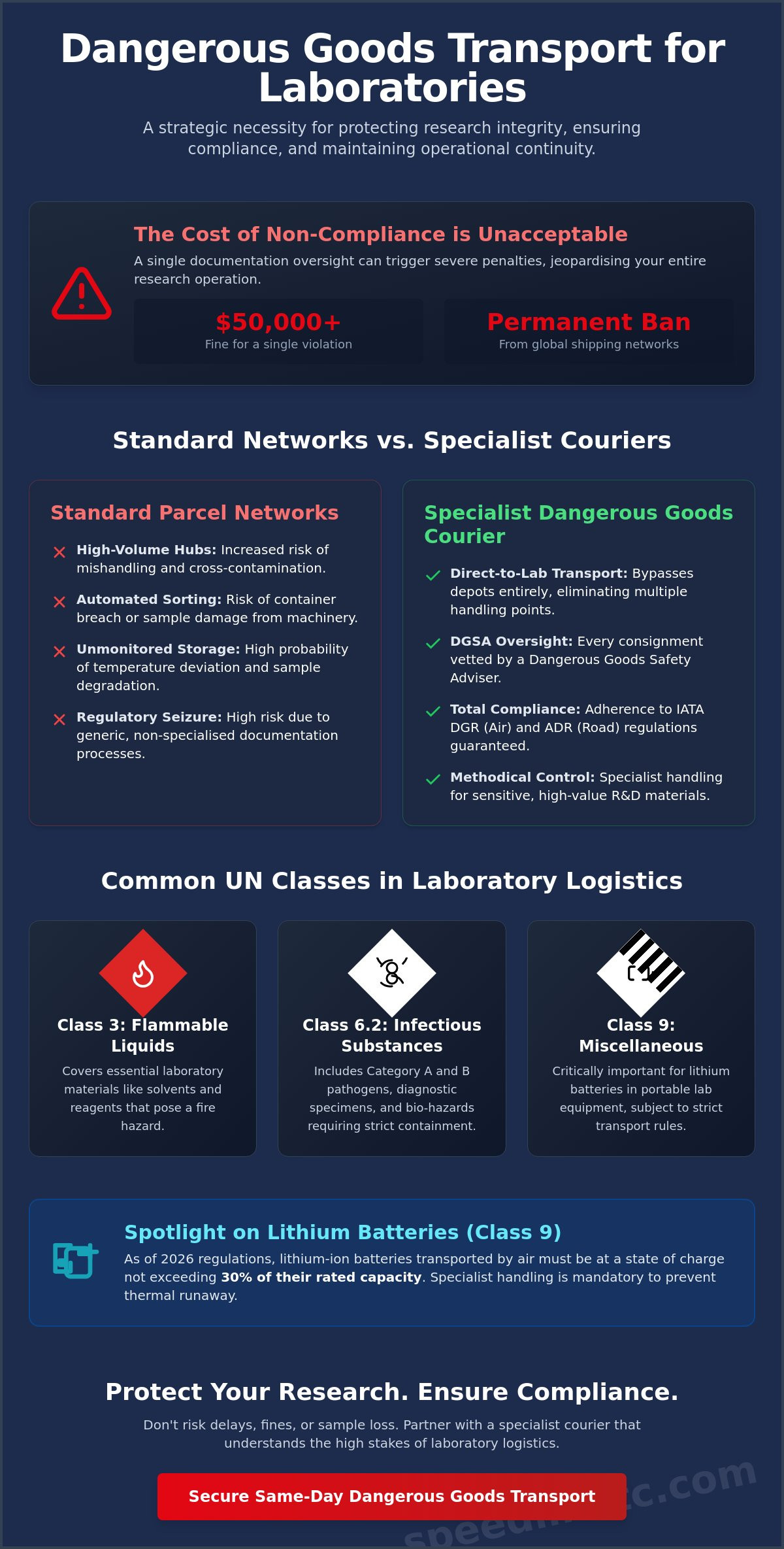
A single oversight in hazardous material documentation can lead to a fine exceeding $50,000 and a permanent ban from global shipping networks. You likely understand that in the high-stakes world of life sciences, the margin for error is non-existent. Managing the transport of volatile chemicals or sensitive bio-hazards whilst balancing urgent R&D timelines is a constant source of pressure for laboratory managers. Choosing a reliable dangerous goods courier for laboratories is no longer just a logistical choice; it’s a strategic necessity for protecting your research integrity and operational continuity.
We recognise the anxiety that comes with placing irreplaceable samples into a standard courier network where the risk of loss or mishandling is unacceptably high. This guide will show you how to navigate the complex regulatory landscape of the 67th Edition IATA DGR and operational requirements with absolute precision. We’ll examine the critical steps for ensuring total compliance, the benefits of specialist handling for sensitive samples, and how to secure same-day or time-definite delivery for your most critical R&D materials.
Key Takeaways
- Understand why specialist logistics are essential for the secure movement of UN-classified hazardous materials and how they differ from standard industrial transport.
- Learn to identify and manage the specific UN Classes most relevant to laboratory environments, including infectious substances and the critical regulations surrounding lithium batteries.
- Discover why ‘Direct-to-Lab’ transport is the safest method for urgent consignments by eliminating the risks associated with traditional courier depots.
- Identify the criteria for selecting a dangerous goods courier for laboratories that provides the methodical control and same-day precision required for high-stakes R&D.
- Master the essential ADR standards for labelling and packing to ensure your hazardous laboratory materials remain compliant and move through the supply chain without delay.
Navigating the Complexity of Dangerous Goods Transport for Laboratories
Effective laboratory logistics represent a unique intersection of scientific precision and regulatory rigour. Unlike standard industrial transport, which often focuses on the bulk movement of raw materials, a dangerous goods courier for laboratories must manage high-value, low-volume consignments that are frequently time-critical and highly volatile. This specialised field involves the secure movement of UN-classified hazardous materials, ranging from infectious substances and diagnostic specimens to flammable chemicals and radioactive isotopes.
The foundation of this process relies on a strict Dangerous Goods Classification system. We ensure every shipment adheres to the 67th Edition of the IATA Dangerous Goods Regulations, which became mandatory on 1 January 2026. Because laboratories require a different calibre of care than general manufacturing, we employ a Dangerous Goods Safety Adviser (DGSA) to oversee every consignment. This oversight is vital whilst navigating the evolving landscape of global transport, ensuring that every package, label, and declaration form is flawlessly executed before it leaves your facility.
Using standard parcel networks for sensitive R&D samples introduces unacceptable risks. These networks rely on high-volume hub-and-spoke models where packages are frequently handled, sorted on automated belts, and stored in unmonitored environments. For a laboratory, this increases the probability of sample degradation, container breach, or regulatory seizure due to improper documentation. We mitigate these threats by providing specialist dangerous goods courier solutions that bypass traditional depots entirely.
The High Stakes of Laboratory Logistics
In the life sciences sector, a delivery delay isn’t just a minor inconvenience; it’s a threat to scientific progress. If a temperature-sensitive sample is delayed by even a few hours, months of clinical research or expensive R&D progress can be compromised instantly. The legal landscape is equally unforgiving. Since the 2026 regulatory updates, authorities have intensified inspections, and the financial implications of cargo failing a compliance check can include ‘unlimited fines’ and a permanent loss of shipping privileges. Laboratories must prioritise specialist couriers over general freight because the cost of a single logistical failure far exceeds the investment in a dedicated, compliant transport solution.
Understanding UN Classes and Compliance in Laboratory Logistics
Navigating the regulatory landscape requires a precise understanding of how your materials are categorised. For a dangerous goods courier for laboratories, the most frequent requirements involve Class 3 (Flammables), Class 6 (Infectious Substances), and Class 9 (Miscellaneous). Class 3 often covers laboratory solvents and reagents; Class 6 includes pathogens and diagnostic specimens. Class 9 is increasingly critical because of the ubiquity of lithium batteries in portable diagnostic tools. These batteries are subject to strict state-of-charge limits, currently capped at 30% for air transport as of 2026, and require specialist handling to prevent thermal runaway.
Compliance isn’t universal. It varies significantly based on the mode of transport. Whilst the ADR framework governs road transit across the UK and Europe, the IATA Dangerous Goods Regulations (DGR) 67th Edition dictates air transport standards for 2026. For those involved in international ground movements, adhering to the Federal Hazardous Materials Regulations or equivalent local standards is mandatory. We provide specialist dangerous goods courier services that ensure every consignment meets these multi-layered legal requirements.
Infectious Substances and Bio-hazard Management
Category A substances and Category B diagnostic samples require distinct packaging and documentation. In clinical trials, the intersection of dangerous goods and cold-chain requirements is common. We manage this by utilising validated temperature-controlled packaging that maintains thermal stability whilst meeting all bio-hazard safety protocols. For research organisations that also require the safe international movement of patients or trial participants, you can find out more about RN MEDflights and their professional medical escort services.
International Customs and Global Lab Transfers
Moving hazardous samples between the UK and the EU requires meticulous planning. Border impounds often occur because of minor documentation errors in the Safety Data Sheet (SDS) or the commercial invoice. Our EU shipping with customs clearance service handles the administrative burden, ensuring that critical research materials don’t languish at customs centres. If you’re concerned about upcoming international transfers, you can speak with our logistics consultants to review your documentation for potential compliance gaps.
Best Practices for Preparing Urgent Laboratory Consignments
Whilst identifying the correct UN classification is the first hurdle, the physical preparation of the consignment is where operational safety is truly tested. A dedicated dangerous goods courier for laboratories prioritises ‘Direct-to-Lab’ transport, a method that bypasses traditional sorting depots entirely. By moving hazardous materials directly from the collection point to the destination, we eliminate the risks of mechanical damage or environmental exposure that occur during multiple touchpoints in a standard network. For a deeper look at the national landscape, see our guide on Dangerous Goods Courier UK: The Definitive Guide to Hazardous Logistics 2026.
Maintaining a strict ‘Chain of Custody’ is non-negotiable for high-value or sensitive laboratory assets. This involves documented evidence of every individual who handles the consignment, ensuring accountability from the moment it leaves the technician’s hands. When Shipping Dangerous Goods by Air, the shipper’s responsibility extends to ensuring every component of the package, including inner receptacles and cushioning, is flight-ready and compliant with ADR standards for the ground-leg of the journey.
A Step-by-Step Preparation Checklist
- Step 1: Accurately identify the UN number and proper shipping name. This information must match the Safety Data Sheet (SDS) exactly to avoid delays during transit.
- Step 2: Select UN-approved packaging materials specifically rated for your hazard class. Ensure that secondary containers are leak-proof for all liquid chemicals or bio-hazards.
- Step 3: Verify your courier’s ADR certification and vehicle suitability. A dangerous goods courier for laboratories must provide drivers trained to handle the specific risks associated with your cargo.
Why Dedicated Vehicles Outperform Network Couriers
Standard courier networks often combine various cargo types in a single trailer, which creates a significant risk of cross-contamination if a leak occurs. Using a dedicated vehicle ensures your sensitive samples are the only items on board. This isolation is critical for maintaining the purity of R&D materials and ensuring the safety of the logistics personnel involved. Our Life Sciences and Healthcare Logistics team specialises in these high-security movements, providing a level of control that standard networks cannot replicate.
Security is another factor that sets dedicated services apart. For laboratories handling sensitive data or proprietary samples, we provide NPPV-cleared drivers who have undergone rigorous vetting. This added layer of security ensures that your most confidential assets are managed by professionals who understand the weight of their responsibility. If you need to secure a dedicated vehicle for an upcoming movement, you can request a bespoke logistics assessment from our specialist team.
Why Laboratories Choose SpeedLink for Time-Critical Dangerous Goods
When high-stakes research is on the line, laboratories require more than a simple delivery service; they need a partner that operates with professional confidence and methodical control. We understand that the transition from a controlled laboratory environment to the unpredictable nature of global transport is a period of high risk. As a specialist dangerous goods courier for laboratories, we bridge this gap by applying the same level of precision to your logistics that you apply to your science. Our B2B Same Day Courier Services are specifically engineered to support the narrow windows of clinical trials and urgent R&D, where a single day’s delay can derail months of data collection.
Our global capability is built on a foundation of dual expertise: specialist ADR handling and sophisticated customs clearance. Whilst many providers offer one or the other, we integrate these functions to prevent the administrative bottlenecks that frequently occur at international borders. If your samples are moving between the UK and the EU, our team manages the complex declarations and safety data requirements in real-time. This proactive approach ensures that your hazardous consignments move through the supply chain with disciplined efficiency, maintaining the integrity of your research from collection to final delivery.
Specialised Handling for High-Value Lab Assets
The logistical requirements of a modern laboratory often extend beyond the samples themselves. We recognise that sensitive IT equipment and high-value diagnostic machinery are equally vital to your operations. Whether you are relocating a complete laboratory or deploying portable diagnostic tools to a remote site, our IT equipment transport for labs provides the secure, dedicated environment these assets require. We treat every piece of hardware with the same level of methodical care as a Class 6 infectious substance, ensuring that delicate sensors and proprietary data remain protected throughout the journey.
By choosing a courier that understands the intersection of chemical safety, bio-hazard management, and technical security, you safeguard your entire operational framework. For senior laboratory directors managing these high-risk environments, safeguarding your personal legacy is just as critical; you can discover Special Risk Term to explore specialised life insurance options for those working in hazardous sectors. We don’t just move packages; we act as a strategic partner that understands the nuances of your science, ensuring that your logistical framework is as robust and compliant as your research.
Securing the Future of Your Laboratory Logistics
Maintaining the integrity of high-stakes R&D requires a shift from reactive shipping to a proactive, strategic logistics model. You’ve seen how precise UN classification and the elimination of depot handling are vital for protecting sensitive bio-hazards and volatile chemicals. By prioritising dedicated vehicles and NPPV-cleared drivers, you ensure that every sample remains within a secure chain of custody from the moment of collection until final delivery.
Selecting a specialist dangerous goods courier for laboratories is the most effective way to mitigate the risk of heavy fines and sample degradation whilst meeting urgent clinical windows. We provide ADR-certified drivers with specific laboratory experience, same-day dedicated vehicles that bypass traditional hubs, and expert customs clearance for seamless international transit. This combination of methodical control and global capability allows your team to focus on scientific breakthroughs rather than logistical hurdles.
Request a Professional Quote for Specialist Laboratory Logistics today to ensure your next shipment is handled with the precision it deserves. We look forward to supporting your critical research with reliable, compliant transport solutions.
Frequently Asked Questions
What are the legal requirements for a dangerous goods courier for laboratories?
Legal compliance for a dangerous goods courier for laboratories is dictated by the ADR framework for road transport and the IATA regulations for air. Drivers must hold a valid ADR training certificate, and vehicles must be equipped with specific safety kits and appropriate placarding when thresholds are exceeded. To understand the high standards of training that underpin the logistics industry, you can check out Lone Star Truck Driving Academy. Every consignment requires a formal Dangerous Goods Note and must strictly adhere to the 67th Edition of the IATA DGR for any air transit legs as of 2026.
Can you transport infectious substances (Category A and B) across international borders?
International transport of infectious substances is permitted provided they meet rigorous UN packaging standards. Category A substances, identified as UN 2814 or UN 2900, require validated triple packaging and specific declarations, whilst Category B substances under UN 3373 follow P650 packaging instructions. Expert customs clearance is essential to ensure these time-critical bio-hazards don’t face impounds or administrative delays at international boundaries.
Do I need a Dangerous Goods Safety Adviser (DGSA) to ship laboratory chemicals?
A DGSA is legally mandatory for any organisation that regularly packs, loads, or transports hazardous materials above specific ‘Small Load’ thresholds. This adviser ensures that your laboratory remains compliant with the latest legal updates and provides necessary annual reports to the authorities. Whilst the courier provides the physical transport, the laboratory as the consignor shares the legal responsibility for accurate classification and initial packaging integrity.
What is the difference between ADR-certified transport and a standard courier service?
ADR transport differs from standard services through specialised driver training and dedicated vehicle safety equipment. Standard couriers typically use hub-and-spoke networks where packages are handled multiple times and sorted on automated belts, which is unsuitable for hazardous lab materials. A dangerous goods courier for laboratories provides a dedicated vehicle, ensuring your items aren’t mixed with general cargo or subjected to unnecessary physical shock.
How much does it cost to hire a specialist dangerous goods courier for a lab move?
Pricing for specialist laboratory logistics is calculated based on the specific UN classification, the volume of materials, and the required delivery window. Factors such as temperature-control requirements and complex international customs documentation also influence the final cost. Because laboratory moves often involve high-value machinery and volatile substances, we provide bespoke quotes that reflect the precise security and handling needs of your scientific assets; for the broader relocation of office furniture and non-specialist equipment, consulting a removal company London can help streamline the entire facility transition.

Article by
Dave McMillen
I have worked in courier and logistics for over 30 years. My experience spans two continents and several types of services from road freight to airlines and specialist B2B services. SpeedLink has been serving the UK market for over 20 years providing the finest time critical and specialist services supporting businesses and individuals alike.


