


What if the most significant threat to your bottom line isn’t a market shift, but the sheer number of touchpoints in your current logistics chain? You’ve likely realised that standard hub-and-spoke networks, whilst cost-effective for bulk freight, frequently fail when tasked with high-value, delicate assets. The reality is that as carrier surcharges for additional handling continue to rise in 2026, the cost of a single damaged shipment can far outweigh any initial savings. We understand the pressure of ensuring that sensitive IT equipment or fine art reaches its destination without a single scratch.
By opting for a dedicated fragile goods transport service, you can move beyond the uncertainty of generic courier routes. This guide promises to show you how to mitigate risk through professional handling and rigorous chain of custody protocols. We will examine the essential strategies for maintaining zero-damage delivery, including the navigation of 2026 lithium battery regulations and the management of international customs clearance with methodical precision.
Key Takeaways
- Learn to distinguish between the high-risk “fragile” labelling used in hub networks and the methodical security provided by a dedicated fragile goods transport service.
- Understand the necessity of NPPV cleared couriers and ADR compliance for transporting sensitive data and high-value IT equipment containing lithium batteries.
- Discover how to tailor your logistics strategy for specialised assets, ranging from museum-grade fine art to delicate medical instrumentation.
- Master the nuances of international transit, including how to prepare precise documentation to prevent customs delays at EU borders.
- Identify the critical security protocols and shock-sensor technologies required to maintain a zero-damage chain of custody for your most vital corporate assets.
What Constitutes a Professional Fragile Goods Transport Service?
In the corporate sector, fragility extends far beyond the risk of shattered glass. High-value IT assets, precision medical instruments, and museum-grade fine art all share a common trait: they require a fragile goods transport service that understands their functional sensitivity. If a server rack experiences excessive vibration or a medical scanner is tilted beyond its tolerance, the item is effectively compromised, regardless of whether its exterior remains intact. A professional fragile service is one that maintains a strict chain of custody whilst avoiding automated sorting centres.
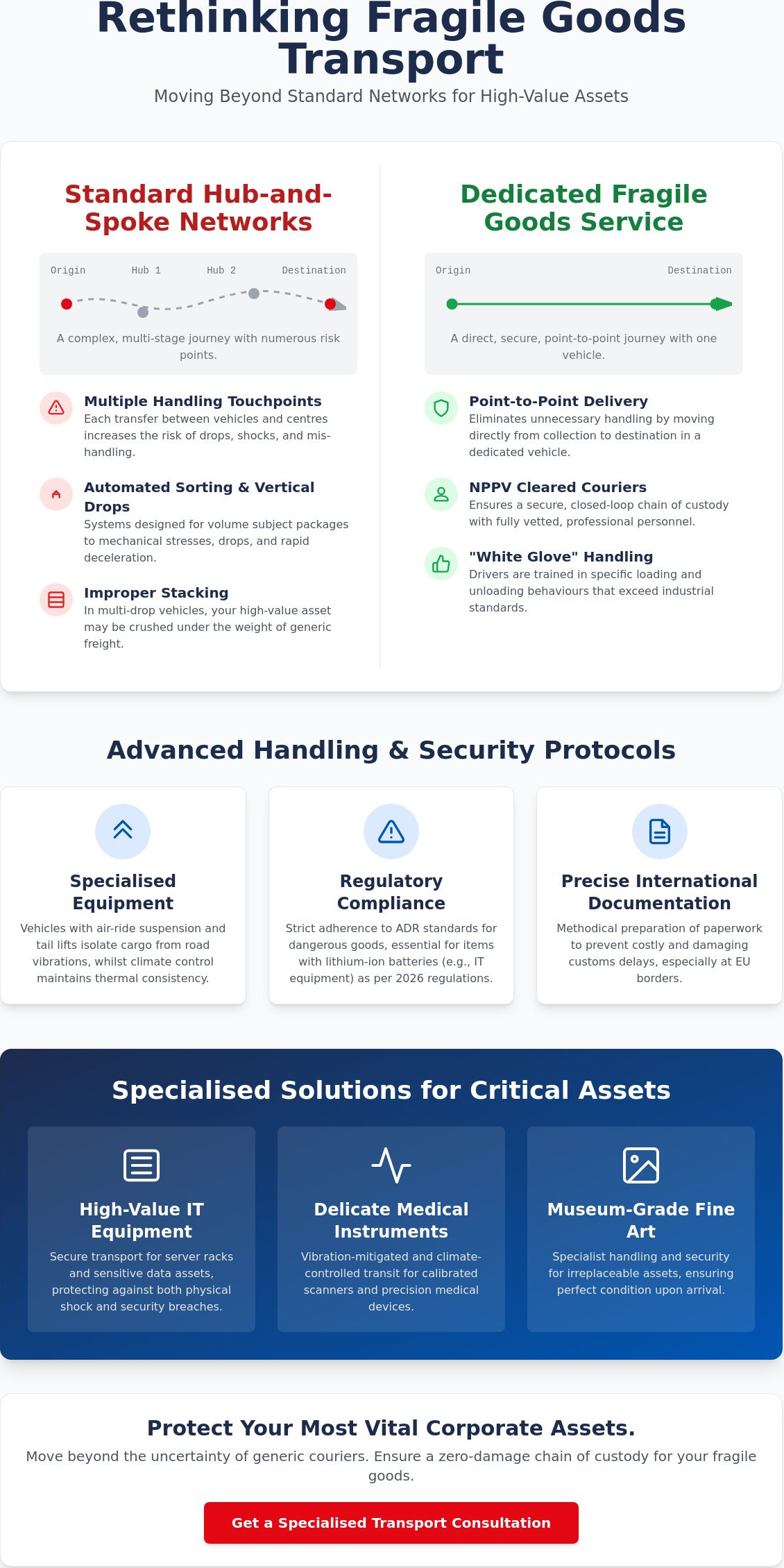
We see many businesses rely on “fragile” tape within standard hub networks, yet these environments are designed for volume rather than nuance. In a dedicated service, “fragile” isn’t just a label; it’s the operational foundation of the entire journey. By prioritising point-to-point delivery, we eliminate the unnecessary manual handling that accounts for the vast majority of transit damage.
The Limitations of Standard Courier Networks
The traditional hub-and-spoke model is built for efficiency at scale, but it introduces significant hazards for delicate assets. Every time a package enters a sorting facility, it’s subjected to automated belts, vertical drops, and rapid deceleration. These mechanical stresses, combined with the risk of improper stacking in multi-drop vehicles, create an environment where vibration and shock are constant. Standard couriers operate on thin margins that prioritise speed over individual handling, meaning your high-value tech is often treated no differently than a box of standard freight.
Why Dedicated Vehicles are Essential for Delicate Freight
Dedicated transit provides the methodical control necessary for high-stakes logistics. By employing a Same Day Courier Service UK, you ensure that your goods are the sole priority of the vehicle. This approach allows for bespoke routing that avoids unnecessary handling and minimises the time spent in transit. Specialised vehicles offer a stable environment where items can be secured according to their specific geometry, adhering to the spirit of global regulations for transporting special care items even when the goods aren’t officially classified as hazardous. This level of precision is the only way to guarantee that sensitive instrumentation arrives in perfect working order through a fragile goods transport service.
Advanced Handling Techniques and Security Protocols
Securing a high-stakes shipment requires more than just heavy-duty padding. It demands a rigorous operational framework that integrates personnel vetting with mechanical precision. When you engage a professional fragile goods transport service, you’re investing in a system designed to neutralise both physical and environmental threats. This is especially critical for assets that are functionally fragile, such as unboxed server racks or calibrated medical sensors that cannot withstand the lateral forces common in standard transit. Our drivers are trained in specific “white glove” behaviours, ensuring that loading and unloading are conducted with a level of care that exceeds standard industrial expectations.
Security Clearances and Vetted Personnel
For many corporate clients, the physical fragility of an item is secondary to the sensitivity of the data it contains. We utilise Secure Courier Services staffed by NPPV (Non-Police Personnel Vetting) cleared drivers to ensure that high-value tech and legal assets remain under the supervision of vetted professionals. This creates a closed-loop chain of custody. By maintaining a single point of contact throughout the journey, we eliminate the communication gaps and “black hole” periods that occur when goods are handed off between multiple drivers in a hub network.
Specialised Equipment for Fragile Transit
Protecting delicate freight involves mitigating vibration at the source. Vehicles equipped with air-ride suspension and tail lifts provide a stable platform for sensitive cargo, isolating it from road imperfections that could otherwise cause internal component failure. For items containing hazardous components, such as the lithium-ion batteries found in high-end IT, we adhere to FMCSA guidelines for ground transport and strict ADR standards. This is vital when managing a Dangerous Goods Courier UK mission. Beyond mechanical stability, we also deploy climate-controlled environments for sensitive medical or chemical goods that require thermal consistency. If you require a tailored assessment for your specific cargo requirements, you can consult our technical team to ensure your assets are protected by the highest industry standards.
Sector-Specific Solutions: From Fine Art to High-Value IT
A generic logistics strategy often proves insufficient when the assets in question possess extreme financial or functional value. We recognise that a fragile goods transport service must be tailored to the specific vulnerabilities of the cargo, whether that involves museum-grade environmental controls or the rapid deployment of business-critical hardware. By categorising freight based on its unique requirements, we provide a level of precision that standard carriers simply cannot match. This methodical approach ensures that the transport mechanism is as sophisticated as the items being moved.
Fine Art and High-Value Asset Management
Transporting oils, sculptures, and antiques requires an understanding of material science alongside traditional logistics. Unlike standard freight, fine art is susceptible to micro-climatic shifts that can occur in a matter of minutes. We utilise specialised Fine Art Courier Service solutions that prioritise temperature and humidity stability to prevent the warping of canvases or the degradation of delicate finishes. Every movement begins with a comprehensive risk assessment to ensure that insurance requirements for museum-grade assets are fully met, providing a reassuring sense of calm control for your most precious collections.
Secure IT and Electronic Equipment Logistics
Logistics Planning: Mitigating Risk in Fragile Freight
Effective logistics planning is the final, critical layer of protection for high-value assets. When moving goods across international borders, the complexity of the operation increases significantly, requiring a fragile goods transport service that can manage both physical safety and regulatory compliance. Whilst meticulous packing is important, the choice of a specialist partner is the ultimate safeguard against the unpredictable nature of global transit. We prioritise proactive communication and real-time visibility, ensuring you maintain a complete chain of custody from the moment an item is collected until it’s safely installed at its destination.
Visibility is non-negotiable in high-stakes logistics. If you don’t have real-time data on the location and condition of your freight, you’re unable to respond to the minor disruptions that can escalate into major losses. Our approach combines advanced tracking technology with a dedicated point of contact, providing a reassuring sense of methodical control throughout the journey.
Navigating International Borders and Customs
In a post-Brexit landscape, the risk of delays at EU borders is a significant concern for fragile freight. A stationary vehicle is a vulnerable vehicle, especially if delicate items are subject to temperature fluctuations or unnecessary inspections in uncontrolled environments. We provide comprehensive Customs Services and EU Shipping to ensure that documentation is precise and pre-cleared where possible. This methodical preparation is vital for sensitive items like lithium batteries, where non-compliance with the 2026 IATA or ADR standards can lead to transit interruptions that compromise the cargo’s integrity.
Choosing Your Fragile Transport Partner
Selecting the right partner requires a thorough vetting of their operational capabilities and sector experience. It’s not enough to offer speed; a provider must demonstrate a specialised fleet equipped with the air-ride suspension and load-securing systems essential for delicate cargo. The most effective fragile goods transport service is one that balances same-day urgency with the disciplined handling required for high-stakes assets. You should look for a partner that acts as a strategic guide, offering the intellectual weight of a consultant alongside a global reach; for those operating in the Australian market, you can visit Freight and More Pty Ltd to see how they handle specialised sea freight requirements. For a deeper look at what to expect from a high-stakes provider, consult our Specialist Courier Service UK guide to ensure your logistics strategy is resilient enough for the challenges of 2026.
Elevating Your Logistics Strategy for 2026 and Beyond
Transitioning from a standard courier model to a specialised fragile goods transport service is a strategic investment in your company’s operational resilience. We’ve established that mitigating risk requires a move away from high-volume automated sorting centres in favour of dedicated point-to-point vehicles. By integrating NPPV cleared personnel and ADR dangerous goods certified protocols, you ensure that every asset, from sensitive data hardware to museum-grade art, is handled with methodical precision and absolute security.
Success in high-stakes logistics depends on the synergy between advanced equipment and expert planning. Whether you’re navigating complex EU customs or deploying critical IT infrastructure, the right partnership provides the calm, authoritative control necessary to prevent business downtime and financial loss. We’re ready to help you secure your most vital assets with a logistics framework that prioritises precision and reliability above all else.
Request a bespoke quote for your fragile goods transport to see how our expertise can safeguard your next shipment. Your most delicate assets are in safe hands.
Frequently Asked Questions
What is the difference between a standard courier and a fragile goods transport service?
The primary distinction lies in the transit mechanism and the intensity of manual handling. Whilst standard couriers utilise hub-and-spoke networks with automated sorting belts and multiple touchpoints, a professional fragile goods transport service prioritises dedicated, point-to-point transit. This methodical approach ensures that your assets remain in a single vehicle from collection to delivery, effectively eliminating the vibration and shock risks associated with mechanical sorting facilities.
How do you ensure the security of high-value fragile items during transit?
We maintain security through a combination of vetted personnel and a strict chain of custody. By utilising NPPV cleared couriers and dedicated vehicles, we ensure that high-value assets are never left unattended or transferred between different drivers in a network. This closed-loop system is supported by real-time GPS tracking and proactive communication, providing you with complete visibility and the assurance that your items are handled by experts who value precision.
Can you provide international fragile goods transport with customs clearance?
Yes, we provide comprehensive international transit that includes methodical customs clearance, specifically tailored for EU borders. Our team manages all necessary documentation to prevent the administrative delays that can compromise delicate or time-sensitive freight. This is critical for items like lithium-ion batteries or fine art, where compliance with 2026 regulations is essential for smooth transit across post-Brexit boundaries without unnecessary handling at customs points.
What types of specialised vehicles are used for fragile freight?
Specialised vehicles for this fragile goods transport service are equipped with air-ride suspension and tail lifts to mitigate physical shock at the source. These vehicles often feature internal load-securing systems and bespoke racking designed to protect unboxed or oddly shaped instrumentation. For specific sectors, such as life sciences or fine art, we also deploy climate-controlled environments to maintain thermal and humidity stability throughout the journey.
Is insurance included for high-value or delicate business assets?
Standard transit typically includes limited liability coverage, but high-value business assets often require specific declared value protection. We recommend that clients declare the full value of their items to ensure appropriate coverage is in place for museum-grade art or sensitive IT equipment. For high-stakes shipments, third-party cargo insurance can offer additional protection, and our consultants can guide you on the most robust options for your specific corporate risk profile.

Article by
Dave McMillen
I have worked in courier and logistics for over 30 years. My experience spans two continents and several types of services from road freight to airlines and specialist B2B services. SpeedLink has been serving the UK market for over 20 years providing the finest time critical and specialist services supporting businesses and individuals alike.


