


In 2026, customs clearance is no longer a back-office administrative task; it is the primary engine of your logistics speed. With the elimination of the €150 duty exemption as of 1 July 2026, every commercial shipment entering the Union now faces immediate financial and regulatory scrutiny. If you’ve found that EU shipping with customs clearance has become a source of unpredictable border delays and complex paperwork, you’re dealing with a new reality where traditional methods simply aren’t enough. The pressure to maintain a fluid supply chain whilst managing new costs like the €3 flat-rate duty is a challenge we recognise as critical to your business continuity.
We’ve developed this guide to help you master these post-Brexit complexities and regain methodical control over your international trade routes. You’ll learn how to ensure zero-delay border crossings and achieve full regulatory compliance through precise data management and strategic logistics planning. We’ll examine the specific requirements of ICS2 Phase 3 and the Carbon Border Adjustment Mechanism to provide a clear path toward predictable shipping costs and timelines. By following this expert framework, you can transform your logistics operation into a reliable, high-performance asset.
Key Takeaways
- Understand why successful EU shipping with customs clearance requires an integrated approach that treats physical transport and border formalities as a single operation.
- Adopt a “Data as Cargo” mindset where your digital manifest’s accuracy is just as vital for speed as the vehicle’s movement.
- Master the essential documentation requirements, from EORI numbers to precise HS codes, to ensure your shipments remain compliant and cost-effective.
- Evaluate whether the Pre-Lodgement model or Temporary Storage provides the most efficient pathway for your specific time-critical logistics requirements.
- Learn how a dedicated European courier manages the flow of documents in parallel with your goods to prevent the common causes of delivery failure.
Understanding EU Shipping with Customs Clearance in 2026
In the current trade landscape, EU shipping with customs clearance is no longer just a delivery service; it is the total synchronisation of physical transport and digital border formalities. The transition from the “frictionless trade” era to a model of rigorous, data-driven compliance is now complete. As the European Union Customs Union enforces more stringent controls, your electronic data becomes the primary gatekeeper for your cargo. Precision isn’t just a goal; it’s a prerequisite for entry.
Standard freight forwarding often treats transport and clearance as separate modules, which frequently results in avoidable delays at the border. For time-critical consignments, this fragmented approach is a significant risk. By contrast, an integrated EU shipping with customs clearance strategy ensures that documentation is processed in parallel with the vehicle’s movement. For UK exporters, mastering this process is a competitive advantage that enables faster market access whilst competitors remain stalled by administrative errors.
The Role of the Customs Representative
Under the Union Customs Code (UCC), businesses must decide between direct and indirect representation. In direct representation, the agent acts in your name and on your behalf, meaning you retain full legal liability for duty payments and the accuracy of the data provided. Indirect representation creates a joint and several liability between you and the agent, which is often required if your business isn’t established within the EU. We provide the expert customs services needed to manage these legal nuances, ensuring your shipments move with methodical control and absolute compliance.
The Critical Components of Compliant European Freight
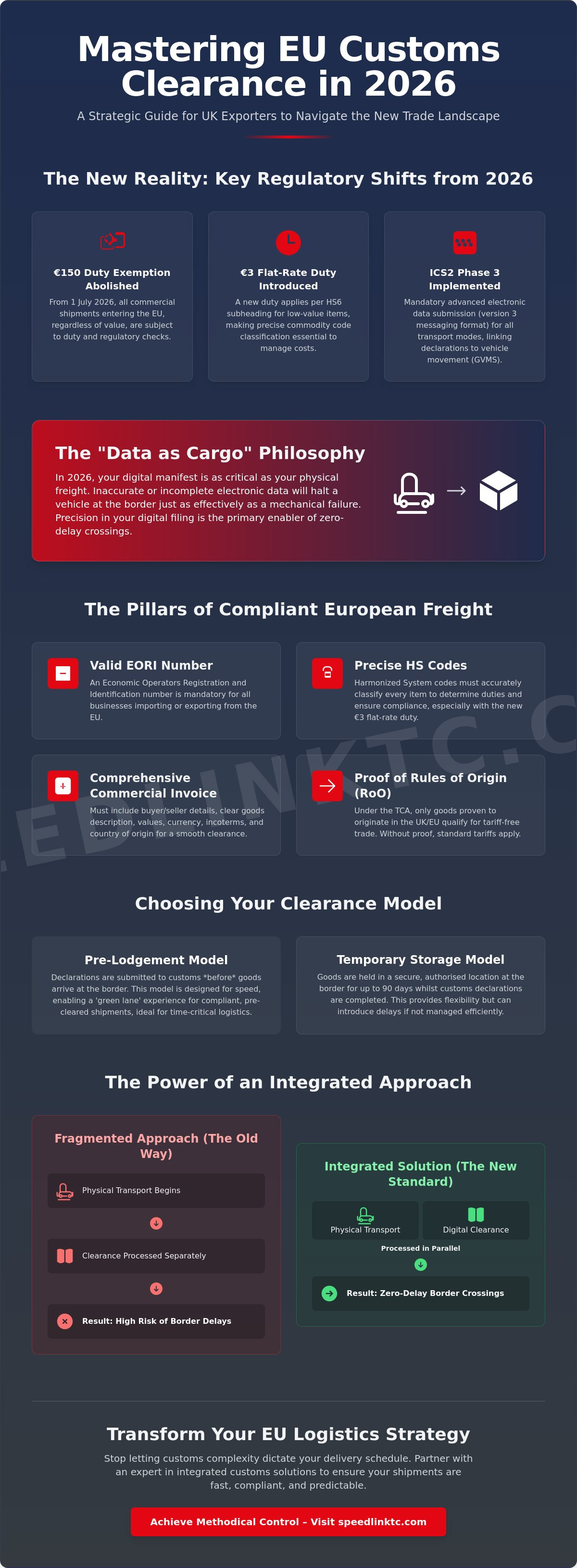
Effective EU shipping with customs clearance requires a shift in perspective. Your digital manifest is now as vital as the physical pallet it describes. This “Data as Cargo” philosophy means that errors in your electronic filing will halt a vehicle just as surely as a mechanical breakdown. Since the elimination of the €150 duty exemption on 1 July 2026, every item requires meticulous documentation to avoid immediate financial penalties at the border.
A compliant shipment relies on three pillars: a valid EORI number, precise HS Commodity Codes, and a comprehensive Commercial Invoice. The accuracy of your HS codes is particularly sensitive now that the EU applies a €3 duty per distinct HS6 subheading for low-value items. You must also provide clear evidence regarding the Rules of Origin (RoO). Under the Trade and Cooperation Agreement, only goods proven to originate in the UK or EU qualify for tariff-free movement. Without this proof, standard Common Customs Tariff rates apply, regardless of the shipment’s value.
The 2026 standard for digital declarations is defined by the Import Control System 2 (ICS2) Phase 3. Since 3 February 2026, all transport modes must use the version 3 messaging format. This data is fed into systems like the Goods Vehicle Movement Service (GVMS) to create a seamless link between customs declarations and the physical movement of goods. You can find a detailed breakdown of the necessary customs clearance documents and procedures through the European Commission’s official portal.
Specialist Logistics: Clearing Sensitive and High-Value Goods
Standard procedures often fall short when handling complex cargo. Our IT equipment courier service manages the additional layers of security and valuation required for sensitive electronics. These high-value assets often trigger more intensive inspections, making data precision even more critical to maintain speed.
Similarly, shipments involving dangerous goods, such as lithium batteries or hazardous chemicals, require specialised declarations and handling. These items are subject to strict safety regulations that must be reconciled with customs requirements before the vehicle reaches the port. If you are unsure how these 2026 regulations affect your specific product line, we recommend you reach out to our strategic consultants for a tailored compliance review.
Navigating the Customs Clearance Process: A Practical Strategy
A successful transit begins long before the vehicle arrives at your warehouse. The journey of a shipment in 2026 follows a rigid sequence: collection, digital pre-lodgement, border crossing, and final mile delivery. To maintain momentum, integrated EU shipping with customs clearance ensures that your digital declaration is submitted and accepted by the destination customs office whilst the goods are still in transit across the Channel.
Choosing the right clearance model is a strategic decision. For urgent business needs, the Pre-Lodgement model is almost always superior. It allows the haulier to link the customs declaration to the vehicle’s movement record through the Goods Vehicle Movement Service (GVMS) before reaching the port. This contrasts with the Temporary Storage model, where goods are held at an approved facility upon arrival whilst awaiting clearance. Whilst Temporary Storage offers more flexibility for complex inspections, it introduces a delay that time-critical logistics cannot afford.
Managing buyer expectations depends heavily on your choice of Incoterms. Using Delivered Duty Paid (DDP) means you, the seller, take full responsibility for all taxes and duties, providing a seamless experience for your EU customer. If you opt for Delivered at Place (DAP), the buyer must pay any VAT and duties before the goods are released. Misunderstandings here are a primary cause of border holds. Vague item descriptions or weight discrepancies between the commercial invoice and the physical manifest also trigger immediate inspections. Adhering to the latest EU Import Requirements is essential to avoid these common pitfalls.
Managing VAT and Duties in 2026
Cash flow management is vital when shipping into the Union. Postponed VAT Accounting (PVA) remains a powerful tool for UK businesses, allowing you to account for and recover import VAT on your periodic VAT return rather than paying it upfront at the border. This avoids tying up capital in tax payments whilst goods are moving. To ensure your financial planning remains accurate, we recommend using our checklist for international freight customs clearance to verify every requirement before dispatch. If you need to streamline your European trade routes, contact our logistics team for a consultation on your specific clearance strategy.
Why Integrated Customs Solutions are Vital for Express Logistics
Treating transport and border formalities as separate entities is the primary cause of express delivery failure in 2026. When a business hires a haulier but relies on an external broker, a communication gap inevitably opens. A single missing data point or a delay in document transmission can stall a vehicle at the port for hours. To maintain the pace required for time-critical movements, EU shipping with customs clearance must be executed as a unified, synchronised operation.
A dedicated European courier eliminates this friction by managing the document flow in parallel with the vehicle’s movement. This enables “wheels-up” or pre-arrival clearance, where the declaration is processed and accepted whilst the courier is still in transit. For urgent courier to Europe services, this integration isn’t just an advantage; it’s the difference between meeting a deadline and a total supply chain breakdown. We specialise in these high-stakes scenarios, providing the methodical control needed to move everything from high-value fine art to secure IT assets.
The SpeedLink Advantage: Expertise and Reliability
Our operational authority is built on the precision of our personnel. We utilise NPPV-cleared couriers to handle sensitive cross-border courier service UK requirements, ensuring that security and compliance are maintained at every stage. This level of vetting is essential for sectors where data integrity and physical security are non-negotiable. Whether you’re shipping critical engineering components or confidential legal documents, our integrated approach to EU shipping with customs clearance provides a reliable pathway through the complexities of 2026 trade. We invite you to consult with our customs services experts for a bespoke logistics audit to ensure your supply chain is fully optimised for the current regulatory environment.
Securing Your European Supply Chain for the Future
Navigating the post-2026 trade environment requires a fundamental shift from viewing customs as a hurdle to seeing it as a strategic component of your delivery speed. Success depends on the absolute accuracy of your digital manifests and a clear understanding of your legal liabilities under the Union Customs Code. By adopting an integrated approach to EU shipping with customs clearance, you eliminate the communication gaps that lead to costly border holds and unpredictable timelines.
Our infrastructure is designed to handle the most demanding logistics challenges with methodical precision. With our dedicated 24/7 European express network, NPPV-cleared couriers, and specialist dangerous goods handling, we provide the operational authority you need to trade with confidence. Whether you’re moving time-critical IT assets or high-value exhibition materials, we ensure your goods move across borders without friction or delay.
We’re ready to help you optimise your cross-border strategy and protect your bottom line from regulatory surprises. Get a Quote for EU Shipping with Integrated Customs Clearance and experience the reassurance of a partner who values reliability above all else. Your European expansion is within reach; let’s ensure it’s built on a foundation of compliant, high-performance logistics.
Frequently Asked Questions
How long does customs clearance take for EU shipping in 2026?
Customs clearance can be completed in minutes if you utilise a pre-lodgement model whilst the vehicle is in transit. By submitting digital declarations before the vehicle reaches the port, we ensure that the border crossing remains fluid. If you rely on temporary storage at the destination, the process typically extends to several hours or even days, depending on the volume at the specific customs office.
Do I need an EORI number for every EU shipment?
Yes, a valid Economic Operators Registration and Identification (EORI) number is mandatory for all commercial EU shipping with customs clearance. You must have a UK EORI number to export, and your customer must possess an EU EORI number to import the goods. Without these unique identifiers, customs authorities cannot process your declaration, leading to immediate rejection at the border.
What is the difference between direct and indirect customs representation?
Direct representation means the agent acts in your name and on your behalf, leaving you solely liable for duty payments and data accuracy. In contrast, indirect representation involves the agent acting in their own name but on your behalf, which creates joint and several liability. Most UK businesses without a physical EU establishment are required to use indirect representation when importing into the Union.
Can I ship lithium batteries to the EU with customs clearance?
We facilitate the movement of lithium batteries as part of our specialised dangerous goods courier service. These items require rigorous adherence to international transport regulations, including specific packaging, labelling, and safety declarations. When integrated with EU shipping with customs clearance, we ensure that all hazardous material documentation is perfectly aligned with customs manifests to prevent delays.
What happens if my goods are held at the EU border due to incorrect paperwork?
If your paperwork is found to be incorrect, customs authorities will halt the vehicle and move the goods into a secure holding area. This typically results in significant storage fees and may trigger a full physical inspection of the cargo. To resolve the hold, you’ll need to submit an amended declaration; this can cause delivery delays of several days and potential financial penalties.

Article by
Dave McMillen
I have worked in courier and logistics for over 30 years. My experience spans two continents and several types of services from road freight to airlines and specialist B2B services. SpeedLink has been serving the UK market for over 20 years providing the finest time critical and specialist services supporting businesses and individuals alike.


