


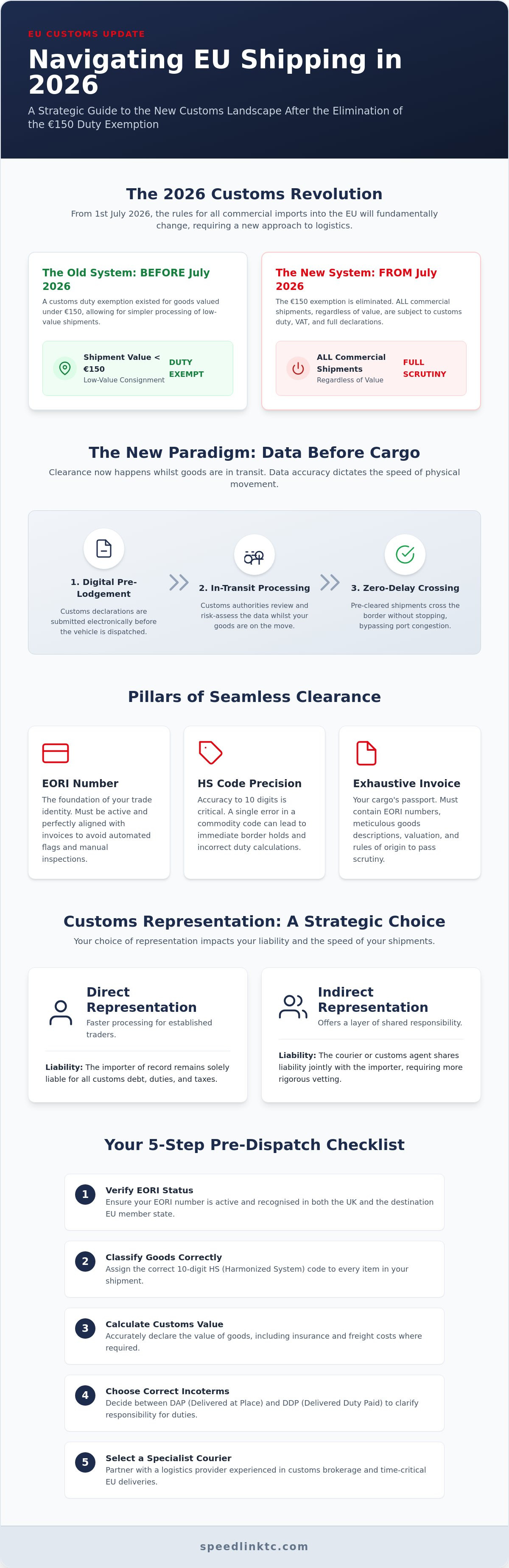
As of July 1, 2026, the elimination of the €150 customs duty exemption means that every commercial shipment entering the European Union now faces immediate fiscal and regulatory scrutiny. You likely understand the frustration of watching time-critical cargo sit idle at a border whilst paperwork is scrutinised or new EU Customs Reform policies are enforced. It is a high-stakes environment where a single data error leads to costly fines and broken supply chains. We have developed this strategic framework to help you master EU shipping with customs clearance, ensuring your deliveries move with the precision and speed your business requires. By integrating clearance into the transport movement itself, we provide the visibility and control necessary for zero-delay border crossings. This guide examines the transition to the €3 flat-rate duty for low-value items, the upcoming mandatory Product Identifier data requirements, and the methodical processes we use to maintain full regulatory compliance for your most urgent freight.
Key Takeaways
- Learn why treating transport and clearance as a single, unified operation is essential for maintaining predictable transit times under the 2026 EU regulations.
- Master the documentation requirements for the modern trade landscape, including the precise HS code classification needed to avoid administrative holds and fines.
- Discover how a pre-clearance model for EU shipping with customs clearance allows data to be processed whilst goods are in transit, effectively bypassing port congestion.
- Understand the strategic importance of your EORI number as the foundation of your trade identity and its role in facilitating seamless cross-border movements.
- Identify the criteria for selecting a logistics partner that can integrate complex handling requirements, such as dangerous goods, into a robust customs framework.
Understanding EU Shipping with Customs Clearance in 2026
Effective logistics within the European Union Customs Union no longer treats transport and administration as separate entities. In the current regulatory environment, EU shipping with customs clearance must be managed as a single, unified operation to prevent systemic delays. If the digital declaration is not synchronised with the physical movement of the vehicle, the shipment is effectively stationary before it even reaches the port. We view every movement as a data-led mission where the clearance process dictates the transport schedule, not the other way around.
Your Economic Operators Registration and Identification (EORI) number remains the foundation of this trade identity. It’s the primary key used by customs authorities to track your goods and assess your compliance levels. When we manage your shipments, we ensure that your EORI data is perfectly aligned with your commercial invoices to avoid the “mismatch flags” that trigger manual inspections.
Customs Representation is the legal framework through which a logistics partner acts on your behalf to fulfill statutory declarations and fiscal obligations. Choosing between direct and indirect representation is a strategic decision that impacts your liability and speed of movement. Under direct representation, the importer remains solely liable for the debt, which often allows for faster processing with established carriers. Conversely, indirect representation sees the courier share the liability, a path that requires more rigorous vetting but offers a layer of shared responsibility for complex or high-value movements.
The Shift from Documents to Data
By 2026, the industry consensus is clear: data is now the primary cargo. The arrival of digital pre-lodgement systems means that for express movements, the “clearance” often happens whilst the vehicle is still on the motorway. Accurate HS codes and origin declarations are non-negotiable. A single digit error in a commodity code can lead to an immediate border hold, as automated risk-profiling systems now scan declarations in milliseconds to identify anomalies before the goods arrive at the frontier.
Member State Nuances
Whilst the EU operates as a single market, local enforcement priorities can vary significantly between entry points. Authorities in France may focus heavily on sanitary and phytosanitary (SPS) checks, whilst German customs are renowned for their meticulous scrutiny of technical documentation and product safety standards. Our European same-day courier services are designed to navigate these regional differences, utilising specific ports and transit routes that align with the urgency and nature of your cargo.
Essential Documentation for Seamless Border Crossings
The commercial invoice acts as the definitive passport for your cargo. It must be exhaustive to withstand the scrutiny of 2026 border protocols. Beyond basic addresses, it requires your EORI number, a meticulous description of the goods, and a clear breakdown of the valuation. For a detailed overview of the legal standards required for entry, consult the official EU Import Requirements and Documentation. Precision here is the only way to avoid administrative holds that can derail time-critical schedules.
Accuracy in HS codes is where many businesses falter. Using a “close enough” classification often results in goods being held for manual inspection or being subject to incorrect duty rates. Authorities expect accuracy to at least six digits, though ten digits are often required for high-value items to ensure correct duty and VAT application. Rules of Origin are equally vital; you must be able to prove where your goods were manufactured to benefit from preferential trade agreements. If you are unsure about the specific certification or commodity codes required for your cargo, you can speak with our customs team for direct guidance.
A 5-Step Checklist for EU Export Preparation
Success in EU shipping with customs clearance depends on a methodical preparation process. We recommend following these steps before any vehicle is dispatched:
- Verify EORI status: Ensure your number is active and recognised in both the UK and the EU.
- Classify goods: Assign the correct 10-digit HS codes to every line item.
- Calculate Customs Value: Include insurance and freight costs where required by the valuation method.
- Choose Incoterms: Decide between DAP (Delivered at Place) and DDP (Delivered Duty Paid).
- Select a specialist courier: Choose a partner capable of handling both the physical transport and the digital declaration.
The choice of Incoterms is the most common cause of delivery confusion. Whilst DAP places the burden of import VAT and duty on the recipient, DDP allows the sender to assume these costs. Mismatched expectations here lead to refused deliveries and administrative gridlock at the final mile.
Managing High-Value Assets
When shipping IT equipment or sensitive hardware, the documentation must reflect the data-bearing nature of the assets. We utilise NPPV cleared couriers to maintain a secure chain of custody amongst EU states, ensuring that both the physical hardware and the internal data remain protected and compliant with local security protocols. Specialist certificates, such as CITES for fine art or ADR declarations for dangerous goods, must be appended to the primary declaration to ensure full regulatory alignment.
Time-Critical Logistics: Maintaining Speed in a Regulated Environment
Standard freight operations often struggle with the rigid queues of consolidated customs hubs where a single error in one merchant’s paperwork can delay an entire vehicle. In contrast, a dedicated courier service treats your cargo as a unique priority. This allows for bespoke routes that bypass the bottlenecks of general haulage. Mastering EU shipping with customs clearance requires more than just correct paperwork; it demands a proactive logistics strategy that anticipates delays before they occur. We utilise a “Pre-Clearance” model, submitting digital declarations whilst the vehicle is in transit to the port or Eurotunnel. This ensure that authorities have already processed the data before the wheels touch EU soil.
Handling items often deemed “unshippable” by standard carriers, such as dangerous goods and lithium batteries, requires even tighter integration. These movements demand additional layers of regulation found in the official EU customs clearance guide. We provide customs services and specialist advice to ensure these complex consignments are accompanied by the correct ADR declarations and UN-certified packaging. If you need to move sensitive or hazardous cargo across borders without delay, contact our specialist team today to discuss a tailored transport plan.
Express Clearance for Same-Day Deliveries
Urgent movements to Paris or industrial hubs in Germany rely on local knowledge of specific customs centres. For instance, navigating the Port of Calais requires an understanding of which lanes offer the fastest processing for pre-lodged declarations. We organise these movements with minimal friction by synchronising our drivers’ schedules with the digital release times of the French and German customs systems.
Mitigating the Risk of Border Holds
What happens when a shipment is flagged? Automated systems may trigger a hold for reasons as simple as a random spot check. Our 24/7 proactive monitoring ensures that if a flag occurs, we respond instantly. Maintaining a calm, methodical control during exception handling is essential. We act as your strategic advisor, communicating directly with customs officials to resolve queries and release the vehicle as quickly as possible.
Selecting Your Strategic EU Shipping Partner
Specialised handling is a key differentiator in this high-stakes environment. You must verify if a provider can not only transport dangerous goods or sensitive electronics but also navigate the specific clearance protocols they trigger. We offer a global capability that remains attentive to these nuances, ensuring that your requirements are handled by seasoned experts who value precision above all else. This collaborative approach transforms logistics from a potential bottleneck into a reliable competitive advantage.
Beyond the Border: Value-Added Services
Our expertise extends to niche requirements that standard carriers often avoid. We provide dedicated exhibitions and events logistics, ensuring that stands and technology are cleared and delivered to European trade shows without friction. For situations where the cargo is a single, vital piece of paper, our passport and legal document couriers offer a secure, hand-carried solution that bypasses the risks associated with traditional mail networks.
The Future of UK-EU Trade
As regulations continue to evolve, the advantage will stay with businesses that employ sophisticated logistics frameworks. The shift toward mandatory Product Identifier data and the elimination of duty exemptions means that data accuracy is no longer optional. We remain committed to proactive guideance, helping you adapt to these structural shifts before they impact your bottom line. To ensure your cargo moves with precision and speed, partner with SpeedLink for your next EU movement.
Securing Your Competitive Edge in European Trade
The logistics landscape of 2026 prioritises data precision and integrated operational control above all else. Success in EU shipping with customs clearance now depends on your ability to synchronise physical movements with digital declarations well before a vehicle reaches the frontier. By adopting a pre-clearance model and ensuring absolute accuracy in commodity classification, you eliminate the administrative friction that leads to costly border holds. We’ve built our reputation on managing these complexities with methodical precision, acting as a strategic advisor for businesses that cannot afford a break in their supply chain.
Our dedicated network provides urgent same-day and express delivery across Europe, supported by specialist handling for high-value IT equipment and fine art. We offer the expert customs advisory required to maintain post-Brexit compliance whilst ensuring your cargo remains secure and on schedule. Whether you’re moving sensitive electronics or exhibition materials, we provide the global capability and individual attention your mission requires. Consult our experts for your next EU shipment with customs clearance and ensure your trade operations remain resilient in this evolving regulatory environment.
Frequently Asked Questions
Do I still need an EORI number for EU shipping with customs clearance in 2026?
Yes, an Economic Operators Registration and Identification (EORI) number remains mandatory for any business involved in EU shipping with customs clearance. It serves as your unique identifier with customs authorities across all member states. Without a valid EORI number, your goods cannot be processed for export or import, leading to immediate border holds and potential administrative fines. It’s the primary key that links your physical cargo to your digital customs declarations.
What is the difference between direct and indirect customs representation?
The primary difference lies in legal liability for the customs debt and the accuracy of the declaration. Under direct representation, the courier acts in your name, but you remain solely responsible for the duties owed and any regulatory errors. In contrast, indirect representation involves the agent acting in their own name but on your behalf. This makes the agent jointly and severally liable for the debt, which usually requires a more rigorous financial vetting process for the client.
How long does customs clearance usually take for an express courier shipment?
Customs clearance for express movements is often completed in as little as 30 to 60 minutes if the digital data is pre-lodged whilst the vehicle is in transit. This speed relies entirely on the accuracy of your documentation and the absence of flags from automated risk profiling systems. If a shipment is selected for a manual inspection or if there are data mismatches, the process can extend to several hours or even days depending on the specific port’s congestion.
Can I ship lithium batteries to the EU with customs clearance?
What are the most common reasons for EU shipping delays at the border?
The most frequent causes of delay are inaccurate HS codes and missing or incorrect EORI data on the commercial invoice. Mismatched Incoterms, such as a sender choosing DAP when the recipient expects DDP, also cause significant friction as authorities wait for payment confirmation before releasing the goods. Digital data errors now trigger automated holds faster than ever, making meticulous preparation the only way to maintain transit speed and avoid broken supply chains.

Article by
Dave McMillen
I have worked in courier and logistics for over 30 years. My experience spans two continents and several types of services from road freight to airlines and specialist B2B services. SpeedLink has been serving the UK market for over 20 years providing the finest time critical and specialist services supporting businesses and individuals alike.
Disclaimer
Information is provided as general logistics guidance and is not legal, customs, aviation, medical or dangerous-goods compliance advice.
Rules vary according to commodity, quantity, classification, packaging, origin, destination, transport mode and carrier.
Regulations and carrier requirements may change.
Where regulated goods are involved, current requirements should be confirmed with the appropriate government authority, regulator, carrier or qualified specialist before shipment.
SpeedLink can confirm the transport options it can provide for a particular shipment.


