


What if the standard tracking link you rely on is actually masking a security “black hole” within a chaotic hub-and-spoke network? Most logistics managers understand the persistent anxiety of shipping irreplaceable assets, from sensitive IT hardware to critical legal documents, only to lose sight of them in a generic sorting centre. Choosing a high value goods courier isn’t just about speed; it’s about eliminating the variables that lead to data breaches or theft. We know that your internal security and insurance mandates demand more than a simple delivery confirmation.
This guide explains how to mitigate risk and ensure a non-broken chain of custody for your most valuable corporate assets using specialised, vetted protocols. We will explore the 2026 standards for NPPV clearance, the impact of new international customs regulations, and why dedicated transport is the only way to achieve true peace of mind during high-stakes transit. By the end of this article, you’ll understand how to align your logistics strategy with the rigorous audit requirements of a modern, secure supply chain.
Key Takeaways
- Identify the critical operational differences between standard parcel networks and a dedicated high value goods courier to eliminate security “black holes” in your supply chain.
- Recognise why Non-Police Personnel Vetting (NPPV) is the essential gold standard for securing sensitive legal documents and government assets in 2026.
- Master the protocols of a non-broken chain of custody to provide a continuous, auditable record for every high-stakes IT asset and server move.
- Apply a strategic evaluation checklist to select a logistics partner that offers the methodical control required for specialist fine art and dangerous goods transport.
Defining the Secure Standard for a High Value Goods Courier
A high value goods courier is defined as a specialist provider of protocol-driven, secure transport. Whilst standard premium delivery services often prioritise speed or convenience, a secure service focuses on maintaining a rigid Chain of Custody Protocols. This distinction is critical for corporate decision-makers who manage more than just a price tag. Monetary value is frequently only one factor; irreplaceable legal documents or prototypes carry a weight that insurance can’t mitigate. High-value logistics is the strategic management of risk through specialised handling and vetting.
Standard couriers often treat a high-value parcel as just another unit in a high-volume system. In contrast, a specialist high value goods courier treats every consignment as a unique mission requiring specific operational protocols. We understand it’s often the case that a data breach during hardware transit is more costly than the hardware itself, requiring a shift to proactive protection.
The Inherent Risks of Hub-and-Spoke Networks
Traditional parcel networks rely on a hub-and-spoke model that inherently increases the number of “touch points” for every consignment. Each time a parcel is moved from a local van to a regional sorting centre, and then onto a line-haul vehicle, the risk of loss or damage escalates. These multi-user environments are often chaotic and lack the oversight required for sensitive assets. In these systems, your assets are amongst thousands of unrelated items, making individualised attention impossible.
By contrast, we utilise a dedicated vehicle model to eliminate these vulnerabilities. SpeedLink’s same day courier services remove the threat of co-loading with residential parcels or low-priority freight. Our point-to-point approach ensures your assets remain under the constant supervision of a single, vetted professional, avoiding the “black holes” of misrouted sorting centres. This methodical control provides a level of security that sorting hubs simply can’t match.
Vetting and Compliance: Why NPPV Cleared Personnel are Essential
In the landscape of Secure B2B Logistics, the physical security of a vehicle is only as robust as the individual behind the wheel. For a high value goods courier, the Non-Police Personnel Vetting (NPPV) standard has emerged as the definitive gold standard in 2026. This framework ensures that personnel handling legal documents or government assets have undergone deep financial and criminal background checks. Since the UK Police Vetting Regulations were placed into formal legislation in June 2026, corporate insurance providers have increasingly made NPPV clearance a non-negotiable requirement for the transit of irreplaceable assets.
Ensuring Compliance in Corporate Audits
Adhering to these vetting standards allows organisations to pass stringent internal security audits whilst maintaining a transparent chain of custody. We implement strict driver verification at the point of collection, providing the peace of mind that only comes from knowing your high value goods courier is a seasoned professional, not a gig-economy worker. This methodical approach to driver selection is fundamental to how we operate. It’s often the case that a low-cost delivery model fails at the first hurdle of a corporate security mandate. For a more technical analysis of these requirements, our NPPV cleared courier service guide provides specific details on clearance levels. If you need to verify our current compliance status for an upcoming audit, you can enquire with our security desk to discuss your specific vetting needs.
Chain of Custody Protocols for High-Value IT and Legal Assets
A non-broken chain of custody is the continuous, documented record of possession from the moment of pick-up to the final delivery signature. For a high value goods courier, this protocol is the foundation of operational trust. By adopting security principles similar to the Customs-Trade Partnership Against Terrorism (C-TPAT), we ensure that every transfer is logged and every handler is verified. This level of scrutiny is vital for IT transport, where the loss of a single server or encrypted device can trigger catastrophic data breach penalties.
Our methodology relies on dedicated, point-to-point transport. It’s a system where your assets are never left unattended in a warehouse or co-loaded amongst unrelated freight. We provide real-time tracking and proactive communication, allowing you to monitor the exact location of your consignment at any stage. This visibility is not a luxury; it’s a requirement for high-stakes movements where delay or diversion is not an option. Every handover is recorded, creating a robust audit trail that satisfies both internal security and external regulatory demands.
Securing the Future of Remote Work: Laptop Courier Services
The rise of distributed teams has created significant logistical challenges for hardware returns and secure deployments. Specialised packaging and shock-resistant transport are non-negotiable for these delicate IT assets. Our IT equipment courier service guide details how we manage tech-refresh cycles with precision. We use custom-moulded transit cases to protect against physical damage whilst maintaining a strict security perimeter around the hardware. If you are planning a large-scale hardware deployment or need to secure a critical server move, contact our IT logistics team to discuss a tailored protocol for your assets.
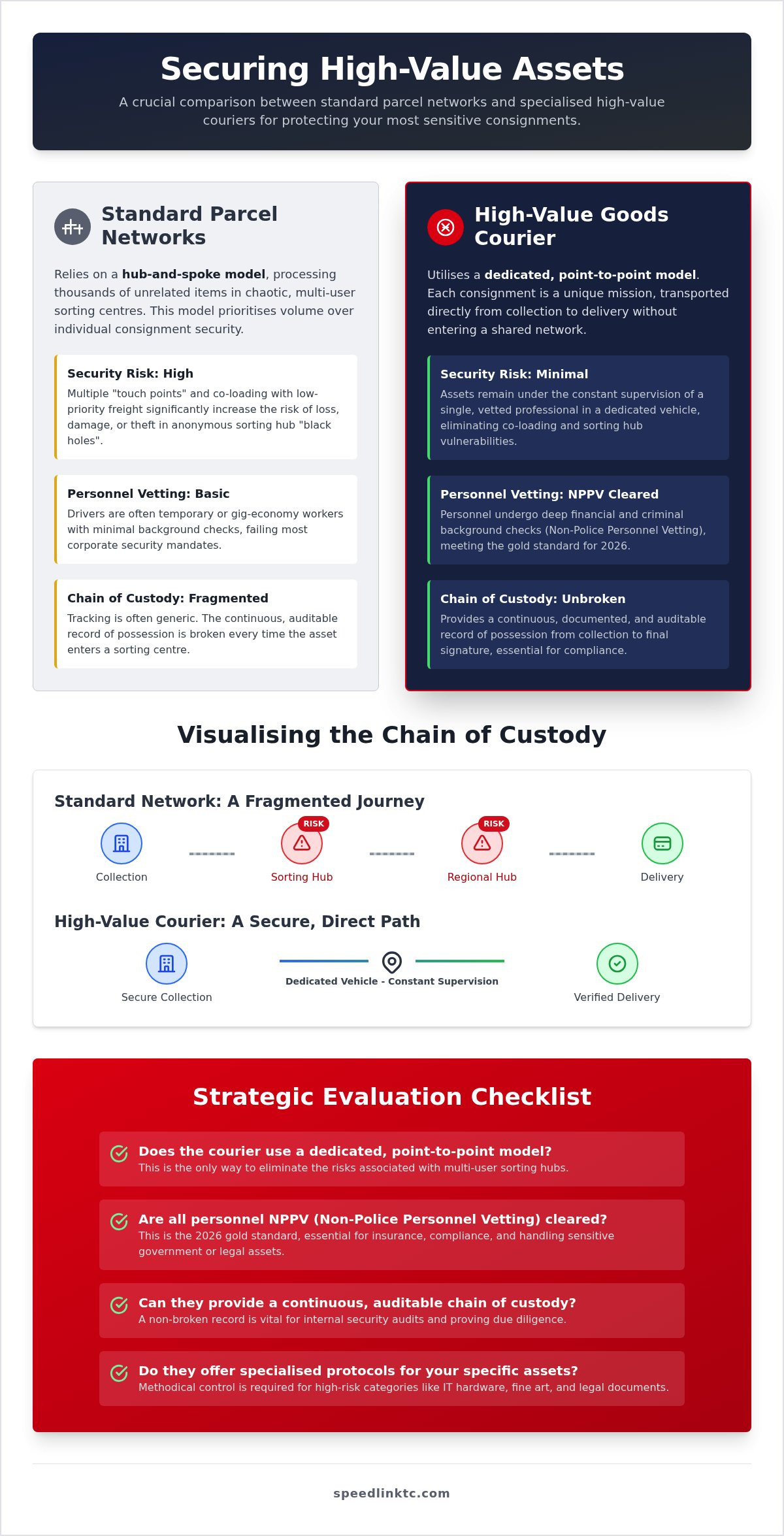
Selecting a Strategic Partner for Critical Asset Transport
- Does the provider guarantee a dedicated vehicle for every consignment to eliminate co-loading risks?
- Are all personnel vetted to NPPV standards, ensuring they’re cleared for sensitive legal and government work?
- Can they demonstrate a documented, non-broken chain of custody for every stage of the journey?
- Do they possess the technical expertise for specialised handling, such as lithium battery or museum-grade art protocols?
Designing Bespoke Security Protocols
Complex logistics projects, such as transporting museum-grade art or sensitive prototypes, require more than a standard delivery route. We organise tailored solutions that address the specific vulnerabilities of your cargo. Our process begins with a thorough risk assessment to design custom security protocols that meet your internal mandates. Whether you’re managing a multi-site tech refresh or a single international movement, requesting a secure quote is the first step toward operational peace of mind. Designing these bespoke protocols is what sets a premier high value goods courier apart from generic logistics firms. We encourage proactive engagement with our experts to ensure every variable is controlled. You can contact SpeedLink to discuss your high-value security requirements and receive a technical proposal tailored to your specific assets.
Securing Your Corporate Future with Methodical Precision
Protecting your organisation’s most sensitive assets requires a decisive move away from the structural risks of traditional parcel networks. By prioritising NPPV-cleared drivers and dedicated point-to-point transport, you eliminate the vulnerabilities inherent in multi-user sorting centres. We’ve established that a documented, non-broken chain of custody is no longer a luxury but a fundamental requirement for modern corporate audits and insurance mandates. Whether you’re managing complex tech refreshes or transporting irreplaceable legal documents, the right high value goods courier acts as a strategic guardian of your operational integrity.
Our team provides the specialist expertise required for the IT, Legal, and Fine Art sectors, ensuring that every movement is handled with methodical precision and absolute control. If you’re ready to secure your supply chain and achieve total peace of mind, it’s time to partner with an authority in high-stakes logistics. You can request a secure quote for high-value goods transport from SpeedLink to begin designing your custom security protocol. We look forward to helping you safeguard your most critical assets.
Frequently Asked Questions
What is the difference between a standard courier and a secure courier service?
A secure service prioritises a non-broken chain of custody over the volume-driven hub-and-spoke models used by standard providers. Whilst standard couriers often co-load items with unrelated freight in sorting centres, a secure high value goods courier utilises dedicated vehicles and vetted personnel. This approach eliminates the structural risks of multi-user networks, ensuring your assets remain under constant supervision to meet strict insurance or internal security mandates.
Does a high value goods courier provide NPPV-cleared drivers for all deliveries?
We provide NPPV-cleared drivers specifically for consignments requiring this level of security, such as sensitive government assets or court documents. Non-Police Personnel Vetting is the industry standard for verifying the background of individuals handling high-stakes items. If your internal compliance or insurance policy mandates a vetted professional, we ensure the driver assigned to your dedicated vehicle meets these exact legislative and security requirements for 2026.
How does a dedicated vehicle improve the security of my high-value IT equipment?
A dedicated vehicle ensures your high-value IT equipment travels point-to-point without the risk of co-loading with unrelated freight. This eliminates the need for sorting centres or third-party warehousing, where hardware is most vulnerable to theft or data breaches. By maintaining a single point of custody from collection to delivery, we provide a secure environment that protects delicate servers and laptops from the physical risks found in multi-user networks.
Can I track my high-value shipment in real-time during the entire transit process?
Yes, real-time tracking is a fundamental component of our secure logistics protocol for every high value goods courier mission. We provide constant visibility into the vehicle’s location and transit status, allowing you to monitor the movement of your assets from pick-up to final signature. This proactive communication ensures that you’re always informed, providing the documented audit trail necessary for high-stakes corporate movements and sensitive hardware deployments.
What are the specific protocols for transporting sensitive legal or court documents?
Transporting sensitive legal documents requires a rigid protocol involving NPPV-cleared personnel and a dedicated vehicle to prevent loss or unauthorised access. We implement a strict handover procedure where the identity of the recipient is verified against pre-agreed instructions. This ensures a non-broken chain of custody, meeting the specific 2026 vetting standards required for court document transport and protecting irreplaceable files from the vulnerabilities of standard postal networks.

Article by
Dave McMillen
I have worked in courier and logistics for over 30 years. My experience spans two continents and several types of services from road freight to airlines and specialist B2B services. SpeedLink has been serving the UK market for over 20 years providing the finest time critical and specialist services supporting businesses and individuals alike.
Disclaimer
Information is provided as general logistics guidance and is not legal, customs, aviation, medical or dangerous-goods compliance advice.
Rules vary according to commodity, quantity, classification, packaging, origin, destination, transport mode and carrier.
Regulations and carrier requirements may change.
Where regulated goods are involved, current requirements should be confirmed with the appropriate government authority, regulator, carrier or qualified specialist before shipment.
SpeedLink can confirm the transport options it can provide for a particular shipment.


