


What if the most sophisticated encryption in your corporate network is rendered entirely useless by a single unvetted handoff during hardware transit? It’s a sobering thought for any professional managing high-value assets, especially when standard courier networks often lack the secure chain of custody tracking required for true peace of mind. You likely recognise that a digital log is only as reliable as the physical security supporting it, and the risk of a broken audit trail or a lost document can have devastating legal consequences.
This guide will show you how to master the principles of physical chain of custody to protect your sensitive assets and ensure absolute legal compliance. We’ll examine how to eliminate transit risks by utilising vetted professionals and dedicated transport, whilst navigating the latest regulatory updates like the FBI’s CJIS Security Policy version 6.0. By the end of this article, you’ll understand how to build a bulletproof audit trail that provides full visibility from the moment of collection to the point of delivery.
Key Takeaways
- Understand why secure chain of custody tracking is the essential physical counterpart to your digital security protocols, ensuring assets remain protected through every handoff.
- Learn why NPPV-cleared personnel and dedicated vehicle transit are non-negotiable standards for eliminating co-loading risks and unauthorised access.
- Identify the “Handover Gap” and other critical points where standard courier networks often fail, leaving your sensitive data and legal evidence vulnerable.
- Master the creation of a bulletproof audit trail that satisfies internal compliance and provides full visibility from collection to final delivery.
- Discover a strategic framework for classifying assets based on sensitivity to determine the precise level of security and courier vetting required for your mission.
What is Secure Chain of Custody Tracking in Physical Logistics?
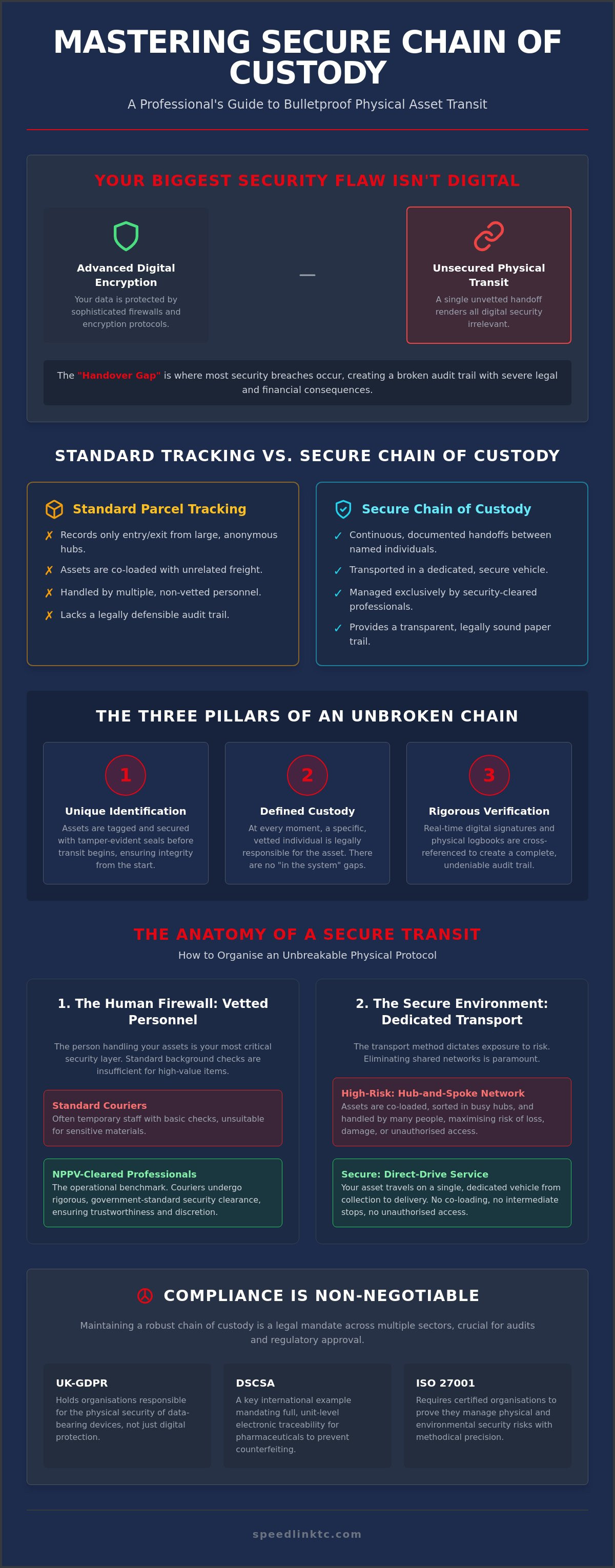
In the context of high-stakes logistics, secure chain of custody tracking represents the definitive chronological documentation that records every stage of an asset’s journey. It encompasses the seizure, custody, control, transfer, and eventual analysis of physical items, providing a transparent paper trail that stands up to legal scrutiny. Whilst many organisations invest heavily in cybersecurity, they often overlook the physical “missing link.” If a server containing sensitive data is intercepted during transit, your firewall becomes irrelevant. Physical security must be the foundation of your data protection strategy.
To complement these physical measures with a reliable digital solution for your sensitive documents, you can discover byNow – Secure document exchange and delivery platform for a robust alternative to traditional registered mail.
There’s a fundamental distinction between standard parcel tracking and a formal Chain of custody. Standard tracking merely records a package entering or leaving a distribution hub amongst thousands of other parcels. In contrast, secure tracking ensures a continuous, documented handoff between vetted individuals. This level of rigour is essential for sectors like legal services handling evidence, life sciences managing clinical samples, and IT departments moving encrypted hardware. Without it, the integrity of the asset is permanently compromised the moment it leaves your sight.
The Core Components of an Unbroken Chain
To maintain absolute integrity, three pillars are required. First, unique identification through tamper-evident seals and asset tagging must occur before the item leaves your facility. Second, custody must be clearly defined; at no point should the asset be “in the system” without a specific individual being legally responsible for it. Finally, verification requires a dual-layered approach where real-time digital signatures are cross-referenced with physical logbooks to ensure no gaps exist in the timeline. This methodical control prevents the “Handover Gap” where most security breaches occur.
Legal and Regulatory Drivers in 2026
Compliance isn’t just a best practice; it’s a legal mandate. Under UK-GDPR, the physical security of data-bearing devices is just as critical as digital encryption. For those in pharmaceuticals, the Drug Supply Chain Security Act (DSCSA) requires full, unit-level electronic traceability for all prescription drugs by the November 2026 deadline. Maintaining a robust secure chain of custody tracking protocol is also a prerequisite for meeting ISO 27001 standards, proving that your organisation manages physical risks with the same methodical precision as your digital infrastructure.
The Anatomy of a Secure Transit: How to Organise an Unbroken Chain
While software provides a digital log, the physical integrity of your assets depends entirely on the human element and the vehicle used. Implementing secure chain of custody tracking requires more than just a barcode scan; it demands a rigid protocol that governs the entire transit environment. We focus on two critical vectors: the vetting of the individuals involved and the exclusivity of the transport method.
The Role of Vetted Couriers
Dedicated Transport vs. Multi-Drop Networks
Most logistical failures occur in the “hub and spoke” model, where items are sorted, co-loaded with unrelated freight, and handled by multiple parties. This environment is where securing chain of custody often breaks down due to unauthorised access or misrouting. By opting for a direct-drive service, you eliminate these risks. Your assets stay on a single, dedicated vehicle from collection to delivery, with zero intermediate stops.
This physical isolation is reinforced by tamper-evident packaging and high-security seals. Modern telematics allow us to monitor every mile in real-time, providing more than just a “delivered” notification. We track the exact path and stops of the vehicle, ensuring full transparency. If you’re ready to enhance your secure chain of custody tracking for your next high-value movement, speak with our strategic advisors to discuss a tailored protocol.
Identifying Risks: Where Most Chain of Custody Protocols Fail
Even the most robust security policies often crumble during the “Handover Gap.” This specific moment occurs when responsibility for an asset transfers between parties; it’s where miscommunication and procedural lapses are most frequent. Standard courier networks exacerbate this risk by prioritising volume over individual asset integrity. When a driver handles dozens of drops, they may leave a vehicle unattended for several minutes. This brief window is all an opportunist needs to compromise a shipment, yet standard secure chain of custody tracking in retail networks rarely accounts for these micro-lapses in physical control.
Another critical failure point is the “blind spot” inherent in hub-and-spoke sorting centres. Once your parcel enters a massive automated facility, its status often shifts to a generic “processing” phase. During this time, the item is out of sight and potentially handled by multiple unvetted staff members. To mitigate the risk of internal tampering or theft, we implement dual-sign-off procedures. This ensures that no single individual has unmonitored access to the asset, creating a layer of internal accountability that standard logistics providers simply cannot match.
The Danger of Co-Loading Sensitive Assets
Sensitive shipments should never share space with general retail freight. Whether you’re moving dangerous goods or high-value electronics, co-loading introduces the threat of cross-contamination or accidental damage from shifting cargo. If a nearby liquid container leaks, it can destroy the physical integrity of your chain. Dedicated transport is the only way to ensure your assets remain isolated and protected from the unpredictable behaviour of other freight.
Inadequate Documentation and Audit Trails
Generic proof of delivery (POD) signatures are insufficient in a legal or forensic environment. They don’t provide the granular detail required for rigorous evidence documentation, which must account for every second of the journey. For high-value IT transport, a time-stamped, person-to-person handover is the only acceptable standard. This level of precision ensures that your secure chain of custody tracking remains unbroken and legally defensible. To protect your assets from these common failure points, contact our specialist team today to arrange a dedicated, secure transit solution.
Implementing a Secure Strategy: A Framework for Corporate Managers
Developing a robust secure chain of custody tracking protocol requires a methodical, four-step framework. Corporate managers must move beyond reactive logistics and adopt a proactive stance that treats every movement as a potential security event. By following this structured approach, you can ensure that your high-stakes assets remain protected from the moment of collection to final delivery.
- Step 1: Asset Classification. Categorise your physical assets based on their sensitivity and the potential financial or legal cost of a breach. High-stakes items require a dedicated vehicle and vetted personnel as a baseline.
- Step 2: Define Vetting Standards. Establish a “Minimum Acceptable Standard” for all courier personnel. For the highest security levels, NPPV3 clearance should be the non-negotiable requirement for anyone handling the shipment.
- Step 3: Software Integration. Integrate your logistics data directly into your internal risk management and audit software. This allows for real-time compliance monitoring and easier reporting during regulatory reviews.
- Step 4: Continuous Auditing. Regularly audit your logistics partners. Conduct site inspections or utilise “test shipments” to verify that security protocols are strictly followed under all conditions.
Choosing the Right Logistics Partner
Selecting a partner is a strategic decision that affects your entire risk profile. You should prioritise providers with essential certifications, such as ADR for hazardous goods, NPPV for security-cleared personnel, and ISO for quality management. Communication is equally vital; you must ensure the provider offers 24/7 access to a dedicated controller. If a challenge arises at 3 AM, you need immediate answers, not an automated voicemail. Explore our secure courier services for your most business-critical requirements.
Future-Proofing Your Chain of Custody for 2026
The landscape of secure chain of custody tracking is evolving with the rise of IoT-enabled smart locks and environmental sensors that monitor light, tilt, and temperature. These devices provide an immediate alert if a package is opened or mishandled. To see how these innovations are applied to high-value assets, you can learn more about Letstrack and their advanced GPS solutions. Additionally, blockchain-based ledgers are creating “digital twins” of physical shipments, providing an immutable record of every handoff. SpeedLink integrates these technologies into same day courier workflows, ensuring that every movement is backed by real-time telemetry and precise digital records. This combination of physical rigour and digital innovation represents the future of high-stakes logistics.
Fortifying Your Operational Integrity Through Precision Logistics
Our approach eliminates uncertainty by utilising NPPV cleared personnel and dedicated direct-drive vehicles. This ensures that high-value IT and legal assets receive the specialist handling they require, with zero intermediate stops or unvetted handoffs. If you’re ready to transition from standard delivery to an unbroken chain of custody, we’re here to guide the process. Request a Secure Logistics Consultation with SpeedLink today to discuss a tailored solution for your high-stakes movements. Your critical assets are in safe hands.
Frequently Asked Questions
What is the difference between a secure chain of custody and standard tracking?
Standard tracking relies on automated scans at massive distribution hubs where your parcel is one amongst thousands of others. In contrast, secure chain of custody tracking ensures that a specific, vetted individual is legally responsible for your asset at every stage of the journey. We eliminate the vulnerabilities of sorting centres by using dedicated vehicles and person-to-person handovers, providing a legally defensible audit trail that standard courier networks cannot replicate.
Why is NPPV clearance important for couriers handling sensitive data?
NPPV clearance is the gold standard for verifying the integrity of individuals handling sensitive data or high-value assets. It involves rigorous background checks conducted to police standards, ensuring couriers are suitable for roles involving access to restricted information or secure sites. When we deploy NPPV-cleared personnel, we mitigate the risk of internal theft or data breaches, providing you with absolute confidence in the professional handling your mission-critical hardware.
How do I maintain a chain of custody for international shipments to the EU?
Maintaining continuity across borders requires a partner who manages both the physical transit and the complex customs clearance process. We use dedicated direct-drive vehicles for EU shipments to ensure your assets never leave our control at a third-party sorting facility. By handling all customs documentation internally, we prevent the “Handover Gap” at the border, ensuring the chain remains unbroken and visible from the UK to any European destination.
What should I do if a chain of custody is broken during transit?
If you suspect a breach, you must immediately secure the asset and conduct a comprehensive audit of the physical and digital logs. Identify exactly where the documentation gap occurred and which individual had last recorded custody. We recommend using tamper-evident seals from the outset; if a seal is compromised, it serves as immediate physical evidence that requires an internal investigation and a formal report to your compliance department.
Can I use secure chain of custody for dangerous goods or lithium batteries?
Yes, we provide specialised handling for secure chain of custody tracking involving dangerous goods and lithium batteries. These shipments require ADR-trained couriers and vehicles equipped for hazardous materials to ensure safety and regulatory compliance. Combining high-security protocols with specialist transport prevents accidental damage or unauthorised access, ensuring that even the most volatile assets reach their destination without their physical integrity being compromised during the journey.

Article by
Dave McMillen
I have worked in courier and logistics for over 30 years. My experience spans two continents and several types of services from road freight to airlines and specialist B2B services. SpeedLink has been serving the UK market for over 20 years providing the finest time critical and specialist services supporting businesses and individuals alike.
Disclaimer
Information is provided as general logistics guidance and is not legal, customs, aviation, medical or dangerous-goods compliance advice.
Rules vary according to commodity, quantity, classification, packaging, origin, destination, transport mode and carrier.
Regulations and carrier requirements may change.
Where regulated goods are involved, current requirements should be confirmed with the appropriate government authority, regulator, carrier or qualified specialist before shipment.
SpeedLink can confirm the transport options it can provide for a particular shipment.


