


In 2026, treating the transport of power cells as a standard freight exercise is no longer just a risk; it’s a guaranteed route to regulatory failure and significant financial penalties. Shipping lithium batteries internationally has become a complex minefield of diverging UK and EU standards, whilst the mandatory 30% State of Charge (SoC) requirement for air freight has transformed from a best practice into an uncompromising law. You likely recognise that a single documentation error or packaging oversight can halt a time-critical supply chain, leaving urgent projects in limbo and exposing your organisation to liability.
We are here to ensure that never happens. This specialist guide provides the operational authority you need to master these complexities, ensuring your cargo meets every IATA and IMDG requirement whilst maintaining the precision your operations demand. We will examine the critical 2026 regulatory updates, specialised packaging protocols, and the expert B2B courier solutions that guarantee 100% compliance and secure transit for your global shipments. By the end of this guide, you will have a clear, methodical framework for managing even the most sensitive lithium battery consignments with absolute confidence.
Key Takeaways
- Identify the essential differences between Lithium Ion and Lithium Metal classifications to select the correct UN number for your consignment.
- Implement safety-first packaging protocols for shipping lithium batteries internationally to mitigate fire risks and meet UN-specification standards.
- Streamline your post-Brexit supply chain by mastering the specific EORI and HS code requirements for seamless EU customs clearance.
- Utilise ADR-trained personnel and dedicated chain-of-custody solutions to protect time-critical components from the risks of multi-hub trans-shipment.
Classification and Regulations for Shipping Lithium Batteries Internationally
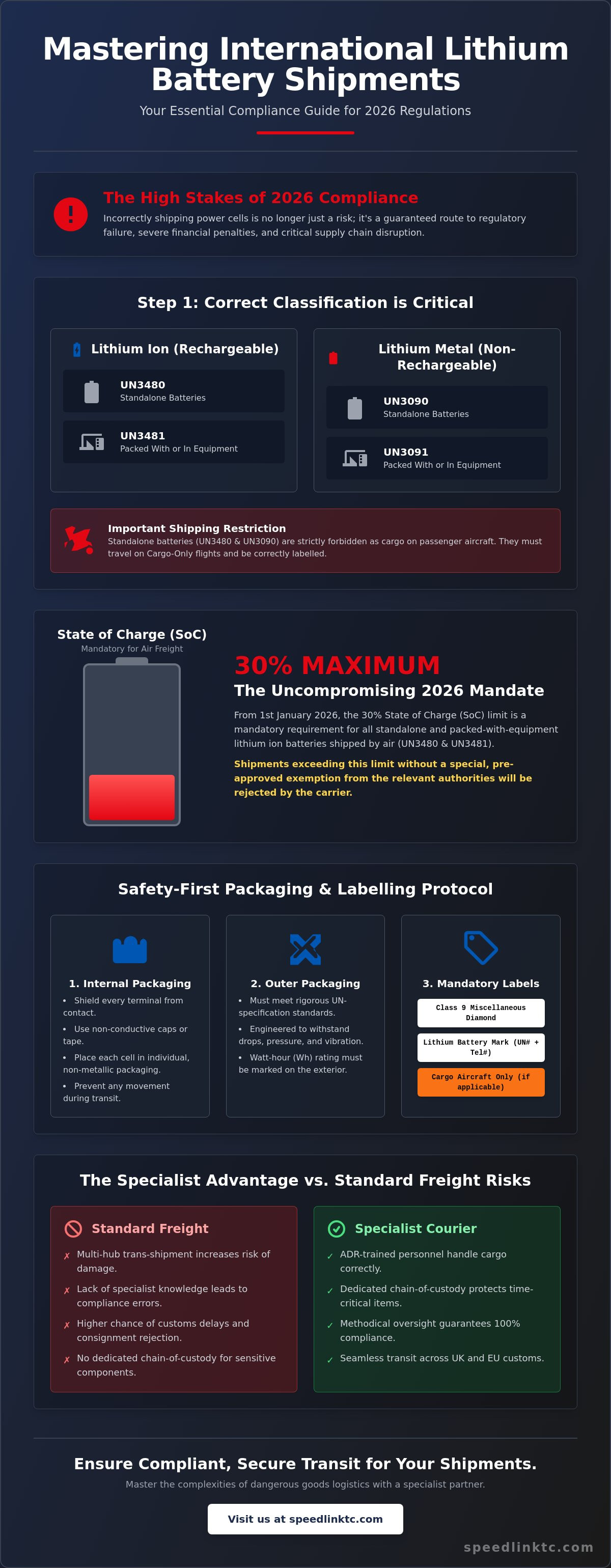
Correct classification is the first step when shipping lithium batteries internationally, as it determines the packaging, labelling, and carrier options available to you. Lithium batteries are legally defined as Class 9 Miscellaneous Dangerous Goods because they pose a significant fire risk if they’re damaged or incorrectly handled. We categorise these power sources into two primary types: Lithium Ion (rechargeable) and Lithium Metal (non-rechargeable). Each chemistry carries a distinct risk profile, necessitating specific UN numbers to guide handlers through the Classification and Regulations for Shipping framework.
Your documentation must accurately reflect one of the following four identifiers:
- UN3480: Lithium ion batteries shipped as standalone units.
- UN3481: Lithium ion batteries contained in or packed with equipment.
- UN3090: Lithium metal batteries shipped as standalone units.
- UN3091: Lithium metal batteries contained in or packed with equipment.
The regulatory landscape is overseen by IATA for air freight, the ADR for road transport across Europe, and the IMDG Code for sea transit. If you require assistance with these technical distinctions, our Dangerous Goods Courier team provides the methodical oversight necessary to keep your cargo moving. The Watt-hour (Wh) rating of a battery dictates the level of regulatory stringency, with higher-capacity cells requiring more complex UN-specification packaging and documentation.
This regulatory complexity is a daily reality for businesses like Bikeline that manage the distribution of high-performance e-bikes, where large-capacity lithium power units must meet stringent safety criteria before being cleared for international or regional transport.
The ‘In’, ‘With’, or ‘Alone’ Rule
The physical configuration of your shipment changes the rules. UN3481 and UN3091 designations (batteries in or with equipment) often face fewer restrictions because the device housing provides a layer of physical protection against short circuits. In contrast, standalone cells (UN3480 and UN3090) are strictly forbidden as cargo on passenger aircraft. These must travel on cargo-only flights and be marked with the “Cargo Aircraft Only” label to ensure safety protocols are maintained throughout the journey.
2026 State of Charge (SoC) Requirements
As of 1 January 2026, the 30% State of Charge (SoC) limit is no longer a suggestion for air freight; it’s a mandatory requirement for both standalone batteries (UN3480) and those packed with equipment (UN3481). This update to the IATA Dangerous Goods Regulations means that any battery exceeding 30% of its rated capacity will be rejected by the carrier unless you hold a special permit. We work closely with our clients to verify SoC levels before transit, ensuring that shipping lithium batteries internationally remains a seamless process without terminal rejections.
Safety-First Packaging and Labelling for International Transit
Thermal runaway remains the primary safety concern when shipping lithium batteries internationally. To prevent this, your internal packaging must ensure that every terminal is shielded from contact with other batteries or conductive surfaces. You should use non-conductive caps, recessed terminals, or high-quality insulation tape to secure every connection point, whilst ensuring each cell is placed in an individual, non-metallic inner packaging to prevent movement during transit.
Outer packaging must meet rigorous UN-specification standards for high-capacity cells. These containers are specifically engineered and tested to withstand drop heights, stacking pressure, and atmospheric changes. If your consignments move through North American hubs, you must also align with US Shipping Regulations, which require the watt-hour rating to be clearly marked on the exterior casing of each battery. Our Dangerous Goods Courier service ensures every layer of your packaging meets these exacting global standards.
Labels serve as the vital communication link between your cargo and the personnel handling it. A compliant shipment requires:
- Class 9 Miscellaneous Diamond: Identifies the specific hazard class.
- Lithium Battery Mark: Displays the UN number and a contact telephone number.
- Cargo Aircraft Only (CAO): Mandatory for standalone batteries forbidden on passenger planes.
Documentation acts as the legal backbone for shipping lithium batteries internationally. You must provide a valid Safety Data Sheet (SDS) and a completed Dangerous Goods Note (DGN). Unlike standard freight, international road transit under ADR rules requires a DGN that details the precise net weight and UN number of the batteries. If you are unsure about the documentation required for your specific route, you can speak with our compliance team for direct assistance.
Mitigating Thermal Runaway Risks
High-value battery prototypes or damaged cells often require more than standard protective layers. We recommend using dedicated vehicles to avoid the vibrations and shocks associated with multi-hub trans-shipment. Use non-combustible, non-conductive cushioning materials like vermiculite or specialised fire-retardant foams. These materials don’t just prevent physical damage; they provide a thermal buffer that can contain a localised cell failure before it escalates into a full-scale fire.
Navigating International Customs and Post-Brexit Logistics
In 2026, the regulatory divergence between the UK and the EU has created a high-stakes environment for hazardous goods transport. UK businesses face specific friction points when moving power components across the channel, particularly as the EU’s Battery Regulation (EU 2023/1542) introduces stricter lifecycle and documentation requirements. To maintain a fluid supply chain, your EORI number must be active and your Harmonised System (HS) codes must be surgically precise. Misidentifying a lithium-ion component doesn’t just invite a paperwork query; it often leads to a full safety quarantine at the border.
Specialist customs clearance services provide the operational buffer necessary to prevent your consignments from becoming stranded in bonded warehouses. When hazardous goods are held due to clerical errors, the associated storage fees and project delays can be catastrophic. We frequently advise our B2B partners to utilise the ‘Delivered Duty Paid’ (DDP) incoterm for urgent deliveries. By assuming responsibility for all duties and taxes at the point of origin, you ensure your client receives their components without administrative delays or unexpected costs at the destination.
Whilst road movements are governed by ADR, any leg of the journey involving air transit must comply with the IATA Dangerous Goods Regulations. These standards represent the most rigorous compliance framework in the logistics industry. Ensuring your digital “battery passport” and safety declarations align with these global benchmarks is essential for shipping lithium batteries internationally without facing border rejections. If you’re navigating complex cross-border requirements for the first time, contact our international logistics team to secure a compliant clearance strategy.
Managing Time-Critical International Freight
Integrating European same-day courier solutions with hazardous goods compliance allows for unparalleled speed in high-pressure sectors. For cross-border battery movements within Europe, dedicated vehicles often prove superior to air freight. A dedicated vehicle bypasses the mandatory 30% State of Charge air restrictions and avoids the bottleneck of “Cargo Aircraft Only” airport processing. This method provides a secure, door-to-door chain of custody that is often the fastest way of shipping lithium batteries internationally whilst maintaining total methodical control over the environment.
The Specialist Advantage: Why Dedicated Battery Couriers Outperform Standard Freight
Standard freight networks, which often utilise LTL shipping models (as detailed by delgate.com), operate on a hub-and-spoke system that prioritises volume over the specific requirements of sensitive cargo. When shipping lithium batteries internationally, this approach exposes cells to unnecessary vibration and multiple handling points during trans-shipment. We replace this risk with a direct ‘Chain of Custody’ model. By using dedicated vehicles, we ensure your batteries aren’t co-loaded with incompatible materials or subjected to the shocks of automated sorting centres. This methodical control is the only way to guarantee the physical integrity of high-capacity power units.
Our operational authority is built on the expertise of our ADR-trained personnel. These handlers don’t just move boxes; they understand the thermal characteristics of lithium chemistry and the strict documentation required for border passage. For sensitive sectors like defence or aerospace, we provide NPPV-cleared drivers and real-time GPS monitoring to secure high-value assets. This positions us as the definitive partner for your dangerous goods courier needs, offering a level of security that standard freight providers cannot match.
Choosing a specialist partner provides several distinct benefits:
- Direct Transit: Eliminating multi-hub transfers reduces the risk of physical damage.
- Technical Expertise: Handlers are trained to recognise and manage thermal runaway risks.
- Regulatory Precision: Every shipment is double-checked for 2026 SoC and labelling compliance.
- Enhanced Security: NPPV clearance ensures your high-value IT and engineering assets are protected.
Choosing the Right Service Level
Deciding between international same-day and express freight depends on your project’s specific pressure points. Same-day solutions are essential when a missed window means a halted production line or a failed exhibition launch. These dedicated routes provide the fastest possible transit for shipping lithium batteries internationally by eliminating the wait times associated with scheduled freight departures. We act as a strategic advisor to help you select the service level that balances urgency with cost-efficiency.
Specialist Handling for IT Equipment Transport
Specialist expertise is also required for IT equipment transport where batteries are pre-installed within laptops or servers. Whilst the equipment housing offers physical protection, the cumulative heat generated in a bulk shipment requires careful management. We apply the same disciplined efficiency to these movements, ensuring that every piece of hardware is handled with the strategic thinking necessary to prevent damage and ensure immediate deployment upon arrival.
Securing Your Global Battery Supply Chain
Mastering the logistics of power components requires more than just following a checklist; it demands a proactive approach to evolving global standards. We’ve seen how the 2026 State of Charge mandates and precise UN classification form the foundation of a compliant journey. By prioritising specialised packaging and methodical customs preparation, you protect your organisation from the operational and financial risks associated with rejected cargo or border delays.
When you’re shipping lithium batteries internationally, the choice of partner determines the resilience of your supply chain. We provide the operational authority needed to navigate these high-stakes movements, offering ADR-qualified specialist drivers and full customs clearance support for UK-EU transit. Whether you require dedicated vehicle options for high-value power cells or expert guidance on IATA compliance, we’re ready to manage your mission-critical consignments with total precision.
Request a specialist quote for your international battery shipment today to ensure your components arrive safely and on schedule. We look forward to facilitating your next successful delivery.
Frequently Asked Questions
Can I ship lithium batteries internationally via standard air mail?
No, you cannot ship standalone lithium batteries internationally via standard air mail. Most postal services strictly prohibit these items because they pose a significant fire risk in aircraft holds. Whilst small batteries contained within equipment are sometimes permitted under very specific quantity and weight limits, commercial consignments must travel via specialist dangerous goods couriers to ensure full compliance with IATA safety protocols.
What is the maximum Watt-hour limit for shipping lithium-ion batteries by air?
The threshold for fully regulated shipping is typically 100 Watt-hours (Wh) for a battery and 20 Wh for a single cell. If your battery exceeds these limits, it’s classified as a fully regulated Class 9 dangerous good, necessitating UN-specification packaging and comprehensive documentation. Correctly calculating the Wh rating is essential for shipping lithium batteries internationally without facing carrier rejections at the terminal.
Do I need a special licence to ship lithium batteries for my business?
Your business doesn’t require a specific licence, but you’re legally obligated to ensure that any staff member involved in the preparation or transport of these goods is appropriately trained. This includes IATA training for air freight and ADR training for road transit. Non-compliance can lead to severe fines and the suspension of your shipping privileges, which is why many firms outsource this task to a specialist partner with qualified handlers.
How has Brexit affected shipping lithium batteries from the UK to Europe?
Brexit has introduced significant administrative layers, specifically regarding customs clearance and regulatory divergence. As of 2026, UK exporters must provide accurate EORI numbers and specific HS codes whilst complying with the EU Battery Regulation (EU 2023/1542) for shipments entering the European market. This includes requirements for digital documentation and lifecycle management that differ from domestic UK standards, making expert customs support vital for a fluid supply chain.
What happens if my lithium battery shipment is not correctly labelled?
Incorrectly labelled shipments will be rejected by the carrier and may be held in a secure quarantine area at your expense. Beyond the financial penalties, failing to identify hazardous cargo poses a severe safety risk to transport personnel and aircraft. In 2026, regulators have increased scrutiny on shipping lithium batteries internationally, meaning even minor labelling errors can lead to long-term supply chain disruptions and potential legal action against your organisation.

Article by
Dave McMillen
I have worked in courier and logistics for over 30 years. My experience spans two continents and several types of services from road freight to airlines and specialist B2B services. SpeedLink has been serving the UK market for over 20 years providing the finest time critical and specialist services supporting businesses and individuals alike.
Disclaimer
Information is provided as general logistics guidance and is not legal, customs, aviation, medical or dangerous-goods compliance advice.
Rules vary according to commodity, quantity, classification, packaging, origin, destination, transport mode and carrier.
Regulations and carrier requirements may change.
Where regulated goods are involved, current requirements should be confirmed with the appropriate government authority, regulator, carrier or qualified specialist before shipment.
SpeedLink can confirm the transport options it can provide for a particular shipment.


