


Dangerous goods compliance is won or lost on the packing bench long before a collection vehicle arrives at your bay. When you transport hazardous freight, even minor discrepancies in classification or uncertified packaging can instantly halt manufacturing lines and trigger severe regulatory penalties. Achieving seamless compliance for shipping dangerous goods isn’t simply about preventing carrier rejections at the hub; it’s about safeguarding your organisation against strict legal liabilities under UK CDG, ADR, and global modal frameworks.
Managing the conflicting demands of road, air, and sea freight often creates costly operational friction, particularly when shifting between ADR road rules and strict IATA air standards. This practical B2B checklist delivers a dependable pre-dispatch framework covering proper shipping names, UN packaging codes, and exact dangerous goods declaration requirements. We will guide you through the mandatory verification stages to guarantee that every consignment moves safely, legally, and without delay.
Key Takeaways
- Understand the vital operational distinctions between UK CDG, ADR road mandates, and IATA air rules to prevent cross-modal cargo rejections.
- Deploy a systematic pre-dispatch workflow to maintain rigorous compliance for shipping dangerous goods across classification, labelling, and UN-certified packaging.
- Eliminate transit penalties by verifying that declarations carry the exact technical descriptions, UN numbers, and certified signatory approvals required by law.
- Evaluate the severe handling risks of multi-hub parcel sortation networks versus dedicated direct courier transit for vulnerable hazardous freight.
The Regulatory Frameworks Governing Dangerous Goods Shipping
Operational compliance for shipping dangerous goods requires strict adherence to legally binding statutory frameworks rather than general freight standards. Global hazardous transport rules originate from the UN Recommendations on the Transport of Dangerous Goods, which establish the model criteria for classification, packaging marks, and hazard communication across all operating jurisdictions.
Primary International and UK Transport Treaties
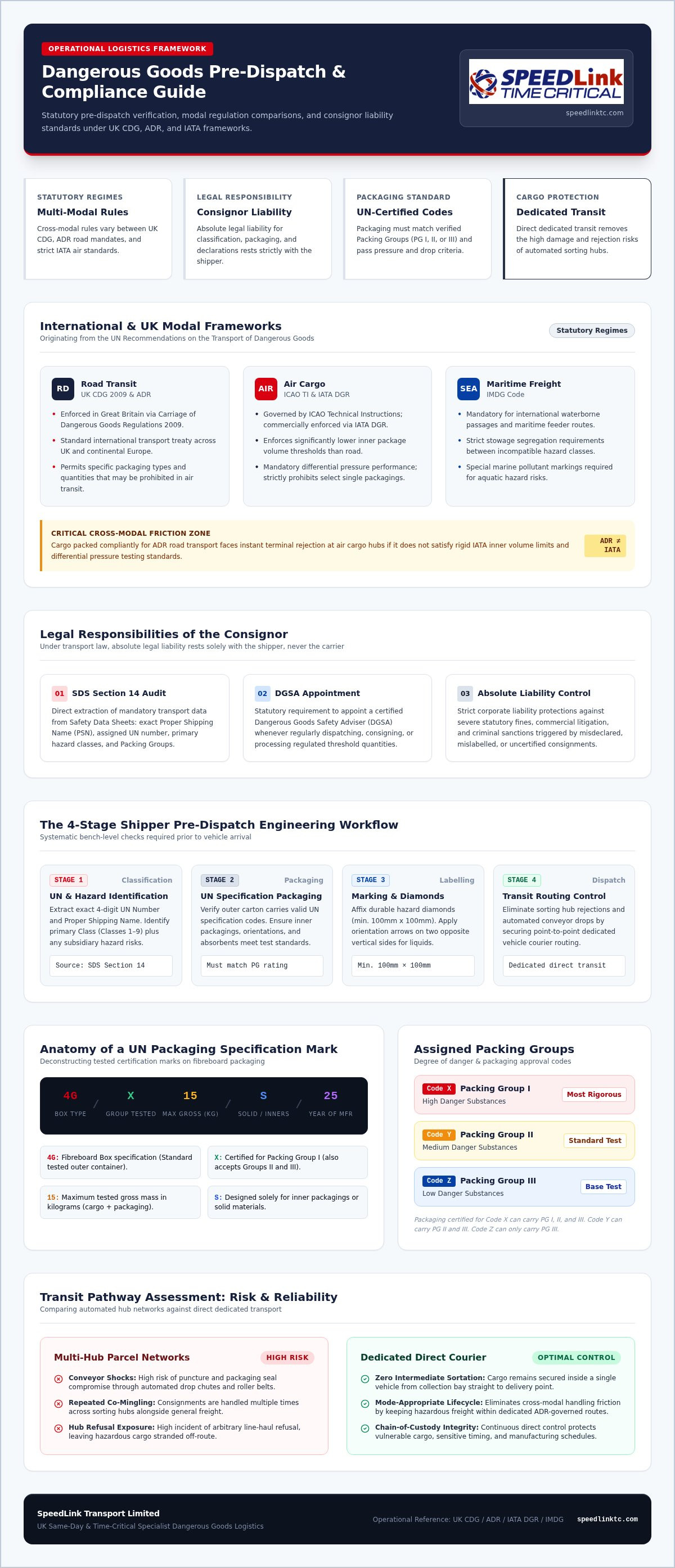
Every transport mode enforces its own distinct legal regime. Road transit throughout Britain and continental Europe operates under ADR, implemented domestically via the Carriage of Dangerous Goods and Use of Transportable Pressure Equipment Regulations 2009 (CDG 2009). Air freight complies with ICAO Technical Instructions, enforced commercially through IATA regulations, whilst maritime crossings require adherence to the IMDG Code.
Friction often arises at modal handoffs. A chemical parcel packed compliantly for an ADR road journey may face immediate refusal at an air cargo terminal. Air transport enforces far lower volume limits per inner packaging, prohibits specific single packagings, and applies stricter differential pressure standards. If your operation manages urgent domestic links or cross-border feeder routes, utilising a dedicated dangerous goods courier eliminates sorting-hub rejection risks by keeping cargo within a controlled, mode-appropriate vehicle lifecycle.
Legal Responsibilities of the Consignor
Under transport law, absolute liability for classification, packaging selection, and declaration accuracy rests with the consignor, not the transport carrier. Key legal duties include:
- Safety Data Sheet (SDS) verification: Deriving precise UN numbers and packing groups from Section 14 transport data.
- DGSA appointment: Appointing a certified Dangerous Goods Safety Adviser whenever handling regulated quantities regularly.
- Liability control: Preventing severe corporate fines, commercial litigation, and criminal sanctions resulting from misdeclared substances.
Ignorance of regulatory changes offers no legal defence when hazardous cargo causes transit incidents or audit failures.
The Shipper Pre-Dispatch Checklist: Classification and Packaging
Executing systematic pre-dispatch checks prevents costly cargo rejections at collection points. Systematic compliance for shipping dangerous goods demands that dispatch teams treat classification and packaging selection as an integrated engineering workflow rather than a standard warehouse dispatch task.
Classification and UN Number Identification
Never rely on commercial product names to prepare hazardous materials for transport. You must review Section 14 of the product’s Safety Data Sheet (SDS) to identify:
- The four-digit UN number and exact Proper Shipping Name (PSN).
- The primary hazard class (Classes 1 through 9) and any subsidiary risks.
- The assigned Packing Group (PG I for high danger, PG II for medium, PG III for low).
Certain industrial items carry complex secondary hazards that alter transport categorisation across different borders. Review our specialist operational guide on finding a dangerous goods courier UK for detailed support with difficult classifications.
UN Packaging Certification and Marking Standards
Once classified, cargo must be secured inside packaging that satisfies strict UN specification standards. A standard fibreboard box marked 4G/X15/S/25 confirms testing for Packing Group I (X) up to 15 kilograms. Combination packagings require manufacturer-tested inner containers, specific cushioning orientations, and sufficient absorbent material to contain the entire liquid volume during transit shocks.
Air transport requires strict adherence to the IATA Dangerous Goods Regulations (DGR), which mandate rigid pressure differential capabilities that exceed basic road standards. External containers must display durable, non-obscured primary hazard diamonds (minimum 100mm x 100mm), appropriate subsidiary hazard labels, and orientation arrows on two opposite vertical sides. If your dispatch team encounters capacity constraints or complex packaging requirements, contact our specialist logistics team to confirm compliant transit options before release.
Documentation Requirements: Paperwork That Prevents Transit Delays
Flawless transport paperwork remains the final hurdle in achieving end-to-end compliance for shipping dangerous goods. Even if physical packaging and hazard labels satisfy every test standard, a single syntax error or missing technical name on your transport documentation will prompt immediate carrier refusal, regulatory impoundment, or border retention.
Drafting the Dangerous Goods Note and Transport Document
The Dangerous Goods Note (DGN) or Multimodal Dangerous Goods Form requires an unvarying descriptive sequence. Any deviation invalidates the document under modal law. The mandatory order comprises:
- UN Number: Preceded by the letters “UN” (e.g., UN 1993).
- Proper Shipping Name: Supplemented by the recognised technical name in brackets for generic entries.
- Primary Class: Followed by subsidiary risk classes in brackets where applicable.
- Packing Group: Denoted in Roman numerals (e.g., PG II).
- Quantity and Packaging: Total net mass or volume, alongside the exact number and type of outer receptacles.
Cross-border consignments moving between Britain and the continent also require aligned customs declarations to avoid extended port inspections; see our operational breakdown of EU shipping with customs clearance for integrated trade protocols.
Written Emergency Instructions and Driver Tremcards
Under ADR rules, commercial vehicles carrying fully regulated consignments must keep standardised Instructions in Writing immediately accessible within the driver’s cab. This four-page statutory document outlines actions to take during roadside emergencies, including leak containment, basic personal protection, and public avoidance measures.
Consignors must also provide a monitored 24-hour chemical emergency telephone number directly on the declaration. Emergency service personnel depend on this contact to confirm chemical behaviours instantly should an on-road incident occur.
Carrier Selection and Dedicated Logistics for Hazardous Cargo
Selecting an appropriate transport partner represents the final, decisive stage in maintaining compliance for shipping dangerous goods. Even impeccably packaged and documented consignments face severe compromise if assigned to standard parcel networks that rely on automated sorting belts, multi-hub transfers, and shared general cargo space.
Assessing Carrier Safety Standards and ADR Equipment
Vetting a transport provider requires auditing driver credentials and vehicle provisions against statutory mandates. Specialist providers operating dedicated dangerous goods transport services must verify:
- Driver qualifications: Valid ADR vocational training certificates covering the specific hazard classes and carriage types involved.
- Statutory vehicle kit: Calibrated dry powder fire extinguishers, wheel chocks, amber warning beacons, and ADR personal protection equipment, including eye wash and drain seals.
- Load restraint: Approved bulkhead barriers and ratcheted tensioning straps capable of eliminating container shifting under emergency braking.
Hub Networks Versus Dedicated Point-to-Point Transport
Conventional hub-and-spoke networks introduce repeated physical handling at central sorting facilities. Every transfer increases the likelihood of mechanical impact, crushed packaging, or chemical leakage. When high-consequence dangerous goods, volatile chemicals, or battery prototypes face business-critical delivery deadlines, direct transport removes hub handling risks altogether.
Dispatching cargo via a dedicated, point-to-point same day courier service UK preserves an unbroken chain of custody. The consignment remains locked within a single vehicle under the constant supervision of a trained driver from initial collection straight to final handover. Regular carrier audits and auditable electronic chain-of-custody logs ensure full regulatory compliance for shipping dangerous goods without leaving industrial operations exposed to network delays.
Securing Seamless Hazardous Shipments Through Operational Control
Achieving total compliance for shipping dangerous goods shields your organisation against severe enforcement penalties, carrier rejections, and business-critical supply chain stalls. Success relies on disciplined pre-dispatch execution: validating classification data against Section 14 of the SDS, selecting verified UN specification packaging, and completing precise transport declarations before collection occurs.
When moving high-consequence hazardous consignments or sensitive battery assemblies across the UK and Europe, choosing dedicated point-to-point courier solutions removes the acute risks associated with multi-hub sortation networks. A single dedicated vehicle maintains an unbroken chain of custody, ensuring that proper stowage, emergency instructions, and trained driver supervision remain intact from loading bay to destination handover.
With structured verification routines and specialist transport support, you can dispatch hazardous cargo with complete operational confidence and regulatory certainty.
Frequently Asked Questions
Who holds legal responsibility for compliance when shipping dangerous goods?
The consignor holds primary legal liability for classifying, packing, and declaring hazardous freight under transport law. While carriers are responsible for safe vehicle operation, driver qualifications, and carriage equipment, statutory enforcement authorities penalise the sender for inaccurate hazard classifications, defective packagings, or omissions on transit paperwork. Consignors regularly handling regulated volumes must appoint or consult a certified Dangerous Goods Safety Adviser.
Can standard parcel courier networks transport commercial dangerous goods?
Most standard parcel networks refuse fully regulated hazardous cargo due to the operational constraints of automated sorting machinery. Hub-and-spoke sortation belts risk crushing uncertified boxes, puncturing chemical receptacles, or triggering cross-contamination. Fragile consignments, high-hazard chemical volumes, and sensitive industrial prototypes generally require point-to-point transport through a specialist dangerous goods courier to eliminate multi-depot transhipment risks completely.
What is the difference between limited quantity exemptions and fully regulated ADR transport?
Limited Quantity (LQ) provisions permit businesses to transport small, inner-packaged dangerous goods without requiring full ADR driver licensing or orange vehicle placards. However, robust compliance for shipping dangerous goods still applies: items must sit inside tested combination packaging displaying distinct diamond-shaped LQ marks, and gross parcel weights must remain within statutory thresholds, typically below 30 kilograms per package.
Which documents must accompany a dangerous goods shipment by road?
A compliant road transit consignment requires an accurate Dangerous Goods Note (DGN) detailing the UN number, Proper Shipping Name, hazard class, and packing group. The vehicle must also carry the statutory four-page ADR Instructions in Writing in the driver’s cab, alongside driver training certifications and any cross-border commercial invoices required for customs clearance during European delivery journeys.
Do lithium batteries always require dangerous goods compliance declarations?
Lithium batteries always require formal regulatory assessment, although standalone declarations depend on cell capacity and configuration. Cells exceeding 20 Watt-hours or battery packs exceeding 100 Watt-hours require full hazardous classification, certified UN packaging, and formal declarations. Lower-capacity equipment may qualify for Section II exemptions under air and road rules, but packages still require mandatory battery handling marks.

Article by
Dave McMillen
I have worked in courier and logistics for over 30 years. My experience spans two continents and several types of services from road freight to airlines and specialist B2B services. SpeedLink has been serving the UK market for over 20 years providing the finest time critical and specialist services supporting businesses and individuals alike.
Disclaimer
Information is provided as general logistics guidance and is not legal, customs, aviation, medical or dangerous-goods compliance advice.
Rules vary according to commodity, quantity, classification, packaging, origin, destination, transport mode and carrier.
Regulations and carrier requirements may change.
Where regulated goods are involved, current requirements should be confirmed with the appropriate government authority, regulator, carrier or qualified specialist before shipment.
SpeedLink can confirm the transport options it can provide for a particular shipment.


