


Did you know that only 6% of companies report having full end-to-end visibility of their supply chain? For those managing high-value or dangerous goods, that lack of clarity isn’t just a frustration; it’s a significant operational risk. Effective waybill tracking is the bedrock of a secure logistics strategy, yet many professionals still struggle with the complexities of post-Brexit customs and the July 2026 IATA Direct Air Waybill framework updates. We understand that when you’re moving specialist consignments, a standard status update simply won’t suffice.
This guide will help you master the nuances of waybill documentation to ensure your most critical items are monitored with professional precision. We’ll explore how to navigate the shift towards mandatory electronic bills of lading and how to use precise tracking to eliminate delays. By the end, you’ll have the strategic insight needed to maintain total supply chain visibility and secure audit trails for every shipment. We’ll show you how to transform tracking from a passive observation into a proactive management tool.
Key Takeaways
- Understand the legal distinction between a tracking number and a waybill to ensure your contract of carriage is robust and your audit trails remain compliant.
- Discover how rigorous waybill tracking provides the essential oversight required for NPPV cleared shipments and the secure transport of dangerous goods.
- Master the interpretation of professional tracking statuses to identify and resolve potential delays before they impact your time-critical delivery schedule.
- Utilise centralised logistics data to analyse carrier performance and drive greater operational efficiency across your multi-modal supply chain.
Understanding the Waybill: More Than Just a Tracking Number
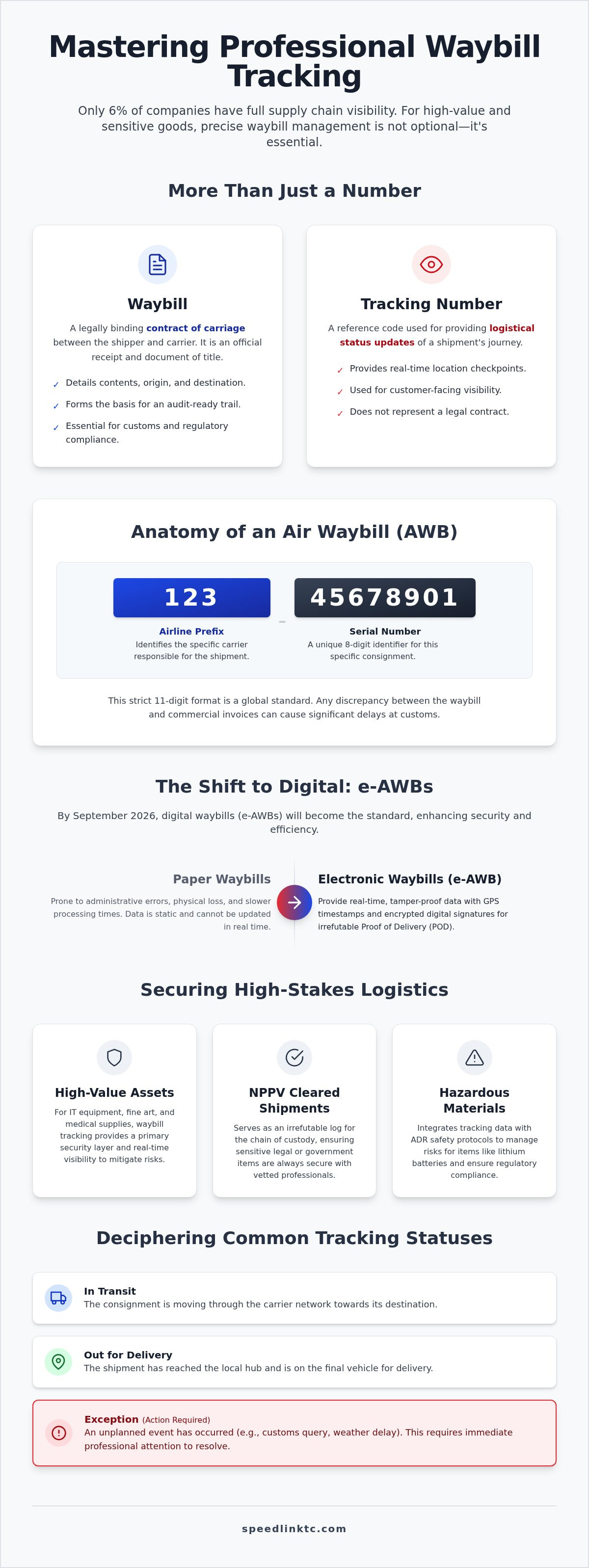
Whilst many view it as a simple reference code, a waybill is actually a non-negotiable contract of carriage. It serves as a binding receipt between the shipper and the carrier, detailing exactly what is being moved and under what specific conditions. What is a waybill? At its core, it’s the legal foundation of your shipment. We distinguish between the Air Waybill (AWB), issued by the airline, and the House Waybill (HWB), issued by a freight forwarder. For high-stakes consignments, precise waybill tracking begins with ensuring these documents accurately reflect consignor details, final destination, and the specific service level required for the cargo.
The Anatomy of a Professional Waybill
A standard AWB follows a strict 11-digit format. The first three digits, known as the prefix, identify the specific airline, whilst the remaining eight digits serve as the unique serial number for the shipment. This structure is vital for EU shipping with customs clearance, as any discrepancy between the waybill and the commercial invoice can lead to immediate delays at the border. Professional waybill management ensures every data point is aligned, creating a foundation for an audit-ready supply chain that can withstand regulatory scrutiny.
Digital vs Paper Waybills in 2026
The industry has transitioned rapidly towards e-AWBs to eliminate administrative errors and enhance security. By September 2026, digital adoption has become the standard for most international routes, including mandatory electronic bills of lading in specific jurisdictions like Russia. These digital frameworks integrate GPS timestamps and encrypted digital signatures, providing an irrefutable proof of delivery (POD). This shift doesn’t just improve operational speed; it enhances the accuracy of waybill tracking by providing real-time, tamper-proof data that traditional paper-based systems simply cannot match.
How Waybill Tracking Secures High-Stakes and Specialist Logistics
Standard tracking might suffice for general freight, but high-stakes logistics require a higher level of professional precision. If you don’t maintain a rigorous audit trail, the risks to your reputation and bottom line are substantial. When moving high-value assets such as IT equipment or fine art, waybill tracking acts as the primary security layer, ensuring every stakeholder has real-time visibility. This level of oversight is vital for mitigating risks associated with time-critical medical supplies or industrial engineering parts where a single hour of downtime can cost thousands of pounds.
Tracking for Sensitive and Vetted Shipments
For NPPV cleared courier services, the waybill serves as an irrefutable log of the chain of custody. Security-cleared couriers use these documents to maintain a strictly controlled environment, ensuring that sensitive items never leave the sight of a vetted professional whilst in transit. This is particularly critical for legal document solutions where court deadlines are non-negotiable. These shipments often require integration with official export documents to pass through international checkpoints without unnecessary friction. If you have concerns about the security of your sensitive items, you can discuss your specific security requirements with our team.
Visibility in Hazardous Goods Transport
Transporting hazardous materials requires more than just a label; it requires a data-driven approach to safety. As a specialist dangerous goods courier, we integrate waybill tracking data with ADR safety protocols to manage the unique risks associated with lithium batteries and volatile chemicals. This ensures that every consignment is handled according to its specific classification and safety data sheet requirements. Waybill tracking ensures that hazardous materials are always accounted for and safely positioned amongst standard freight to maintain regulatory compliance.
Deciphering Tracking Statuses and Navigating Common Delays
Interpreting waybill tracking data accurately is essential for maintaining operational control over your supply chain. Standard statuses like ‘In Transit’ indicate the consignment is moving through the network, whilst ‘Out for Delivery’ signifies final mile dispatch. However, the ‘Exception’ status is the most critical; it indicates an unplanned event, such as a weather delay or a documentation query, that requires immediate professional intervention. When tracking appears to ‘stall’ during international movements, it is rarely a sign of lost cargo. Instead, it often reflects a transition between carrier systems or a mandatory pause at a customs checkpoint.
International shipments to Germany or The Netherlands frequently encounter these pauses. If your shipment is high-value or time-critical, these periods of radio silence can be unsettling. We mitigate this by taking proactive steps the moment an exception is flagged, ensuring that minor hurdles don’t escalate into significant delays.
The Customs Clearance Hurdle
Many tracking flags relate specifically to duty payments or missing commercial data. Without expert oversight, shipments can fall into tracking ‘black holes’ at the border whilst officials await clarification. By utilising our European customs services, you ensure that all necessary paperwork is pre-lodged, allowing for seamless transitions that keep the waybill status moving. If you are facing persistent delays with your current provider, contact our logistics specialists for a more reliable solution.
Real-Time vs Point-to-Point Tracking
There is a fundamental difference between passive scan-point updates and active GPS monitoring. Most express networks rely on point-to-point scans, which only update when a parcel reaches a physical hub. Conversely, same-day courier services offer superior visibility by providing continuous data. This eliminates the uncertainty of ‘blind spots’ and ensures you have total visibility of your supply chain from collection through to the final signature.
Optimising Your Supply Chain with Professional Waybill Management
Effective waybill tracking is a strategic asset that extends far beyond simple location monitoring. By meticulously analysing transit data and the frequency of specific exceptions, corporate decision-makers can identify systemic bottlenecks and refine their overall supply chain efficiency. Centralising this information for multi-modal international freight provides a comprehensive view of global operations, allowing for more precise forecasting and risk mitigation. A professional tracking framework is the hallmark of a mature B2B logistics strategy, transforming raw data into actionable intelligence that supports long-term business goals.
Integrating Tracking into Your Operations
Proof of Delivery (POD) data is a vital component for streamlining internal billing and reporting processes. When you integrate digital PODs directly into your financial systems, you eliminate the administrative lag associated with manual reconciliation. This level of integration is particularly valuable for high-priority IT transport or exhibition logistics. In these sectors, proactive notifications and real-time data ensure that site managers and technical teams are perfectly synchronised, reducing wait times and ensuring that specialist equipment is ready for immediate deployment upon arrival.
The SpeedLink Advantage: Human-Centred Tracking
Whilst automated aggregators can handle high volumes of low-value parcels, they often fail when faced with the complexities of specialist transport. SpeedLink offers a dedicated, professional alternative that prioritises accountability and operational authority. We act as a strategic partner, providing the depth of process required to manage urgent, high-value, or dangerous goods with absolute precision. SpeedLink provides calm, methodical control in high-pressure logistics scenarios, ensuring that every consignment is monitored by experts who understand the stakes involved. This human-centred approach ensures that when challenges arise, you have a proactive guide ready to implement an immediate resolution.
Ready to secure your most critical shipments? Contact our specialist team today for a tailored logistics solution.
Securing the Future of Your High-Value Supply Chain
Moving beyond basic status updates is essential for any organisation handling specialist or time-critical consignments. By viewing your waybill as a strategic asset rather than a simple receipt, you gain the operational authority needed to manage complex international movements with absolute precision. We’ve explored how professional waybill tracking facilitates compliance and provides the visibility required to mitigate risks before they impact your bottom line. Whether you’re navigating the latest IATA frameworks or managing sensitive document transfers, the right partnership ensures your cargo is never left to chance.
Our team brings together NPPV security-cleared couriers, ADR dangerous goods specialists, and international customs clearance experts to provide a level of control that standard networks simply cannot match. We don’t just move items; we manage the mission-critical details that protect your reputation in high-stakes situations. Secure your high-stakes logistics with SpeedLink’s specialist tracking and courier solutions. We look forward to helping you achieve total supply chain visibility.
Frequently Asked Questions
What is the difference between a waybill number and a tracking number?
A waybill number is a legal identifier for the contract of carriage, whilst a tracking number is a reference used for status updates. In many professional systems, the waybill number serves as the tracking ID, but they remain conceptually distinct. The waybill contains critical data like consignor details and cargo descriptions, functioning as a binding legal document. Tracking numbers are simply tools for monitoring movement across a logistics network.
How can I track a waybill for international customs-cleared freight?
You can track international freight by entering your Air Waybill (AWB) or House Waybill (HWB) number into a professional visibility platform. For shipments requiring customs clearance, tracking often shows specific statuses related to duty payments or documentation review. We ensure that all commercial invoices and export documents are pre-lodged, which prevents the tracking from stalling at the border and maintains a continuous audit trail through various international transit points.
What should I do if my waybill tracking hasn’t updated for 24 hours?
If your tracking hasn’t updated, it often indicates the consignment is currently between scan points, such as during a long-haul flight or a customs inspection. You should first check for any ‘Exception’ flags that might require your action. If the silence persists, contact your logistics provider directly. A specialist partner will have access to internal carrier data to provide a precise location update that automated public portals might frequently miss.
Can I track a dedicated same-day courier in real-time?
Yes, dedicated same-day courier services provide superior visibility by assigning a single vehicle to your consignment. Unlike standard networks where items are scanned only at major hubs, a dedicated courier provides constant updates from collection to delivery. This level of waybill tracking is essential for time-critical industrial parts, where knowing the exact arrival time allows for precise site coordination and prevents costly operational downtime for your technical teams.
Is it possible to track high-value or sensitive items without compromising security?
Security and visibility are maintained through encrypted tracking portals and vetted chains of custody. For NPPV cleared or high-value IT transport, we use secure waybill management systems that only authorised personnel can access. This ensures you have total visibility of your consignment’s progress without exposing sensitive transit details to the public. Professional waybill tracking balances the need for transparency with the rigorous security protocols required for specialist logistics.

Article by
Dave McMillen
I have worked in courier and logistics for over 30 years. My experience spans two continents and several types of services from road freight to airlines and specialist B2B services. SpeedLink has been serving the UK market for over 20 years providing the finest time critical and specialist services supporting businesses and individuals alike.


