


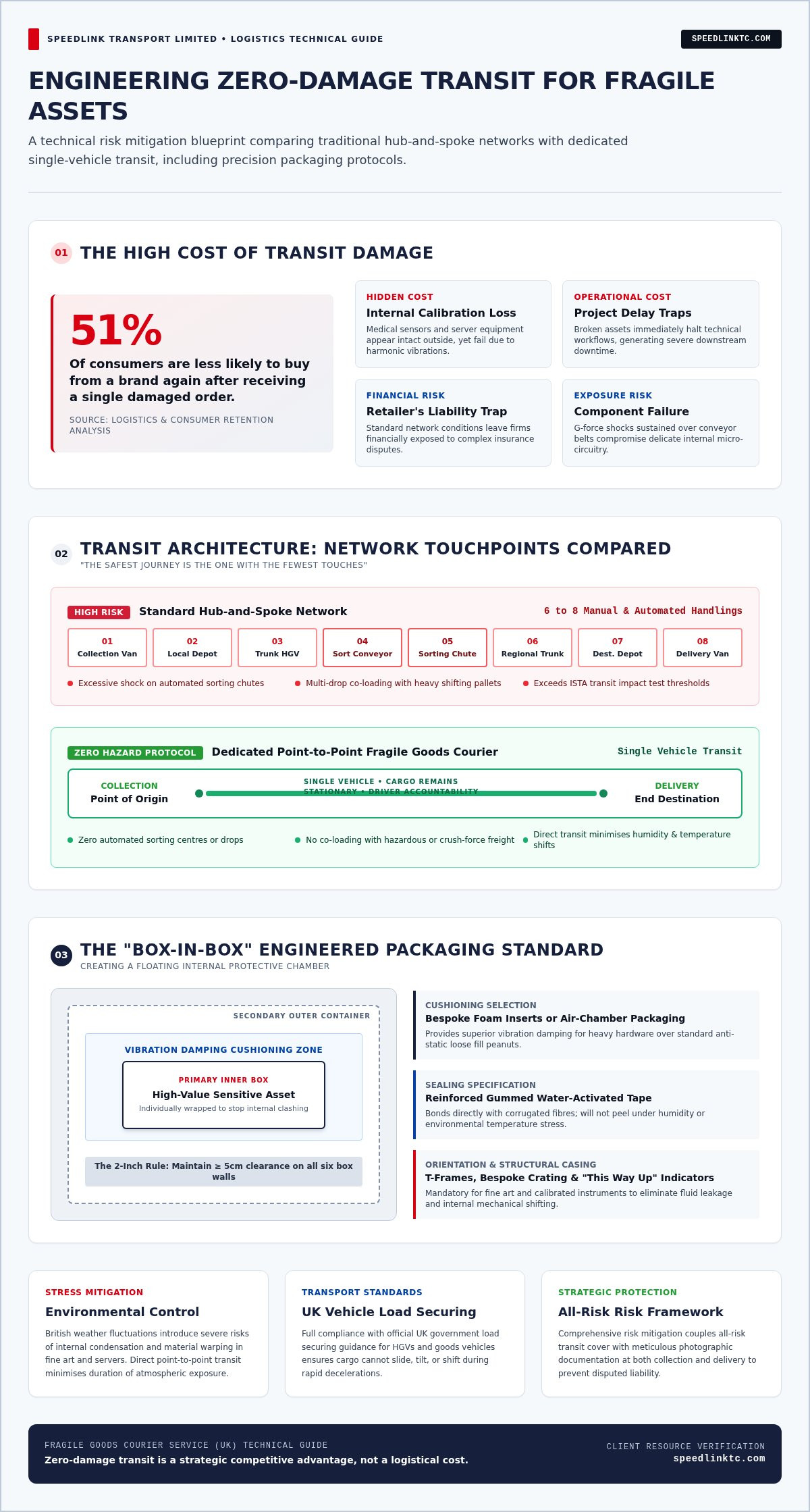
Did you know 51% of consumers are less likely to buy from a brand again after receiving a single damaged order? For UK businesses managing high-value assets, the stakes are even higher than a lost sale. Broken assets trigger operational delays, high replacement costs, and complex insurance disputes. Standard hub-and-spoke networks, where parcels are handled up to eight times, create unnecessary risk for sensitive equipment. Selecting the right fragile goods courier service UK is only the first step in a broader strategy of risk mitigation.
We’ll help you master the technical and strategic steps required to eliminate transit damage and protect your professional reputation. This guide provides a repeatable packing protocol and moves beyond the “Retailer’s Liability Trap” that leaves many firms financially exposed. We will examine the critical shift from automated sorting centres to dedicated point-to-point transit. This ensures your assets arrive in perfect condition every time. By the end, you’ll have a blueprint for zero-damage delivery that functions as a competitive advantage.
Key Takeaways
- Identify the hidden risks of transit damage, including internal calibration loss, and understand why standard hub-and-spoke networks are unsuitable for sensitive assets.
- Master the technical “Box-in-Box” packing method to create a floating protective chamber for high-value equipment and sensitive IT assets.
- Eliminate the hazards of automated sorting by partnering with a dedicated fragile goods courier service UK that prioritises single-vehicle transit and driver accountability.
- Secure your shipments with a strategic risk management framework, focusing on the nuances of all-risk insurance and precise photographic documentation.
Identifying the Core Risks to Fragile Goods in Transit
In a B2B environment, shipping damage extends far beyond a shattered exterior. For high-precision industries, damage often manifests as internal component failure or the loss of delicate calibration. Sensitive medical sensors or server hardware may appear intact upon arrival, yet fail to function because of harmonic vibrations or G-force shocks sustained during transit. Protecting these assets requires sophisticated package cushioning techniques that account for more than just a simple drop.
The primary threat stems from the traditional hub-and-spoke model. In these networks, a parcel is handled between six and eight times as it moves through various sortation centres and conveyor systems. Each touchpoint introduces a fresh opportunity for impact. As we often advise our clients: “The safest journey is the one with the fewest touches.” Using a dedicated fragile goods courier service UK eliminates these intermediate hazards by keeping your cargo on a single vehicle from collection to delivery.
The Hidden Dangers of Co-loading
Multi-drop vehicles frequently carry a mix of industrial freight and delicate parcels. If heavy pallets shift during transit, the resulting crush force can compromise even the most robust packaging. Dedicated transport removes this variable entirely, ensuring your high-value items don’t get co-loaded with incompatible or hazardous cargo that could jeopardise their structural integrity.
Environmental Stressors: Temperature and Humidity
British weather fluctuations present a silent risk to fine art transport and sensitive electronics. Rapid changes in humidity can cause materials to warp or lead to internal condensation. Maintaining asset integrity requires a fragile goods courier service UK that understands these environmental stressors and provides rapid, direct transit to minimise exposure. This methodical control is essential for items that simply cannot break.
How to Pack Fragile Items for Maximum Protection
High-value logistics require engineered packaging rather than generic retail solutions. The “Box-in-Box” method remains the gold standard for creating a floating inner chamber. Place the asset in a primary container with adequate cushioning, then suspend that container within a larger secondary box. This dual-layer structure absorbs kinetic energy and vibration before it reaches the item. For hardware-specific requirements, our IT equipment courier service provides technical advice on protecting sensitive circuitry from electrostatic discharge and impact.
Cushioning selection is a critical variable in your packing strategy. Whilst anti-static peanuts prevent movement for lightweight items, bespoke foam inserts or air-chamber packaging offer superior vibration damping for heavier assets. Structural integrity is finalised at the seal; use reinforced gummed tape as it bonds directly with the corrugated fibres. This is far more reliable than standard pressure-sensitive tape which can peel under environmental stress. Selecting a professional fragile goods courier service UK ensures these meticulous efforts aren’t wasted by poor handling.
Step-by-Step: The Professional Packing Protocol
Wrap items individually to prevent internal clashing during movement. Follow the “2-inch Rule” by maintaining at least 5cm of clearance between the asset and every box wall. Whilst “Fragile” labels are necessary, they are a secondary defence to internal stabilisation. Proper load distribution ensures compliance with UK government load securing guidance to prevent shifting whilst in transit.
Specialist Requirements for Fine Art and Glass
Standard parcel networks depend on high volume and automated sortation. This efficiency often comes at the cost of asset safety. When you engage a dedicated fragile goods courier service UK, the primary objective is the total elimination of automated sorting centres. In a dedicated vehicle, your item remains stationary from the point of collection until it reaches the recipient. This removes the variables of conveyor drops and chute impacts that frequently exceed ISTA transit testing standards for small parcels.
Unlike anonymous hub systems, a dedicated driver is personally accountable for the load’s integrity. They employ bespoke securing methods, such as adjustable load bars and ratchet straps, to neutralise lateral movement. This level of methodical control is a core feature of our same day courier service UK, where the vehicle is tailored to the specific requirements of your shipment. We don’t just move boxes; we manage high-stakes transitions.
Why “No Co-loading” is the Ultimate Damage Prevention
Multi-drop vans carry disparate cargo that can shift and crush lighter items. By contrast, a SpeedLink vehicle carries only your goods. We often utilise a “Last-on, First-off” loading strategy for urgent fragile assets, ensuring they are positioned for maximum stability and minimal disturbance during the journey. This strategic advantage is vital for items that simply cannot break, providing a level of precision that consolidated haulage cannot match.
Security and Vetting for Sensitive Fragile Goods
Sensitive prototypes or legal assets require more than just physical protection. Our NPPV cleared courier services provide an additional layer of security for high-value shipments. We maintain a strict chain of custody, ensuring that items which are both fragile and confidential are handled only by vetted professionals. This integrated approach guarantees both the physical and operational security of your most critical business assets. Request a quote for dedicated fragile goods transport today.
Establishing a Robust Risk Management Strategy for Logistics
A strategic approach to logistics requires looking beyond the immediate transport cost. When evaluating a fragile goods courier service UK, you must distinguish between standard “per kilo” liability and comprehensive “all-risk” goods-in-transit cover. Under the RHA Conditions of Carriage 2026, standard carrier liability is capped at £1,300 per tonne. For a high-value 5kg medical sensor or delicate server, this provides negligible protection. Always ensure your insurance reflects the true replacement value and technical worth of the cargo.
Documentation is your primary defence in liability disputes. We advocate for high-resolution photography at both the point of collection and delivery to establish an undeniable record of the item’s condition. The true cost of failure extends far beyond the invoice; it includes operational downtime and significant brand erosion. Research shows that 51% of consumers are less likely to buy from a brand again after receiving damaged goods. For deeper insights into managing high-stakes assets, consult our guide on Specialist Courier Service UK: The 2026 Guide.
Selecting a Logistics Partner for High-Value Assets
Vetting a partner requires a rigorous checklist. Prioritise providers that offer specialised driver training and dedicated vehicles. B2B specialists like SpeedLink outperform generalist residential couriers because our processes are designed for high-stakes fragile freight rather than volume-based parcel sortation. Our drivers understand they’re handling critical business assets that simply cannot break.
Post-Delivery Protocol
Asset protection doesn’t end when the vehicle arrives. Implement a strict inspection protocol where recipients check for signs of internal failure or calibration loss before signing. Utilising a fragile goods courier service UK that provides Real Time Proof of Delivery ensures your operations team has immediate visibility. This methodical closing of the chain of custody is essential for maintaining precision in time-critical B2B sectors.
Securing Your High-Stakes Logistics Future
Eliminating transit damage is a strategic imperative that requires more than just high-quality bubble wrap. It demands a fundamental shift from consolidated parcel networks to a dedicated logistics model where your assets are never co-loaded or handled in automated hubs. By mastering professional packing protocols and establishing a robust risk management framework, you protect both your bottom line and your brand reputation. We provide the precision required for items that simply cannot break.
Our team offers a 90-minute collection service nationwide, utilising dedicated vehicles and specialist handlers for IT, fine art, and medical equipment. When you partner with a professional fragile goods courier service UK, you gain a strategic advisor committed to zero-damage delivery. Ready to secure your next high-stakes shipment? Request a Quote for Dedicated Fragile Goods Transport and ensure your assets arrive in perfect condition. We look forward to supporting your most critical missions with methodical, authoritative care.
Frequently Asked Questions
What is the best way to pack extremely fragile items for UK shipping?
Use the “Box-in-Box” method. Place the item in a primary container with cushioning, then suspend that box inside a larger secondary container with at least 5cm of clearance on all sides. This creates a floating chamber that absorbs vibration. Use reinforced gummed tape for structural integrity. This technical approach is essential when using a fragile goods courier service UK for high-value hardware or sensitive medical equipment.
Why do fragile items often break even when labelled “Fragile”?
Labels are a secondary defence and don’t protect against the physical mechanics of a hub-and-spoke network. Automated conveyor belts and sorting chutes don’t read labels; they subject parcels to drops and compression forces. Most breakage occurs because of internal movement or harmonic vibrations during road transit. If an item isn’t internally stabilised and handled by a dedicated professional, a label won’t prevent structural failure or calibration loss.
Is dedicated courier transport safer than standard parcel networks?
Dedicated transport is safer because it eliminates sorting centres entirely. Your assets remain on a single vehicle from collection to delivery, removing the risk of multiple manual handlings. In a standard network, a parcel is handled six to eight times. By choosing a dedicated fragile goods courier service UK, you ensure your items aren’t co-loaded with heavy freight or subjected to the hazards of automated sorting belts and chutes.
What insurance do I need for shipping high-value fragile goods in the UK?
Standard carrier liability is often insufficient for high-value assets. Under RHA Conditions of Carriage 2026, liability is capped at £1,300 per tonne, which offers little protection for light, expensive equipment. You should verify if your shipment is covered by “all-risk” goods-in-transit insurance. This provides protection based on the full replacement cost. Many standard couriers explicitly exclude fragile items from damage compensation, leaving businesses financially exposed without a specialist B2B provider.
Can I ship lithium batteries as fragile goods?
Lithium batteries are classified as dangerous goods and require specialist handling beyond standard fragile protocols. We provide a dedicated lithium battery courier service that complies with ADR regulations. These items must be correctly packaged and transported in dedicated vehicles to manage thermal risks. If your fragile equipment contains integrated batteries, you must declare this. This ensures the shipment meets all legal safety requirements whilst maintaining the physical integrity of the sensitive components.

Article by
Dave McMillen
I have worked in courier and logistics for over 30 years. My experience spans two continents and several types of services from road freight to airlines and specialist B2B services. SpeedLink has been serving the UK market for over 20 years providing the finest time critical and specialist services supporting businesses and individuals alike.


