


EU-bound goods need accurate customs and VAT details, as well as a delivery address. A customs clearance courier service in the UK can coordinate transport with the paperwork required for the shipment, such as a commercial invoice and, where relevant, a packing list or permits. Requirements depend on the goods and route.
Getting a consignment moving is only part of the process. Incomplete or inconsistent information can complicate clearance, which may take from minutes to weeks depending on shipment complexity, customs-authority efficiency and documentation. This article explains which details and documents to prepare, what can affect clearance time, and how transport and final delivery fit together. Treat the route, customs support and delivery requirements as one coordinated movement, so you can plan each handover with a clearer view of what happens next.
Key Takeaways
- Prepare shipment details and supporting paperwork together to help reduce avoidable customs queries.
- Understand how VAT treatment and the goods themselves affect the information needed for clearance.
- Plan around the factors that can extend processing, rather than assuming clearance follows a fixed timetable.
- Match the transport method and delivery handover to the shipment’s urgency, route and requirements.
What documents are required for UK customs clearance?
Prepare a commercial invoice, packing list and transport document, then add any origin evidence or permits required for the goods. The paperwork depends on the shipment, its route and whether the goods are controlled.
Import and export declarations
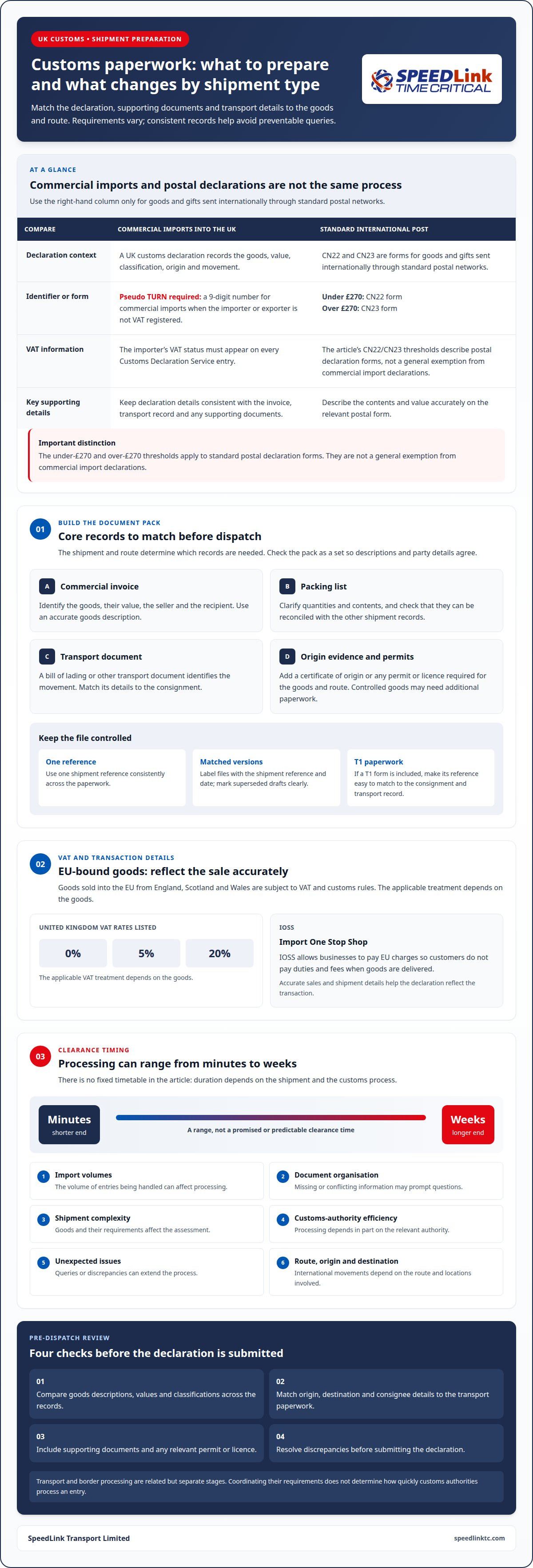
A UK customs declaration records the goods, their value, classification, origin and movement. Import and export entries need consistent details that match the supporting paperwork; discrepancies can delay clearance. Commercial imports into the UK require a Pseudo TURN, a 9-digit number used when the importer or exporter isn’t VAT registered. The importer’s VAT status must also be declared on every Customs Declaration Service entry. Compare courier services by whether declaration handling and transport are coordinated, and by how clearly they identify the information needed from you.
For controlled goods, check whether an import or export permit or licence is required, and include the relevant document. The goods’ classification and intended use help determine which controls apply.
EU VAT and IOSS details
Goods sold into the EU from England, Scotland and Wales are subject to VAT and customs rules. HM Revenue & Customs lists United Kingdom VAT rates of 0%, 5% and 20%; the applicable treatment depends on the goods. The Import One Stop Shop (IOSS) allows businesses to pay EU charges so customers don’t pay duties and fees when goods are delivered. Include accurate sales and shipment details so the declaration reflects the transaction.
Commercial parcel imports
For a commercial parcel entering the UK, prepare an invoice that identifies the goods, their value, the seller and the recipient. A packing list can clarify quantities and contents, while a bill of lading or other transport document identifies the movement. Customs duties and taxes depend on the goods’ value, classification and applicable regulations, so use accurate descriptions.
What are the UK rules for low-value imports and customs declarations? For commercial imports, a Pseudo TURN is required, and the importer’s VAT status must appear on each Customs Declaration Service entry. Separately, for goods and gifts sent internationally through standard postal networks, items valued under £270 require a CN22 form; items valued over £270 require a CN23. These thresholds describe standard postal declaration forms, not a general exemption from commercial import declarations.
Documents needed for customs clearance
Organise the document pack so everyone handling the consignment can identify which records belong together. Before dispatch, assign one shipment reference and use it consistently across the paperwork. The sender, freight team and consignee can then refer to the same movement when discussing it or resolving a discrepancy.
Transit paperwork and T1 forms
If a T1 form is included in your shipment file, make its reference easy to match to the consignment. Compare the identifying details against the transport record, and keep the corresponding documents together for the teams handling the movement.
Use a controlled file rather than sending separate, unlabelled versions. For example, name each document with the shipment reference and date, and mark superseded drafts clearly. If a detail changes, circulate the current version to everyone using the paperwork. This helps prevent teams from working from conflicting records.
Required customs documents
The shipment and route determine which supporting records belong in the pack. Common documents include a commercial invoice, packing list, bill of lading, certificate of origin, and permits or licences for regulated goods. Check that each document relates to the same consignment and reflects the same transaction.
Review the pack as a set before sending it, rather than checking each file in isolation. Confirm that the goods can be reconciled across the documents and that sender and recipient details identify the parties involved. If a certificate or permit accompanies the shipment, ensure its description matches the goods being sent.
For regular freight movements, use a repeatable document-control process and review requirements whenever the route, transaction or goods change. Record who prepared the paperwork and who holds the current version. If customs agents or transport teams request a correction, circulate the amended document set together instead of updating one file and leaving the others unchanged. This gives everyone handling the shipment a consistent record for the handover.
Customs clearance processing time
UK customs clearance can take from minutes to weeks. The duration depends on import volumes, document organisation, shipment complexity, customs-authority efficiency and unexpected issues. International consignments to Europe or elsewhere also depend on the route, origin and destination. Businesses using a customs clearance courier service in the UK should plan transport and border processing as related but separate stages.
Start by checking the information needed for the declaration. Accurate details can prevent avoidable questions, while missing paperwork or conflicting entries may delay assessment. For example, a goods description that differs between documents may need clarification before the entry can proceed. Controlled goods may also need additional paperwork prepared before dispatch.
A practical pre-dispatch review can help teams catch inconsistencies:
- Compare goods descriptions, values and classifications across the shipment records.
- Match origin, destination and consignee details to the transport paperwork.
- Include supporting documents and any relevant permit or licence.
- Resolve discrepancies before submitting the declaration.
These checks address preparation, but they do not determine how quickly customs authorities process an entry. For regular consignments, use a consistent review process and revisit it when the goods, transaction details or route change. An old declaration may not reflect the details of a new shipment.
Allow for administrative preparation too. UK Pseudo TURN applications used to take approximately 4 working days to process. If an import requires this identifier, factor the application into the schedule before the customs entry is planned. This is a separate preparation step, not a measure of clearance duration.
For an international delivery, map the sequence from document preparation and declaration through any customs queries to release and onward movement. Assign a contact who can explain the goods or provide records promptly. This helps the team coordinate its response if information needs clarification during processing.
Transport and delivery alongside customs clearance
A cross-border shipment needs a transport plan connecting collection, border handovers and final delivery. A UK customs clearance courier service should coordinate these stages around the goods, route and delivery requirements. Record the origin, destination, consignee and delivery address consistently, then share them with the teams arranging transport and preparing shipment records.
Choose a transport method that suits the journey and urgency. Dedicated road transport can suit a direct route, whilst air freight may be appropriate for longer international movements when speed is a priority. Economy transport may suit less urgent consignments. Compare options against the cargo, route and required handovers, rather than distance alone.
Before dispatch, assign responsibilities for the practical handovers:
- Identify who arranges collection and who receives the goods at each transfer point.
- Give the shipment a reference that appears on its transport records.
- Confirm the delivery address and recipient’s receiving arrangements.
- Agree how changes to the route or consignee will be communicated.
These details matter when a consignment passes between transport stages. For example, a business sending engineering components should ensure the receiving team knows which shipment is due and who can accept it. Provide any access instructions to the driver or transport team before the handover, rather than relying on messages arriving in transit.
For global movements, consider how the country pair, cargo and chosen mode shape the route. A shipment with several transfers needs clear ownership at each point, while a direct movement may involve fewer handovers. Keep the delivery contact informed of planned milestones, and assign one person to communicate operational changes. Clear ownership helps everyone follow the same transport plan.
SpeedLink Transport Limited: Same Day Courier
SpeedLink Transport Limited provides a Same Day Courier service for businesses with urgent UK deliveries that need a direct transport plan. For cross-border consignments, its EU shipping with customs clearance combines transport and customs support for goods moving between the UK and an EU destination.
Different requirements call for different services. Exhibition and Events Courier supports the movement of event materials, while the NPPV Cleared Courier Service is suited to deliveries requiring that specific clearance. Choose according to the shipment’s urgency, route and handling requirements, then prepare accurate customs and delivery details.
Contact SpeedLink Transport Limited to discuss your shipment, or visit speedlinktc.com.
Plan your next cross-border movement
Use your next shipment to establish a clear handover process between the person preparing customs information and the team arranging transport. Agree who owns each document, who can answer a customs query and who receives the goods after release. This operational clarity helps your team plan delivery around the shipment’s actual progress, rather than treating border clearance as an invisible step.
If you’re assessing a customs clearance courier service in the UK, consider how transport and customs support fit your route, cargo and delivery priorities. SpeedLink Transport Limited provides courier and customs services for business movements, including urgent consignments and EU shipping. Share the shipment details and destination to focus the discussion on your movement’s practical requirements.
A well-planned movement starts with a clear brief. Take the next step with confidence and keep your cross-border delivery moving.
Frequently Asked Questions
Do I need any additional details when sending to the EU?
Yes. Include the destination country, recipient’s full details, a precise description of each item and the transaction information. For a sale to an EU customer, establish whether the business uses the Import One Stop Shop (IOSS), which allows businesses to pay EU charges so customers do not pay duties and fees on delivery. Distinguish a sale from a gift or sample, as the declared purpose must match the shipment.
What determines UK duty and VAT amounts?
The goods’ value, classification and applicable regulations determine the duties and taxes payable. A description such as “parts” gives little context. Identify the actual product and its use so the classification can be assessed appropriately, and keep the declared value consistent with the commercial transaction. If an exemption or relief applies, tell the customs clearing agent before the declaration is made so it can be considered at the right stage.
What is a customs form for?
A customs form gives authorities information about an international shipment, including its contents and declared value. It helps distinguish a commercial sale from a gift, document or sample, and supports the customs declaration. Customs forms aren’t required for correspondence-only letters or large letters containing invoices or shipping documents. If goods are included, describe them accurately. Incomplete or missing forms on international mail are likely to result in its return.
What is the difference between customs duty and import VAT?
Customs duty and import VAT are separate charges that may apply to imported goods. Duty relates to the goods and their customs classification, while import VAT is calculated under the applicable VAT treatment. The goods’ value and relevant rules affect the amounts due. For example, consignments with different classifications or values may not receive the same assessment, even on the same route.
When are duties and taxes paid?
UK import duties and taxes are typically due before freight is released from customs. Build payment responsibility into the shipment plan: the importer, finance team and customs agent should understand who will settle the amount and how payment will be arranged. Outstanding payment or information can affect release and onward delivery. Treat customs release as a separate milestone from the goods’ arrival at the border.
How does customs clearance work for courier shipments to the UK?
The shipment details and supporting paperwork are used to prepare its UK customs declaration. Customs processing may involve assessment, a request for further information, or payment of duties and taxes before freight release. Once released, the courier can continue the planned delivery. For a commercial import, the importer’s VAT status must be declared on each Customs Declaration Service entry, and a Pseudo TURN is required.

Article by
Dave McMillen
I have worked in courier and logistics for over 30 years. My experience spans two continents and several types of services from road freight to airlines and specialist B2B services. SpeedLink has been serving the UK market for over 20 years providing the finest time critical and specialist services supporting businesses and individuals alike.
Disclaimer
Information is provided as general logistics guidance and is not legal, customs, aviation, medical or dangerous-goods compliance advice.
Rules vary according to commodity, quantity, classification, packaging, origin, destination, transport mode and carrier.
Regulations and carrier requirements may change.
Where regulated goods are involved, current requirements should be confirmed with the appropriate government authority, regulator, carrier or qualified specialist before shipment.
SpeedLink can confirm the transport options it can provide for a particular shipment.


