


A confidential document can be exposed during handovers, not only if a package is lost or opened. Transporting confidential documents securely means controlling collection and handling, protecting the contents with suitable packaging, maintaining visibility in transit and recording receipt at the destination.
That takes more than choosing a delivery method. A clear chain of custody shows who was responsible for a document at each stage. Careful collection and a recorded handover also make it easier to identify and address exceptions.
This article explains how secure collection, vetted drivers, GPS-tracked vehicles, protective packaging and custody records work together. You’ll learn what to consider when selecting a transport approach, how to structure handovers and why the right method depends on the document’s sensitivity, route and delivery requirements.
Key Takeaways
- Record each custody handover so responsibility for sensitive documents remains traceable throughout transit.
- Use clear collection and delivery procedures to reduce gaps where documents could be misplaced or exposed.
- Consider how driver vetting and vehicle tracking can improve oversight while documents are on the move.
- Choose protective packaging and a delivery method that reflect the sensitivity of the material and the journey.
Why is Chain of Custody Important for Sensitive Document Security?
A documented chain of custody records who handles a document, when responsibility changes and whether receipt is confirmed. It can reveal gaps that a sealed package alone cannot explain.
Transport risks and custody gaps
Documents can be misplaced, accessed or left unattended during collection, vehicle transfers or delivery. Without a named recipient and a recorded handover time, the sender may not be able to establish who held the package or when responsibility changed. For legal case files, begin with an inventory before dispatch and finish with documented acceptance at the destination.
Custody visibility and tracking
Tracking updates show the shipment’s progress, while handover records identify the person responsible at each stage. GPS-tracked vehicles can add route visibility, but location data does not replace confirmation of collection or receipt. A sound process combines dispatch updates, arrival confirmation and completion records. When selecting transport, assess vehicle suitability and safety equipment against the route and package, rather than assuming a custom-built truck is necessary.
Chain-of-custody records
Record the document reference, package condition, collection time, the parties involved in each transfer and every handover. At delivery, obtain a signature or other recorded acknowledgement and keep the evidence with the shipment record. If classified material requires a receipt, place it inside the inner wrapper and retain a suspense copy until the signed copy returns. These controls create an auditable sequence, not just a delivery notification.
Transport requirements across locations
In the United States, relevant classified-information rules include DODM 5200.01 and Title 32 CFR Part 117; the National Archives and Records Administration identifies E.O. 13526 as the executive order on classified national security information. Permitted transport methods depend on the applicable classification and circumstances, so check current requirements before dispatch rather than assuming a particular USPS method is allowed.
For state-line or international movements, match the method to the classification, recipient’s eligibility and need-to-know, and route requirements. Hand delivery, registered mail or a courier may suit different documents; none is a universal choice. Businesses handling case files can also use legal document transport to structure collection and delivery records.
GPS-tracked vehicles and vetted drivers
GPS visibility helps an operations team follow a vehicle’s progress along its planned route. A route view, for example, can flag an unexpected diversion or prolonged stop so staff can investigate promptly. Its value depends on who monitors the information and how exceptions are handled. Before dispatch, name an escalation contact who can assess the operational impact of a location alert.
Review tracking arrangements for coverage throughout the journey, including areas where signal interruptions may occur. A temporary loss of position data is a visibility issue, not automatically evidence of a security incident. Set a process to distinguish technical interruptions from unexplained route changes, and record the operational decision made in response.
Driver vetting is a separate control. Organisations should assess identity, relevant experience, references and understanding of secure handling procedures. Training should cover professional conduct, keeping shipment details private, following route instructions and reporting unexpected circumstances. Drivers need enough information to complete the assignment safely, but not the documents’ contents or business purpose.
Vehicle access also needs attention. Agree how the driver will secure the vehicle when unattended and prevent unauthorised access. Instructions should cover planned stops, route changes and where the package should be positioned in transit. These measures manage the vehicle and the people around it, rather than relying on tracking technology alone.
Procurement teams should compare proposed monitoring and driver-control arrangements with the journey’s risk profile. A short domestic trip on familiar routes may need a different level of oversight from a cross-border movement with changing conditions. Set expectations for location visibility, exception escalation and driver conduct in the transport brief, without requesting unnecessary personal or document details.
Collection of confidential material
Plan collection around the sending organisation’s site procedures. Identify the collection point, arrange access through reception or security, and name the staff member responsible for releasing the consignment. For a law firm, this could mean directing the driver to a designated office rather than leaving files at a public reception desk.
Prepare the consignment before the collection window. Retrieve the intended documents from secure storage, reconcile them against the internal dispatch instruction and keep unrelated paperwork separate. If several departments are contributing files, appoint one coordinator to resolve discrepancies before the driver arrives. This reduces last-minute searches and helps prevent unauthorised material from being collected.
On arrival, the collection representative should follow the site’s access procedure and present the agreed collection reference. The releasing employee can then match the assignment to the prepared consignment and confirm it is ready to move. If the reference, destination or collection instruction differs, pause the release and refer the discrepancy to the authorised coordinator.
Control activity around the collection point. Avoid discussing file contents where visitors or other staff can overhear, and keep documents out of public view while arranging the handover. At a shared office, move the consignment directly from secure storage to the agreed collection area, rather than leaving it in a corridor or reception space.
Plan for practical exceptions. If the named release contact is unavailable, use the organisation’s approved substitute instead of asking an unbriefed colleague to decide. If the consignment is not ready, report the delay through the agreed operational contact. For collections involving multiple packages, group them by destination before release to avoid combining separate movements.
Before collection, confirm site access instructions, the release contact, the collection reference and any restrictions on vehicle stopping. These details help the driver reach the correct point and allow the organisation to release only the intended material.
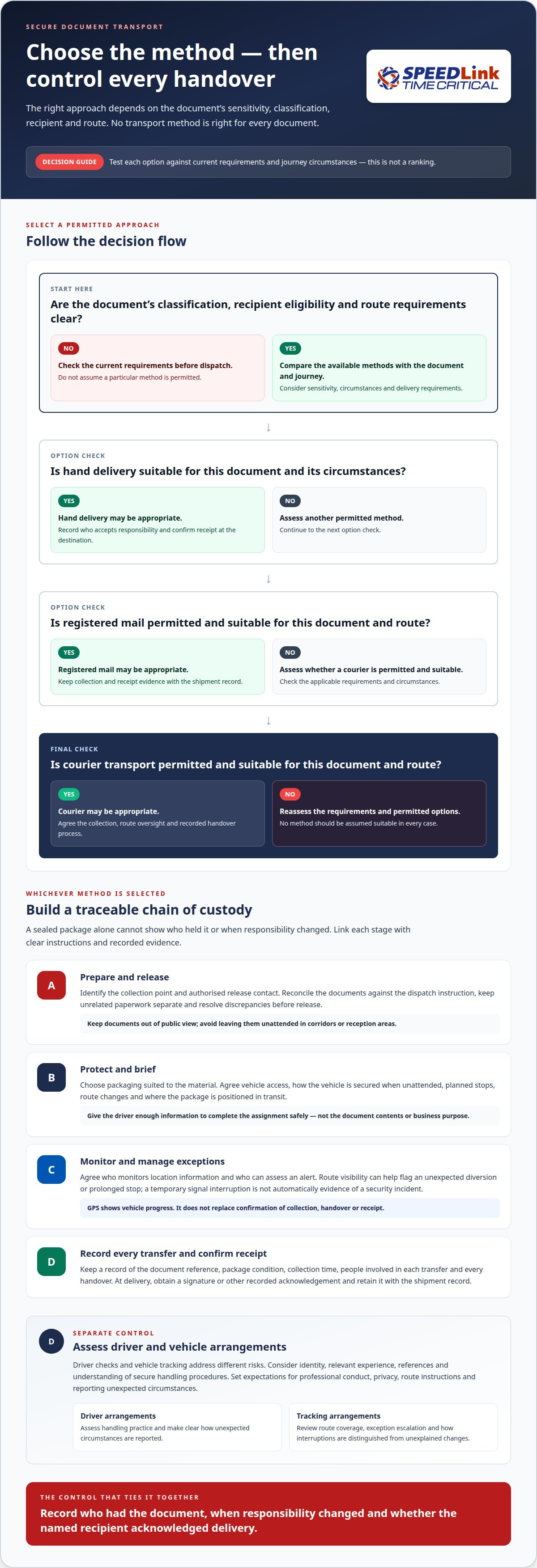
What are the safest ways to transport confidential documents?
Choose a transport method based on urgency, distance, document volume and the recipient’s availability. A small, time-critical original may suit hand-carry, with a designated courier accompanying it. A dedicated vehicle can work for a direct road journey or a larger consignment. For routine records, a standard delivery service may be proportionate if its routing and handling meet the requirement.
Consider the full journey before selecting a mode. Direct road transport avoids the transfers that can occur on a multi-stage route. Air transport may suit longer distances when timing is the main constraint, but airport processing and onward delivery are also part of the journey. For personnel hand-carrying documents through London and the Home Counties, arranging private transfers via fleetminicabs.com can help maintain a direct and reliable connection to departure terminals. The fastest leg alone does not determine the most suitable end-to-end option.
Recipient readiness also matters. Confirm that the destination can accept the consignment during the planned arrival window, and identify an alternative arrangement if the intended department is unavailable. For example, a legal team preparing for a hearing may need files delivered to a named office before staff begin reviewing them.
For international movements, include the origin, destination and relevant customs paperwork in the planning brief. Keep shipment descriptions accurate without adding unnecessary detail about the documents’ contents. The route, transfer points and destination procedures all affect which transport mode is practical.
Assess the document’s business impact as well as its sensitivity. Replacing a routine copy may allow a less urgent service; an original contract or time-critical filing may justify a more direct option. Balance urgency against route complexity, handling needs and the consequences of delay. This helps you choose a proportionate method instead of defaulting to the most intensive option.
A clear plan should also address disruption: identify who can approve a route change, how the recipient will be updated and what happens if delivery cannot proceed. Discuss secure document transport
SpeedLink Transport Limited
SpeedLink Transport Limited helps organisations plan document movements around urgency, route and handling requirements. For a time-sensitive UK movement, SpeedLink’s Same Day Courier service can suit a direct collection and delivery. For eligible European consignments, its EU shipping with customs clearance supports cross-border movement alongside the required shipment documentation.
For document movements requiring specific vetting or security arrangements, contact SpeedLink to confirm what is currently available. Classified material must follow applicable authorised procedures. Clear collection details and recipient information help shape the transport plan.
When discussing a movement with SpeedLink, share the origin, destination, urgency and any specific handover requirements. These details give the operations team practical information to assess the route and suitable service.
Make secure document movements part of the plan
Make transport a defined part of your organisation’s information-handling policy. Assign an internal owner for each movement, specify who can approve changes, and decide how to escalate exceptions. This gives operations, legal and records teams a shared basis for action when plans change.
For recurring requirements, document the workflow alongside existing records procedures. A consistent approach to transporting confidential documents helps teams apply the same decision-making principles across departments and locations, rather than relying on informal arrangements or individual memory.
Before arranging a movement, bring together the practical details: the required delivery outcome, intended recipient and any handling constraints. A clear brief helps define what the transport plan needs to support.
With responsibilities clearly defined, your team can manage each movement with greater clarity.
Frequently Asked Questions
What Happens When Sensitive Documents Fall into the Wrong Hands?
Unauthorised access can expose personal, commercial or legal information, creating risks such as identity misuse, fraud, reputational damage or disruption to a case. The consequences depend on the contents and who can use the information. Misplaced contract drafts, for example, could reveal negotiation positions, while exposed personnel records could compromise individuals’ privacy. Treat suspected exposure as an information security incident.
How should confidential documents be packaged for transport?
Choose packaging that protects papers from accidental opening, weather and bending during routine handling. Put documents in a secure inner envelope or folder, then use a suitably sized outer package that keeps them flat and conceals their contents. For a mixed consignment, separate files using distinct internal references. Before dispatch, check that the seal is intact and no paperwork is visible through the packaging.
What chain-of-custody procedures should be used when transporting sensitive documents?
Define who can release and receive the consignment, and who can authorise changes. If the intended recipient is unavailable, for example, the delivery process should identify an authorised alternative or return route instead of allowing an informal handover. Keep the dispatch record, exception notes and proof of receipt together under the same shipment reference. This helps reconstruct decisions as well as physical handovers.
How should confidential documents be labelled without revealing sensitive information?
Use a neutral shipment reference, the recipient organisation’s name and the destination address. Avoid case titles, patient names, project names or labels such as “confidential” unless handling rules specifically require them. Keep detailed contents information in a controlled internal record linked to the neutral reference. Authorised staff can then identify the consignment without advertising its subject.
What security risks arise when transporting confidential documents?
Risks include loss, theft, unauthorised inspection, misdelivery, damage and exposure through careless labelling or paperwork. A package may also be handed to someone without authority or left unattended during a route disruption. Electronic notifications can create another exposure if they display sensitive file names. Assess the document contents, route, recipients and communication process together: a weak point in any one can undermine the other controls.
What should you do if confidential documents are lost or stolen in transit?
Promptly notify your organisation’s designated security or privacy lead, then report the incident to the transport provider through its incident channel. Record when the package was last accounted for, its reference, contents category and known route events. Preserve tracking and handover records, and restrict further disclosure of shipment details. The organisation should assess potential access, follow its incident response procedure and determine whether any applicable notification duties arise.

Article by
Dave McMillen
I have worked in courier and logistics for over 30 years. My experience spans two continents and several types of services from road freight to airlines and specialist B2B services. SpeedLink has been serving the UK market for over 20 years providing the finest time critical and specialist services supporting businesses and individuals alike.
Disclaimer
Information is provided as general logistics guidance and is not legal, customs, aviation, medical or dangerous-goods compliance advice.
Rules vary according to commodity, quantity, classification, packaging, origin, destination, transport mode and carrier.
Regulations and carrier requirements may change.
Where regulated goods are involved, current requirements should be confirmed with the appropriate government authority, regulator, carrier or qualified specialist before shipment.
SpeedLink can confirm the transport options it can provide for a particular shipment.


