


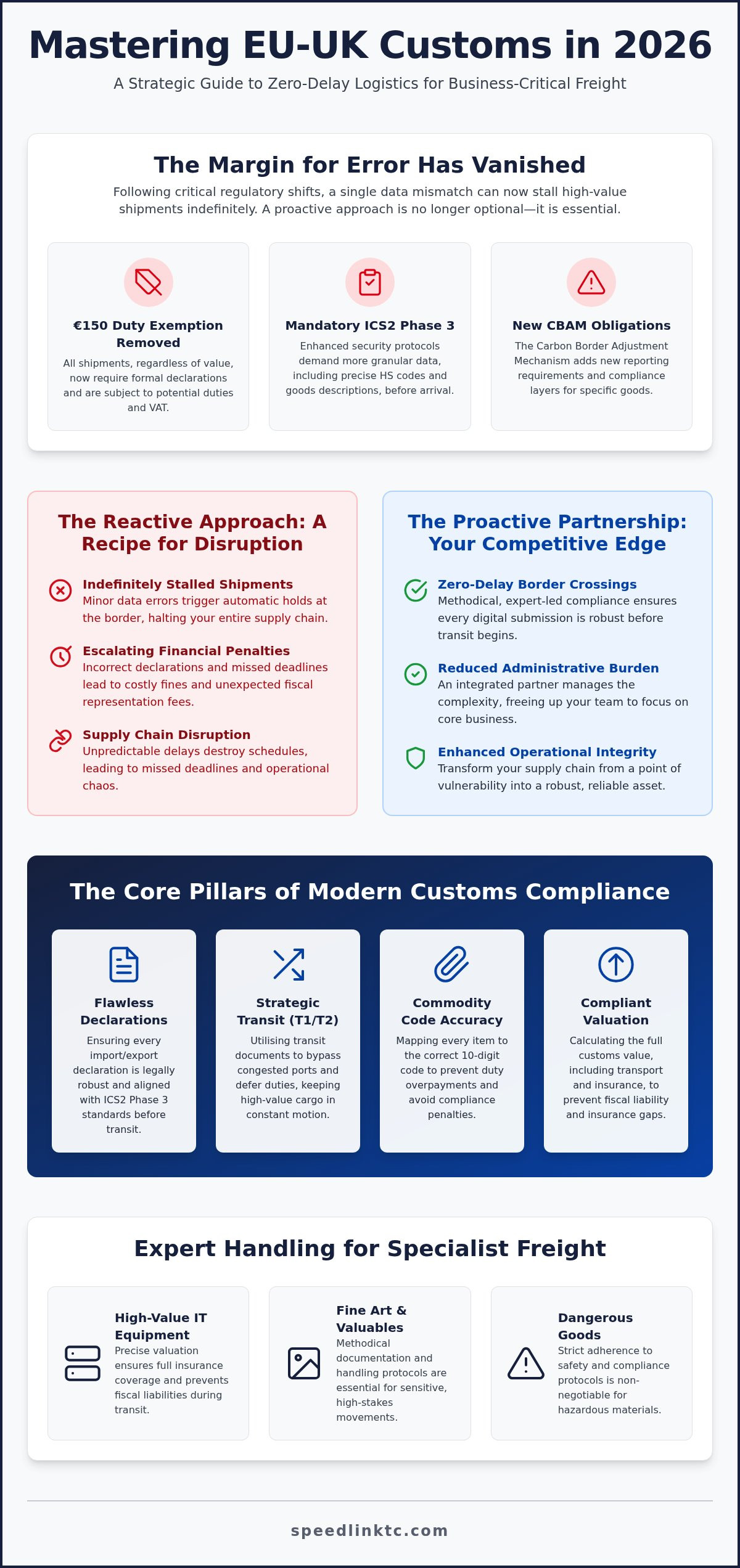
In 2026, the margin for error in cross-border logistics has effectively vanished. Following the removal of the €150 duty exemption in July and the mandatory shift to ICS2 Phase 3, a single data mismatch now has the power to stall high-value shipments indefinitely. You’re likely aware that unpredictable border delays and hidden fiscal representation costs aren’t just administrative nuisances; they’re direct threats to your operational integrity. We understand that for business-critical cargo, the standard mass-market approach to customs brokerage for EU freight often lacks the precision and personal accountability your industry demands.
This guide provides the strategic insights you need to master the latest regulatory shifts, from navigating new CBAM account obligations to ensuring seamless transit for sensitive goods like IT equipment or fine art. We’ll examine how a methodical, expert-led approach to compliance can transform your supply chain from a point of vulnerability into a competitive advantage. By the end of this article, you’ll have a clear roadmap for achieving zero-delay border crossings and reduced administrative burdens, ensuring your freight moves with absolute certainty across every European border.
Key Takeaways
- Understand why the 2026 trade landscape requires a proactive approach to customs brokerage for EU freight to mitigate the risk of impounded shipments.
- Learn how to apply precise commodity codes and valuation methods to eliminate tariff classification errors and unexpected compliance costs.
- Gain expert insights into the specialised handling requirements for dangerous goods and high-value technology assets during the customs clearance process.
- Evaluate the operational benefits of integrated courier-broker partners versus standalone services for time-sensitive, business-critical logistics.
- Prepare your supply chain for the latest ICS2 Phase 3 requirements and CBAM obligations to ensure seamless, zero-delay movement through EU-UK border controls.
The Critical Role of Customs Brokerage in Post-Brexit EU Trade
Effective customs brokerage for EU freight has evolved from a back-office administrative task into a high-stakes strategic function. Since the full implementation of the Customs Declaration Service (CDS) and the 2026 removal of the €150 duty exemption, the margin for error has effectively vanished. A professional customs broker doesn’t merely submit digital declarations; they act as an operational shield against border seizures and escalating financial penalties. If you treat customs as an afterthought, you risk more than just fines. You risk permanent reputational damage and the total disruption of your supply chain integrity.
We’ve observed a definitive shift toward specialised freight requirements where general cargo handling is no longer sufficient. Reactive brokerage leads to stalled vehicles and missed deadlines. Proactive brokerage involves verifying commodity codes and ensuring all fiscal representation is established well before the vehicle reaches the port. For business-critical movements, this methodical control is the only way to maintain a predictable schedule in an increasingly regulated environment.
Understanding Import and Export Declarations
In 2026, the essential data set for EU-UK movements requires granular detail. Every declaration must align with the latest ICS2 Phase 3 standards, providing precise goods descriptions and HS codes to satisfy enhanced security requirements. SpeedLink facilitates this complex relationship between your business and Border Force, managing the transition between simplified procedures and full declarations depending on your specific urgency. By utilising our customs services, you ensure that every digital submission is legally robust and operationally sound before the wheels even turn.
The Value of Transit Services (T1 and T2)
When speed is your primary objective, moving goods under customs supervision becomes a vital strategic tool. Transit documents, specifically T1 and T2, allow freight to move through the EU without immediate duty payment at the first point of entry. This is particularly effective for bypassing congested border points where traditional clearance might cause significant delays. We manage these European logistics by opening and closing transit movements at authorised inland facilities, ensuring your cargo stays in motion whilst duties are deferred to the final destination. This level of precision is essential for maintaining the safety and compliance of dangerous goods and other time-sensitive assets.
Navigating Tariff Classification, Valuation, and Compliance
Precision is the foundation of high-stakes logistics. In the 2026 trade environment, misclassifying a single shipment can trigger an audit that spans years of historical data. Expert customs brokerage for EU freight ensures that every item is mapped to the correct ten-digit commodity code, preventing the financial leakage of overpaid duties. Under the current EU customs regulations, the burden of proof rests entirely with the trader, making methodical documentation a non-negotiable requirement. Interpreting the Trade and Cooperation Agreement (TCA) requires a deep understanding of Rules of Origin to benefit from zero-tariff trade by proving your goods meet specific criteria, whilst managing the complexities of dual-use goods requires strict adherence to export licensing protocols.
Mastering Commodity Code Accuracy
Accuracy isn’t just about avoiding fines; it’s about operational certainty. If you’re unsure about a product’s classification, we recommend applying for Binding Tariff Information (BTI) to secure a legal guarantee from customs authorities for up to three years. Our experts perform rigorous audits of your commodity codes to identify misclassifications that could lead to significant duty overpayments or HMRC penalties. This proactive approach is essential when dealing with restricted items that require specific export licences for EU markets, ensuring compliance before the vehicle departs.
Valuation Methods for Specialised Freight
Determining the “Transaction Value” for high-value assets requires more than just the invoice price. You must factor in transport costs, insurance premiums, and even royalties to arrive at a compliant customs value. This is particularly critical for our IT equipment courier service, where precise valuation prevents insurance gaps and ensures full recovery in the event of a claim. For fine art or sensitive technology, a valuation error doesn’t just stall the shipment; it creates a fiscal liability that can take months to resolve. If you require assistance with complex valuation structures, you can reach out to our strategic advisors for a detailed review of your current processes.
Handling Specialist Freight: Dangerous Goods and High-Value Assets
High-value technology and fine art require specific procedural frameworks to avoid unnecessary tax liabilities. For instance, moving exhibition pieces or high-end IT hardware often necessitates the use of ATA Carnets or Temporary Admission regimes. These mechanisms allow goods to enter the EU without the immediate payment of VAT or duties, provided they’re destined to return to the UK. Managing these Customs clearance documents with precision prevents the “stuck at port” scenarios that frequently plague less experienced operators. If you’re managing complex movements of specialised cargo, you can contact our specialist freight team for tailored logistical support.
Dangerous Goods and Regulatory Scrutiny
Hazardous materials demand a level of meticulousness that standard freight simply doesn’t require. The alignment between your Safety Data Sheets (SDS) and your customs declarations is a primary focus for border authorities in 2026. Any discrepancy between the hazardous classification on your transport documents and the commodity code on your customs entry will result in immediate detention. We specialise in the unique challenges of lithium battery courier services, ensuring that every piece of additional documentation for hazardous materials is present and correct. For a deeper look at managing these risks, our Dangerous Goods Courier UK guide provides a definitive framework for hazardous logistics.
Secure and Vetted Logistics
Security is as vital as compliance when handling sensitive assets. For legal documents or high-stakes corporate data, we provide customs brokerage for NPPV cleared courier services. This ensures a secure chain of custody whilst navigating the digital borders of the EU. By combining vetted personnel with disciplined customs processes, we remove the lack of accountability often found in large-scale brokerage firms. This methodical control is essential for maintaining the integrity of your most sensitive shipments from collection to final delivery.
Selecting a Customs Partner for Seamless EU Logistics
Choosing the right partner for customs brokerage for EU freight is a decision that dictates your supply chain’s resilience. Many businesses make the mistake of separating their transport provider from their customs agent, creating a fragmented process where accountability is easily lost. In 2026, the complexity of trade requires a “Control Tower” approach where the physical movement and the digital declaration are managed as a single, cohesive operation. Before appointing a partner, you must verify their ability to handle specialised cargo and confirm they hold AEO (Authorised Economic Operator) status. This certification isn’t just a badge; it’s a commitment to security and compliance that often grants your freight priority treatment at border crossings.
We’ve designed our EU shipping with customs clearance to eliminate the friction inherent in international logistics. By integrating the brokerage directly into the transport workflow, we remove the communication gaps that often lead to data errors and port delays. This model ensures that when a challenge arises at the border, the team resolving the customs query is the same team managing the vehicle. This level of methodical control is what separates a strategic logistics partner from a standard 3PL.
The Integrated Advantage
The primary risk in post-Brexit logistics is the lack of real-time visibility. When you use an integrated courier-broker, you can track your freight and its customs status simultaneously. This transparency is vital for business-critical shipments where a three-hour delay can have significant downstream consequences. A dedicated courier provides a level of personal accountability that large-scale 3PLs simply cannot match. If your shipment requires specific handling, such as dangerous goods or secure documents, an integrated partner ensures the safety protocols are reflected accurately in the customs entry from the moment of collection.
Next Steps for EU Freight Success
To ensure your logistics remain robust throughout 2026, we recommend conducting an immediate customs audit of your current supply chain. Verify that your EORI and VAT numbers are correctly registered for the latest EU requirements and that your data sets align with the granular needs of ICS2 Phase 3. If you’re struggling with unpredictable delays or complex tariff classifications, it’s time to transition to a more disciplined logistics model. You can contact SpeedLink for a specialised EU customs consultation to review your current processes and secure your border operations.
Securing Your Supply Chain for 2026 and Beyond
The transition to a more rigorous trade environment in 2026 leaves no room for logistical ambiguity. Proactive compliance and the methodical application of commodity codes are no longer optional strategies; they’re essential requirements for maintaining border velocity. By consolidating your transport and clearance into a single, cohesive workflow, you eliminate the handover risks that frequently lead to costly delays and compliance failures. Whether you’re moving high-security documents or hazardous materials, the key to success lies in choosing a partner that prioritises precision over volume.
We provide the operational authority needed to manage these complexities, offering specialist ADR and dangerous goods handling alongside NPPV cleared logistics for your most sensitive assets. Our integrated approach ensures that your customs brokerage for EU freight is managed by experts who understand the physical nuances of your cargo. If you’re ready to achieve zero-delay results and full regulatory compliance, it’s time to elevate your logistics strategy. Streamline your EU trade with SpeedLink’s specialised customs brokerage today and move your freight with absolute confidence.
Frequently Asked Questions
What is the role of a customs broker for EU freight in 2026?
In 2026, a customs broker for EU freight acts as your legal representative and strategic consultant for all cross-border movements. Beyond simply filing digital declarations, they manage complex requirements like the Carbon Border Adjustment Mechanism (CBAM) and Import Control System 2 (ICS2) Phase 3 filings. By verifying commodity codes and establishing fiscal representation, they ensure your cargo meets all Union Customs Code standards before it reaches the point of transit.
Do I need a customs broker for every shipment to the EU?
Whilst businesses are legally permitted to submit their own declarations via the Customs Declaration Service (CDS), most organisations find that the risk of error outweighs the cost of professional representation. For business-critical freight where delays aren’t an option, a broker provides the necessary technical expertise to navigate 2026’s stricter data requirements. This is particularly vital for specialised cargo like dangerous goods or high-value IT equipment that requires precise handling protocols.
How much does customs brokerage for EU freight typically cost?
The cost of customs brokerage for EU freight varies significantly based on the complexity of the cargo, the volume of entries, and the level of urgency required. Factors such as the need for specialised transit documents, the number of distinct commodity codes per shipment, and whether the goods require temporary admission also influence the final fee structure. We recommend requesting a tailored quote based on your specific supply chain requirements to ensure all compliance costs are accurately accounted for.
What documents are required for customs clearance after Brexit?
Standard requirements for EU-UK trade in 2026 include a commercial invoice, a detailed packing list, and a valid EORI number for both the importer and exporter. Depending on the nature of the freight, you might also need a Safety Data Sheet (SDS) for hazardous materials or an ATA Carnet for temporary movements like exhibitions. Ensuring these documents align perfectly with your digital declarations is the most effective way to prevent border seizures and administrative penalties.
Can a customs broker help with T1 and T2 transit documents?
Yes, a specialist broker facilitates the creation and management of T1 and T2 transit documents to allow goods to move under customs control without immediate duty payment. This process is essential for bypassing congested border points by deferring the final clearance to an inland facility or the final destination. We manage the opening and closing of these transit movements, providing the necessary guarantees to ensure your freight remains in motion whilst maintaining full regulatory compliance.
What happens if my EU freight is delayed at the border due to paperwork?
If your freight is delayed due to documentation errors, it’s typically moved to a secure holding area whilst the discrepancy is investigated by Border Force or EU customs authorities. This often results in significant storage charges, financial penalties for incorrect data, and the potential loss of time-sensitive contracts. A proactive customs broker resolves these issues by liaising directly with authorities and amending digital entries in real-time to release the cargo as quickly as possible.

Article by
Dave McMillen
I have worked in courier and logistics for over 30 years. My experience spans two continents and several types of services from road freight to airlines and specialist B2B services. SpeedLink has been serving the UK market for over 20 years providing the finest time critical and specialist services supporting businesses and individuals alike.
Disclaimer
Information is provided as general logistics guidance and is not legal, customs, aviation, medical or dangerous-goods compliance advice.
Rules vary according to commodity, quantity, classification, packaging, origin, destination, transport mode and carrier.
Regulations and carrier requirements may change.
Where regulated goods are involved, current requirements should be confirmed with the appropriate government authority, regulator, carrier or qualified specialist before shipment.
SpeedLink can confirm the transport options it can provide for a particular shipment.


