


Did you know that under standard carrier regulations, a masterpiece valued at £1 million might only be legally protected for roughly 60 cents per pound? This statutory liability limit represents a significant financial risk for collectors and galleries who mistake standard transit terms for comprehensive fine art shipping insurance. We recognise the underlying anxiety that accompanies the movement of high-value assets, particularly when international customs inspections and manual handling introduce variables that feel outside your control. It’s a common concern that a single logistical oversight could lead to an underinsured loss or a frustratingly complex claims process.
In this guide, we’ll show you how to eliminate these risks by securing ‘nail-to-nail’ coverage that aligns with the 2026 industry standard of insuring at 110% of appraised value. We’ll examine why the current soft market offers unique opportunities for flexible terms and how integrating specialist customs expertise prevents damage before it occurs. By the end of this article, you’ll have a clear strategy for protecting your portfolio with precision, ensuring your requirements are handled by seasoned experts who value reliability above all else.
Key Takeaways
- Understand why specialist fine art shipping insurance is vital to bridge the coverage gap left by standard business policies that typically exclude assets once they leave your premises.
- Identify the operational advantages of ‘nail-to-nail’ protection, which secures your assets from the moment of de-installation until they are safely hung at their destination.
- Learn how to utilise pre-transit condition reports and route risk assessments to create a robust evidentiary foundation for any future claims.
- Explore the strategic integration of expert handling and precise customs clearance to prevent the invasive inspections that often lead to transit damage.
- Discover how ‘Depreciation and Loss of Value’ clauses protect the long-term financial integrity of your collection beyond basic restoration costs.
What is Fine Art Shipping Insurance and Why is it Essential?
Fine art shipping insurance is a specialist form of inland marine insurance designed to secure physical assets against loss or damage whilst they are in transit. Most commercial property policies are tethered to a specific “insured location”; they offer robust protection for pieces on the wall but often terminate coverage the moment an item leaves the premises. We find that many collectors and galleries operate under the false assumption that their existing portfolio insurance extends to the road. In reality, the logistics phase represents the highest period of vulnerability for any collection.
Distinguishing between carrier liability and first-party cargo insurance is the first step toward true risk mitigation. While a fine art courier maintains professional standards, their legal liability is often capped by international conventions. This gap leaves the owner exposed to the risks of art theft and accidental damage that exceed those basic limits. Fine art shipping insurance serves as valuation-based protection that mirrors the market worth of the asset, rather than a weight-based calculation that treats a masterpiece like bulk freight.
Standard Carrier Liability vs. Specialist Art Insurance
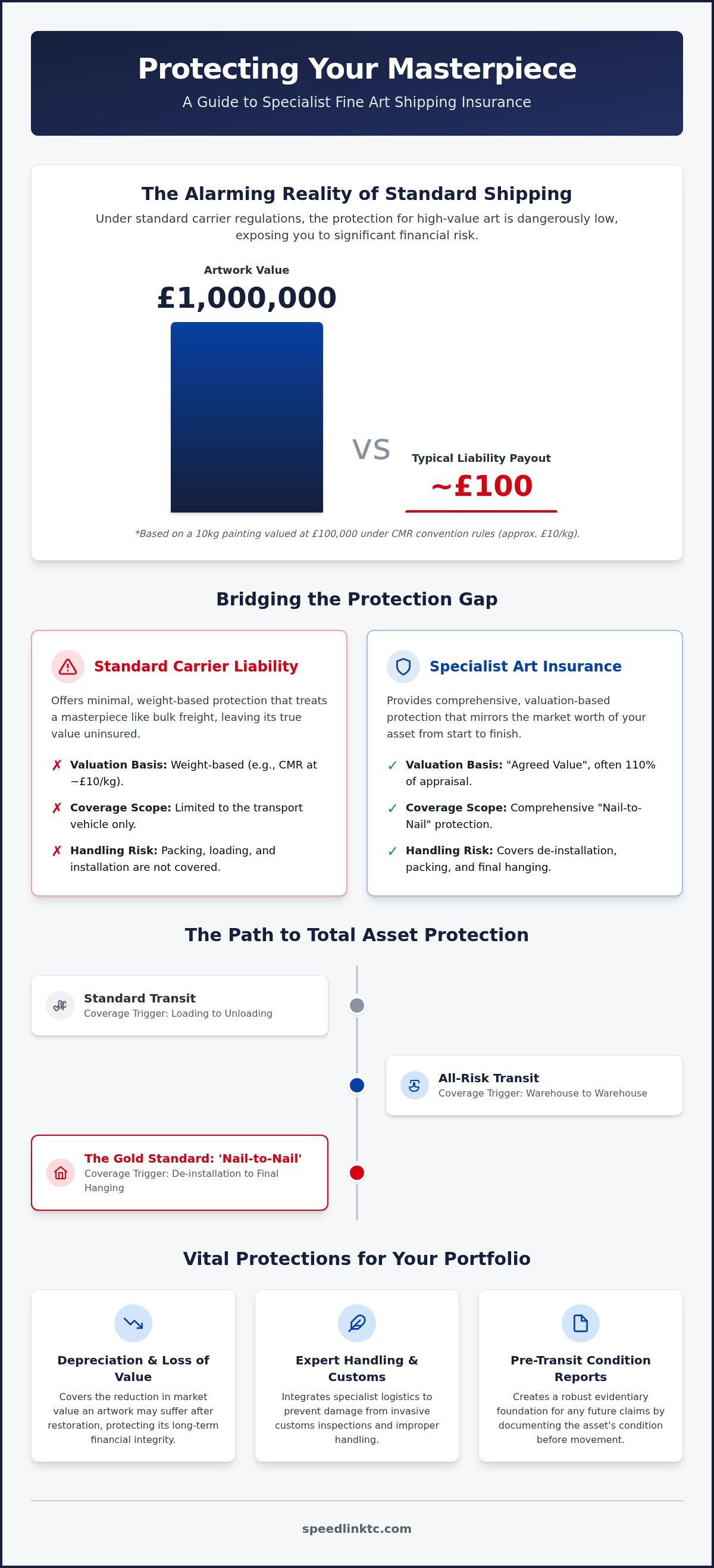
The danger of relying on standard transit terms lies in the “Convention on the Contract for the International Carriage of Goods by Road” (CMR). Under these rules, a carrier’s payout is typically restricted to approximately £10 per kilogram. If a painting worth £100,000 weighs only ten kilos, the maximum recovery without specialist insurance would be a negligible £100. This discrepancy is why we advise clients to secure “Agreed Value” coverage. Unlike “Actual Cash Value” policies that may factor in depreciation, an agreed value policy ensures that you receive the full appraised amount, often set at 110% to account for market appreciation during the transit period.
Types of Coverage: From ‘In-Transit’ to ‘Nail-to-Nail’ Protection
Selecting the right fine art shipping insurance requires an understanding of where risk actually begins and ends. While basic policies only cover the period when an asset is on a vehicle, “nail-to-nail” protection offers a more comprehensive solution. This coverage activates the moment a piece is de-installed from its original location and remains in effect through packing, transit, and customs handling until it is safely hung at its final destination. For high-stakes movements, such as loans to international exhibitions, this seamless continuity is non-negotiable.
A critical component often overlooked by generalist brokers is the “Depreciation and Loss of Value” clause. If a sculpture is damaged and subsequently restored, its market value may still decrease significantly despite a perfect physical repair. Specialist policies ensure that the settlement covers not just the cost of restoration, but also the financial difference between the pre-damage appraisal and the post-restoration valuation. We recommend that clients verify these clauses before any movement to ensure their portfolio’s capital value remains intact.
| Feature | Standard Transit | All-Risk Transit | Nail-to-Nail |
|---|---|---|---|
| Valuation Basis | Weight-based (CMR) | Declared Value | Agreed Value |
| Coverage Trigger | Loading to Unloading | Warehouse to Warehouse | De-installation to Hanging |
| Handling Included | No | Limited | Full Professional Handling |
Key Exclusions and ‘Fine Print’ to Organise
Even the most robust fine art shipping insurance contains specific exclusions that require proactive management. “Inherent vice” is a standard exclusion; it refers to damage caused by the natural qualities of the object itself, such as a canvas stretching due to its own weight or unstable pigments fading. Atmospheric conditions, including extreme humidity or temperature shifts, are also typically excluded unless the transport is conducted via climate-controlled units. If you are planning a complex movement through varying climates, it is wise to consult with a specialist handler to align your logistics with your policy requirements. Additionally, be aware that “Inventory Shortage” is rarely covered without physical evidence of theft, and international movements may still be subject to “Terrorism and War” exclusions depending on the route risk.
Evaluating Your Risk: A Professional’s Checklist for Art Transit
Risk mitigation is not merely a byproduct of a policy; it’s the result of rigorous preparation. Insurance underwriters expect a high degree of “due diligence” that begins long before a vehicle arrives for collection. The foundation of this process is a comprehensive pre-transit condition report. This document provides a definitive baseline of the asset’s state, utilizing high-resolution photography and meticulous notes to document existing vulnerabilities. Without this evidentiary trail, proving that damage occurred specifically during the window covered by your fine art shipping insurance becomes an unnecessary challenge during the claims process.
Route risk assessment serves as another vital pillar of asset protection. We evaluate variables such as urban congestion in major transit hubs and the specific hazards associated with international flight transfers. Every instance where a crate is handled by third-party ground staff represents a spike in the risk of accidental impact or environmental exposure. Opting for Specialist Fine Art Transport ensures that your assets remain within a controlled, professional environment, significantly reducing the probability of ever needing to file a claim.
The Role of Security and Vetted Personnel
Integrating Logistics and Insurance for Total Asset Protection
A “logistics first” strategy remains the most effective form of fine art shipping insurance. While a financial payout covers the monetary loss, it cannot replace the cultural or historical significance of a damaged masterpiece. We view insurance as a secondary safeguard; the primary defence is a methodical handling process that eliminates the need for a claim. This synergy requires precise coordination between your broker, the underwriter, and your Same Day Courier to ensure that every transit variable is accounted for before the vehicle departs.
Navigating Customs Clearance is a critical phase where logistics and insurance intersect. Invasive physical inspections by untrained border officials can inadvertently void insurance terms, particularly those that mandate museum-grade packing remains undisturbed. By utilising expert customs agents, we facilitate smooth transitions through international borders, ensuring that documentation like ATA Carnets is correctly handled to prevent unnecessary handling. If damage is discovered upon arrival, you must document the state of the crate and the artwork immediately, maintaining the original packing materials as evidence for the insurer.
International Art Shipping: Post-Brexit and Global Nuances
Moving assets between the UK and the EU now requires sophisticated management of Temporary Admission and VAT bonds to avoid unexpected tax liabilities. High-value hubs like Switzerland or New York present unique logistical challenges, from specific local security protocols to complex urban delivery requirements. We also advise clients to ensure their fine art shipping insurance includes a “General Average” clause for maritime or air freight. This protects you from being legally required to contribute to the losses of other shippers if a vessel or aircraft must jettison cargo during an emergency; it is a rare but significant risk in global logistics.
Securing the Future of Your Collection with Strategic Precision
Managing high-value assets in a global market requires more than just a financial safety net; it demands a strategic partnership between valuation-based coverage and museum-grade logistics. You’ve seen how “nail-to-nail” protection and rigorous pre-transit condition reports form the bedrock of a secure movement. By prioritising prevention over cure, you ensure that the financial integrity of your portfolio remains uncompromised by the limitations of standard carrier liability. True peace of mind stems from knowing that every variable, from atmospheric conditions to customs protocols, is under methodical control.
As you plan your next international movement or exhibition loan, remember that the most robust fine art shipping insurance is only as effective as the handlers who manage the physical risk. We provide the operational precision needed to navigate complex customs inspections and high-security routes with absolute confidence. Our approach integrates dedicated same-day handling for maximum security with the expertise of NPPV cleared and vetted personnel. We also provide specialist customs clearance for international art movements to ensure your assets bypass the risks of invasive inspections.
We are ready to facilitate your global requirements with precision and disciplined efficiency. Secure your high-value assets with SpeedLink’s Fine Art Courier services today and experience the reassurance that comes from working with seasoned industry experts. Your collection deserves a standard of care that matches its cultural and financial significance.
Frequently Asked Questions
What does fine art shipping insurance typically cover?
Most specialist policies provide “all-risk” coverage against physical loss or damage, including theft, accidental impact, and water damage, unless a specific exclusion applies. Unlike standard courier terms, fine art shipping insurance secures the full agreed value of the asset. This ensures that your financial interests are protected based on the artwork’s market worth rather than a generic calculation.
Why is weight-based insurance a risk for artwork?
Standard couriers often operate under CMR or RHA conditions, which limit their legal liability to a small fixed amount per kilogram. If a lightweight sketch worth £50,000 is lost or destroyed, a weight-based payout might only return a few pounds. This statutory limitation creates a massive financial deficit for the owner, making specialist valuation-based protection an operational necessity for high-value movements.
What is ‘nail-to-nail’ insurance?
Nail-to-nail insurance is the industry benchmark for comprehensive art transport. It provides continuous coverage from the moment a piece is de-installed from its original location, through every phase of packing and transit, until it is safely installed at the destination. This approach eliminates the dangerous coverage gaps that often occur when assets are moved between different “insured locations.”
Does my existing business property insurance cover art in transit?
Generally, it does not. Most standard commercial property policies are tied to a specific premises and only cover assets whilst they remain on-site. Once an item is loaded into a vehicle or handed to a third-party courier, it usually requires a specific transit rider or a separate fine art policy to ensure the protection remains active throughout the journey.
How do I calculate the insured value of a piece for shipping?
The insured value should be based on a recent professional appraisal or a commercial invoice if the piece was recently acquired. For contemporary works, the “Agreed Value” is typically set at the retail replacement cost. This ensures you can replace the work with a similar piece from the artist, maintaining the integrity of your collection even in the event of a total loss.

Article by
Dave McMillen
I have worked in courier and logistics for over 30 years. My experience spans two continents and several types of services from road freight to airlines and specialist B2B services. SpeedLink has been serving the UK market for over 20 years providing the finest time critical and specialist services supporting businesses and individuals alike.
Disclaimer
Information is provided as general logistics guidance and is not legal, customs, aviation, medical or dangerous-goods compliance advice.
Rules vary according to commodity, quantity, classification, packaging, origin, destination, transport mode and carrier.
Regulations and carrier requirements may change.
Where regulated goods are involved, current requirements should be confirmed with the appropriate government authority, regulator, carrier or qualified specialist before shipment.
SpeedLink can confirm the transport options it can provide for a particular shipment.


