


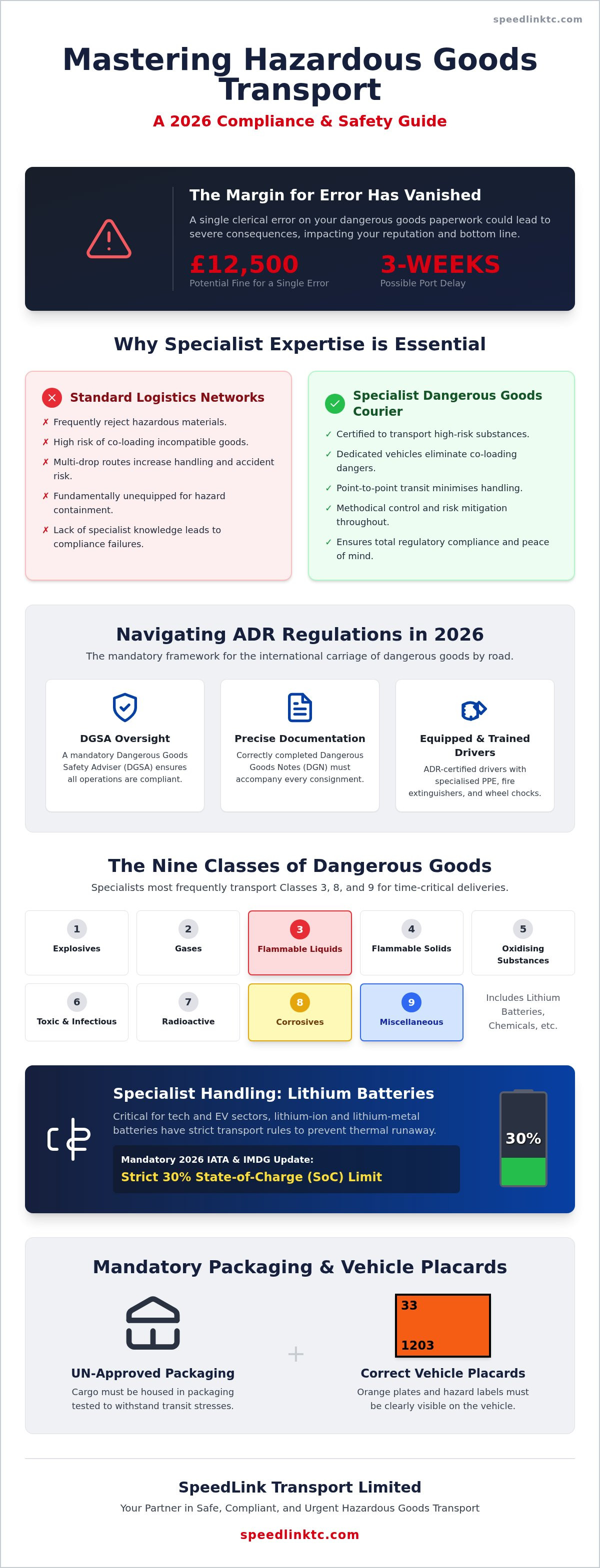
What if a single clerical error on your ADR paperwork resulted in a £12,500 fine and a three-week port delay? In 2026, the margin for error in hazardous logistics has effectively vanished, leaving many businesses fearful of shipment rejections or transit accidents. Partnering with a specialist dangerous goods courier is no longer just a logistical choice; it’s a critical strategy for safeguarding your reputation and your bottom line.
We recognise that the pressure to maintain total regulatory compliance whilst ensuring rapid delivery is immense. You need a partner who treats your cargo with the methodical control it requires. This guide provides the expert insight needed to master the complexities of hazardous transport. We’ll examine the mandatory 2026 IATA and IMDG updates, including the strict 30% state-of-charge limits for lithium batteries, and demonstrate how same-day delivery for dangerous goods can be both safe and seamless. By the end of this article, you’ll have a clear roadmap for achieving total peace of mind through expert handling and precise operational authority.
Key Takeaways
- Understand why standard logistics networks frequently reject hazardous materials and how a specialist provider eliminates the risks associated with co-loading.
- Learn how the ADR framework and the mandatory oversight of a Dangerous Goods Safety Adviser (DGSA) ensure your corporate compliance throughout 2026.
- Discover the critical distinctions between lithium-ion and lithium-metal battery transport to meet the specific safety requirements of the tech and EV sectors.
- Identify the operational advantages of using a professional dangerous goods courier for time-critical, same-day deliveries across the UK and Europe.
- Explore how NPPV-cleared couriers provide an essential layer of security for shipments that are both hazardous and high-value.
What is a Dangerous Goods Courier and Why is Specialism Essential?
A professional dangerous goods courier is a highly specialised logistics provider certified to transport substances that pose significant risks to health, safety, or property. While standard delivery services excel at moving benign consumer products, they are fundamentally unequipped to manage hazardous materials. Most general courier networks strictly prohibit these items due to the inherent dangers of co-loading. If a single chemical container leaks within a crowded multi-drop van, it can cause catastrophic fire, toxic exposure, or irreversible environmental damage. We provide the technical expertise and dedicated infrastructure required to mitigate these risks before they escalate into operational failures.
Specialism is not optional. It is a prerequisite for safety. A Dangerous goods overview reveals that these materials are substances which, because of their physical or chemical properties, require precise handling and specific vehicle configurations. Without dedicated vehicles, the risk of cross-contamination increases, and the ability to execute a rapid response during an incident is compromised. We ensure that every vehicle is equipped to handle the specific class of hazard it carries, maintaining a reassuring sense of methodical control throughout the journey.
The Risk of Non-Compliance in Hazardous Transport
If your business fails to adhere to strict transport protocols, the consequences are severe. Legal ramifications for non-compliance include unlimited fines and, in extreme cases, the potential imprisonment of company directors. Beyond the courtroom, the impact on business-critical supply chains is devastating. When goods are seized at ports or borders due to incorrect documentation, the resulting delays can stall entire production lines and damage long-term commercial partnerships. Precision in paperwork is as vital as safety in transit.
Dedicated vs. Multi-Drop Networks
Dedicated transport is the gold standard for any dangerous goods courier service. Unlike multi-drop networks that involve constant loading and unloading at various hubs, a dedicated vehicle moves your cargo point-to-point. This approach minimises physical handling and virtually eliminates the likelihood of accidents caused by shifting loads or incompatible substances. By utilising a dedicated vehicle, we ensure that your shipment remains under our direct supervision from collection to final delivery, providing the intellectual weight of a strategic advisor for your most sensitive cargo.
Navigating ADR Regulations and Compliance Standards in 2026
ADR is the Agreement concerning the International Carriage of Dangerous Goods by Road. To ensure your organisation remains compliant with these rigorous standards, the role of a Dangerous Goods Safety Adviser (DGSA) is indispensable. A DGSA monitors your transport operations, provides technical guidance, and ensures that your chosen dangerous goods courier adheres to the latest ADR version, which remains the mandatory framework for road transport throughout 2026.
Documentation serves as the legal foundation of every movement. A correctly completed Dangerous Goods Note (DGN) must accompany each consignment, detailing the UN number, proper shipping name, and hazard class. ADR-certified drivers also carry specialised equipment at all times. This includes specific fire extinguishers, wheel chocks, and Personal Protective Equipment (PPE) such as chemical-resistant gloves and eye protection. If you’re unsure whether your current documentation meets these requirements, we recommend you speak with our compliance team for a detailed review.
The Nine Classes of Dangerous Goods
Hazardous materials are categorised into nine distinct classes. These range from Class 1 (Explosives) to Class 9 (Miscellaneous Dangerous Substances). Whilst we handle a broad spectrum, same-day specialist couriers most frequently transport Class 3 flammable liquids, Class 8 corrosives, and Class 9 items. These classes often require the highest degree of urgency and precision to prevent supply chain disruption.
Packaging and Labelling Requirements
Compliance extends to the physical state of the cargo. All hazardous items must be housed in UN-approved packaging that has been tested to withstand the stresses of transit. Labelling must be durable and clearly visible. Vehicles must display the correct orange plates and hazard placards to alert emergency services to the nature of the load. While these road rules are strict, they often mirror the safety protocols found in the IATA Dangerous Goods Regulations (DGR), ensuring a high global standard of safety across all transport modes.
Specialist Handling: Lithium Batteries and Chemical Logistics
The rise of electric vehicles (EVs) and high-performance computing has triggered a surge in demand for specialist logistics. We’ve seen a sharp increase in requirements for moving lithium batteries across the UK and Europe. Unlike standard cargo, these power sources require a dangerous goods courier who understands the nuances of Class 9 hazards. SpeedLink manages this by balancing the urgent timelines of the IT sector with the methodical control required for safe transit.
It’s vital to distinguish between lithium-ion and lithium-metal batteries. Both carry the risk of thermal runaway, a phenomenon where an internal short circuit leads to a self-sustaining increase in temperature. This can result in fire or the release of toxic gases. We utilise specialised containment solutions and dedicated vehicles to mitigate these risks. While the UK follows ADR, international standards often align with global Hazardous Materials/Dangerous Goods Regulations to ensure safety across borders.
Safe Transport of Lithium Batteries
Shipping damaged, defective, or recalled batteries requires even stricter protocols. These items are often prohibited from air freight and must be moved via dedicated road transport with enhanced packaging. Our lithium battery courier service is a core competency, designed to handle these high-stakes scenarios. We ensure that even compromised units reach their destination without incident, providing a secure bridge between manufacturers and recycling centres.
Chemical and Industrial Liquid Transport
In B2B environments, the transport of flammable liquids and corrosive chemicals is a daily necessity. Our role as a dangerous goods courier extends to the safe movement of industrial solvents and laboratory reagents. We integrate comprehensive spill kits and specific containment protocols into every delivery process. Drivers are trained to manage potential leaks immediately, ensuring that your facility remains safe and compliant. If your current logistics provider lacks this level of technical depth, contact our specialist team today to secure your supply chain.
Choosing SpeedLink as Your Dangerous Goods Courier Partner
Selecting a dangerous goods courier is a strategic decision that directly influences your regulatory standing and operational continuity. We position ourselves as the premier partner for high-stakes hazardous logistics, offering a level of methodical control that standard networks cannot match. If your consignment involves sensitive materials that require an additional layer of security, our NPPV-cleared couriers provide the necessary authority to handle shipments that are both hazardous and high-value. This combination of safety certification and security clearance is essential for sectors where the margin for error is zero.
We understand that in the industrial and engineering sectors, delays are not just inconvenient; they’re expensive. Our same day courier service is specifically designed for urgent dangerous goods, ensuring your cargo moves directly from your facility to its destination without unnecessary hub handling. For international requirements, we provide EU shipping with customs clearance, managing the complex intersection of ADR regulations and post-Brexit border protocols so you don’t have to. It’s about providing a seamless transition from collection to final delivery.
Global Capability with Local Precision
Our reach extends across the continent, facilitating the compliant movement of dangerous goods to major economic centres such as Paris and industrial hubs throughout Germany. We maintain a strict focus on B2B requirements, eschewing residential parcel delivery to ensure our resources remain dedicated to professional freight standards. This precision ensures that whether you’re shipping lithium batteries or industrial chemicals, your cargo is handled by seasoned experts who value reliability above all else.
A Strategic Partnership for Your Supply Chain
We invite you to view us as a proactive guide in your logistics planning. Our team is available to consult on bespoke hazardous movements, helping you navigate the evolving landscape of 2026. For a deeper analysis of the regulatory environment, you can explore our Dangerous Goods Courier UK: The Definitive Guide. Let’s work together to build a supply chain that is resilient, compliant, and consistently efficient.
Securing Your Hazardous Supply Chain for 2026 and Beyond
The landscape of hazardous logistics is becoming increasingly complex. With the 2026 updates to IATA and ADR regulations now in full effect, the distinction between standard delivery and professional handling has never been more critical. You’ve seen how specialist knowledge in lithium battery transport and chemical safety prevents catastrophic supply chain failures. By prioritising dedicated transport over multi-drop networks, you protect your organisation from both physical risk and regulatory penalty.
Choosing a reliable dangerous goods courier provides the peace of mind that comes from methodical control. Our ADR-certified specialist drivers and dedicated B2B vehicles ensure your cargo remains under expert supervision from start to finish. With our global hazardous logistics expertise, we handle the intricacies of customs and compliance so you can focus on your core business operations. It’s time to move beyond the fear of shipment rejection and embrace a logistics strategy built on precision.
Ready to safeguard your next shipment? Request a Quote for Dangerous Goods Transport today and experience the difference of authoritative logistics. We look forward to becoming your trusted strategic partner in high-stakes transport.
Frequently Asked Questions
What items are classified as dangerous goods for courier transport?
Dangerous goods encompass any substances or articles that pose a risk to health, safety, property, or the environment during transit. These are categorised into nine specific classes, including flammable liquids like industrial solvents, corrosive acids, and toxic chemicals. We also frequently transport Class 9 miscellaneous items, such as lithium batteries and genetically modified organisms. Understanding these classifications is the first step in ensuring your shipment is handled with the necessary methodical control.
Do I need special packaging for shipping lithium batteries by courier?
Yes, lithium batteries must be contained in UN-approved packaging that has been tested to withstand the rigours of transport. The packaging must effectively prevent short circuits, movement within the outer casing, and accidental activation of the equipment. If you’re shipping damaged or defective batteries, the requirements become even more stringent, often necessitating specialised thermal containment. Using a specialist dangerous goods courier ensures that your packaging meets these mandatory safety standards for 2026.
Can dangerous goods be delivered on a same-day basis in the UK?
Dangerous goods can be delivered on a same-day basis across the UK when using a dedicated vehicle service. Unlike standard multi-drop networks, a dedicated courier moves your hazardous cargo directly from the point of collection to the final destination. This approach eliminates the risks associated with hub handling and co-loading incompatible substances. It’s the most efficient method for time-critical shipments that require both rapid transit and absolute regulatory compliance.
What is an ADR-certified driver and why do I need one?
An ADR-certified driver has undergone rigorous training to handle and transport hazardous materials safely under the Agreement concerning the International Carriage of Dangerous Goods by Road. You need one because it’s a legal requirement for transporting goods that exceed specific thresholds. These drivers possess the technical knowledge to manage spills, use specialised fire-fighting equipment, and ensure that all vehicle placarding is accurate, protecting your business from significant legal liabilities.
How much does it cost to hire a dangerous goods courier?
The cost of hiring a dangerous goods courier is determined by several specific factors, including the hazard class, the volume of the cargo, the distance of the journey, and the required level of urgency. Because hazardous transport requires dedicated vehicles and specialised driver training, it’s priced differently to standard logistics. We recommend requesting a bespoke quote to ensure all compliance requirements are factored in, providing you with a transparent and accurate cost for your specific mission.
Can you transport hazardous materials across the EU post-Brexit?
We continue to transport hazardous materials across the European Union by combining ADR compliance with expert customs clearance services. Post-Brexit, cross-border movements require precise documentation, including the Dangerous Goods Note and specific customs declarations. By managing these complexities on your behalf, we ensure that your hazardous freight moves through ports without the delays often associated with incorrect paperwork. This global capability allows your supply chain to remain fluid whilst adhering to all international safety standards.

Article by
Dave McMillen
I have worked in courier and logistics for over 30 years. My experience spans two continents and several types of services from road freight to airlines and specialist B2B services. SpeedLink has been serving the UK market for over 20 years providing the finest time critical and specialist services supporting businesses and individuals alike.
Disclaimer
Information is provided as general logistics guidance and is not legal, customs, aviation, medical or dangerous-goods compliance advice.
Rules vary according to commodity, quantity, classification, packaging, origin, destination, transport mode and carrier.
Regulations and carrier requirements may change.
Where regulated goods are involved, current requirements should be confirmed with the appropriate government authority, regulator, carrier or qualified specialist before shipment.
SpeedLink can confirm the transport options it can provide for a particular shipment.


