


In 2026, the margin for error in European logistics has effectively vanished. Since the removal of the €150 duty-free threshold on 1 July and the full implementation of the Import Control System 2 (ICS2) for road movements, a single minor oversight in your UK to EU freight services can now sideline a business-critical shipment for days. You likely recognise the mounting frustration of navigating complex customs paperwork whilst worrying if your high-value IT equipment or urgent exhibition parts will arrive intact and on schedule. It’s a high-stakes environment where unreliable delivery windows and the risk of damage in shared loads are simply no longer acceptable for a professional operation.
We’ve developed this guide to help you master these complexities and secure your supply chain against the latest regulatory shifts. You’ll learn how to achieve seamless border crossings through expert customs management and dedicated vehicle solutions that eliminate transit delays. We will also detail the specialised handling required for dangerous goods, such as lithium batteries, to ensure your most sensitive cargo remains compliant and secure from collection to final delivery.
Key Takeaways
- Understand why integrated customs clearance management has become the primary engine of speed within the 2026 landscape for UK to EU freight services.
- Learn to distinguish when to utilise dedicated vehicle solutions for time-critical assets and when economy groupage offers the most efficient route for non-urgent freight.
- Identify the specialist handling requirements for sensitive cargo, including lithium batteries and high-value IT infrastructure, to maintain security and compliance.
- Follow a strategic checklist for preparing your EU consignments to ensure reliable delivery windows and avoid common border delays.
- Gain insights into selecting a logistics partner that provides the operational authority and precision required for high-stakes business sectors.
Navigating the Landscape of UK to EU Freight Services in 2026
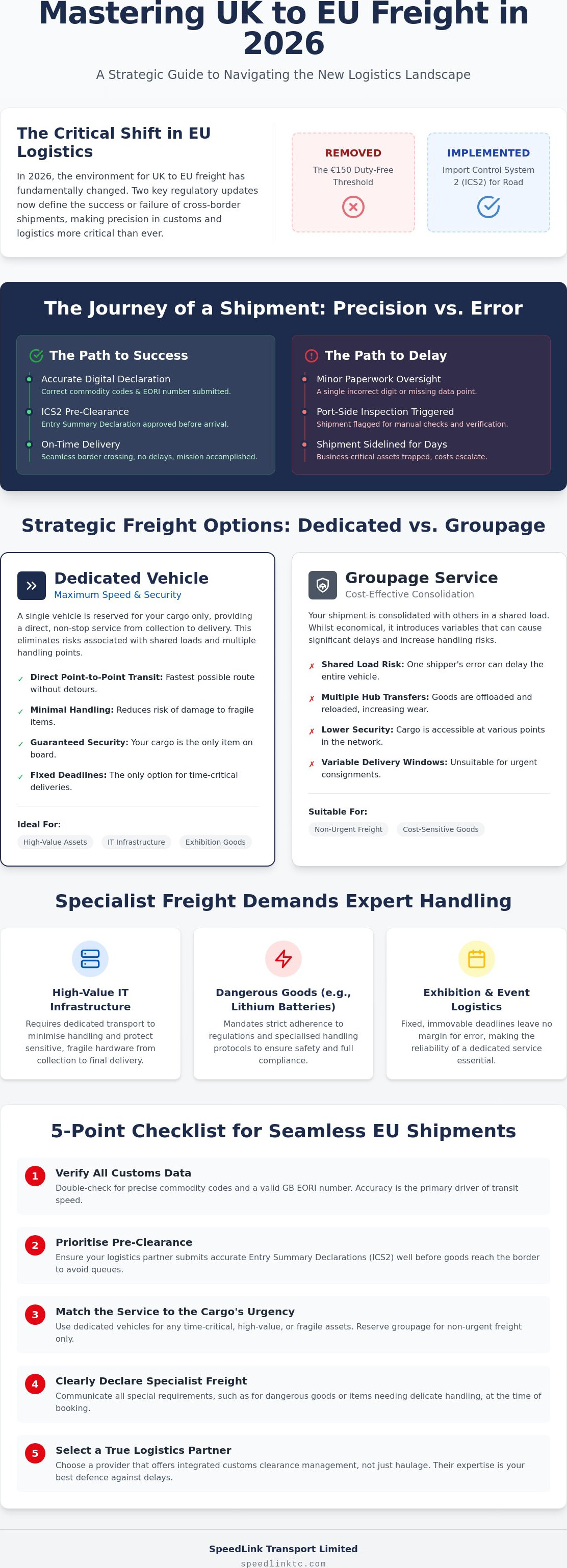
In the context of time-critical B2B needs, UK to EU freight services represent the high-precision coordination of physical transport and regulatory compliance to ensure mission-critical assets move across borders without interruption. By 2026, the industry has shifted away from simple haulage. It’s now an integrated discipline where logistics and legal expertise are inseparable. Whilst the EU-UK Trade and Cooperation Agreement provides the framework for tariff-free trade, the operational reality is defined by the rigorous data requirements of the Import Control System 2 (ICS2) and the removal of the €150 duty-free threshold. Success isn’t measured by the speed of the vehicle alone, but by the accuracy of the digital declaration that precedes it.
The Evolution of Cross-Border Logistics
Documentation that once felt like a temporary hurdle has matured into a sophisticated, permanent requirement. Precise commodity codes and valid GB EORI numbers are the baseline for any successful movement. In 2026, carriers are legally responsible for submitting accurate Entry Summary Declarations before goods even reach the border. We see that businesses prioritising end-to-end customs clearance management avoid the common bottlenecks that trap less prepared consignments in port-side inspections. Precision in paperwork is now the primary driver of transit velocity.
Why “Cheap” Often Costs More in EU Freight
Opting for the lowest-cost economy network often introduces systemic risks to your supply chain. These networks frequently consolidate diverse loads, meaning a single paperwork error from another shipper can delay the entire vehicle for days. For industrial and engineering sectors, the cost of a production line stoppage far outweighs the marginal savings of a shared load. Cheap freight often ignores the hidden expenses of customs delays and the administrative burden of resolving border disputes. True value is found in reliability and the assurance that your high-stakes cargo won’t be caught in a backlog of low-priority parcels.
Strategic Freight Options: Dedicated vs. Groupage Solutions
Selecting the optimal transport model requires a calculation of total value rather than just the initial quote. For many businesses, the choice between dedicated and groupage models is a pivotal decision that impacts both risk and reliability. Whilst economy groupage offers cost-efficiency for non-critical consignments, the inherent risks of shared loads can be prohibitive for urgent parts or high-value assets. If your shipment is time-critical, an international same-day courier using a dedicated vehicle ensures your cargo remains on a single vehicle from collection to delivery. The selection of UK to EU freight services should always align with the specific vulnerability and urgency of the cargo involved.
The Business Case for Dedicated EU Transport
Dedicated transport effectively removes the complexities and physical risks associated with trans-shipment. In a standard economy network, goods are typically offloaded and reloaded at multiple hubs, which significantly increases the likelihood of accidental damage or misrouting. By contrast, a dedicated vehicle provides direct, point-to-point transit. This method is the gold standard for several high-stakes scenarios:
- Fragile IT infrastructure: Minimising handling is the most effective way to protect sensitive hardware.
- Exhibition and Event Logistics: Fixed deadlines leave no room for the variable windows of groupage networks.
- High-Value Assets: Fine art and precision instruments benefit from the security of a locked, single-occupancy load.
Customs-Integrated Freight: The SpeedLink Advantage
Speed in 2026 is dictated by how quickly a vehicle clears the border. Our approach integrates customs documentation directly into the freight process, managing T1 and T2 transit forms to facilitate seamless movement through multiple EU member states. We strictly adhere to the official government guidance for hauliers, but we go further by pre-clearing data to avoid the common pitfalls of Roll-on/Roll-off (RoRo) freight. This methodical control keeps your supply chain moving whilst others remain stationary at the port. If you have a complex shipment requiring this level of precision, you may wish to discuss your requirements with our specialist team.
Handling Specialist Freight: Security, Danger, and Value
Standard UK to EU freight services often encounter significant friction when confronted with ADR (Accord Dangereux Routier) requirements or high-security mandates. If your consignment includes lithium batteries, hazardous chemicals, or flammable materials, you’ll need a dangerous goods courier with the specific certifications to ensure compliance across every European jurisdiction. We treat these movements as high-stakes operations where safety and regulatory adherence are the primary benchmarks of success.
We recognise that for legal, governmental, or tech sectors, the physical transport of goods is only half the requirement. Security is the other. Using NPPV cleared courier services provides a level of operational authority that generic hauliers simply cannot match. This is particularly vital when managing the Post-Brexit challenges for exporters who deal in sensitive corporate data or restricted materials. Our protocols ensure a documented chain of custody that remains unbroken from the moment of collection.
Transporting Sensitive Technology and IT Equipment
When moving IT infrastructure, the priority shifts to vibration control and climate management. We handle everything from individual server racks to entire data centre migrations with methodical precision. Every vehicle used for these assignments is equipped to protect delicate hardware, ensuring that your high-value laptops and proprietary equipment arrive ready for immediate deployment. If you’re managing a complex tech rollout across Europe, contact our specialist team to discuss a tailored security plan.
Exhibition and Event Logistics: Meeting Rigid Deadlines
Trade show logistics operate on zero-tolerance schedules where there is no room for the variable delivery windows of standard freight. If your exhibition stand or high-value prototype isn’t on-site for the opening, the entire marketing investment is jeopardised. We provide dedicated exhibition and events courier support that bypasses the uncertainty of groupage networks. By utilising a dedicated vehicle, we ensure your materials are the only priority, providing you with a guaranteed arrival time that allows your team to focus on the event itself.
Implementing a Seamless UK to EU Freight Strategy
By 2026, the success of your UK to EU freight services depends entirely on the transition from reactive shipping to a proactive, integrated strategy. It’s no longer sufficient to hand over a pallet and hope for the best. High-stakes B2B logistics demand a partner that offers real-time visibility and a granular understanding of current border protocols. We find that the most resilient supply chains are those built on professional communication and a shared commitment to data accuracy. This ensures that every stakeholder is aware of the consignment’s status as it traverses European borders.
Preparation Checklist for EU Shipments
Ensuring your cargo isn’t delayed at the point of entry requires meticulous preparation before the vehicle ever departs. Whilst the customs clearance process is complex, following a structured checklist mitigates the vast majority of risks. Precision is not optional.
- Commercial Invoices: Every item must have a precise commodity code (HS code) and a clearly stated valuation.
- VAT and Duty Verification: Confirm whether you are shipping under Delivered Duty Paid (DDP) or Delivered At Place (DAP) terms to avoid unexpected charges for the recipient.
- Packing Lists: These must match your customs declaration exactly to satisfy the requirements of the Import Control System 2 (ICS2).
Partnering for Long-Term Logistics Success
Choosing a partner for UK to EU freight services should be based on their operational authority and specialist capability rather than the lowest initial quote. A strategic consultant helps you move beyond one-off shipments toward a structured EU distribution model that scales with your business requirements. We position ourselves not merely as a carrier, but as a proactive guide for your European expansion, providing the precision and security required for legal, IT, and engineering sectors. To ensure your consignments are handled with this level of methodical control, you can organise your business-critical EU freight with SpeedLink today. Our expertise ensures that your high-value assets remain secure, compliant, and on schedule, regardless of the shifting regulatory landscape.
In addition to cargo, if your business requires the same level of precision for the international travel of individuals with health-related needs, you can learn more about RN MEDflights and their expert medical assistance for commercial flights.
Securing Your European Logistics Future
The logistics landscape of 2026 demands more than just a transport provider; it requires a strategic partner capable of navigating complex regulatory frameworks with precision. We’ve explored how the transition to integrated customs management and the use of direct dedicated vehicles can effectively eliminate the inherent risks of shared loads and border bottlenecks. Whether you’re moving high-value IT infrastructure or time-critical exhibition materials, the focus must remain on maintaining a secure, compliant, and unbroken chain of custody.
Our approach prioritises this methodical control through the deployment of NPPV cleared personnel and specialist ADR handling for dangerous goods like lithium batteries. By aligning your UK to EU freight services with an authoritative logistics expert, you ensure that your business-critical assets move across borders with the speed and reliability required in today’s high-stakes environment. We are ready to help you turn these logistical challenges into a competitive advantage for your international operations.
Contact our specialists for a tailored UK to EU freight quote and ensure your consignments are handled with the operational authority they deserve.
Frequently Asked Questions
What documents are required for UK to EU freight in 2026?
Successful transit in 2026 requires a valid GB EORI number, precise commercial invoices, and accurate packing lists that correspond to your customs declaration. Since the implementation of the final phase of the Import Control System 2 (ICS2) for road movements, carriers are also legally required to submit an Entry Summary Declaration (ENS) before the vehicle reaches the EU border. Following the 1 July 2026 regulatory update, you must also account for the removal of the €150 duty-free threshold for all commercial consignments.
How long does dedicated road freight take from London to Paris or Berlin?
A dedicated vehicle typically completes the London to Paris route within 8 to 12 hours, whilst Berlin generally requires a window of 24 to 36 hours. These transit times depend heavily on the efficiency of your customs clearance and the chosen channel crossing. Because dedicated transport bypasses the “hub-and-spoke” delays of groupage networks, it remains the most reliable method for meeting rigid business deadlines across the continent.
Can you transport lithium batteries as part of a standard freight shipment?
No, lithium batteries are classified as dangerous goods and cannot be moved through standard, unregulated freight networks. They require specialist ADR handling and must be transported by drivers with the correct certifications and vehicle equipment. Attempting to ship these items without the proper declarations often leads to significant border delays and potential legal penalties under current EU safety regulations.
What is the difference between DDP and DAP in EU freight services?
DDP (Delivered Duty Paid) means the shipper takes full responsibility for all transport costs, duties, and taxes, ensuring the recipient has nothing to pay upon arrival. DAP (Delivered At Place) shifts the responsibility for import duties and VAT to the buyer when the goods reach the destination. Choosing DDP for your UK to EU freight services is often the preferred strategic choice for B2B partnerships as it prevents shipments from being held at customs whilst waiting for recipient payment.
Do I need NPPV cleared couriers for my EU freight delivery?
You should utilise NPPV cleared couriers if your consignment involves sensitive corporate data, legal documents, or restricted government materials. Non-Police Personnel Vetting (NPPV) ensures that the individuals handling your cargo have undergone rigorous security checks. This level of vetting is essential for high-stakes sectors like the legal and tech industries where maintaining a secure and documented chain of custody is a non-negotiable requirement.

Article by
Dave McMillen
I have worked in courier and logistics for over 30 years. My experience spans two continents and several types of services from road freight to airlines and specialist B2B services. SpeedLink has been serving the UK market for over 20 years providing the finest time critical and specialist services supporting businesses and individuals alike.
Disclaimer
Information is provided as general logistics guidance and is not legal, customs, aviation, medical or dangerous-goods compliance advice.
Rules vary according to commodity, quantity, classification, packaging, origin, destination, transport mode and carrier.
Regulations and carrier requirements may change.
Where regulated goods are involved, current requirements should be confirmed with the appropriate government authority, regulator, carrier or qualified specialist before shipment.
SpeedLink can confirm the transport options it can provide for a particular shipment.


