


As of 24 June 2026, the responsibility for hazardous transport compliance no longer rests solely with the carrier; it now extends across your entire logistics chain. You’re likely feeling the pressure of these updated ADR regulations, perhaps worrying that a single oversight in lithium battery packaging or a missing document in the driver’s cab could result in heavy fines under the new three-tier risk classification system. It’s a high-stakes environment where the margin for error has effectively vanished. Finding a reliable dangerous goods courier UK is no longer just about moving a pallet; it’s about mitigating corporate risk through methodical, expert-led logistics.
We understand that post-Brexit ADR requirements and the 30% State of Charge mandate for lithium-ion batteries can feel overwhelming. This guide simplifies those complexities, offering you a clear roadmap through the latest safety protocols and vehicle standards, including the mandatory Advanced Emergency Braking systems. You’ll gain a thorough understanding of ADR classes and a practical checklist for preparing your goods for transit. By the end of this article, you’ll have the confidence to select a vetted partner who ensures your most sensitive shipments move with precision and total regulatory alignment.
Key Takeaways
- Understand the fundamental distinction between standard parcel delivery and a specialist dangerous goods courier UK so you don’t face the risks of non-compliant transport.
- Identify the specific transport requirements for each of the nine ADR classes, including high-demand items like lithium batteries and clinical samples.
- Optimise your dispatch workflow by using Safety Data Sheets to ensure accurate classification and facilitate rapid same-day collection.
- Evaluate the strategic benefits of employing NPPV-cleared couriers for sensitive hazardous items that require an enhanced level of security.
- Recognise how a collaborative partnership with a strategic logistics advisor ensures your business stays ahead of 2026 regulatory shifts.
Navigating the Complexities of Dangerous Goods Transport in the UK
Operating as a dangerous goods courier UK involves far more than simply moving a package from point A to point B. It is a highly regulated discipline that requires a fusion of specialised equipment and rigorously trained personnel. Unlike standard delivery services, a hazardous logistics provider must utilise drivers who hold valid vocational training certificates under the European Agreement concerning the International Carriage of Dangerous Goods by Road (ADR). These professionals manage vehicles specifically equipped to handle substances that pose potential risks to health, safety, or the environment. Every shipment is treated with a methodical level of control that standard networks simply cannot replicate.
Standard parcel networks are designed for high-volume, non-hazardous items; they often rely on automated sorting hubs that are entirely unsuitable for sensitive chemicals or lithium batteries. If a business attempts to bypass these requirements, they face immediate scrutiny from the Health and Safety Executive (HSE). We operate on the principle of time-critical safety. This means that while we recognise the urgency of your supply chain, we never allow speed to compromise regulatory rigour. True operational agility is only possible when it’s built upon a foundation of total compliance, ensuring that every dangerous goods courier UK movement is both swift and secure.
Why Specialist Handling is Non-Negotiable
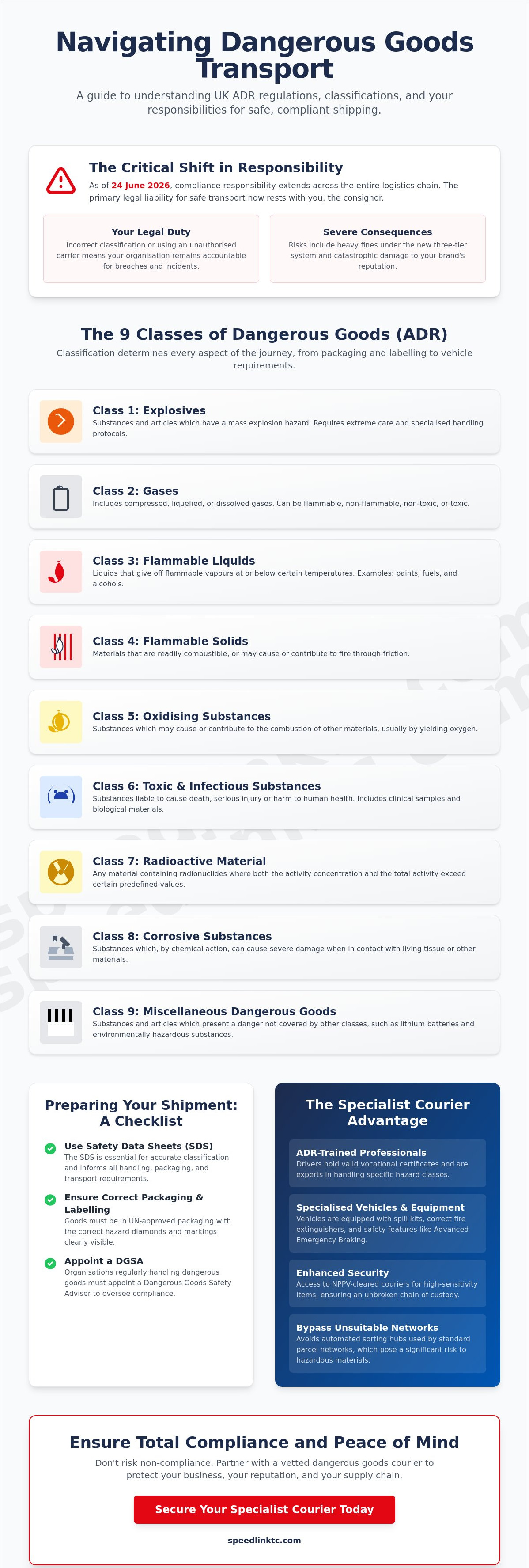
Under UK law, the primary legal liability for the transport of hazardous materials often rests with the consignor. If you dispatch a shipment that is incorrectly classified or handled by an unauthorised carrier, your organisation remains accountable for any resulting incidents or regulatory breaches. This makes the selection of a dedicated courier service UK a critical decision for your risk management strategy. Beyond the threat of heavy fines, the damage to your brand reputation following a publicised safety failure can be catastrophic. We act as your strategic partner, mitigating these risks by ensuring every movement adheres to the strictest safety protocols, protecting both your cargo and your corporate standing.
Understanding ADR Classes and UK Regulatory Frameworks
The legal foundation for hazardous transport in the UK is rooted in The Carriage of Dangerous Goods Regulations 2009. This statutory instrument aligns British law with international standards, ensuring that any dangerous goods courier UK operates within a strictly defined safety perimeter. Post-Brexit, the landscape has become more complex. While the core technical requirements remain harmonised, businesses moving goods to the EU must now contend with additional customs documentation and specific national variations. We act as a strategic guide through these shifts, ensuring your international movements remain uninterrupted by administrative friction.
Every organisation involved in the regular carriage of hazardous materials is typically required to appoint a Dangerous Goods Safety Adviser (DGSA). This expert role is responsible for monitoring compliance, investigating accidents, and preparing annual reports to ensure safety standards never slip. We work in tandem with your internal or external DGSA to ensure that the operational execution of every delivery matches the theoretical safety requirements, creating a seamless bridge between legal mandate and physical transport.
The 9 Classes of Dangerous Goods
Hazardous materials are categorised into nine distinct classes based on the type of risk they present. Class 3 (Flammable Liquids) and Class 8 (Corrosive Substances) are particularly prevalent in industrial supply chains, requiring specialised containment and specific spill-response equipment. “ADR classification determines every aspect of the journey, from vehicle marking to the specific training required by the courier.” This meticulous categorisation ensures that emergency services know exactly how to respond in the event of an incident. For shipments requiring this level of precision, engaging SpeedLink’s dangerous goods service ensures that every variable is accounted for before the vehicle departs.
- Class 1-2: Explosives and Gases.
- Class 3: Flammable Liquids (e.g., paints, fuels).
- Class 4-5: Flammable Solids and Oxidising Substances.
- Class 6: Toxic and Infectious Substances (Critical for Healthcare/Life Sciences).
- Class 7: Radioactive Material.
- Class 8: Corrosive Substances (e.g., acids, batteries).
- Class 9: Miscellaneous (e.g., Lithium batteries, environmentally hazardous substances).
Lithium Batteries: The Modern Logistics Challenge
Lithium-ion batteries present a unique thermal runaway risk, making them amongst the most scrutinised Class 9 items in 2026. Regulatory updates have tightened the requirements for State of Charge (SOC) and specific packaging certifications. It’s vital to distinguish between batteries “contained in” equipment and those “packed with” or shipped as standalone units. Each scenario demands different labelling and handling protocols to ensure safety. For a detailed breakdown of the classification rules, packaging standards, and 2026 compliance requirements, our guide on how to ship lithium ion batteries provides the strategic clarity you need. If your B2B operations depend on moving power cells at scale, our dedicated lithium battery courier service covers the full scope of 2026 IATA and ADR requirements, from UN 38.3 test summaries to state of charge mandates. If you’re unsure how these classifications apply to your specific inventory, you can contact our specialist team for expert clarification on your next dangerous goods courier UK movement.
How to Prepare Your Hazardous Shipment for Same-Day Collection
Successful hazardous logistics rely on a disciplined partnership between your dispatch team and our operations centre. Before a dangerous goods courier UK arrives at your facility, the technical groundwork must be completed to ensure both safety and legal compliance. This collaborative effort begins with the Safety Data Sheet (SDS). This document serves as the primary source of truth, informing us of the transport category, packing group, and necessary emergency response protocols. We require this data to confirm that the assigned driver holds the specific ADR qualifications required for your cargo.
UN-approved packaging is a fundamental requirement for the safe carriage of dangerous goods. These specialised containers are engineered to withstand the unique stresses of road transit, including vibration and pressure changes. Sourcing these through verified industrial suppliers ensures that your chemicals, gases, or batteries remain secure throughout their journey. Without the correct performance-tested packaging, a shipment cannot legally enter the transport chain.
A Checklist for Compliant Despatch
- Step 1: Identify the UN number and proper shipping name from Section 14 of the SDS to ensure accurate classification.
- Step 2: Utilise compliant, leak-proof, or shock-resistant outer packaging that meets the specific requirements of the packing group.
- Step 3: Prepare the Dangerous Goods Note (DGN) or equivalent documentation, ensuring it’s ready for the driver to carry in the vehicle cab.
Common Labelling Mistakes to Avoid
Precision in marking is just as vital as the packaging itself. One of the most frequent causes of transit delays occurs when hazard labels are obscured by stretch wrap or when businesses reuse old boxes that still display conflicting hazard marks. A professional same day courier service UK requires this information well before the vehicle reaches your loading bay. This foresight allows us to dispatch a vehicle with the appropriate safety equipment and ADR placarding. If you’re unsure about the specific packaging requirements for your next dangerous goods courier UK shipment, get in touch with our hazardous logistics specialists for immediate assistance.
Choosing the Right Dangerous Goods Courier: The SpeedLink Advantage
Selecting a dangerous goods courier UK requires a partner who balances regulatory precision with operational speed. We don’t view hazardous logistics as a simple transaction; we act as a strategic partner that integrates directly into your supply chain. With a network of 83 service centres positioned across the country, we can organise a collection in under 60 minutes. This rapid response doesn’t sacrifice safety. Every movement follows a strict dedicated vehicle policy. We never co-load your hazardous materials with unrelated parcels, eliminating the risk of cross-contamination or incompatible chemical reactions during transit.
Our operational authority is built on a foundation of methodical control. When you entrust us with sensitive cargo, you’re benefiting from a system designed to handle high-stakes requirements with absolute calm. By maintaining a dedicated vehicle for every hazardous consignment, we ensure that the driver’s focus remains entirely on the specific safety requirements of your shipment. This approach is the only way to guarantee the level of precision that modern UK industry demands.
Security and Chain of Custody
For high-value or sensitive hazardous items, the profile of the driver is just as important as their ADR training. We provide access to NPPV cleared courier service personnel, ensuring that your shipment is handled by individuals vetted to national police standards. This is a critical component of our secure courier service. Our “Vital Link” philosophy ensures total transparency from the moment of collection to the final delivery. You maintain a direct line of sight to your cargo, which is essential for maintaining a robust chain of custody in high-stakes sectors like life sciences or industrial engineering. For organisations that also need to transport sensitive identity documents under the same rigorous chain-of-custody standards, our same day passport courier service applies the same NPPV-vetted driver protocols to ensure total security from collection to final handover.
Ready to Organise a Compliant Shipment?
Managing the complexities of hazardous transport shouldn’t distract you from your core business objectives. We handle the intricate details of vehicle placarding, driver certification, and route planning so you don’t have to. Whether you’re moving lithium batteries or corrosive industrial chemicals, our team ensures every mile is compliant. If you’re looking for a dependable dangerous goods courier UK that prioritises safety and speed, we’re ready to assist. Contact our dangerous goods experts for a bespoke quote to secure your supply chain today.
Securing Your Hazardous Supply Chain for 2026 and Beyond
The regulatory landscape for hazardous logistics has reached a level of complexity where internal oversight is often insufficient. Successfully managing ADR classifications and the rigid requirements of UN-approved packaging is no longer just a logistical task; it’s a critical component of your risk management strategy. By selecting a specialist dangerous goods courier UK, you ensure that your operations remain resilient against the stricter enforcement and evolving safety standards that define the current market. Precision in these high-stakes movements protects both your corporate reputation and your bottom line.
We provide the operational authority needed to navigate these challenges with absolute confidence. Our processes are built on DGSA-compliant frameworks and executed by ADR-trained drivers who understand the nuances of hazardous handling. Whether you require NPPV cleared courier service personnel for sensitive items or a 60-minute collection to meet an urgent deadline, our team is equipped to handle your requirements with methodical control. Don’t leave your compliance to chance. Request an urgent quote for dangerous goods transport and partner with a consultant who values efficiency and reliability above all else. We look forward to securing your next shipment.
Frequently Asked Questions
What documents do I need to provide for a dangerous goods courier in the UK?
You must provide a current Safety Data Sheet (SDS) and a completed Dangerous Goods Note (DGN) for every hazardous shipment. The SDS allows us to verify the UN number and packing group, whilst the DGN serves as the essential legal transport document the driver carries in the vehicle cab. Without these documents, a specialist dangerous goods courier UK cannot legally accept or move your cargo on the public road network.
Can all same-day couriers transport hazardous materials?
No, standard courier networks lack the specific ADR vocational training and vehicle safety equipment required for hazardous cargo. Transporting dangerous goods without a qualified driver or a compliant vehicle is a direct violation of UK law. We utilise only ADR-certified professionals and dedicated vehicles to ensure your cargo moves within a strictly controlled safety perimeter, avoiding the risks associated with general parcel hubs.
Is it possible to ship lithium batteries internationally from the UK?
Yes, we organise international transport for lithium batteries, provided they meet the latest IATA and ADR regulatory standards. This includes adhering to the mandatory 30% State of Charge (SOC) limit for standalone batteries and ensuring all packaging is UN-certified. Businesses seeking a compliant lithium battery courier service for international B2B shipments will find that our team handles the complex customs clearance and documentation required for seamless transit across EU borders, ensuring your high-tech components reach their destination without administrative delays.
How much does a dangerous goods courier cost compared to standard delivery?
Specialist hazardous transport carries a premium over standard delivery because it involves higher operational overheads and specialised training. This investment reflects the cost of ADR-certified drivers, specialised vehicle equipment, and enhanced insurance cover. Whilst we don’t provide standard parcel pricing, the cost ensures your business is protected against the significant financial and legal risks of non-compliance. Every quote is bespoke to your specific hazard class and urgency.
What happens if my hazardous shipment is not properly labelled?
If a shipment is incorrectly labelled or marked, our drivers will refuse collection to maintain safety and legal compliance. Inadequate labelling is a primary cause of transport delays and can lead to heavy fines from the Health and Safety Executive (HSE) if an incident occurs. We recommend double-checking all hazard diamonds and UN markings against your Safety Data Sheet before your dangerous goods courier UK arrives at the loading bay.

Article by
Dave McMillen
I have worked in courier and logistics for over 30 years. My experience spans two continents and several types of services from road freight to airlines and specialist B2B services. SpeedLink has been serving the UK market for over 20 years providing the finest time critical and specialist services supporting businesses and individuals alike.
Disclaimer
Information is provided as general logistics guidance and is not legal, customs, aviation, medical or dangerous-goods compliance advice.
Rules vary according to commodity, quantity, classification, packaging, origin, destination, transport mode and carrier.
Regulations and carrier requirements may change.
Where regulated goods are involved, current requirements should be confirmed with the appropriate government authority, regulator, carrier or qualified specialist before shipment.
SpeedLink can confirm the transport options it can provide for a particular shipment.


