


If your lithium-ion batteries are packed at 31% state of charge or lack a verified UN 38.3 test summary, your entire supply chain could grind to a halt at the departure gate. You likely recognise that transporting these power sources is no longer a simple logistics task; it’s a complex exercise in strategic risk management. Many organisations feel a justified anxiety regarding the 2026 mandate for a 30% state of charge on equipment-packed shipments, especially when the threat of thermal runaway makes standard networks hesitant to accept the cargo. Securing a specialised lithium battery courier service is the most effective way to mitigate these operational dangers whilst maintaining the pace of your business.
We’ve developed this guide to help you master these intricacies, ensuring your high-value tech benefits from zero-damage transit and full regulatory alignment. You’ll learn how to navigate the 67th Edition of the IATA Dangerous Goods Regulations, including the new UN numbers for battery-powered vehicles and the essential documentation required for global compliance. We’ll also provide a framework for selecting a partner capable of delivering same-day reliability without compromising on the meticulous safety standards your business demands.
Key Takeaways
- Understand the classification of lithium batteries as Class 9 Miscellaneous Dangerous Goods and the specific physical risks that necessitate expert handling.
- Identify the correct UN numbers for your cargo and learn how to navigate the 2026 State of Charge (SoC) restrictions for compliant air freight.
- Discover why a dedicated lithium battery courier service is superior to standard hub-and-spoke networks for reducing vibration and impact damage.
- Learn how to secure sensitive IT equipment and laptop batteries through specialised transport solutions that prioritise business continuity.
- Gain a strategic framework for choosing a logistics partner who manages the legal liabilities and technical complexities of hazardous cargo.
Understanding the Risks and Regulations of Lithium Battery Transport
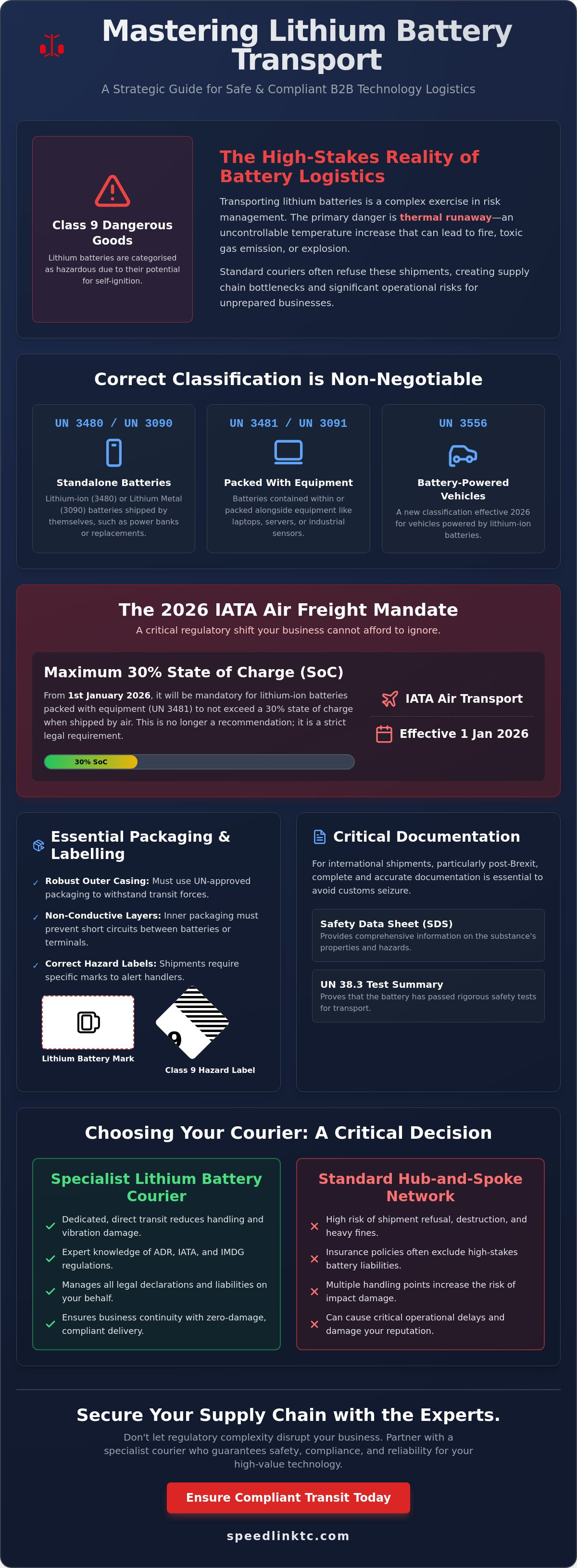
Lithium batteries are officially categorised as Class 9 Miscellaneous Dangerous Goods because they possess the unique potential to self-ignite if compromised. Unlike standard cargo, these power sources carry their own fuel and oxygen, making any resulting fire exceptionally difficult to extinguish. This inherent volatility is why a specialised lithium battery courier service is a necessity rather than a luxury for B2B tech logistics.
The primary physical risk is thermal runaway. If a battery sustains impact damage or a short circuit, internal temperatures can escalate uncontrollably, leading to electrolyte leaks, toxic gas emission, or explosive combustion. We distinguish between two main types: lithium-ion batteries, which are rechargeable and common in IT equipment, and lithium metal batteries, which are non-rechargeable and often found in industrial sensors. Each type requires specific handling protocols under the broader Dangerous Goods Regulations to prevent catastrophic failures during transit.
Standard residential couriers frequently refuse these shipments because their high-volume “hub and spoke” networks aren’t designed for hazardous containment. Their insurance policies often exclude the high-stakes liability associated with battery fires, leaving businesses that attempt to bypass these rules at risk of heavy fines and shipment destruction. If a standard network detects an undeclared battery, they’ll likely reject the entire consignment, causing critical delays to your operations. Understanding how to ship dangerous goods UK compliantly is essential to avoiding these costly disruptions, and many of the hazardous logistics myths that surround dangerous goods shipping can lead businesses to make costly regulatory mistakes.
The Legal Framework: ADR, IATA, and IMDG
Compliance is governed by three primary regulatory bodies depending on the mode of transport. ADR controls road transport across Europe, whilst IATA sets the rigorous standards for air freight, and the IMDG Code manages maritime shipments. As a shipper, you hold the legal responsibility for the correct classification, declaration, and packaging of your goods. Because these regulations are updated at least every two years, including the significant 2026 amendments regarding state-of-charge, partnering with a dedicated dangerous goods courier is the only way to ensure your documentation remains beyond reproach. Organisations operating in the life sciences sector may also benefit from understanding how specialist transport applies to other regulated categories, such as a UN3373 courier service for Category B biological substances, where the same principles of precision compliance and chain of custody are equally critical.
Classification and Compliance: UN Numbers and Packaging
Correct classification is the cornerstone of a safe lithium battery courier service. Misidentifying your cargo leads to more than just administrative delays; it creates genuine safety hazards and legal liabilities for your organisation. The United Nations (UN) classification system categorises batteries based on their chemistry and how they’re packaged for transit. Common identifiers you must recognise include:
- UN 3480: Standalone Lithium-ion batteries, which include power banks.
- UN 3481: Lithium-ion batteries contained within or packed alongside equipment.
- UN 3090: Standalone Lithium metal batteries.
- UN 3091: Lithium metal batteries contained within or packed alongside equipment.
- UN 3556: A specific new 2026 classification for vehicles powered by lithium-ion batteries.
As of 1 January 2026, the IATA Dangerous Goods Regulations mandate that lithium-ion batteries packed with equipment must not exceed a 30% state of charge (SoC) for air transport. This requirement is now a strict regulatory threshold rather than a mere recommendation. Beyond the charge level, your packaging must feature non-conductive inner layers to prevent short circuits, housed within a robust, UN-approved outer casing. Every shipment must also display the Lithium Battery Mark and, where applicable, the Class 9 hazard label to ensure handlers immediately recognise the sensitive nature of the contents.
Navigating Customs for International Battery Shipments
Post-Brexit logistics have added layers of complexity to EU shipping with customs clearance. To cross borders without incident, you must provide a comprehensive Safety Data Sheet (SDS) and a UN 38.3 test summary for every battery in your supply chain. These documents prove the product has passed rigorous safety testing and allow for accurate tax and duty assessment. We specialise in managing these declarations on your behalf, ensuring that your high-value tech isn’t impounded at the border due to clerical errors. If you’re unsure about your current documentation, you can consult our specialists for a review of your international requirements.
Specialist vs. General Couriers: Choosing the Right Service
Choosing between a high-volume parcel network and a specialised lithium battery courier service is often a decision between short-term cost-saving and long-term risk management. Standard “hub and spoke” networks rely on mass automation, where packages traverse miles of conveyor belts and undergo multiple manual handlings. For sensitive electronics, this environment introduces excessive vibration and the risk of mechanical shock. Dedicated, point-to-point delivery eliminates these variables. Your consignment remains on a single vehicle from collection to drop-off, which significantly reduces the likelihood of internal cell damage that leads to thermal runaway.
The human element is equally critical. Our drivers are ADR-trained, meaning they possess the technical knowledge to handle hazardous incidents and understand the specific chemistry of the cargo they carry. This level of expertise is rarely found in general delivery networks where speed often precedes safety protocols. When a critical component fails in a data centre or a production line halts, utilizing a same day courier service UK ensures that replacements arrive through a secure, controlled channel that maintains your business continuity.
Risk Mitigation through Dedicated Logistics
Dedicated logistics offer the “sole-occupancy” advantage. In a general network, your batteries might be stored alongside incompatible hazardous goods, such as corrosives or flammable liquids, which could exacerbate a fire. By providing a dedicated vehicle, we ensure your cargo is isolated and secure. We also provide real-time tracking and NPPV-cleared drivers for sensitive corporate assignments, offering an extra layer of security for high-value tech assets. This bespoke approach allows for collection times that fit your specific industrial or event schedule, rather than forcing you to wait for a standard carrier’s window. If you require a secure, dedicated transport solution, you can request a tailored quote from our team.
SpeedLink’s Approach to Lithium Battery Courier Services
We position ourselves as a strategic advisor rather than just a logistics provider. Our specialised dangerous goods courier UK division manages the entire lifecycle of hazardous transport, ensuring that your organisation meets its legal obligations whilst maintaining operational speed. We handle the complexity. You maintain the continuity. This partnership model allows us to provide tailored solutions for the IT transport sector, where the movement of laptop and server batteries requires a high degree of precision to prevent data loss or hardware failure.
One of the most significant challenges in modern logistics is the handling of “damaged, defective, or recalled” (DDR) batteries. Standard courier networks almost universally refuse these items due to the extreme fire risk they present. We possess the specific operational capacity and containment protocols required to move DDR units safely. By booking a dedicated vehicle through our lithium battery courier service, you ensure your shipment avoids the hazards of automated sorting centres and remains under the constant supervision of a trained professional. The process is designed for immediate action, providing a compliant pathway for even the most sensitive cargo.
Expert Handling for High-Stakes Sectors
Our expertise extends deeply into the life sciences and engineering sectors, where battery-powered medical devices and industrial tools are critical to project success. We understand that a delayed shipment in these fields can have far-reaching consequences. Utilising our specialist courier service UK for exhibition and event logistics ensures your equipment arrives on time and in perfect working order, regardless of the venue’s location. We manage the technical details of the 2026 regulatory landscape so you don’t have to. To secure your supply chain, request a quote for your lithium battery shipment today.
Securing Your 2026 Battery Supply Chain
The landscape of hazardous goods logistics has shifted from mere compliance to a critical pillar of strategic risk management. By mastering the 2026 mandate for a 30% state of charge and ensuring every cell is backed by a verified UN 38.3 test summary, your organisation avoids the costly delays of shipment rejection and border impounds. Transitioning away from general parcel networks towards a specialised lithium battery courier service ensures your high-value tech remains in a controlled, dedicated environment. This methodical approach protects both your physical assets and your corporate reputation whilst maintaining the pace of your operations.
We provide the operational authority required to navigate these high-stakes movements with absolute precision. Our ADR-trained specialist drivers and NPPV-cleared personnel are equipped to handle the most sensitive assignments, from urgent IT replacements to large-scale industrial components. With dedicated point-to-point same-day delivery, your business continuity is never left to chance. Secure your mission-critical lithium battery shipment with SpeedLink today and ensure your cargo arrives safely and compliantly. We look forward to facilitating your next high-priority delivery.
Frequently Asked Questions
Can I send lithium batteries via a standard courier service?
Most standard courier networks refuse standalone lithium batteries (UN 3480 or UN 3090) because their high-volume sorting systems aren’t equipped to manage the risk of thermal runaway. Whilst some residential carriers accept small batteries contained within equipment, they often impose strict limitations that don’t meet B2B safety or insurance requirements. For business-critical tech, a dedicated lithium battery courier service is necessary to ensure your cargo isn’t rejected or destroyed by a standard carrier during transit.
What is the maximum capacity of a lithium battery that can be shipped by air?
Lithium-ion batteries shipped as cargo are generally restricted to a maximum capacity of 100Wh per battery for most passenger aircraft configurations. Standalone lithium-ion batteries (UN 3480) are strictly forbidden on passenger aircraft and must travel via cargo-only flights regardless of their capacity. If your batteries exceed 160Wh, they require specific Dangerous Goods documentation and specialised handling protocols to remain compliant with the 67th Edition of the IATA regulations.
Do I need special training to ship lithium ion batteries for my business?
Yes, any employee responsible for classifying, packaging, or documenting lithium batteries for transport must have completed the appropriate Dangerous Goods training. The legal liability for the shipment’s safety rests entirely with the shipper, meaning your organisation must ensure that the staff preparing the consignment understand the nuances of the ADR and IATA frameworks. Partnering with a specialist courier allows you to leverage their operational expertise, but your internal declaration must still be accurate and compliant.
What happens if my lithium battery shipment is not correctly labelled?
Incorrect labelling typically results in immediate shipment rejection, border impounds, or significant financial penalties from regulatory bodies. Beyond the logistical delays, mislabelled hazardous goods create a serious safety risk for transport personnel and can lead to your business being blacklisted by major airlines or freight networks. Ensuring the Lithium Battery Mark and Class 9 hazard labels are correctly applied is a non-negotiable requirement for every consignment to avoid legal repercussions.
How much does a specialised lithium battery courier service cost?
The cost of a lithium battery courier service is determined by several factors, including the UN classification, the total weight of the batteries, and the required delivery speed. Because these shipments are categorised as Dangerous Goods, they incur specific handling surcharges that cover the cost of ADR-trained drivers and specialised containment. We recommend requesting a bespoke quote to ensure all regulatory and distance-based variables are accurately accounted for in your logistics budget based on your specific cargo requirements.

Article by
Dave McMillen
I have worked in courier and logistics for over 30 years. My experience spans two continents and several types of services from road freight to airlines and specialist B2B services. SpeedLink has been serving the UK market for over 20 years providing the finest time critical and specialist services supporting businesses and individuals alike.
Disclaimer
Information is provided as general logistics guidance and is not legal, customs, aviation, medical or dangerous-goods compliance advice.
Rules vary according to commodity, quantity, classification, packaging, origin, destination, transport mode and carrier.
Regulations and carrier requirements may change.
Where regulated goods are involved, current requirements should be confirmed with the appropriate government authority, regulator, carrier or qualified specialist before shipment.
SpeedLink can confirm the transport options it can provide for a particular shipment.


