


What if a single oversight in your logistics chain could lead to a three-tier risk classification violation under the updated June 2026 ADR regulations? You likely understand that transporting Category B infectious substances requires more than just a standard delivery partner; it demands a level of precision that general networks simply cannot provide. When the integrity of a biological specimen is at stake, relying on a specialist UN3373 courier service is no longer optional, it’s a strategic necessity for any medical or research institution.
We recognise the pressure of maintaining a perfect chain of custody whilst facing the threat of heavy fines for non-compliance. This guide will help you master the complexities of Category B transport, from the rigid P650 packaging standards to the nuances of specialist courier selection. We’ll explore how to ensure 100% regulatory compliance and seamless same day courier delivery to protect your high-stakes shipments and maintain the absolute integrity of your samples.
Key Takeaways
- Distinguish between Category A and Category B substances to ensure accurate classification under the latest ADR and IATA regulatory frameworks.
- Implement the P650 triple-layer packaging standard correctly to prevent sample degradation and mitigate the risk of heavy non-compliance fines.
- Evaluate why a dedicated UN3373 courier service offers a more secure, manual-handling environment than standard parcel networks for high-stakes biologicals.
- Utilise point-to-point delivery strategies to minimise physical vibration and maintain the environmental stability of your clinical specimens.
- Leverage specialist expertise for complex dangerous goods transport across the UK and Europe to maintain a seamless, professional chain of custody.
Understanding UN3373 Courier Services: The Category B Standard
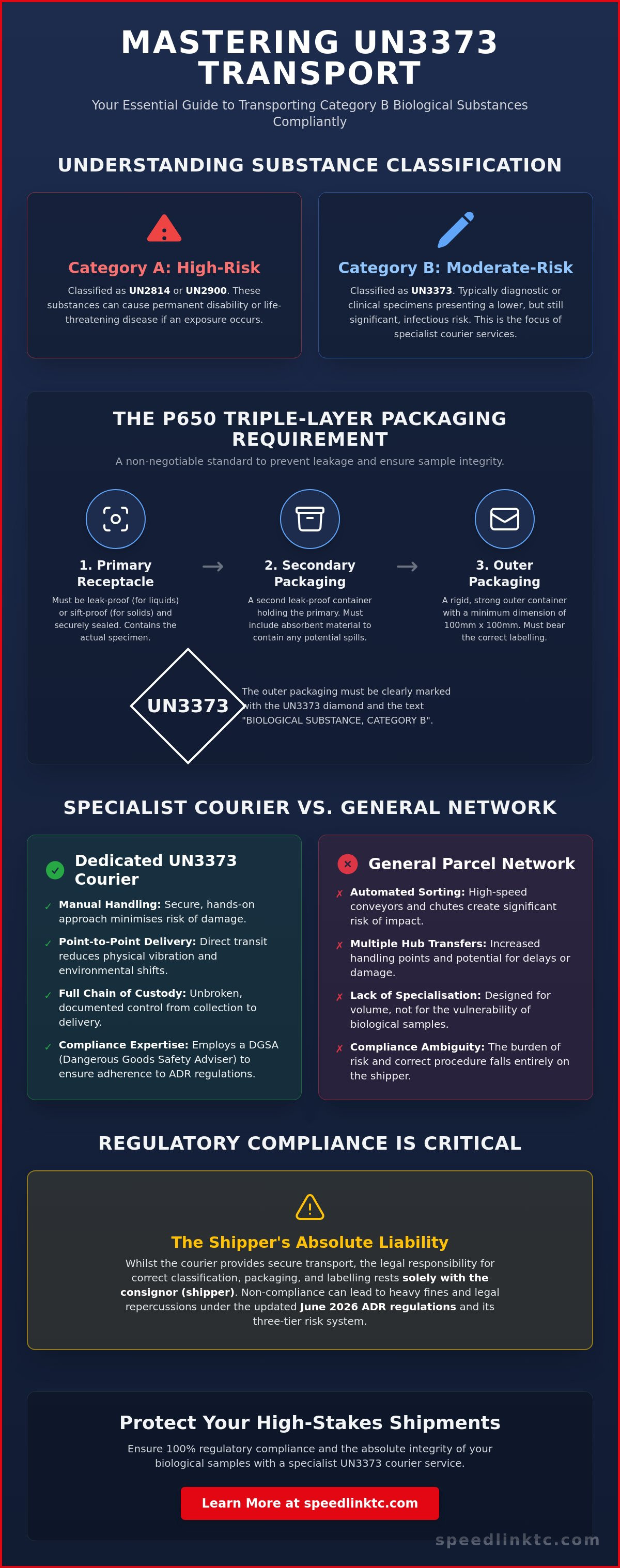
UN3373 is the specific classification for a Biological Substance, Category B under both ADR road and IATA air regulations. Unlike Category A materials, identified as UN2814 or UN2900, which are capable of causing permanent disability or life-threatening disease in humans or animals, Category B substances present a lower but still substantial risk. These typically include diagnostic specimens, excreta, secreta, or blood components being transported for research or clinical purposes. Every shipment must be handled with a level of precision that recognises the potential for infection if the contents are compromised during transit.
A professional UN3373 courier service provides the methodical control required to protect these high-stakes shipments. We act as a critical link in the clinical chain of custody, ensuring that diagnostic specimens and clinical trial samples remain secure from the point of collection to the final laboratory destination. This isn’t merely a transport task; it’s a strategic partnership designed to mitigate risk. By June 2026, the updated ADR regulations have formalised a three-tier risk classification system for violations, making it clear that accountability isn’t limited to the carrier. The liability for the consignor is absolute. If substances are incorrectly classified or poorly packaged, the legal and financial repercussions for your organisation can be severe.
The Legal Framework for UK Biological Transport
Road transport within the United Kingdom is strictly governed by the Carriage of Dangerous Goods and Use of Transportable Pressure Equipment Regulations (CDG). These rules ensure that biological materials are moved safely whilst aligning with the broader European ADR standards. It is a mandatory requirement for any specialised logistics organisation to employ a Dangerous Goods Safety Adviser (DGSA) to oversee compliance and manage operational risks. For a broader regulatory overview of how these rules apply to hazardous materials, you can consult our Dangerous Goods Courier UK pillar. This framework ensures that every participant in the supply chain understands their legal obligations, from the initial packer to the final consignee.
Compliance and Packaging: The Triple-Layer Requirement for 2026
Adhering to the P650 instruction is a non-negotiable requirement for any organisation utilising a UN3373 courier service. This standard dictates a triple-layer system designed to withstand the physical rigours of transport whilst preventing any potential leakage. The process begins with the primary receptacle, which must be leak-proof or sift-proof and securely sealed. This is then placed inside a secondary packaging layer that is also leak-proof. Crucially, you must include enough absorbent material between these two layers to contain the entire volume of the liquid contents in the event of a breach.
The final stage involves the outer packaging. This must be a rigid container with minimum dimensions of 100mm x 100mm to ensure it can be handled and labelled effectively. Under the official UN3373 packaging requirements, the exterior must clearly display the diamond-shaped UN3373 mark alongside the text “Biological Substance, Category B”. If you’re unsure about the specific materials required for your shipment, you can speak with our compliance team for technical guidance.
The Shipper’s Responsibility in the Logistics Chain
Whilst a specialist courier provides the secure transport environment, the legal responsibility for correct packaging rests solely with the consignor. This division of duty ensures that the person closest to the substance manages the initial risk. Our expertise in complex logistics extends across various sectors, which you can see in our guide on how to ship lithium ion batteries. This cross-industry knowledge informs our methodical approach to all dangerous goods. Additionally, we ensure that the “Instructions in Writing” (IIW) accompany the driver whenever required, providing clear protocols for emergency response during transit. Maintaining this level of detail is how we ensure your organisation remains fully compliant with the 2026 ADR updates.
Why Dedicated UN3373 Courier Services Outperform General Networks
General parcel networks are designed for volume, not vulnerability. In these environments, packages are often subjected to mechanical sorting via automated conveyors and high-speed chutes, which creates a significant risk of physical impact for sensitive biological containers. A dedicated UN3373 courier service eliminates these variables by providing a controlled, manual handling environment where your samples are never co-loaded with incompatible industrial goods or subjected to automated hub-and-spoke processing. This methodical approach ensures that the integrity of the specimen is protected from the moment of collection until it reaches the laboratory bench.
Point-to-point delivery is the gold standard for biological logistics. By moving a shipment directly from the site of origin to the destination without intermediate stops, we minimise the vibration and temperature fluctuations that can compromise sample viability. This level of responsiveness is particularly vital for diagnostic specimens that require a same day courier service UK capability to meet strict testing windows. When time is the critical factor, the direct route isn’t just faster; it’s the only way to guarantee the stability of the clinical chain of custody.
Risk Mitigation and Professional Handling
Every vehicle in our specialised fleet is equipped with ADR-compliant spill kits and appropriate PPE to manage any unforeseen incidents immediately. Our drivers undergo rigorous training in biohazard response, ensuring they have the confidence to act methodically if a primary receptacle is compromised. We also provide real-time tracking for every movement, offering full transparency for high-value clinical trial materials whilst maintaining a strict chain of custody. This operational precision is a core component of our life sciences and healthcare solutions, where we serve as a proactive guide for pharmaceutical and research clients. Contact our specialist team to discuss your specific transport requirements and secure your logistics chain.
SpeedLink’s Specialist Approach to Business-Critical Bio-Logistics
SpeedLink operates as a strategic partner for organisations with specialist courier service UK requirements. We don’t handle residential parcel delivery; our entire infrastructure is built exclusively for professional B2B logistics where the stakes are high and the margins for error are non-existent. By focusing solely on commercial, medical, and research sectors, we provide the intellectual weight and operational precision necessary for high-pressure environments. This specialisation allows us to treat your requirements with the individual attention they deserve, ensuring that sensitive materials are never lost in a general delivery network.
Our approach to a UN3373 courier service is defined by a sense of calm, methodical control. We don’t just move samples; we manage the entire movement from inception to completion. This involves ensuring that every piece of documentation is organised and verified before the vehicle departs, effectively eliminating the risk of administrative delays. Whether you require local same-day transport or urgent dangerous goods movement across the UK and Europe, our processes are designed to maintain a seamless chain of custody. We view every biological shipment as a shared mission, valuing disciplined efficiency and reliability above all else.
International UN3373 Transport and Customs
Moving biological substances between the UK and the EU post-Brexit has introduced significant regulatory friction. Category B samples can easily be delayed at borders if customs declarations are incomplete or inaccurate, which can be catastrophic for time-sensitive specimens. We utilise our in-house customs services to navigate these complexities, ensuring that your shipments move through transit points without interruption. If you’re managing international clinical trials or cross-border research, we encourage you to contact our team to develop a bespoke logistics plan. Our global capability ensures that your UN3373 courier service requirements are handled by seasoned experts who understand the nuances of cross-border bio-logistics and the absolute urgency of the clinical chain.
Securing Your Clinical Chain of Custody
The landscape of biological logistics in 2026 demands a shift from passive transport to active strategic management. Achieving 100% regulatory compliance requires a combination of precise P650 packaging and a deep understanding of the ADR risk classification system. Relying on a dedicated UN3373 courier service ensures that your Category B specimens are handled with the methodical care they require, far removed from the risks of automated sorting hubs. This approach protects the vital research and diagnostic work your organisation conducts by prioritising stability over volume.
We provide ADR-trained specialist drivers and dedicated point-to-point transport to maintain the absolute integrity of every sample. For movements between the UK and Europe, our full customs clearance support eliminates the friction often found at international boundaries. This level of operational control provides the reassurance that your business-critical specimens will arrive on time and in perfect condition. Request a tailored quote for your UN3373 courier requirements to secure your logistics chain with expert precision. We’re ready to support your mission with disciplined efficiency.
Frequently Asked Questions
What is a UN3373 courier service and when is it required?
A UN3373 courier service is a specialised logistics solution designed for the safe transport of Category B biological substances. It’s required whenever you move human or animal materials, such as blood, tissue, or diagnostic specimens, that are potentially infectious but don’t meet the high-risk criteria for Category A. These services ensure that your samples are handled in strict accordance with ADR road regulations, maintaining a secure chain of custody from the point of collection to the laboratory.
Can Category B biological substances be shipped via a standard parcel network?
Standard parcel networks are typically unsuitable and often legally prohibited for the transport of Category B biological substances. Most general carriers lack the ADR-trained personnel and specialised spill response equipment necessary for safe handling. Additionally, the mechanical sorting processes used in high-volume hubs can compromise the integrity of P650 packaging. Utilising a dedicated UN3373 courier service avoids these risks and ensures your organisation remains compliant with the 2026 ADR updates regarding violation classifications.
What are the triple-packaging requirements for UN3373 shipments?
The P650 standard requires a triple-layer system to prevent leakage during transit. This includes a leak-proof primary receptacle, a leak-proof secondary packaging containing enough absorbent material to contain the entire liquid volume, and a rigid outer container. Each layer serves as a fail-safe, ensuring that the biological material remains contained even if the package is subjected to physical stress. Correct marking with the diamond-shaped UN3373 label is also a mandatory requirement for every shipment.
How does SpeedLink handle international UN3373 transport after Brexit?
We manage international movements through a combination of dedicated transport and integrated customs clearance support. Post-Brexit, biological samples face increased scrutiny at borders, which can lead to catastrophic delays for time-sensitive clinical trials. We organise all necessary documentation and declarations before the vehicle departs, ensuring your specimens move through UK and EU transit points with methodical efficiency and minimal risk of interruption at the border.
Who is responsible for the documentation in a biological substance shipment?
The legal responsibility for classification, packaging, and documentation rests with the consignor, often referred to as the shipper. You must ensure that the substance is correctly identified as UN3373 and that the accompanying paperwork reflects this classification accurately. Whilst we provide the secure transport environment and verify the documentation before departure, the shipper remains accountable for the initial compliance and the legal validity of the biological substance shipment.

Article by
Dave McMillen
I have worked in courier and logistics for over 30 years. My experience spans two continents and several types of services from road freight to airlines and specialist B2B services. SpeedLink has been serving the UK market for over 20 years providing the finest time critical and specialist services supporting businesses and individuals alike.
Disclaimer
Information is provided as general logistics guidance and is not legal, customs, aviation, medical or dangerous-goods compliance advice.
Rules vary according to commodity, quantity, classification, packaging, origin, destination, transport mode and carrier.
Regulations and carrier requirements may change.
Where regulated goods are involved, current requirements should be confirmed with the appropriate government authority, regulator, carrier or qualified specialist before shipment.
SpeedLink can confirm the transport options it can provide for a particular shipment.


